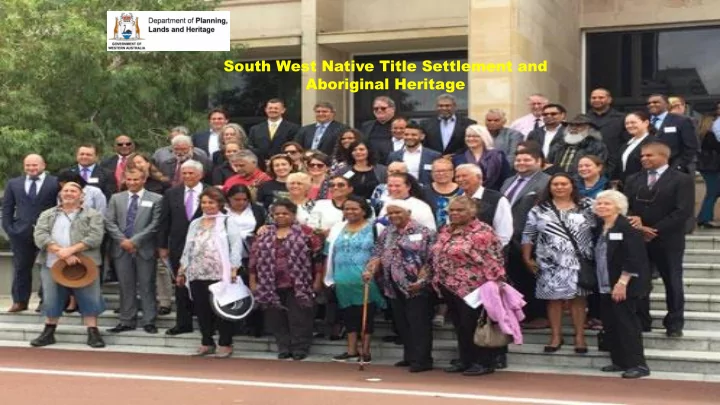
South West Native Title Settlement and Aboriginal Heritage SWS - - PowerPoint PPT Presentation

south west native title settlement and aboriginal
SMART_READER_LITE
LIVE PREVIEW

South West Native Title Settlement and Aboriginal Heritage SWS - - PowerPoint PPT Presentation

South West Native Title Settlement and Aboriginal Heritage SWS Heritage context Heritage Agreement Provisions (since 8 June 2015) : Since 8 June 2015 (SWS Agreement execution), State Government departments, agencies and other authorities


slide-1
SLIDE 1

South West Native Title Settlement and Aboriginal Heritage

slide-2
SLIDE 2

SWS Heritage context

Heritage Agreement Provisions (since 8 June 2015):

  • Since 8 June 2015 (SWS Agreement execution), State Government departments, agencies and other

authorities and instrumentalities that are identified by the State Government (including the Development Commissions) are required to enter into a Noongar Standard Heritage Agreement (NSHA) with SWALSC on behalf of the relevant SWS Agreement group, when conducting an Aboriginal Heritage Survey in any SWS Agreement area

  • 280 NSHAs/NAHAs: 38 Government = 222 non-Gov’t/industry proponents at September 2019
  • Since 8 June 2015 DMIRS has placed heritage conditions on all new mineral and petroleum titles requiring a

Heritage Agreement or NSHA before tenement holders can exercise rights in the six ILUA areas

  • 391 with conditions on title as at September 2019
  • Parties not bound by the SWS Agreement (for example Local Government and Non Government

Organisations) will need to determine if the NSHA is suitable for their needs and complies with the

  • rganisations rules
  • Alternatively Local Government and Non Government Organisations may choose to follow the heritage

principles of the NSHA

slide-3
SLIDE 3

Due Diligence Assessment

Could the Activity potentially impact an Aboriginal heritage site?

  • Does a Register Search reveal any sites in the area?
  • Have there been previous heritage surveys in the area?
  • Refer to Aboriginal Heritage Due Diligence Guidelines

(https://www.dplh.wa.gov.au/information-and-services/aboriginal-heritage/land-use-under-the-

aha/aboriginal-heritage-surveys )

  • How much has the landscape already been altered?
  • What is the potential impact on the landscape?
  • NSHA Definitions of Minimal Impact Activities and Low Ground Disturbance Activities, and cl. 8.1(b)(ii),

can assist

  • If unsure, check with:
  • DPLH – SWS Aboriginal Heritage team
  • SWALSC/Regional Corporation (once established)
slide-4
SLIDE 4

Benefits of a NSHA

The Noongar Standard Heritage Agreement is a new template heritage agreement for the South West of WA:

  • Facilitates the protection and preservation of Aboriginal Sites/Objects in

accordance with the Aboriginal Heritage Act 1972 (AHA)

  • NSHAs provide a clear process for engagement with the Noongar

community about activities that may impact Aboriginal heritage sites, and a structured framework for when and how Aboriginal heritage surveys will be conducted across SWS Agreement areas.

  • NSHAs assist compliance with the AHA, and ensure the submission of

relevant information to the Department of Planning, Lands and Heritage for potential inclusion on the Register of Aboriginal Sites, which can in turn be accessed by future land users.

slide-5
SLIDE 5

Who is a NSHA with and where can it apply?

Who with?

  • ‘Interim Period’ (pre-Settlement) – with SWALSC on behalf of the Agreement Group
  • Regional Corporations (‘RCs’) – once they are established and have been assigned all

necessary rights and obligations

Where can it apply?

  • Specific activity area/s – may be used for one-off activities
  • An entire Local Government area – recommended if activities are likely to be ongoing

and over a wide area

slide-6
SLIDE 6

What are the key heritage elements?

  • If a Local Government or Non-Government Organisation chooses not to enter a

NSHA the State nevertheless encourages following the key heritage principles

  • f the NSHA which are:

– Undertaking early engagement with SWALSC (acting on behalf of the relevant ILUA group) regarding proposed Activities that may impact Aboriginal sites (NSHA clause 7) – Assessment of risks of proposed works damaging or altering an Aboriginal heritage site by using the Due Diligence Guidelines (NSHA clause 7.2) https://www.dplh.wa.gov.au/information-and-services/aboriginal-heritage/land- use-under-the-aha/aboriginal-heritage-surveys – Issuing notices for works that may potentially damage or alter Aboriginal heritage sites in a format similar to the ‘Activity Notices’ within the NSHA (NSHA clause 8, Schedule 4, and using the Template Activity Notice).

slide-7
SLIDE 7

What are the key heritage elements contd

– If a heritage survey is to be completed seeking the names of suitable Aboriginal survey participants from SWALSC (NSHA clause 9) – Following the NSHA heritage survey processes (NSHA clause 9 and 10) – Following the NSHA timelines (NSHA clauses 8 to 12) – Adhering to the NSHA heritage survey costs schedule (Schedule 5) – Following the NSHA heritage survey report content requirements (NSHA clause 12.4 and Schedule 6) – Providing the heritage survey reports and Heritage Information Submission forms to DPLH (Clause 12.5) – Providing notice to and consulting with SWALSC (acting on behalf of the ILUA group) prior to lodging an Aboriginal Heritage Act (1972) Section 16 or Section 18 Application (NSHA clause 15).

slide-8
SLIDE 8

Positive Outcomes from the NSHA process

  • Early engagement facilitates improved outcomes and builds strong relationships

between proponents and Noongar people. – This also allows for works program clearances (including Surveys, if required) to be completed well in advance of scheduled commencement dates. – This also assists with considering reengineering options if available.

  • Many proponents see site avoidance as a realistic option as opposed to managing

impacts i.e. using existing infrastructure easements rather than creating new or increasing current easement size.

  • Early engagement may find solutions that avoid impacting heritage and reduce the

need to lodge s16 and s18 applications, which in turn may reduce overall project cost and project timeframes.

slide-9
SLIDE 9

Noongar Heritage Partnership Agreement (NHPA)

  • After Registration of the ILUAs NHPAs between the Regional Corporations

and DPLH which aim to:

– Increase the community understanding of Noongar heritage values including Noongar history, stories and language – Develop and implement local and regional Heritage Management Plans and prioritise Site management and protection programs – Identify and develop heritage training and employment initiatives – Seek funding opportunities to support heritage management – Implement a genuine partnership approach to reassess the integrity of the information on the Register of Aboriginal places and objects, and, where required improve that information

slide-10
SLIDE 10

Review of the Aboriginal Heritage Act 1972 (AHA)

  • Minister Wyatt announced the Review of the Aboriginal Heritage Act 1972 (AHA) in

March 2018.

  • In Round 1 there were a total of 41 Workshops with participants from Industry and the

Aboriginal community.

  • There were a total of 133 written submissions received.
  • Feedback was collated and a Discussion Paper developed for Round 2 Consultation

which commenced in March 2019 with a further 11 Information Sessions for Industry and Government Agencies and 34 community Workshops.

  • 76 written submissions were received following Round 2
  • It is proposed Round 3 of the Consultation will commence early 2020.
  • Information on the AHA Review process so far can be found at

https://www.dplh.wa.gov.au/aha-review

slide-11
SLIDE 11

AHA Review – Proposed Amendments

Changes proposed include

  • Repeal the current AHA and deliver new Aboriginal heritage legislation
  • Update definitions and scope of the Act
  • Establishment of Local Aboriginal Heritage Services (LAHS)
  • Establishment of the Aboriginal Heritage Council (AHC)
  • Amend the Role of the Minister and the Role of the Department
  • Establish a Directory of Heritage Professionals
  • Rename the Aboriginal Heritage Register
  • Referral process and tiered assessment
  • Encourage Agreement making
  • Improve transparency and Appeals
  • Modernise the enforcement regime
  • Amend the current Protected Areas process
slide-12
SLIDE 12
slide-13
SLIDE 13

Resources

  • The Due Diligence Guidelines are available at

https://www.dplh.wa.gov.au/information-and-services/aboriginal-heritage/land-use- under-the-aha/aboriginal-heritage-surveys

  • Copies of the six NSHA templates including the Schedules,

supporting templates and maps can be found at

https://www.dplh.wa.gov.au/information-and-services/aboriginal-heritage/noongar- heritage-and-history/noongar-standard-heritage-agreement/resources-and- templates

  • Further information about the Settlement, including the six

Settlement Agreements (or Indigenous Land Use Agreements – ILUAs) can also be found on the DPLH website at

https://www.dplh.wa.gov.au/information-and-services/aboriginal-heritage/noongar- heritage-and-history/noongar-standard-heritage-agreement/resources-and- templates

slide-14
SLIDE 14

Contacts

SWALSC – Currently acting on behalf of Agreement Groups General heritage enquiries including executing a new NSHA

  • Peter Nettleton - 9358 7400; Peter.Nettleton@noongar.org.au

DPLH (Aboriginal Heritage):

  • ‘Go to’ agency for heritage information/advice
  • Jeremy Elliott - SW Settlement Director: 6551 8070 Jeremy.Elliott@dplh.wa.gov.au
  • General Inquiries to SWSHeritage@dplh.wa.gov.au

DPC (APCU, Recognition and Partnership Projects):

  • Overseeing implementation of SWS Agreements
  • Angela Elder – Manager: 6552 5491 Angela.Elder@dpc.wa.gov.au
  • Natalie Contos – Principal Policy Officer: 6552 6236

Natalie.Contos@dpc.wa.gov.au