HENP Directorate Structure HENP Directorate Structure Associate Lab - - PowerPoint PPT Presentation

henp directorate structure henp directorate structure
SMART_READER_LITE
LIVE PREVIEW

HENP Directorate Structure HENP Directorate Structure Associate Lab - - PowerPoint PPT Presentation

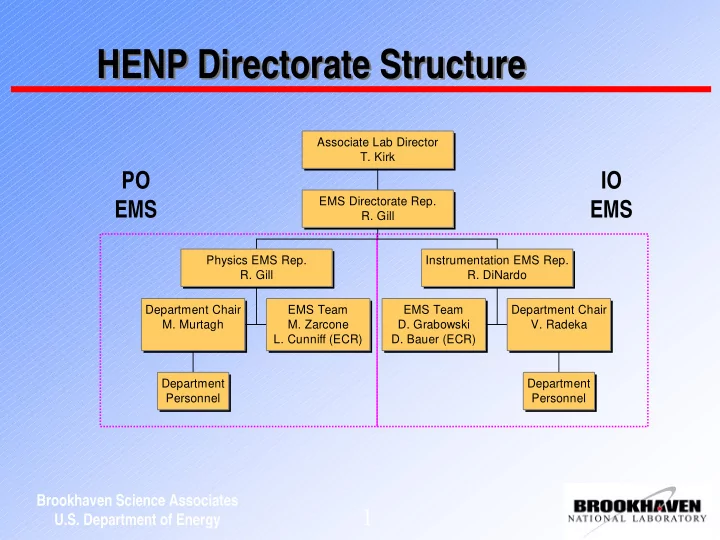
HENP Directorate Structure HENP Directorate Structure Associate Lab Director T. Kirk PO IO EMS Directorate Rep. EMS EMS R. Gill Physics EMS Rep. Instrumentation EMS Rep. R. Gill R. DiNardo Department Chair EMS Team EMS Team


slide-1
SLIDE 1

Brookhaven Science Associates U.S. Department of Energy

1

HENP Directorate Structure HENP Directorate Structure

Department Personnel Department Chair

  • M. Murtagh

EMS Team

  • M. Zarcone
  • L. Cunniff (ECR)

Physics EMS Rep.

  • R. Gill

EMS Team

  • D. Grabowski
  • D. Bauer (ECR)

Department Personnel Department Chair

  • V. Radeka

Instrumentation EMS Rep.

  • R. DiNardo

EMS Directorate Rep.

  • R. Gill

Associate Lab Director

  • T. Kirk

PO EMS IO EMS

slide-2
SLIDE 2

Brookhaven Science Associates U.S. Department of Energy

2

EMS Management Review – HENP EMS Management Review – HENP

Program Description Review of Assessments Stakeholder Concerns EMS Improvements Pollution Prevention Initiatives Environmental Performance Financial Investments Questions & Answers Program Evaluation by Senior Management

slide-3
SLIDE 3

Brookhaven Science Associates U.S. Department of Energy

3

EMS & ESR Connections EMS & ESR Connections

Approve Experiment Do Work Modification

  • r Annual

Update Modify Systems Evaluate Impacts Controls Safety Issues Revise EMP & OCF Develop Controls New Aspect Include in EMP & OCF Existing EMS Aspect Identification Committee Review Identify Activity and Submit ESR DER & ECR EMS Requirements Improvements, etc.

slide-4
SLIDE 4

Brookhaven Science Associates U.S. Department of Energy

4

EMS Program Description – Physics EMS Program Description – Physics

Operations

  • Small scale experiments & Special areas – ESR process
  • Machine shops – PEP process

Key Elements – Integration

  • Aspect identification, controls & management plans

integrated into ESR process

  • Communication

– Web pages (EMS information & training) – Weekly meetings with Chair & key personnel – Group Safety Coordinators – Department “All Hands” meetings

  • EMS Assessments

– Integrated into Department self-assessment plan – Integrated with Tier I where effective

slide-5
SLIDE 5

Brookhaven Science Associates U.S. Department of Energy

5

Significant Aspects Identified Significant Aspects Identified

Industrial Waste – various oils

  • Haz. Waste

– from small scale experiments: solvents, epoxy, Hg, chems.

  • Rad. Waste

– from decayed sealed sources: an anticipated waste stream

Medical Waste

– non-medical use of syringes: epoxy & grease application

  • Atmos. Dischg.

– permit for abrasive saw in shop

slide-6
SLIDE 6

Brookhaven Science Associates U.S. Department of Energy

6

Review of Assessments Review of Assessments

Compliance – No Issues

  • Satellite areas listed & inspected
  • 90-Day area maintained
  • Radioactive waste storage maintained
  • All permits in order

System – April 2000 Audit

  • Implementation is good
  • Improved self-assessment to address findings
  • Expanded E controls to address concerns

Haz Waste is Main Aspect

slide-7
SLIDE 7

Brookhaven Science Associates U.S. Department of Energy

7

Stakeholder Concerns Stakeholder Concerns

Issues and Actions

  • Activists – none
  • Community – none

– Personnel give lectures – Involved in BNL open days

  • Regulators – none
slide-8
SLIDE 8

Brookhaven Science Associates U.S. Department of Energy

8

EMS Improvements EMS Improvements

Aspect Analysis EMS Maintenance Compliance Assessment via Tier I’s Pollution Prevention Explicitly Included

  • Dept. Web Pages & Internal Shared Files
  • Aspect identification (ESRs)
  • EM plans & Operational controls
  • Training, program descriptions & other information

Integrated into ESR Process

slide-9
SLIDE 9

Brookhaven Science Associates U.S. Department of Energy

9

Pollution Prevention Initiatives Pollution Prevention Initiatives

Hazardous Waste

  • Antifreeze → recycle
  • Solder scraps → recycle
  • Alkaline batteries → trash
  • Waste ethanol → sink disposal
  • Reduced satellite areas 40 → 15

“Free Table” Radioactive Source Inventory Annual Chemical Inventory

$ Savings $ Resource recovery

slide-10
SLIDE 10

Brookhaven Science Associates U.S. Department of Energy

10

Environmental Performance Environmental Performance

Physics Waste Generation

100 200 300 400 500 600 700 CY97 CY98 CY99 CY00 Hazardous Industrial Radioactive

slide-11
SLIDE 11

Brookhaven Science Associates U.S. Department of Energy

11

Environmental Performance Environmental Performance

Objectives

  • EMS implementation complete, milestones met
  • Compliance with Regs
  • P2/waste reduction

Performance Measures (Goals)

  • PEP corrective actions (95%) → 100%
  • Evaluate & disposition APC (25%) → 40%
  • Prioritize & evaluate P2 opportunity (1) → 2
  • Tier I inspections → 97% on time, 33% with ECR

Integrated into ESR & Tier I process

slide-12
SLIDE 12

Brookhaven Science Associates U.S. Department of Energy

12

Financial Investments Financial Investments

Time & Effort

  • Physics → 1,200 ± 10% person-hours
  • ECR (included above) → 0.3 FTE

Other Resources

  • Web servers → minimal additional costs

Sustaining EMS

  • Physics → 0.3 FTE
  • ECR → 0.3 FTE
slide-13
SLIDE 13

Brookhaven Science Associates U.S. Department of Energy

13

EMS Management Review – Physics EMS Management Review – Physics

Questions & Answers

  • Your particular questions on EMS

Senior Management EMS Program Evaluation

  • Identify possible improvement actions →

assign responsibility to track & implement

  • Suggestions will be recorded & actions taken.
  • Five general topics
slide-14
SLIDE 14

Brookhaven Science Associates U.S. Department of Energy

14

Senior Management EMS Evaluation Senior Management EMS Evaluation

Effective in Achieving Policy

  • Commitments?

Effective in Achieving

Objectives & Performance Measures?

Is EMS Adequate in Terms of:

  • Identification of significant

aspects & impacts?

  • Resource allocation?
  • Information systems?
slide-15
SLIDE 15

Brookhaven Science Associates U.S. Department of Energy

15

Senior Management EMS Evaluation Senior Management EMS Evaluation

Objectives & Performance

  • Measures Suitable in Terms of:
  • Impacts & current conditions?
  • Concerns of stakeholders?
  • Current & future regulatory

requirements?

  • Internal organizational or process

changes?

Recommend Revisions to:

  • Environmental policy & commitments?
  • Objectives & performance measures?
  • Elements of EMS?