Helium Ground State tremendously accelerated by using basis - - PDF document

helium ground state
SMART_READER_LITE
LIVE PREVIEW

Helium Ground State tremendously accelerated by using basis - - PDF document

Atomic Wave Function Forms S. A. ALEXANDER, 1 R. L. COLDWELL 2 1 Department of Physics, University of Texas at Arlington, Arlington, Texas 76019 2 Department of Physics, University of Florida, Gainesville, Flordia 32611 Received


slide-1
SLIDE 1

— —

  • Atomic Wave Function Forms
  • S. A. ALEXANDER,1 R. L. COLDWELL2

1 Department of Physics, University of Texas at Arlington, Arlington, Texas 76019 2 Department of Physics, University of Florida, Gainesville, Flordia 32611

Received 3 June 1996; revised 24 December 1997; accepted 2 January 1997

ABSTRACT: Using variational Monte Carlo, we compare the features of 118 trial

wave function forms for selected ground and excited states of helium, lithium, and beryllium in order to determine which characteristics give the most rapid convergence toward the exact nonrelativistic energy. We find that fully antisymmetric functions are more accurate than are those which use determinants, that exponential functions are more accurate than are linear function, and that the Pade function is anomalously

´

accurate for the two-electron atom. We also find that the asymptotic and nodal behavior

  • f the atomic wave function is best described by a minimal set of functions.

1997 John Wiley & Sons, Inc. Int J Quant Chem 63: 10011022, 1997

Introduction

ariational Monte Carlo is a method of com-

V puting the total energy

2

² :

  • Ž .

H

  • Hw

w 1

Ý Ý

i i i i i

i i

Ž . and its variance i.e., statistical error

2 2 2 2 2 2

Ž .

  • H E

w w

Ý Ý

i in i i i i i

½ 5

i i

Ž . 2

  • using Monte Carlo integration 117 . Here, H is

Ž . the Hamiltonian, x is the value of the

i t i

trial wave function at the Monte Carlo integration Ž . point x , and w w x is the relative probability

i i i

Ž

  • f choosing this point

usually referred to as a

Correspondence to: S. A. Alexander.

. configuration . The constant E is fixed at a value

in

close to the desired state in order to start the

  • ptimization in the proper region. The exact wave

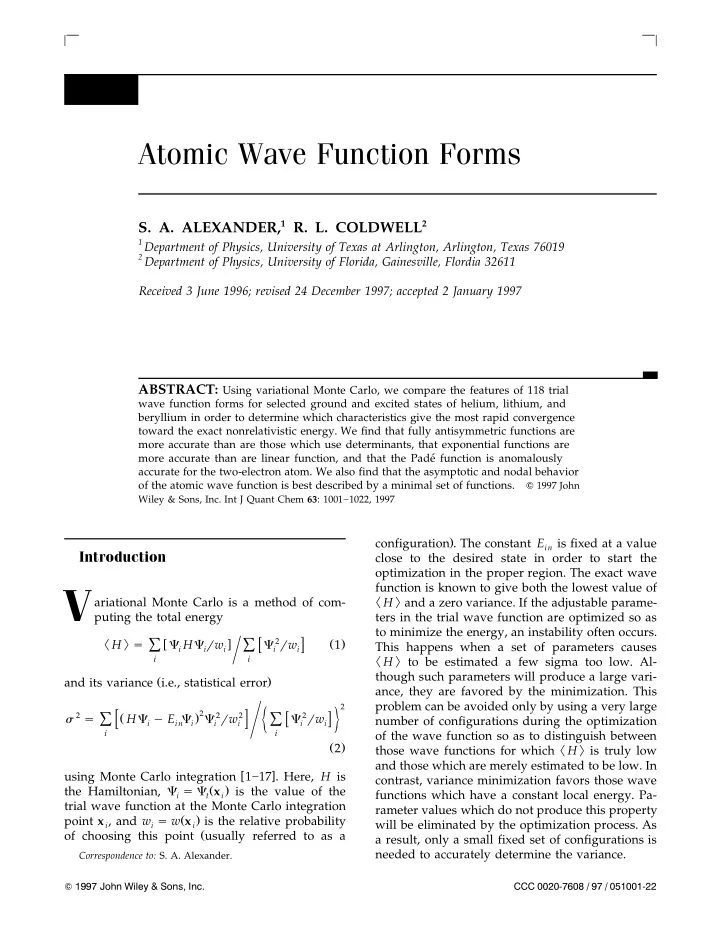
function is known to give both the lowest value of ² : H and a zero variance. If the adjustable parame- ters in the trial wave function are optimized so as to minimize the energy, an instability often occurs. This happens when a set of parameters causes ² : H to be estimated a few sigma too low. Al- though such parameters will produce a large vari- ance, they are favored by the minimization. This problem can be avoided only by using a very large number of configurations during the optimization

  • f the wave function so as to distinguish between

² : those wave functions for which H is truly low and those which are merely estimated to be low. In contrast, variance minimization favors those wave functions which have a constant local energy. Pa- rameter values which do not produce this property will be eliminated by the optimization process. As a result, only a small fixed set of configurations is needed to accurately determine the variance.

1997 John Wiley & Sons, Inc. CCC 0020-7608 / 97 / 051001-22

slide-2
SLIDE 2

ALEXANDER AND COLDWELL Previous studies have shown that the rate of convergence of a variational calculation can be tremendously accelerated by using basis functions which satisfy the two-electron cusp condition and which have the correct asymptotic behavior

  • 1824 . Unfortunately, the integrals of such func-

tions can rarely be evaluated analytically. Because

  • ur method uses Monte Carlo integration, we can

easily build into the trial wave function many features which will accelerate convergence. Al- though, in principle, this flexibility leads to an enormous number of possible forms, in practice, the ideal trial wave-function form must have a low variance, must add adjustable parameters in a straightforward manner, and must be easy to opti- mize. In this article, we examine a variety of trial wave-function forms for the ground and first ex- cited singlet states of helium, the triplet ground state of helium, the ground state of lithium, and the ground state of beryllium. We use the ratio of the variance and the number of adjustable parame- ters to determine which forms produce the most rapid convergence. When computed at several val- ues, this quantity enables us to tell whether addi- tional parameters will noticeably lower the vari- ance of a particular wave-function form or if this form has saturated. All our energies and variances are computed using a set of 4000 biased-as-ran- dom configurations which were generated specifi-

  • cally for each atom 15 . In those forms which use

a Hylleraas or Pade-type function, we add all

´

possible combinations of variables which produce a given excitation level. The excitation level N denotes the sum of the exponents of the variables in each term of the Hylleraas function, e.g., r 2 and

13

r r are N 2. Unless otherwise indicated, all

1 23

values in this article are in atomic units.

Helium Ground State

Table I presents the results of those trial wave- function forms which consist exclusively of a prod- uct of one-electron orbitals. These include a deter- minant which was optimized so as to minimize the

  • total energy

25 , a variance-optimized determi- Ž . Ž . nant, r r , and a variance-optimized

2 1 2

Ž different-orbitals-for-different-spins form, 1

3

. Ž . Ž . P r r . All three forms contain enough

12 1 2

adjustable parameters to obtain a saturated result from their respective optimization functionals. Be- cause is the result of an energy minimization, it

1

is not surprising that this form has the lowest energy and the largest variance. When variance Ž . minimization, Eq. 2 , is used to optimize the ad- justable parameters in and , the energy of

2 3

both forms increases by a significant amount while their variance decreases. Even though the energy

  • f is much higher than that of the HartreeFock

3

determinant, its variance is almost a factor of 2

  • smaller. For this reason,

will turn out to be a

3

better starting point for our next step which is the addition of correlation. In Table II, the process of including electron correlation begins with a study of wave-function forms which consist of one-electron orbitals multi- plied by a function of the interelectronic coordi- Ž . nate, i.e., g r . When the orbitals from the

12

HartreeFock determinant are used, e.g., , the

5

variance drops by a factor of 2.9 compared to 1 and roughly 69% of the correlation energy is ob- tained before saturation occurs. Using a variance-

  • ptimized determinant, e.g., , or a different-

14

  • rbitals-for-different-spins form, e.g., , lowers

17

the variance by an additional factor of 2 and 2.8,

  • respectively. Although we find that the form of

TABLE I

Helium ground-state wave functions: product form.a No. ( ) Form parameters Energy au = det 2.8655059 0.130e-1

1

( ) ( ) = r r 5 2.7948343 0.111e-1

2 1 2

( ) ( ) ( ) = 1 + P r r 10 2.7617876 0.858e-2

3 12 1 2

[ ] Literature 2.903724375 26

a

( ) ( ) [ ] ( ) [ Here, det = r r as computed by Clementi and Roetti 25 using an energy minimization. Elsewhere, r = 1 +

1 2 1 4 k ] r1

( ) [

4 k ] r2

Ý a r e and r = 1 + Ý b r e .

k =1 k 1 2 k =1 k 2

  • VOL. 63, NO. 5

1002

slide-3
SLIDE 3

ATOMIC WAVE-FUNCTION FORMS TABLE II

Helium ground-state wave functions: product form times function of r

a; N is the excitation level. 12

( ) Form

  • No. parameters

Energy au

k

( ) ( ) = det exp Ý a r 1 N = 1 2.8776681 0.633e-2

4 k = 0 k 12

( ) 2 N = 2 2.8913797 0.471e-2 ( ) 3 N = 3 2.8907489 0.445e-2

k

( ) = det Ý a r 1 N = 1 2.8820978 0.555e-2

5 k = 0 k 12

( ) 2 N = 2 2.8923208 0.451e-2 ( ) 3 N = 3 2.8919144 0.443e-2 Best form with Hartree-Fock determinant

k

Ý a r

k= 0 k 12

( ) = det exp 2 N = 1 2.8911825 0.448e-2

6 k

ž /

Ý b r ( )

k= 0 k 12

4 N = 3 2.8916771 0.446e-2

k

Ý a r

k= 0 k 12

( ) = det 2 N = 1 2.8917250 0.448e-2

7 k

Ý b r

k= 0 k 12

( ) 4 N = 2 2.8922225 0.443e-2 ( ( )) ( ) = det exp a exp br 2 N = 1 2.8922208 0.443e-2

8 12

( ( )) ( ) = det exp ar exp br 2 N = 1 2.8924062 0.447e-2

9 12 12 r

k 12

( )

  • = det 1 + Ý

a e 2 2.8921694 0.444e-2

10 k =1 k

4 2.8921900 0.443e-2

k

( ) ( ) ( ) ( )

  • = r r

exp Ý a r 6 N = 1 2.8894165 0.426e-2

11 1 2 k = 0 k 12

( ) 7 N = 2 2.8963100 0.254e-2 ( ) 8 N = 3 2.8979303 0.237e-2

k

( ) ( ) ( )

  • = r r

Ý a r 6 N = 1 2.8948153 0.307e-2

12 1 2 k = 0 k 12

( ) 7 N = 2 2.8979310 0.231e-2 ( ) 8 N = 3 2.8981832 0.230e-2

k

Ý a r

k= 0 k 12

( ) ( ) ( )

  • = r r

exp 7 N = 1 2.8985944 0.230e-2

13 1 2 k

ž /

Ý b r

k= 0 k 12

( ) 9 N = 2 2.8984142 0.229e-2

k

Ý a r

k= 0 k 12

( ) ( ) ( )

  • = r r

7 N = 1 2.8986614 0.230e-2

14 1 2 k

ž /

Ý b r

k= 0 k 12

( ) 9 N = 1 2.8983958 0.229e-2 Best form with same orbitals

k

( ) ( ) ( ) ( ) ( )

  • = 1 + P

r r exp Ý a r 11 N = 1 2.8963143 0.368e-2

15 12 1 2 k = 0 k 12

( ) 12 N = 2 2.8992829 0.210e-2 ( ) 13 N = 3 2.9030682 0.173e-2

k

( ) ( ) ( ) ( )

  • = 1 + P

r r Ý a r 11 N = 1 2.9009906 0.263e-2

16 12 1 2 k = 0 k 12

( ) 12 N = 2 2.9023661 0.174e-2 ( ) 13 N = 3 2.9041682 0.163e-2

k

Ý a r

k= 0 k 12

( ) ( ) ( ) ( )

  • = 1 + P

r r exp 12 N = 1 2.9038071 0.161e-2

17 12 1 2 k

ž /

Ý b r

k= 0 k 12

( ) 14 N = 2 2.9043052 0.159e-2 Best form with different orbitals ( ) Continued

INTERNATIONAL JOURNAL OF QUANTUM CHEMISTRY 1003

slide-4
SLIDE 4

ALEXANDER AND COLDWELL TABLE II

( ) Continued ( ) Form

  • No. parameters

Energy au

k

Ý a r

k= 0 k 12

( ) ( ) ( ) ( )

  • = 1 + P

r r 12 N = 1 2.9038865 0.161e-2

18 12 1 2 k

Ý b r

k= 0 k 12

( ) 14 N = 2 2.9043037 0.159e-2 [ ] Literature 2.903724375 26

a

( ) ( ) [ ] ( ) [ Here, det = r r as computed by Clementi and Roetti 25 using an energy minimization. Elsewhere, r = 1 +

1 2 1 4 k ] r1

( ) [

4 k ] r2

Ý a r e and r = 1 + Ý b r e .

k =1 k 1 2 k =1 k 2

Ž . g r has relatively little influence on the conver-

12

gence of the variance, all these forms saturate at about the third excitation level; it should be noted that our best wave-function form in this group, , is able to obtain almost 100% of the correla-

17

tion energy before this occurs. In Table III, we generalize the wave-function form used above to include electronic coordinates Ž . in the correlation function, i.e., g r , r , r . This

1 2 12

allows some of the restrictions which are imposed Ž . by the orbital function, f r , r , to be relaxed.

1 2

Such forms have been examined by a number of

  • earlier studies 5, 7, 8, 12, 2730 . Our results show

that the rapid saturation of the variance which

  • ccurred in Tables I and II has been eliminated

and that it is now possible to obtain even lower variances and much better energies. When the

  • rbitals from the HartreeFock determinant are

used, the variance of our best form of this type, , is a factor of 23 lower than . Our best

21 5

variance-optimized determinant form, , and

23

best different-orbitals-for-different-spins form, ,

26

show an even more impressive decrease—a factor

  • f 83 compared to

and a factor of 49 compared

14

to , respectively. When examined as a whole,

17

we find a slight preference for the Pade-like func-

´

tions over the Hylleraas-like functions as well as a slight preference for the exponential Pade forms

´

  • ver the linear Pade forms. On a per constant

´

Ž . Ž . Ž basis, we also find that the form r r g r ,

1 2 1

. r , r converges more rapidly than does the

2 12

Ž . Ž . Ž . r r g r ,r , r

  • form. This somewhat coun-

1 2 1 2 12

terintuitive result is due to the eight constants required to saturate both and compared to

  • nly four constants needed to saturate alone.

These extra four constants are apparently much more effective when placed in the correlation func- tion rather than in the orbital. This suggests that we could obtain even better convergence if we were to examine the form of our orbitals. This is done below. In Table IV, we make no distinction between the

  • rbital part of the wave function and the correla-

Ž . tion function. The wave-function form r , r , r

1 2 12

is parameterized as freely as we could imagine. When compared to the results in Table III, our results show that the best convergence is obtained when each orbital is reduced to a single exponen-

  • tial. This ‘‘minimal orbital’’ set satisfies the bound-

ary conditions and gives the correlation part the maximum flexibility it needs to reproduce the rest

  • f the wave function. In contrast to the wave-func-

tion forms in Table III, the forms in this group show an even more pronounced preference for the Pade-like functions over the Hylleraas-like func-

´

tions and a still slight preference for the exponen- tial Pade forms over the linear Pade forms. The

´ ´

variance of our best form, the exponential Pade

´

, is almost a factor of 5 lower than its counter-

43

part in Table III. In Table IV, we also examine the convergence of some of the more widely used wave-function

  • forms. The form popularized by Drake

31 is based on the use of two Hylleraas expansions in

  • rder to more rapidly reproduce the form of the

wave function at different length scales. We find that for this system such a form, , is not sub-

40

stantially better than the original Hylleraas form, . In contrast, a wave function of Slater-type

31

  • geminals 32, 33 , , and two of its variants,

46 47

and , converge much more rapidly. We found,

48

however, that adding additional fully optimized functions to these wave functions became increas- ingly difficult. This greatly limits their usefulness. Morgan and co-workers obtained very accurate energies for two-electron atoms using Hylleraas- like expansions containing negative powers and

  • logarithmic terms 26, 34 . The latter are designed

to increase convergence by correctly modeling the

  • three-particle cusp 23, 35 . We find that negative

powers do not noticeably improve the convergence Ž

  • f our calculations

is actually worse than the

41

  • VOL. 63, NO. 5

1004

slide-5
SLIDE 5

ATOMIC WAVE-FUNCTION FORMS TABLE III

Helium ground-state wave functions: product form times a general function of r , r , and r

a; N is the 1 2 12 a

excitation level. ( ) Form

  • No. parameters

Energy au

n l m

( ) ( ) ( )

  • = det Ý

a r + r r r r 2 N = 1 2.8942232 0.429e-2

19 k = 0 k 1 2 1 2 12

( ) 6 N = 2 2.9001721 0.208e-2 ( ) 12 N = 3 2.9028168 0.965e-3 ( ) 21 N = 4 2.9036992 0.471e-3

n l m

( ) ( ) Ý a r + r r r r

k= 0 k 1 2 1 2 12

( )

  • = det exp

4 N = 1 2.8983108 0.320e-2

20 n l m

ž /

( ) ( ) Ý b r + r r r r ( )

k= 0 k 1 2 1 2 12

12 N = 2 2.9038436 0.890e-3 ( ) 24 N = 3 2.9034622 0.196e-3

n l m

( ) ( ) Ý a r + r r r r

k= 0 k 1 2 1 2 12

( )

  • = det

4 N = 1 2.8982490 0.320e-2

21 n l m

( ) ( ) Ý b r + r r r r ( )

k= 0 k 1 2 1 2 12

12 N = 2 2.9038469 0.887e-3 ( ) 24 N = 3 2.9034624 0.195e-3 Best form with Hartree-Fock determinant

n l m

( ) ( ) ( ) ( ) ( )

  • = r r

Ý a r + r r r r 7 N = 1 2.8979704 0.282e-2

22 1 2 k = 0 k 1 2 1 2 12

( ) 11 N = 2 2.9028438 0.108e-2 ( ) 17 N = 3 2.9040016 0.371e-3 ( ) 25 N = 4 2.9036601 0.206e-3

n l m

( ) ( ) Ý a r + r r r r

k= 0 k 1 2 1 2 12

( ) ( ) ( )

  • = r r

exp 9 N = 1 2.8978042 0.226e-2

23 1 2 n l m

ž /

( ) ( ) Ý b r + r r r r

k= 0 k 1 2 1 2 12

( ) 17 N = 2 2.9037349 0.201e-3 ( ) 29 N = 3 2.9037314 0.275e-4 Best form with same orbitals

n l m

( ) ( ) Ý a r + r r r r

k= 0 k 1 2 1 2 12

( ) ( ) ( )

  • = r r

9 N = 1 2.8977419 0.226e-2

24 1 2 n l m

( ) ( ) Ý b r + r r r r ( )

k= 0 k 1 2 1 2 12

17 N = 2 2.9038225 0.208e-3 ( ) 29 N = 3 2.9037383 0.209e-4

n l m

( ) ( ) ( ) ( )

  • = 1 + P

r r Ý a r r r 13 N = 1 2.9003935 0.224e-2

25 12 1 2 k = 0 k 1 2 12

( ) 19 N = 2 2.9041190 0.767e-3

n l m

Ý a r r r

k= 0 k 1 2 12

( ) ( ) ( ) ( )

  • = 1 + P

r r exp 16 N = 1 2.9035825 0.278e-3

26 12 1 2 n l m

ž /

Ý b r r r ( )

k= 0 k 1 2 12

28 N = 2 2.9037524 0.322e-4 Best form with different orbitals

n l m

Ý a r r r

k= 0 k 1 2 12

( ) ( ) ( ) ( )

  • = 1 + P

r r 16 N = 1 2.9036545 0.352e-3

27 12 1 2 n l m

Ý b r r r

k= 0 k 1 2 12

( ) 28 N = 2 2.9037527 0.457e-4 [ ] Literature 2.903724375 26

a

( ) ( ) [ ] ( ) [ Here, det = r r as computed by Clementi and Roetti 25 using an energy minimization. Elsewhere, r = 1 +

1 2 1 4 k ] r1

( ) [

4 k ] r2

Ý a r e and r = 1 + Ý b r e .

k =1 k 1 2 k =1 k 2

. functionally similar form . Similarly, we find

39

that adding logarithmic terms to an exponential Pade, , decreased our variance only slightly.

´

49

This result is probably due to the fact that our calculations have not reached the required level of accuracy needed for the three-particle cusp to play an important role. In Table V, we examine whether the use of transformed variables can improve our rate of con-

  • vergence. These variables enable one to separate

INTERNATIONAL JOURNAL OF QUANTUM CHEMISTRY 1005

slide-6
SLIDE 6

ALEXANDER AND COLDWELL TABLE IV

Helium ground-state wave functions: general function in r , r , and r ; N is the excitation level.

1 2 12

( ) Form

  • No. parameters

Energy au ( ( )) ( )

  • = exp r + r

1 N = 0 2.8522779 0.154e-1

28 1 2 k

( ( )) ( )

  • = exp Ý

a r r + r 2 N = 1 2.8806861 0.533e-2

29 k = 0 k 12 1 2

( ) 3 N = 2 2.8759777 0.493e-2 ( ) 4 N = 3 2.8797514 0.457e-2

k (r + r )

1 2

( )

  • = Ý

a r e 2 N = 1 2.8785526 0.480e-2

30 k = 0 k 12

( ) 3 N = 2 2.8770205 0.474e-2 ( ) 4 N = 3 2.8823565 0.445e-2

n l m (r + r )

1 2

( ) ( ) ( )

  • = Ý

a r + r r r r e 3 N = 1 2.8798136 0.468e-2

31 k = 0 k 1 2 1 2 12

( ) 7 N = 2 2.9030741 0.119e-2 ( ) 13 N = 3 2.9042841 0.470e-3 ( ) 21 N = 4 2.9038214 0.212e-3

k

Ý a r

k= 0 k 12

( ) ( )

  • = exp

r + r 3 N = 1 2.8764614 0.473e-2

32 1 2 k

ž /

Ý b r

k= 0 k 12

( ) 5 N = 2 2.8816835 0.443e-2

n l m

( ) ( ) Ý a r + r r r r

k= 0 k 1 2 1 2 12

( ) ( )

  • = exp

r + r 5 N = 1 2.8822870 0.367e-2

33 1 2 n l m

ž /

( ) ( ) Ý b r + r r r r ( )

k= 0 k 1 2 1 2 12

13 N = 2 2.9039788 0.221e-3 ( ) 25 N = 3 2.9037142 0.392e-4

k

Ý a r

k= 0 k 12 (r + r )

1 2

( )

  • =

e 3 N = 1 2.8767865 0.471e-2

34 k

Ý b r

k= 0 k 12

( ) 5 N = 2 2.8815663 0.444e-2

n l m

( ) ( ) Ý a r + r r r r

k= 0 k 1 2 1 2 12 (r + r )

1 2

( )

  • =

e 5 N = 1 2.8822005 0.367e-2

35 n l m

( ) ( ) Ý b r + r r r r ( )

k= 0 k 1 2 1 2 12

13 N = 2 2.9040320 0.231e-3 ( ) 25 N = 3 2.9037121 0.369e-4 ( ) ( ) ( )

  • = 1 + P

exp r r 2 N = 0 2.7836668 0.898e-2

36 12 1 2 k

( ) ( ) ( )

  • = 1 + P

exp Ý a r r r 3 N = 1 2.8974720 0.387e-2

37 12 k = 0 k 12 1 2

( ) 4 N = 2 2.8978520 0.278e-2 ( ) 5 N = 3 2.8984970 0.241e-2

k r r

1 2

( ) ( )

  • = 1 + P

Ý a r e 3 N = 1 2.8995372 0.294e-2

38 12 k = 0 k 12

( ) 4 N = 2 2.8991548 0.246e-2 ( ) 5 N = 3 2.8999454 0.229e-2

n l m r r

1 2

( ) ( )

  • = 1 + P

Ý a r r r e 5 N = 1 2.9021813 0.234e-2

39 12 k = 0 k 1 2 12

( ) 11 N = 2 2.9027775 0.883e-3 ( ) 21 N = 3 2.9041953 0.363e-3 ( ) 36 N = 4 2.9038038 0.172e-3 ( ) 57 N = 5 2.9037496 0.796e-4

n l m r r

1 2

( )[ ( )

  • = 1 + P

Ý a r r r e 11 N = 1 2.9028785 0.206e-2

40 12 k = 0 k 1 2 12 n l m r r

ˆ 1

2]

( ) +Ý a r r r e 23 N = 2 2.9048122 0.368e-3

ˆ

k= 0 k 1 2 12

( ) 43 N = 3 2.9038500 0.104e-3 ( ) Continued

  • VOL. 63, NO. 5

1006

slide-7
SLIDE 7

ATOMIC WAVE-FUNCTION FORMS TABLE IV

( ) Continued ( ) Form

  • No. parameters

Energy au

n l m r r

1 2

( ) ( ) ( )

  • = 1 + P

Ý a r + r r r r e

41 12 k = 0 k 1 2 1 2 12

( ) 5 N = 1 2.9021811 0.234e-2 ( ) 11 N = 2 2.9027419 0.884e-3 ( ) 15 N = 2, n = 1 2.9023392 0.640e-3 ( ) 20 N = 2, n = 2 2.9024091 0.578e-3 ( ) 26 N = 2, n = 3 2.9019591 0.522e-3

k

Ý a r

k= 0 k 12

( ) ( )

  • = 1 + P

exp r r 4 N = 1 2.8996389 0.235e-2

42 12 1 2 k

ž /

Ý b r

k= 0 k 12

( ) 6 N = 2 2.9006769 0.225e-2

n l m

Ý a r r r

k= 0 k 1 2 12

( ) ( )

  • = 1 + P

exp r r 8 N = 1 2.9035974 0.408e-3

43 12 1 2 n l m

ž /

Ý b r r r

k= 0 k 1 2 12

( ) 20 N = 2 2.9037434 0.297e-4 ( ) 40 N = 3 2.9037228 0.558e-5 Best form

k

Ý a r

k= 0 k 12 r r

1 2

( ) ( )

  • = 1 + P

e 4 N = 1 2.8997302 0.234e-2

44 12 k

Ý b r ( )

k= 0 k 12

6 N = 2 2.9006684 0.225e-2

n l m

Ý a r r r

k= 0 k 1 2 12 r r

1 2

( ) ( )

  • = 1 + P

e 8 N = 1 2.9036625 0.558e-3

45 12 n l m

Ý b r r r

k= 0 k 1 2 12

( ) 20 N = 2 2.9036934 0.380e-4 ( ) 40 N = 3 2.9037201 0.595e-5

r r r

k 1 k 2 k 12

( )

  • = 1 + P

Ý a e 8 2.9016091 0.123e-2

46 12 k =1 k

16 2.9037691 0.426e-3 24 2.9036837 0.151e-3 32 2.9037805 0.603e-4

r r

k 1 k 2

( ) ( )

  • = 1 + P

Ý a 1 + r e 8 2.9020742 0.201e-2

47 12 k =1 k k 12

16 2.9032493 0.152e-2 24 2.9036084 0.147e-2

2 r r

k 1 k 2

( ) ( )

  • = 1 + P

Ý a 1 + r + r e 10 2.9016281 0.122e-2

48 12 k = 0 k k 12 k 12

20 2.9043933 0.454e-3 30 2.9040674 0.290e-3

n l m

Ý a r r r

k= 0 k 1 2 12

( )

  • = 1 + P

exp

49 12 n l m

ž Ý

b r r r

k= 0 k 1 2 12 2 2 2 2 2

( ) [ ] ( ) +c r + r r ln r + r r r 21 N = 2 2.9037428 0.297e-4

1 2 12 1 2 1 2/

( ) 41 N = 3 2.9037235 0.556e-5 [ ] Literature 2.903724375 26

two major demands on the trial wave function—its need to satisfy the asymptotic boundary condi- tions of the system and its need to fill space in the appropriate regions. Transformed variables also allow us to consider some new wave-function forms, e.g., ehyll, which might otherwise violate the boundary conditions at r . For helium, one Ž . common transformation is q r 1 b r ,

x x x x

where x 1, 2, or 12. The value of b can be fixed

x

  • at a constant, e.g., 1.0 as in

12 , optimized as a INTERNATIONAL JOURNAL OF QUANTUM CHEMISTRY 1007

slide-8
SLIDE 8

ALEXANDER AND COLDWELL TABLE V

Helium ground-state wave functions: general form in transformed coordinatesa; N is the excitation level. ( ) Form

  • No. parameters

Energy au

n l m

( ( ) ( ) ) ( )

  • = det exp Ý

a q + q q q q 3 N = 1 2.8989579 0.344e-2

50 k = 0 k 1 2 1 2 12

( ) 7 N = 2 2.9022706 0.162e-2 ( ) 13 N = 3 2.9039398 0.580e-3 ( ) 22 N = 4 2.9035629 0.165e-3

n l m

( ) ( ) ( ( ) ( ) ) ( )

  • = r r

exp Ý a q + q q q q 8 N = 1 2.8995703 0.230e-2

51 1 2 k = 0 k 1 2 1 2 12

( ) 11 N = 2 2.9024948 0.161e-2

n l m

( ( ) ( ) ( )) ( )

  • = exp Ý

a q + q q q q r + r 4 N = 1 2.8799693 0.452e-2

52 k = 0 k 1 2 1 2 12 1 2

( ) 8 N = 2 2.8984988 0.243e-2 ( ) 14 N = 3 2.9037259 0.141e-2

n l m

( ) ( . ( )

  • = 1 + P

exp Ý a q q q r r 6 N = 1 2.9001629 0.177e-2

53 12 k = 0 k 1 2 12 1 2

( ) 12 N = 2 2.9029465 0.506e-3 ( ) 21 N = 3 2.9037485 0.916e-4

n l m

Ý a q q q

ˆ ˆ ˆ

k= 0 k 1 2 12

( ) ( )

  • = 1 + P

exp r r 8 N = 1 2.9024366 0.139e-2

54 12 1 2 n l m

ž /

Ý b q q q

ˆ ˆ ˆ

( )

k= 0 k 1 2 12

20 N = 2 2.9035820 0.249e-3

n l m

Ý a q q q

k= 0 k 1 2 12

( ) ( )

  • = 1 + P

exp r r 9 N = 1 2.9035968 0.408e-3

55 12 1 2 n l m

ž /

Ý b q q q

k= 0 k 1 2 12

( ) 21 N = 2 2.9037434 0.297e-4

n l m

Ý a q q q

˜ ˜ ˜

k= 0 k 1 2 12

( ) ( )

  • = 1 + P

exp r r 11 N = 1 2.9035998 0.408e-3

56 12 1 2 n l m

ž /

Ý b q q q

˜ ˜ ˜

( )

k= 0 k 1 2 12

23 N = 2 2.9037447 0.297e-4 [ ] Literature 2.903724375 26

a

( ) ( ) [ ] ( ) ( ) Here, det = r r as computed by Clementi and Roetti 25 using an energy minimization; q = r / 1 + r , q = r / 1 + br

ˆ

1 2 i i i i i i

( ) ( ) ( ) [

4 k ] r1

and q = r / 1 + b r i = 1, 2, 12 . Elsewhere, r = 1 + Ý a r e .

˜i

i i i 1 k =1 k 1

single parameter for all three variables or opti- mized as a separate parameter for each variable. For this system, none of these options, ,

54 56

was found to significantly improve the conver- gence of our best form . We did find, however,

43

that when we use transformed variables to create several of the exponential Hylleraas forms many of these wave functions converged faster than did the corresponding linear Hylleraas forms in Tables III and IV. The relative convergence of many of our trial wave-function forms is shown in Figure 1. Al- though both the Hylleraas and the Pade forms are

´

easily extendible, the former is much easier to

  • ptimize. For this system, however, any increase

in difficulty due to the Pade form is more than

´

  • ffset by its superior convergence.

For comparison, we also evaluated the exponen- tial Pade helium wave-function form in 7 with

´

the same 4000 configurations used to determine the results in Tables IV. This form is similar to

  • in Table IV and gives comparable results,

33

2.9037245 0.792e-5, using 52 parameters which include terms up to the fourth power of the vari-

  • ables. In contrast, our best form, , has a lower

43

variance, -2.9037228 0.558e-5, and uses only 40 adjustable parameters with terms only up to the third power. The major difference is that in-

43

cludes an explicit permutation of the electronic Ž . coordinates while the one in 7 and does

33

not.

Helium Singlet Excited State

We have optimized several wave-function forms for this state using a functional which includes Ž explicit orthogonality with the ground state see . Appendix 1 . Table VI and Figure 2 show that the convergence of these forms is generally slower

  • VOL. 63, NO. 5

1008

slide-9
SLIDE 9

ATOMIC WAVE-FUNCTION FORMS FIGURE 1. Convergence comparison of several helium ground-state wave functions. Variances from Table IV. than are their ground-state counterparts. One ex- ception, however, is the Drake form, , which is

6

now noticeably better than either the Hylleraas or linear Pade forms. Although the values are not

´

included in Table VI, we also investigated the effect of negative powers and logarithmic terms on the convergence of this state. As in the ground state, these features were found to have little influ- ence on the variance. Our best form is once again an exponential Pade. The forms show that

´

10 14

Ž the terms associated with r the unexcited elec-

1

. tron have little effect on the variance and can be eliminated without penalty. In contrast, the terms associated with r describe the excited-state node

2

and must be considered in some detail. Our results show that the maximum convergence per constant is given by which uses the polynomial 1 cr

13 2

dr 2 to describe the single node in this system.

2

Helium Triplet Ground State

A HartreeFock description of the triplet ground Ž . Ž . state is usually written as

  • r
  • r
  • 1s

1 2 s 2

Ž . Ž .

  • r
  • r

. The question that we wish to ex-

2 s 1 1s 2

amine here is whether the nodal structure of this Ž state requires an explicit node like the one pro- vided by above or by r in the singlet excited

2 s 2

. state . We show in Table VII that the extra bound- Ž . ary condition 1 cr does not speed the conver-

2

gence of the exponential Pade form as a function

´

  • f the number of adjustable parameters. Thus, we

conclude that the antisymmetry operator alone is capable of introducing the proper symmetry.

Lithium Ground State

In Table VIII and Figure 3, we compare the results of several trial wave-function forms for the ground state of lithium. Those forms which most accurately describe this state are different in sev- eral respects from those which best described the various helium states in the second to fourth sec-

  • tions. Transformed coordinates, e.g., were of minor

importance for helium but are essential for all of the good lithium forms. Although, in principle, any wave function can be expanded in a polyno- mial basis, in practice, the higher-power terms of such expansions have an increasing tendency to violate the asymptotic boundary condition of sys- tems with more than two electrons. Coordinate transformation remove this problems by making the variables local. The form that we have chosen, Ž . r 1 b r , is especially well suited for this job.

x x x

It has no maximum for r 0 and is very smooth.

x

INTERNATIONAL JOURNAL OF QUANTUM CHEMISTRY 1009

slide-10
SLIDE 10

ALEXANDER AND COLDWELL TABLE VI

Helium excited-state wave functions of general forma; N is the excitation level. ( ) Form

  • No. parameters

Energy au ( ) ( ) ( ) ( ) = 1 + P r r 12 N = 0 2.1226698 0.141e-2

1 12 1 2 k

( ) ( ) ( ) ( ) ( ) = 1 + P r r exp Ý a r 13 N = 1 2.1269442 0.756e-3

2 12 1 2 k = 0 k 12

( ) 14 N = 2 2.1296726 0.657e-3

k

( ) ( ) ( ) ( ) = 1 + P r r Ý a r 13 N = 1 2.1271674 0.749e-3

3 12 1 2 k = 0 k 12

( ) 14 N = 2 2.1274805 0.539e-3

n l m

( ) ( ) ( ) ( ) = 1 + P r r Ý a r r r 15 N = 1 2.1269762 0.724e-3

4 12 1 2 k = 0 k 1 2 12

( ) 21 N = 2 2.1393280 0.465e-3

n l m r r

1 2

( ) ( ) = 1 + P Ý a r r r e 5 N = 1 2.1462072 0.743e-3

5 12 k = 0 k 1 2 12

( ) 11 N = 2 2.1453213 0.569e-3 ( ) 21 N = 3 2.1456610 0.327e-3 ( ) 36 N = 4 2.1465248 0.161e-3

n l m r r

1 2

( )[ = 1 + P Ý a r r r e

6 12 k = 0 k 1 2 12 ˆ n l m r r

ˆ 1

2]

( ) +Ý a r r r e 11 N = 1 2.1370713 0.832e-3

ˆ

k= 0 k 1 2 12

( ) 23 N = 2 2.1459418 0.940e-4 ( ) 43 N = 3 2.1459938 0.298e-4

k

Ý a r

k= 0 k 12

( ) ( ) ( ) ( ) = 1 + P r r exp 12 N = 1 2.1454987 0.349e-3

7 12 1 2 k

ž /

Ý b r

k= 0 k 12

( ) 14 N = 2 2.1457859 0.322e-3

n l m

Ý a r r r

k= 0 k 1 2 12

( ) ( ) ( ) ( ) = 1 + P r r exp 18 N = 1 2.1457433 0.312e-3

8 12 1 2 n l m

ž /

Ý b r r r

k= 0 k 1 2 12

( ) 30 N = 2 2.1459725 0.254e-4

n l m

Ý a r r r

k= 0 k 1 2 12

( )( ) ( ) = 1 + P 1 + cr exp r r 9 N = 1 2.1440458 0.429e-3

9 12 2 1 2 n l m

ž /

Ý b r r r

k= 0 k 1 2 12

( ) 21 N = 2 2.1459913 0.492e-4 ( ) 41 N = 3 2.1459722 0.963e-5

n l m

Ý a r r r

k= 0 k 1 2 12 3

( )( ) ( )

  • = 1 + P

1 + cr + dr exp r r 10 N = 1 2.1439478 0.426e-3

10 12 2 2 1 2 n l m

ž /

Ý b r r r

k= 0 k 1 2 12

( ) 22 N = 2 2.1459590 0.353e-4 ( ) 42 N = 3 2.1459755 0.722e-5 Best form

n l m

Ý a r r r

k= 0 k 1 2 12

( )( ) ( )

  • = 1 + P

1 + cr + dr exp r r 10 N = 1 2.1440997 0.429e-3

11 12 2 12 1 2 n l m

ž /

Ý b r r r

k= 0 k 1 2 12

( ) 22 N = 2 2.1459770 0.489e-4 ( ) 42 N = 3 2.1459632 0.944e-5

k

Ý a r

k= 0 k 12

( ) ( ) ( ) ( )

  • = 1 + P

r r 12 N = 1 2.1381185 0.528e-3

12 12 1 2 k

Ý b r

k= 0 k 12

( ) 14 N = 2 2.1457857 0.322e-3

n l m

Ý a r r r

k= 0 k 1 2 12

( ) ( ) ( ) ( )

  • = 1 + P

r r 18 N = 1 2.1439512 0.442e-3

13 12 1 2 n l m

Ý b r r r

k= 0 k 1 2 12

( ) 30 N = 2 2.1458232 0.163e-3 ( ) Continued

  • VOL. 63, NO. 5

1010

slide-11
SLIDE 11

ATOMIC WAVE-FUNCTION FORMS TABLE VI

( ) Continued ( ) Form

  • No. parameters

Energy au

n l m

Ý a r r r

k= 0 k 1 2 12 r r

1 2

( ) ( )

  • = 1 + P

e 8 N = 1 2.1424814 0.734e-3

14 12 n l m

Ý b r r r

k= 0 k 1 2 12

( ) 20 N = 2 2.1457626 0.210e-3 ( ) 40 N = 3 2.1459045 0.633e-4

n l m

Ý a r r r

k= 0 k 1 2 12 r r

1 2

( )( ) ( )

  • = 1 + P

1 + cr e 9 N = 1 2.1440590 0.615e-3

15 12 2 n l m

Ý b r r r

k= 0 k 1 2 12

( ) 21 N = 2 2.1457518 0.209e-3 ( ) 41 N = 3 2.1459049 0.632e-4

r r r

k 1 k 2 k 12

( )

  • = 1 + P

Ý a e 16 2.1389128 0.795e-3

16 12 k =1 k

24 2.1458506 0.143e-3 32 2.1460007 0.425e-4 [ ] Literature 2.145974046 31

a

( ) [

4 k ] r1

( ) [

4 k ] r2

Here, r = 1 + Ý a r e and r = 1 + Ý b r e .

1 k =1 k 1 2 k =1 k 2

This makes the task of parameterizing the wave function relatively straightforward. We examined the difference between scaling all variables inde- pendently and scaling all variables using a single

  • parameters. For this system, we find that there is

little difference between these two approaches. Another major difference is that all our lithium wave functions have a variance which is much larger than their helium counterparts. This is due almost entirely to the presence of the third electron Žthe lithium cation can be computed to the same . relative error as helium . The variance of just the HartreeFock determinant, , is 0.042 Hartrees

1

Ž . compared to 0.013 for the helium ground state . Multiplying the lithium determinant by an expo- nential Pade, , lowers the variance by a factor of

´

3

28 to 0.0015 Hartrees. Optimizing the parameters in the determinant, however, had little influence

  • n this number. On a per constant basis, the vari-

ance also seems to be relatively insensitive to the form of the correlation functional. The Pade form

´

which was by an order of magnitude more accu- rate than any other trial wave function for the helium ground state is not significantly better on a FIGURE 2. Convergence comparison of several helium 2S wave functions. Variances from Table VI. INTERNATIONAL JOURNAL OF QUANTUM CHEMISTRY 1011

slide-12
SLIDE 12

ALEXANDER AND COLDWELL TABLE VII

Helium triplet ground-state wave functions of general form; N is the excitation level. ( ) Form

  • No. parameters

Energy au

n l m

Ý a r r r

k= 0 k 1 2 12

( ) ( ) = 1 P exp r r 8 N = 1 2.1742064 0.390e-3

1 12 1 2 n l m

ž /

Ý b r r r

k= 0 k 1 2 12

( ) 20 N = 2 2.1752449 0.174e-4 Best form

n l m

Ý a r r r

k= 0 k 1 2 12

( )( ) ( ) = 1 P 1 + cr exp r r 9 N = 1 2.1751780 0.331e-3

2 12 2 1 2 n l m

ž /

Ý b r r r

k= 0 k 1 2 12

( ) 21 N = 2 2.1752392 0.155e-4 [ ] Literature 2.175229378 31

per constant basis than is the simpler Hylleraas form for the lithium ground state. The only advan- tage of the Pade in this system is that it provides a

´

straightforward way to double the number of pa- rameters. Our examination of the asymptotic form of the wave function shows that the ‘‘minimal orbitals’’ for this system are given by e r1 and e r2 for the Ž . Ž . r3 first two 1s-type electrons and r c e for

3

Ž . the third 2s-type electron. This is entirely consis- tent with what one would expect from a single- particle description. While a decrease in the vari- ance can be gained by making the 1s orbital more flexible, setting the correct nodal behavior of the 2s orbital is ultimately more important. For a system with multiple electrons, the anti- symmetric nature of the wave function can be described using either a determinant or by explic- Ž . itly permuting all electrons see Appendix 2 . When compared with our best determinant-based wave function, , the variance of our best fully anti-

6

symmetric wave function, , is smaller by a

18

factor of 5.6.

Beryllium Ground State

In Table IX and Figure 4, we compare the re- sults of several trial wave-function forms for the ground state of beryllium. For the most part, we find that the behavior of this system is simi- lar to that of the lithium ground state. The major difference is that an accurate orbital description requires that we now take into account the near degeneracy of the 2s2 p levels. In a determinant- based wave function, this can be done most sim- Ž ply by using the four-determinant form det ,

1s

.

  • Ž

. Ž .

  • constant det

, det ,

  • 2 s

1s p x 1s p y

Ž .

  • det

, . In a purely antisymmetric wave

1s p z

function, this degeneracy can be included by using Ž . the term x x y y z z to reproduce the

3 4 3 4 3 4

  • close-in behavior of the p states 36 .

For this system, the variance of the Hartree Fock determinant, , is 0.035 Hartrees. Multiply-

1

ing this form by an exponential Pade, , lowers

´

3

the variance by a factor of 8 to 0.0044 Hartrees. As in lithium, optimizing the parameters inside the determinant does not significantly lower the vari- ance—in fact, the value for is slightly worse

13

than for . On a per constant basis, the form of

3

the correlation functional again seems to have little

  • effect. Although the variances of our four determi-

nant forms, e.g., , have only a slightly smaller

14

variance than those of our single-determinant forms, e.g., , their energy is noticeably better.

12

This behavior was also seen by Umrigar et al. in 7 . Our examination of the asymptotic form of the wave function again shows that the ‘‘minimal or- bitals’’ for this system are given by e r1 and e r2 Ž . Ž for the first two 1s-type electrons and r

3

. r3 Ž . c e for the third 2s-type electron. We still see, however, some lingering desire to make the 1s

  • rbital more flexible.

If we choose to explicitly permute the electronic coordinates in the wave function rather than to use determinants, both our variance and our energy show a significant improvement. When compared

  • VOL. 63, NO. 5

1012

slide-13
SLIDE 13

ATOMIC WAVE-FUNCTION FORMS TABLE VIII

Lithium ground wave functions of general forma; N is the excitation level. ( ) Form

  • No. parameters

Energy au ( ) = det 0 N = 0 7.377666 0.426e-1

1 hyll1

( ) = det e 7 N = 1 7.469512 0.101e-1

2

( ) 28 N = 2 7.479467 0.416e-2

pade1

´

( ) = det e 13 N = 1 7.466850 0.979e-2

3

( ) 55 N = 2 7.475383 0.151e-2

hyll1

( ) ( ) = opt det a e 2 N = 0 7.270501 0.361e-1

4

( ) 9 N = 1 7.468003 0.706e-2 ( ) 30 N = 2 7.474828 0.410e-2

hyll1

( ) ( ) = opt det b e 4 N = 0 7.301724 0.311e-1

5

( ) 11 N = 1 7.467400 0.689e-2 ( ) 32 N = 2 7.475041 0.403e-2

hyll1

( ) ( ) = opt det c e 3 N = 0 7.233649 0.357e-1

6

( ) 10 N = 1 7.454445 0.682e-2 ( ) 31 N = 2 7.477295 0.407e-2 ( ) 87 N = 3 7.477064 0.152e-2 Best form with minimal orbital determinant

pade1

´

( ) ( ) = opt det a e 2 N = 0 7.274083 0.361e-1

7

( ) 15 N = 1 7.470297 0.525e-2 ( ) 57 N = 2 7.473268 0.261e-2

pade1

´

( ) ( ) = opt det b e 4 N = 0 7.305709 0.311e-1

8

( ) 17 N = 1 7.473371 0.398e-2 ( ) 59 N = 2 7.473565 0.150e-2

pade

´1

( ) ( ) = opt det c e 3 N = 0 7.233649 0.357e-1

9

( ) 16 N = 1 7.465996 0.521e-2 ( ) 58 N = 2 7.474210 0.259e-2

hyll1 r r r

1 2 3

[ ] ( )

  • = A e

3 N = 0 7.275161 0.345e-1

10

( ) 10 N = 1 7.470221 0.473e-2 ( ) 31 N = 2 7.477487 0.124e-2

r r r

1 2 3

[ ] ( )

  • = A hyll1e

10 N = 1 7.463641 0.589e-2

11

( ) 31 N = 2 7.476566 0.165e-2

pade1 r r r

´

1 2 3

[ ] ( )

  • = A e

16 N = 1 7.463701 0.446e-2

12

( ) 58 N = 2 7.477765 0.577e-3

r r r

1 2 3

[ ] ( )

  • = A pade1e

16 N = 1 7.471567 0.458e-2

´

13

( ) 58 N = 2 7.477468 0.433e-3

hyll1 r r r

1 2 3

[ ] ( )

  • = A r e

3 N = 0 7.287719 0.362e-1

14 3

( ) 10 N = 1 7.471244 0.476e-2 ( ) 31 N = 2 7.477611 0.123e-2

r r r

1 2 3

[ ] ( )

  • = A r hyll1e

10 N = 1 7.472713 0.378e-2

15 3

( ) 31 N = 2 7.477633 0.148e-2 ( ) Continued

INTERNATIONAL JOURNAL OF QUANTUM CHEMISTRY 1013

slide-14
SLIDE 14

ALEXANDER AND COLDWELL TABLE VIII

( ) Continued ( ) Form

  • No. parameters

Energy au

pade1r r r

´

1 2 3

[ ] ( )

  • = A r e

16 N = 1 7.470518 0.435e-2

16 3

( ) 58 N = 2 7.477935 0.330e-3

r r r

1 2 3

[ ] ( )

  • = A r pade1e

16 N = 1 7.470874 0.218e-2

´

17 3

( ) 58 N = 2 7.477702 0.438e-3

hyll1 r r r

1 2 3

[( ) ] ( )

  • = A r c e

4 N = 0 7.275045 0.345e-1

18 3

( ) 11 N = 1 7.470166 0.473e-2 ( ) 32 N = 2 7.477765 0.123e-2 ( ) 88 N = 3 7.478281 0.276e-3 Best form

r r r

1 2 3

[( ) ] ( )

  • = A r c hyll1e

11 N = 1 7.473313 0.375e-2

19 3

( ) 32 N = 2 7.477858 0.146e-2

pade1 r r r

´

1 2 3

[( ) ] ( )

  • = A r c e

17 N = 1 7.470957 0.199e-2

20 3

( ) 59 N = 2 7.478069 0.319e-3

r r r

1 2 3

[( ) ] ( )

  • = A r c pade1e

17 N = 1 7.471629 0.213e-2

´

21 3

( ) 59 N = 2 7.477793 0.352e-3

hyll2 r r r

1 2 3

[( ) ] ( )

  • = A r c e

16 N = 1 7.472168 0.457e-2

22 3

( ) 37 N = 2 7.477795 0.119e-2

r r r

1 2 3

[( ) ] ( )

  • = A r c hyll2e

16 N = 1 7.474202 0.369e-2

23 3

( ) 37 N = 2 7.477785 0.146e-2

pade2 r r r

´

1 2 3

[( ) ] ( )

  • = A r c e

22 N = 1 7.475782 0.165e-2

24 3

( ) 64 N = 2 7.478067 0.316e-3

r r r

1 2 3

[( ) ] ( )

  • = A r c pade2e

22 N = 1 7.469480 0.192e-2

´

25 3

( ) 64 N = 2 7.477967 0.327e-3 [ ] Exact 7.478060326 37

a

[ ] Here, det is the HartreeFock determinant computed by Clementi and Roetti 25 using an energy minimization;

c d e f g h

( ) hyll1 = a q q q q q q , where q = r / 1 + br ,

Ý

k 1 2 3 12 13 23 i i i

k=0

c d e f g h

( ) hyll2 = a q q q q q q , where q = r / 1 + b r ,

Ý

k 1 2 3 12 13 23 i i i i

k=0

Ý a q cq dq eq f q g q h

k = 0 k 1 2 3 12 13 23

( ) pade1 = , where q = r / 1 + br ,

´

i i i c d e f g h

Ý b q q q q q q

k = 0 k 1 2 3 12 13 23

Ý a q cq dq eq f q g q h

k = 0 k 1 2 3 12 13 23

( ) pade2 = , where q = r / 1 + b r .

´

i i i i c d e f g h

Ý b q q q q q q

k = 0 k 1 2 3 12 13 23

( )

1r 2r

( )

1r 2r

The orbitals which define det a are = e and = re . The orbitals which define det b are = e + ce and

1 2 1 3r

( )

1r

( )

2r

= re . The orbitals which define det c are = e and = r + c e .

2 1 2

  • VOL. 63, NO. 5

1014

slide-15
SLIDE 15

ATOMIC WAVE-FUNCTION FORMS FIGURE 3. Convergence comparison of several lithium ground-state wave functions. Variances from Table VIII. with the best determinantal form, , the vari-

14

ance of our best fully antisymmetric form, , is

16

smaller by a factor of 2.7. For comparison, we have also examined the four-determinant exponential Pade form described

´

  • in 17 . This form has 110 parameters and includes

terms up to the fourth power of the variables but Ž has a single parameter for each type of term e.g., the coefficient of r r is the same for all values of i

i i j

. and j . When evaluated with the same 4000 con- figurations used to determine the results in Table IX, this wave function has a value of 14.66642 0.175e-2. In contrast, our most similar form, ,

15

has 137 parameters and includes terms up to the second power of the variables but uses separate Ž parameters for all terms e.g., the coefficient of . r r is allowed to be different from that of r r .

1 12 3 34

Because

  • ur

value, 14.66261 0.265e-2, is

  • slightly worse than the one in 17 , we conclude

that our rate of convergence could be improved by combining some types of terms in the Hylleraas and Pade expansions rather than using separate

´

parameters for each one.

Antisymmetry Considerations

A number of calculations have recently been able to obtain highly accurate energies of atoms and molecules by using a fully antisymmetric wave Ž

  • .

function see, e.g., 3840 . For this reason, it is of interest to compare the convergence of the forms Ž . Ž . det f r , . . . , r and A f r , . . . , r in some de-

1 n 1 n

  • tail. It should be noted that on the order of N!

evaluations of the complete trial wave function are required to antisymmetrize N same-spin coordi- Ž .

3

nates see Appendix 2 . In contrast, only about N arithmetic operations are required to evaluate a

  • determinant. This is a substantial difference and a

large drop in the variance will be needed to justify the extra time required. For the helium ground state, our best single-de- terminant form, , produced an energy of

24

Ž . 2.90374 2 with 29 adjustable constants. In con- Ž . trast, our best form, , gives 2.903723 6 with

43

40 constants, i.e., a factor of 4 decrease in the

  • variance. A similar improvement was found for

the lithium ground state. There our best single-de- terminant form, , produced an energy

  • f

6

Ž . 7.477 1 with 87 adjustable constants, while our Ž . best form, , gives 7.4783 3 with 32 constants,

18

i.e., a factor of 5.4 improvement in the variance. In the case of the beryllium ground state, our best single-determinant form, , produced an energy

12

Ž .

  • f 14.640 4 with 69 adjustable constants while
  • ur

best four-determinant form, , gives

14

Ž . 14.661 4 with 72 constants. Our best form for this system, , was designed to include the de-

16

  • generacy between the 2s and 2 p orbitals

36 . Compared to either of the single determinant or the multideterminant form, the variance of the full Ž . antisymmetrized wave function, 14.663 1 with 72 constants, is lower by almost a factor of 3. INTERNATIONAL JOURNAL OF QUANTUM CHEMISTRY 1015

slide-16
SLIDE 16

ALEXANDER AND COLDWELL TABLE IX

Beryllium ground wave functions of general forma; N is the excitation level. ( ) Form

  • No. parameters

Energy au ( ) = det 0 N = 0 14.521009 0.350e-1

1 hyll1

( ) = det e 11 N = 1 14.631914 0.674e-2

2

( ) 66 N = 2 14.638787 0.438e-2

pade1

´

( ) = det e 21 N = 1 14.632676 0.491e-2

3

( ) 131 N = 2 14.662865 0.305e-2

hyll1

( ) ( ) = opt det a e 2 N = 0 14.531015 0.329e-1

4

( ) 13 N = 1 14.628944 0.708e-2 ( ) 68 N = 2 14.641285 0.468e-2

pade1

´

( ) ( ) = opt det a e 23 N = 1 14.633346 0.526e-2

5

( ) 133 N = 2 14.639388 0.384e-2

4 hyll1

[ ( )] ( ) = Ý

  • pt det b

e 5 N = 0 14.512123 0.326e-1

6 i=1 i

( ) 16 N = 1 14.643356 0.693e-2 ( ) 71 N = 2 14.660304 0.444e-2

4 pade1

´

[ ( )] ( ) = Ý

  • pt det b

e 26 N = 1 14.654809 0.491e-2

7 i=1 i

( ) 136 N = 2 14.658009 0.321e-2

hyll1

( ) ( ) = opt det c e 4 N = 0 14.563531 0.290e-1

8

( ) 15 N = 1 14.628784 0.696e-2 ( ) 70 N = 2 14.641373 0.468e-2

pade1

´

( ) ( ) = opt det c e 25 N = 1 14.633497 0.522e-2

9

( ) 135 N = 2 14.643355 0.350e-2

4 hyll1

[ ( )] ( )

  • = Ý
  • pt det d

e 9 N = 0 14.536849 0.277e-1

10 i=1 i

( ) 20 N = 1 14.631374 0.686e-2 ( ) 75 N = 2 14.660843 0.441e-2

4 pade1

´

[ ( )] ( )

  • = Ý
  • pt det d

e 30 N = 1 14.653399 0.490e-2

11 i=1 i

( ) 140 N = 2 14.662517 0.277e-2

hyll1

( ) ( )

  • = opt det e e

3 N = 0 14.520258 0.323e-1

12

( ) 14 N = 1 14.629705 0.686e-2 ( ) 69 N = 2 14.640387 0.431e-2 Best single determinant form

pade1

´

( ) ( )

  • = opt det e e

24 N = 1 14.634530 0.490e-2

13

( ) 134 N = 2 14.642677 0.325e-2

4 hyll1

[ ( )] ( )

  • = Ý
  • pt det f

e 6 N = 0 14.491088 0.316e-1

14 i=1 i

( ) 17 N = 1 14.644169 0.670e-2 ( ) 72 N = 2 14.661215 0.403e-2 Best multiple determinant form

4 pade1

´

[ ( )] ( )

  • = Ý
  • pt det f

e 27 N = 1 14.658263 0.444e-2

15 i=1 i

( ) 137 N = 2 14.662610 0.266e-2 ( ) Continued

  • VOL. 63, NO. 5

1016

slide-17
SLIDE 17

ATOMIC WAVE-FUNCTION FORMS TABLE IX

( ) Continued ( ) Form

  • No. parameters

Energy au [(( )( )

  • = A

r d r d

16 3 4 hyll1 r r r r

1 2 3 4

( )) ] ( ) +c x x + y y + z z e 5 N = 0 14.670208 0.314e-1

3 4 3 4 3 4

( ) 17 N = 1 14.669376 0.694e-2 ( ) 72 N = 2 14.663186 0.150e-2 Best form [(( )( ))

  • = A

r d r d

17 3 4 r r r r

1 2 3 4

( )) ] ( ) +c x x + y y + z z hyll1e 17 N = 1 14.662252 0.621e-2

3 4 3 4 3 4

( ) 72 N = 2 14.663404 0.191e-2 [(( )( )

  • = A

r d r d

18 3 4 pade1 r r r r

´

1 2 3 4

( )) ] ( ) +c x x + y y + z z e 27 N = 1 14.665581 0.472e-2

3 4 3 4 3 4

( ) 137 N = 2 14.667133 0.745e-3 [(( )( )

  • = A

r d r d

19 3 4 r r r r

1 2 3 4

( )) ] ( ) +c x x + y y + z z pade1e 27 N = 1 14.661077 0.468e-2

´

3 4 3 4 3 4

( ) 137 N = 2 14.665984 0.735e-3 ( ) [ ] Literature 14.66737 3 41

a

[ ] Here, det is the HartreeFock determinant computed by Clementi and Roetti 25 using an energy minimization;

c d e f g h m n

  • p

( ) ( ) hyll1 = a q q q q q q q q q q , where q = r / 1 + br and q = r / 1 + br ,

Ý

k 1 2 3 4 12 13 14 23 24 34 i i i ij ij ij

k=0

Ý a q cq dq eq f q g q h q m q n q o q p

k = 0 k 1 2 3 4 12 13 14 23 24 34

( ) ( ) pade1 = , where q = r / 1 + br and q = r / 1 + br .

´

i i i ij ij ij c d e f g h m n

  • p

Ý b q q q q q q q q q q

k = 0 k 1 2 3 4 12 13 14 23 24 34

( )

1r 2r

[

4

( )] ( ) [ ( ( )) The orbitals which define det a are = e and = re . Ý

  • pt det b

= det , + const det , x +

1 2 i=1 i 1 2 3 4

( ( )) ( ( ))]

1r 2r 3r

( )

4r

det , y + det , z , where = e , = re , = e , and x = xe . The orbitals which define

3 4 3 4 1 2 3 4

( )

1r 2r 3r

[

4

( )] ( ) [ ( ( )) ( ( )) det c are = e + ce and = re . Ý

  • pt det d

= det , + const det , x + det , y +

1 2 i=1 i 1 2 3 4 3 4 r r r r r r

1 2 3 4 5 6

( ( ))] ( ) det , z , where = e + ce , = re , = e + ce , and x = xe . The orbitals which define

3 4 1 2 3 4

( )

1r

( )

2r

[

4

( )] ( ) [ ( ( )) ( ( )) det e are = e and

  • = r + c e

. Ý

  • pt det f

= det , + const det , x + det , y +

1 2 i=1 i 1 2 3 4 3 4

( ( ))]

1r

( )

2r 3r

( )

4r

det , z , where = e , = r + c e , = e , and x = xe .

3 4 1 2 3 4

FIGURE 4. Convergence comparison of several beryllium ground-state wave functions. Variances from Table IX. INTERNATIONAL JOURNAL OF QUANTUM CHEMISTRY 1017

slide-18
SLIDE 18

ALEXANDER AND COLDWELL

Expanding the Wave Function

Although

  • ur

comparison of wave-function forms has heretofore been done using a relatively small number of configurations, we also calculated the energies of our best wave functions using

  • 1,024,000 configurations. As discussed in 13 , the

variances of such expansions may be distorted because of the influence of the electronelectron singularities in the Hamiltonian. In the present work, we eliminated this problem by modifying

  • ur algorithm for generating Monte Carlo integra-

tion points so as to explicitly sample these singu-

  • larities. This is done by selecting 10% of the elec-

tron locations with respect to other electrons and averaging over the various ways of selecting an electron as first discussed in 2 , rather than only with respect to the nucleus. As shown in Table X, with our best wave func- tions, we are able to obtain both a low variance and a large percentage of the correlation energy for all of the states considered. These values are also in excellent agreement with those computed using

  • ther methods.

In addition to the wave-function forms listed in Table X, we also expanded a few of the Pade forms

´

for lithium and beryllium. These calculations ex- hibited clear signs of numerical instability. In each case, either the energy andor the variance were found to be anomalously large. We traced this problem to the presence of nodes in the denomina- TABLE X

Comparison of our best energies evaluated with 1,024,000 biased-as-random configurations with those in the literature. The number in parentheses is the variance. ( ) System Method Energy au

1

( ) ( ) 1 S He Variational Monte Carlo 2.9037243 4 This work

43

[ ] Hylleraas expansion 2.903724375 42 [ ] Gaussian geminal expansion 2.9037238 43 [ ] Slater geminal expansion 2.903724363 32 [ ] Hylleraas expansion with log terms 2.9037243770341184 26 ( ) [ ] VMC 2.903722 2 7 ( ) [ ] QMC 2.90374 5 44

3

( ) ( ) 2 S He Variational Monte Carlo 2.175228 1 This work

13

[ ] Hylleraas expansion 2.175229378237 42 [ ] Slater geminal expansion 2.175229376 33 [ ] Double Hylleraas expansion 2.1752293782367907 31 ( ) [ ] VMC 2.175226 2 7 ( ) [ ] QMC 2.175243 66 45

1

( ) ( ) 2 S He Variational Monte Carlo 2.1459737 5 This work

1

[ ] Hylleraas expansion 2.145974037 46 [ ] Slater geminal expansion 2.145973824 33 [ ] Double Hylleraas expansion 2.145974046054143 31 ( ) [ ] QMC 2.14493 7 47

2

( ) ( ) 1 S Li Variational Monte Carlo 7.47800 3 This work

18

[ ] Hylleraas expansion 7.478060326 37 ( ) [ ] MBPT 2 7.4743 48 [ ] CI 7.477906662 49 ( ) [ ] VMC 7.4768 3 12 ( ) [ ] QMC 7.47809 24 50

1

( ) ( ) 1 S Be Variational Monte Carlo 14.6667 2 This work

16

[ ] Hylleraas expansion 14.66654 51 ( ) [ ] Numerical MCSCF 14.66737 3 41 [ ] Numerical CCSD 14.666690 52 ( ) [ ] CCSD T 14.667264 53 ( ) [ ] VMC 14.66648 1 17 ( ) [ ] QMC 14.66718 3 17

  • VOL. 63, NO. 5

1018

slide-19
SLIDE 19

ATOMIC WAVE-FUNCTION FORMS tor of the Pade. During the optimization step,

´

these nodes were placed in poorly sampled re-

  • gions. If a configuration happens to sample this

region during the expansion, a singularity is pro-

  • duced. We were able to eliminate this problem by

making the coefficients in the denominator of the Pade positive definite, i.e., changing b to b2 but

´

k k

this significantly increased the variances of these functions.

Conclusions

In this article, we examined the relationship between wave-function form and the rate of con- vergence for several atomic systems. Our calcula- tions reveal a number of trends: There is often a tradeoff one must make be- tween the complexity of a wave-function form and its computational cost. Although the convergence

  • f the Slater-geminal forms was quite good for

helium, its structure makes it difficult to add addi- tional functions. In contrast, both Hylleraas and Pade forms allow additional terms to be added in

´

a straightforward manner. Because the Pade and

´

Slater-geminal forms contain a number of nonlin- ear parameters per basis function, they take much Ž longer to optimize than a Hylleraas form in fact,

  • ur Pade optimizations were almost always started

´

. from the corresponding Hylleraas result . Once all parameters are optimized, however, the computa- tional time needed to evaluate a trial wave func- tion scales as the number of basis functions. We find that of use of minimal orbitals to de- Ž scribe the boundary conditions a concept not ex- plicitly described in 7 but which is used there

  • .

and in 17 leads to an especially compact wave- function form. Because information about the HartreeFock determinant is available for many systems, a large number of trial wave functions incorporate this function. HartreeFock orbitals, however, contain a number of parameters which do not provide any information about the asymp- totic or nodal behavior of the system but exist only to maintain orthogonality with the other orbitals. In a Monte Carlo calculation, this orthogonality requirement is unnecessary and may slow conver- gence. We have found that explicit permutation of the electrons leads to even more flexible wave-func- tion forms and more rapid convergence than do similar forms which are based on determinants. Explicit permutation of the wave function can probably be used in systems with up to about six electrons before the computational cost becomes

  • prohibitive. The latter, however, give good results

and will be much cheaper for systems with large number of electrons. Transformed coordinates allow us to create ex- ponential Hylleraas-type wave functions which do not violate the boundary conditions at large dis-

  • tances. Our calculations show that after a trial

wave function reaches a certain level of accuracy these exponential forms are more accurate than are the corresponding linear forms. This can probably be attributed to the fact that an exponential form is able to adjust more rapidly to changes in the wave

  • function. Because it is also a positive definite func-

tion, the exponential form cannot introduce extra- neous nodes. In general, we have found that the form of our trial wave function does not need to explicitly satisfy the cusp condition at the origin in order to

  • btain highly accurate results. The error associated

with this omission is easily corrected by having the optimized guiding function put more configu- rations in this region. We have examined several wave-function forms which do explicitly satisfy this cusp condition and found that for a fixed number of constants they raised the total energy andor the variance. We recommend that such terms not be used. Our calculations confirm that the Pade form

´

introduced by Umrigar et al. 7 is capable of Ž producing low variances and most of the correla- . tion energy with few parameters for the ground and excited states of helium. Although we have

  • presented the results from only m, m -type Pades,

´

  • we have explored the use of m, n -type Pades and

´

found without exception that they performed slightly worse. Unfortunately, the rapid conver- gence of the Pade form seems to be restricted only

´

to the helium atom. For larger systems, we find that the energies and variances produced by Hylleraas and Pade forms are not substantially

´

different when examined on a per constant basis. This, together with the problems we had expand- ing the Pade forms for lithium and beryllium, led

´

us to recommend that Hylleraas forms with trans- formed coordinates be used as the basis for future atomic calculations. ACKNOWLEDGMENTS We wish to thank Dr. Cyrus Umrigar with gen- erously sharing with us the details of his helium INTERNATIONAL JOURNAL OF QUANTUM CHEMISTRY 1019

slide-20
SLIDE 20

ALEXANDER AND COLDWELL and beryllium wave functions. We also wish to thank Drs. J. D. Morgan III, H. J. Monkhorst, R. D. Poshusta, B. Jezorzski, and K. Szalewicz for many useful discussions and the staff of the Northeast Regional Data Center for their support in running

  • ur program on the University of Florida IBM

NERSP.

Appendix 1: Excited-state Calculations

The procedure used to optimize the wave func- tions of excited states is basically the same as the

  • ne used for ground states. For the first excited

state, the optimization functional of the wave func- Ž . tion must be changed from Eq. 2 to

2

Ž . x

t i 2

  • Ž

. Ž . H x E x

Ý

t i in t i

Ž . w x i

i

2 2

Ž . x

t i

Ý

½ 5

Ž . w x i

i

2

Ž . Ž . x x

t i t i

Ý

½ 5

Ž . w x i

i

Ž . . A1

2 2

Ž . Ž . x x

t i t i

Ý Ý

Ž . Ž . w x w x

i i

i i

Here, is the optimized wave function for the

t

ground state and is the trial wave function for

t

the first excited state. The second term approxi- mately orthogonalizes the first excited state to the ground state. Higher excited states can be gener- ated in similar manner. While this procedure has

  • proved to be quite accurate 15 , the only way to

be certain that an excited state is rigorously or- thogonal to all lower-state approximate wave func- tions is to perform a RayleighRitz calculation

  • 13 .
  • In 15 , we reported that the mixing parameter

0.001 was adequate for most applications. During the current calculations, we noticed that when the variance is smaller than 103 the opti- mization was frequently dominated by the orthog-

  • nality rather than by the variance. Setting

0.1 removes this problem. As both Table XI and Figure 5 illustrate, this value produces a low vari- ance and sufficient orthogonality with the ground state for accurate optimization.

Appendix 2: Electron Permutation

A fermion wave function must be antisymmet- ric with respect to all electrons. In many textbooks, this requirement is usually expressed as a summa- Ž

  • .

tion over all N! permutations see, e.g., 54 : 1

v

Ž . Ž . Ž . 1, 2 . . . N 1 P 1, 2 . . . N ,

Ý

v

'N!

v

Ž . A2 FIGURE 5. Convergence of a helium 2S wave function as a function of the orthogonality parameter .

  • VOL. 63, NO. 5

1020

slide-21
SLIDE 21

ATOMIC WAVE-FUNCTION FORMS TABLE XI

Energy of the helium singlet excited state and its

  • verlap with the helium ground state as a function

( )

  • f the orthogonality parameter in Eq. A1 .
  • Energy

Overlap

2

10 2.1459924 0.4188e-4 0.114e-4

3

10 2.1459901 0.4154e-4 0.124e-3

4

10 2.1459836 0.3866e-4 0.110e-2

5

10 2.1459684 0.2865e-4 0.522e-2

6

10 2.1459721 0.2536e-4 0.815e-2

7

10 2.1459740 0.2528e-4 0.862e-2

( ) The excited state wave function is N = 2 as described

8

in Table VI and the ground-state wave function is 26 ( ) N = 2 as described in Table III. All values are in atomic units.

Ž . where P 1, 2 . . . N denotes the function ob-

v

Ž . tained from 1, 2 . . . N by the vth permutation

  • f the N electrons in the system. If contains
  • nly single-particle functions, can be written

Ž simply as a Slater determinant which may not be . an eigenfunction of the spin . If contains inter- particle coordinates, however, one must explicitly permute the electrons in the wave function in

  • rder to properly incorporate antisymmetry. The

symmetric group approach is perhaps the most straightforward method of determining which of the possible N! operations will contribute to a

  • particular spin state

55 . In this procedure, one first writes down the Young diagram for the de- sired spin state, antisymmetrizes with respect to the columns, and then symmetrizes with respect to the rows. For the lithium doublet ground state, this leads to 1 2 3

  • Ž

. Ž . I 12 I 13

  • Ž

. Ž . Ž .Ž . Ž . I 12 13 12 13 . A3 Ž . Here, I is the unit operator no permutation and Ž . ij interchanges electrons i and j in . For the beryllium singlet ground state, the symmetric group approach yields 1 2 3 4

  • Ž

. Ž . Ž . I 12 I 34 I 13

  • Ž

. I 24

  • Ž

. Ž . Ž . Ž . I 12 34 13 24 Ž .Ž . Ž .Ž . Ž .Ž . 12 34 12 13 12 24 Ž .Ž . Ž .Ž . Ž .Ž . 34 13 34 24 13 24 Ž .Ž .Ž . Ž .Ž .Ž . 12 34 13 12 34 24 Ž .Ž .Ž . Ž .Ž .Ž . 12 13 24 34 13 24 Ž .Ž .Ž .Ž . 12 34 13 24 . With such wave functions, the computation of the

  • Ž .
  • Ž .

total energy Eq. 1 and the variance Eq. 2 is

  • straightforward. For each configuration, one sim-

ply evaluates the trial wave function as well as the quantity H at each set of permuted electronic coordinates specified by the symmetric group ap-

  • proach. These values are then summed with the

proper signs to produce and H, respectively. In our lithium calculation, this method requires four evaluations of the trial wave function for each configuration, and for beryllium, 16 evaluations. Although the computational cost of an explicitly permuted wave function is larger than that re- quired by a wave function which uses a determi- nant to permute the electrons, the large reduction in the variance which we obtain does justify the additional expense.

References

Ž .

  • 1. R. L. Coldwell, Int. J. Quantum Chem. S11, 215 1977 .
  • 2. R. L. Coldwell and R. E. Lowther, Int. J. Quantum Chem.

Ž . S12, 329 1978 . Ž .

  • 3. R. L. Coldwell, Int. J. Quantum Chem. S13, 705 1979 .
  • 4. R. E. Lowther and R. L. Coldwell, Phys. Rev. A 22, 14

Ž . 1980 .

  • 5. J. W. Moskowitz and M. H. Kalos, Int. J. Quantum Chem.

Ž . 20, 1107 1981 .

  • 6. J. W. Moskowitz, K. E. Schmidt, M. A. Lee, and M. H.

Ž . Kalos, J. Chem. Phys. 76, 1064 1982 .

  • 7. C. J. Umrigar, K. G. Wilson, and J. W. Wilkins, Phys. Rev.

Ž .

  • Lett. 60, 1719 1988 .
  • 8. C. J. Umrigar, K. G. Wilson, and J. W. Wilkins, in Computer

Simulation Studies in Condensed Matter Physics D. P. Landau Ž . and H. B. Schuttler, Eds. Springer, New York, 1988 .

  • 9. Z. Sun, P. J. Reynolds, R. K. Owens, and W. A. Lester, Jr.,

Ž .

  • Theor. Chim. Acta 75, 353 1989 .
  • 10. S. Huang, Z. Sun, and W. A. Lester, Jr., J. Chem. Phys. 92,

Ž . 597 1990 .

  • 11. Z. Sun, S. Y. Huang, R. N. Barnett, and W. A. Lester, Jr., J.

Ž .

  • Chem. Phys. 93, 3326 1990 .
  • 12. K. E. Schmidt and J. W. Moskowitz, J. Chem. Phys. 93, 4172

Ž . Ž . 1990 ; Ibid. 97, 3382 1992 .

  • 13. S. A. Alexander, R. L. Coldwell, H. J. Monkhorst, and J. D.

Ž . Morgan III, J. Chem. Phys. 95, 6622 1991 .

  • 14. S. A. Alexander, R. L. Coldwell, G. Aissing, and A. J.

Ž . Thakkar, Int. J. Quantum Chem. S26, 213 1992 .

  • 15. S. A. Alexander, R. L. Coldwell, and J. D. Morgan III, J.

Ž .

  • Chem. Phys. 97, 8407 1992 .

INTERNATIONAL JOURNAL OF QUANTUM CHEMISTRY 1021

slide-22
SLIDE 22

ALEXANDER AND COLDWELL

  • 16. Z. Sun, W. A. Lester, Jr., and B. L. Hammond, J. Chem.

Ž .

  • Phys. 97, 7585 1992 .
  • 17. C. J. Umrigar, M. P. Nightingale, and K. J. Runge, J. Chem.

Ž .

  • Phys. 99, 2865 1993 .

Ž .

  • 18. T. Kato, Commun. Pure Appl. Math. 10, 151 1957 .

Ž .

  • 19. C. Schwarz, Meth. Comp. Phys. 2, 241 1963 .
  • 20. B. Klahn and W. A. Bingel, Theor. Chim. Acta 44, 9, 27

Ž . 1977 . Ž .

  • 21. B. Klahn and J. D. Morgan III, J. Chem. Phys. 81, 410 1984 .

Ž .

  • 22. R. N. Hill, J. Chem. Phys. 83, 1173 1985 .
  • 23. J. D. Morgan III, in Numerical Determination of the Electronic

Structure of Atoms, Diatomics and Polyatomic Molecules, NATO ASI Series 271, M. Defranceschi and J. Delhalle, Ž . Eds., Kluwer, Boston, 1989 .

  • 24. W. Kutzelnigg and J. D. Morgan III, J. Chem. Phys. 96, 4484

Ž . 1992 .

  • 25. E. Clementi and C. Roetti, At. Data Nucl. Data Tab. 14, 177

Ž . 1974 .

  • 26. J. D. Baker, D. E. Freund, R. N. Hill, and J. D. Morgan III,

Ž .

  • Phys. Rev. A 41, 1247 1990 .
  • 27. L. C. Green, S. Matsushima, C. Stephens, E. K. Kolchin,
  • M. M. Kholer, Y. Wang, B. B. Baldwin, and R. J. Wisner,

Ž .

  • Phys. Rev. 112, 1187 1958 .

Ž .

  • 28. H. O. Prichard, J. Chem. Phys. 40, 1496 1964 .

Ž .

  • 29. T. S. Carlton, J. Chem. Phys. 53, 4234 1970 .
  • 30. K. E. Banyard and G. J. Seddon, J. Chem. Phys. 58, 1132

Ž . 1973 . Ž .

  • 31. G. W. F. Drake, Nucl. Inst. Methods B 31, 7 1988 .

Ž .

  • 32. A. J. Thakkar and V. H. Smith, Jr., Phys. Rev. A 15, 1 1977 .
  • 33. A. J. Thakkar and V. H. Smith, Jr., Phys. Rev. A 15, 16

Ž . 1977 .

  • 34. D. E. Freund, B. D. Huxtable, and J. D. Morgan III, Phys.

Ž .

  • Rev. A 29, 980 1984 .

Ž .

  • 35. P. C. Abbot and E. N. Maslen, J. Phys. B 19, 1595 1986 .
  • 36. H. Eyring, J. Walter, and G. E. Kimble, Quantum Chemistry

Ž . Wiley, New York, 1944 , pp. 135151.

  • 37. D. K. McKenzie and G. W. F. Drake, Phys. Rev. A 44, R6973

Ž . 1991 .

  • 38. D. B. Kinghorn and R. D. Poshusta, Phys. Rev. A 47, 367

Ž . 1993 .

  • 39. E. Schwegler, P. M. Kozlowski, and L. Adamowicz, J. Comp.

Ž .

  • Chem. 14, 566 1993 .
  • 40. W. Cencek and J. Rychlewski, J. Chem. Phys. 102, 2533

Ž . 1995 .

  • 41. A. M. Martensson-Pendrill, S. A. Alexander, L. Adamo-

wicz, N. Oliphant, J. Olsen, P. Oster, H. M. Quiney, S. Salomonson, and D. Sundholm, Phys. Rev. A 43, 3355 Ž . 1991 . Ž .

  • 42. C. L. Pekeris, Phys. Rev. 115, 1216 1959 .
  • 43. S. Rybak, K. Szalewicz, and B. Jeziorski, J. Chem. Phys. 91,

Ž . 4779 1989 .

  • 44. R. J. Harrison and N. C. Handy, Chem. Phys. Lett. 113, 257

Ž . 1985 . Ž .

  • 45. S. Zhang and M. H. Kalos, Phys. Rev. Lett. 67, 3074 1991 .

Ž .

  • 46. C. L. Pekeris, Phys. Rev. 127, 509 1962 .
  • 47. P. J. Reynolds, R. N. Barnett, B. L. Hammond, R. M. Grimes,

Ž . and W. A. Lester, Jr., Int. J. Quantum Chem. 29, 589 1986 . Ž .

  • 48. E. Eggarter and T. P. Eggarter, J. Phys. B 11, 1157 1978 .

Ž .

  • 49. O. Jitrik and C. F. Bunge, Phys. Rev. A 43, 5804 1991 .
  • 50. W. A. Lester, Jr. and B. L. Hammond, Annu. Rev. Phys.

Ž .

  • Chem. 41, 283 1990 .

Ž .

  • 51. J. S. Sims and S. A. Hagstrom, Phys. Rev. A 4, 908 1971 .

Ž .

  • 52. S. Salomonson and P. Oster, Phys. Rev. A 41, 4670 1990 .

Ž .

  • 53. J. Noga, Chem. Phys. Lett. 199, 497 1992 .

Ž

  • 54. A. S. Davydov, Quantum Mechanics, 2nd ed.

Pergamon, . Oxford, 1976 , p. 296.

  • 55. C. D. H. Chisholm, Group Theoretical Techniques in Quantum

Ž . Chemistry Academic Press, London, 1976 , Chaps. 6 and 7.

  • VOL. 63, NO. 5

1022