Question: Balloons A helium balloon has mass, yet it doesnt fall - - PDF document

question balloons
SMART_READER_LITE
LIVE PREVIEW

Question: Balloons A helium balloon has mass, yet it doesnt fall - - PDF document

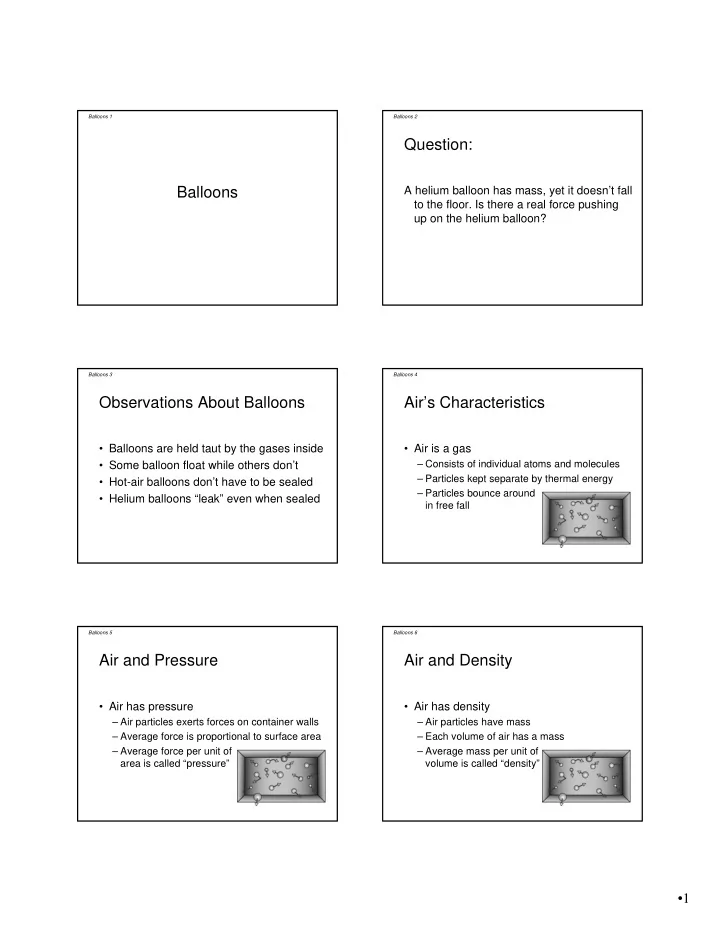
Balloons 1 Balloons 2 Question: Balloons A helium balloon has mass, yet it doesnt fall to the floor. Is there a real force pushing up on the helium balloon? Balloons 3 Balloons 4 Observations About Balloons Airs Characteristics


slide-1
SLIDE 1
  • 1

Balloons 1

Balloons

Balloons 2

Question:

A helium balloon has mass, yet it doesn’t fall to the floor. Is there a real force pushing up on the helium balloon?

Balloons 3

Observations About Balloons

  • Balloons are held taut by the gases inside
  • Some balloon float while others don’t
  • Hot-air balloons don’t have to be sealed
  • Helium balloons “leak” even when sealed

Balloons 4

Air’s Characteristics

  • Air is a gas

– Consists of individual atoms and molecules – Particles kept separate by thermal energy – Particles bounce around in free fall

Balloons 5

Air and Pressure

  • Air has pressure

– Air particles exerts forces on container walls – Average force is proportional to surface area – Average force per unit of area is called “pressure”

Balloons 6

Air and Density

  • Air has density

– Air particles have mass – Each volume of air has a mass – Average mass per unit of volume is called “density”

slide-2
SLIDE 2
  • 2

Balloons 7

Air Pressure and Density

  • Air pressure is proportional to density

– Denser particles hit surface more often – Denser air → more pressure

Balloons 8

Pressure Imbalances

  • Balanced pressure exerts no overall force

– Forces on balloon’s sides cancel

  • Unbalanced pressure exerts overall force

– Forces on balloon’s sides don’t cancel – Forces push balloon toward lower pressure

  • Air pressure also pushes on the air itself

– Air itself is pushed toward lower pressure

Balloons 9

The Atmosphere

  • Air near the ground supports air overhead

– Air pressure is highest near the ground – Air density is highest near the ground

  • Key observations:

– Air pressure decreases with altitude – A balloon feels more force at bottom than top – Imbalance yields an upward buoyant force

Balloons 10

Archimedes’ Principle

  • A balloon immersed in a fluid experience

an upward buoyant force equal to the weight of the fluid it displaces

Balloons 11

Room-Air Balloon in Air

  • A rubber balloon filled with room air

– weighs more than the room air it displaces – experiences a downward net force in room air – sinks in room air

  • Its average density > density of room air

Balloons 12

Air and Temperature

  • Air pressure is proportional to temperature

– Faster particles hit surface more and harder – Hotter air → more pressure

slide-3
SLIDE 3
  • 3

Balloons 13

An Aside About Temperature

  • Air has temperature

– Air particles have thermal kinetic energy – Average thermal kinetic energy is proportional to absolute temperature

  • SI absolute temperature: kelvins or K

– 0 K is absolute zero — no thermal energy left – Step size: 1 K step same as 1 °C step

Balloons 14

Hot-Air Balloon in Air

  • A rubber balloon filled with hot air

– contains fewer air particles than if it were cold – weighs less than the room air it displaces – experiences an upward net force in room air – floats in room air

  • Its average density < density of room air

Balloons 15

Helium vs. Air

  • Replacing air particles with helium atoms

– leaves particle density unchanged

  • all particles contribute equally to pressure

– reduces the gas’s density

  • helium atoms are less massive than air particles

– leaves the gas’s pressure unchanged

  • helium atoms travel faster & hit more often

Balloons 16

Helium Balloon in Air

  • A rubber balloon filled with helium

– has same particle density as air – weighs less than the air it displaces – experiences an upward net force in air – floats in air

  • Its average density < density of room air

Balloons 17

Question:

A helium balloon has mass, yet it doesn’t fall to the floor. Is there a real force pushing up on the helium balloon?

Balloons 18

Ideal Gas Law

Pressure = Boltzmann constant · Particle density · Absolute temperature

  • Assumes perfectly independent particles
  • Real particles aren’t perfectly independent
slide-4
SLIDE 4
  • 4

Balloons 19

Summary About Balloons

  • Balloons float when their average

densities are less than that of air

  • Helium balloons float because helium

atoms are lighter than air particles

  • Hot-air balloons float because hot air has

lower particle density than cold air