
1
Balloons 1
Balloons
Turn off all electronic devices
Balloons 2
Observations about Balloons
Balloons are held taut by the gases inside Some balloon float in air while others don’t Hot-air balloons don’t have to be sealed and most are not Helium balloons leak even when they are sealed
Balloons 3
5 Questions about Balloons
- 1. How does air inflate a rubber balloon?
- 2. Why doesn’t the atmosphere fall or collapse?
- 3. Why does the atmosphere push up on a balloon?
- 4. Why does a hot air balloon float in cold air?
- 5. Why does a helium balloon float in air?
Balloons 4
Question 1
Q: How does air inflate a rubber balloon? A: Its pressure pushes the balloon’s skin outward
Air is a gas: individual atoms and molecules Air has pressure: it exerts a force on a surface Pressure inside a balloon is greater than outside
Total pressure forces on balloon skin are outward Balloon is held taut by those outward pressure forces Balloons 5
Air and Pressure
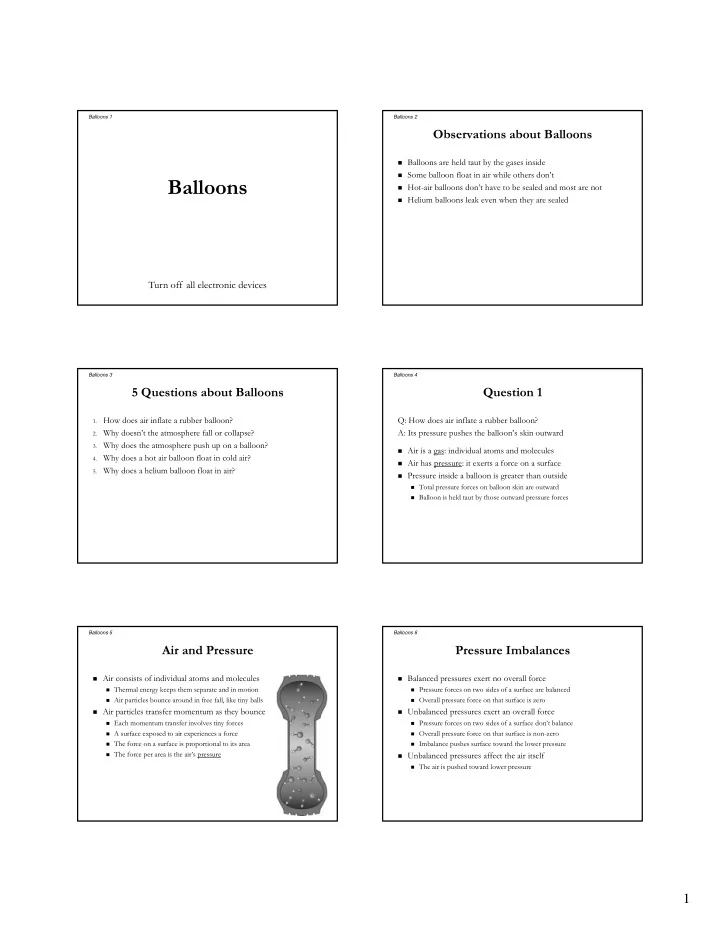
Air consists of individual atoms and molecules
Thermal energy keeps them separate and in motion Air particles bounce around in free fall, like tiny balls
Air particles transfer momentum as they bounce
Each momentum transfer involves tiny forces A surface exposed to air experiences a force The force on a surface is proportional to its area The force per area is the air’s pressure Balloons 6
Pressure Imbalances
Balanced pressures exert no overall force
Pressure forces on two sides of a surface are balanced Overall pressure force on that surface is zero
Unbalanced pressures exert an overall force
Pressure forces on two sides of a surface don’t balance Overall pressure force on that surface is non-zero Imbalance pushes surface toward the lower pressure
Unbalanced pressures affect the air itself
The air is pushed toward lower pressure