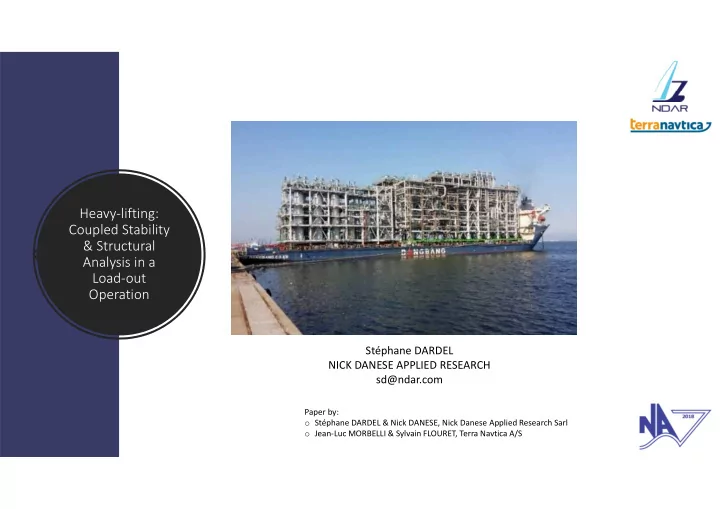
Heavy-lifting: Coupled Stability & Structural Analysis in a - - PowerPoint PPT Presentation

heavy lifting coupled stability structural analysis in a
SMART_READER_LITE
LIVE PREVIEW

Heavy-lifting: Coupled Stability & Structural Analysis in a - - PowerPoint PPT Presentation

Heavy-lifting: Coupled Stability & Structural Analysis in a Load-out Operation Stphane DARDEL NICK DANESE APPLIED RESEARCH sd@ndar.com Paper by: o Stphane DARDEL & Nick DANESE, Nick Danese Applied Research Sarl o Jean-Luc


slide-1
SLIDE 1

Heavy-lifting: Coupled Stability & Structural Analysis in a Load-out Operation

Stéphane DARDEL NICK DANESE APPLIED RESEARCH sd@ndar.com

Paper by:

  • Stéphane DARDEL & Nick DANESE, Nick Danese Applied Research Sarl
  • Jean-Luc MORBELLI & Sylvain FLOURET, Terra Navtica A/S
slide-2
SLIDE 2

Heavy-lifting: coupled stability & structural analysis in a load-out operation

2 DIGITAL MODELS:

HYDROSTATIC MODEL (GHS) STRUCTURAL MODEL (MAESTRO Marine)

Working in synchrony !

slide-3
SLIDE 3

Heavy-lifting: coupled stability & structural analysis in a load-out operation HYDROSTATIC MODEL:

  • Drafts & trim & hydrostatics
  • Stability
  • Tank status
  • Ballast sequence
  • Ballast pump capacity check
  • Longitudinal strength & girder deflection

(beam theory)

  • Torque

STRUCTURAL MODEL:

  • Finite Element model
  • Automatic transfer of tank loads from GHS to

MAESTRO

  • Hydrostatic balance
  • -> Synchrony with GHS
  • Global strength & deflection, along 3 axis
  • Torque
  • Local structural strength: Limit State Analysis
slide-4
SLIDE 4

Heavy-lifting: coupled stability & structural analysis in a load-out operation Cargo control in GHS:

slide-5
SLIDE 5

Heavy-lifting: coupled stability & structural analysis in a load-out operation MAESTRO Marine’s Limit State analysis:

Beyond customary stress maps. Load bearing capability of a structural assembly as a whole. 14 failure modes. « Evaluation patches » are rated with an adequacy parameter, always lying within the normalized limits of -1 to +1

slide-6
SLIDE 6

Heavy-lifting: coupled stability & structural analysis in a load-out operation Engineering: Hydrostatic model:

  • Prepared in a few hours,
  • Early feasibility checks: payload capcity vs drafts, longitudinal strength limits,

ballast capacity, etc.

Structural model:

  • 3 man-weeks. acceptable even in an initial study
  • Invaluable gains in predicting structural behaviour: identifying weak zones,

planning eventual reinforcing very early in the process, etc. Model creation = one-time job, directly re-usable for future operations

slide-7
SLIDE 7

Heavy-lifting: coupled stability & structural analysis in a load-out operation Next?

Integrated « Hydro + structural » model supports at-sea operations too, opening new areas of engineering analysis and behavioural prediction:

  • Combination and interaction of cargo’s and carrier’s strength and overall girder stiffness,
  • Assessment of risks to the cargo’s integrity taking into account waves, sea-states, ship speed

and duratio,n of the voyage,

  • Integrated Seakeeping analysis: Extreme load analysis, Fatigue analysis,

 Voyage prediction, planning and critical decision making during the passage.

slide-8
SLIDE 8

Heavy-lifting: coupled stability & structural analysis in a load-out operation

Thank you!