Strategy of lifting up Strategy of lifting up small or medium scale - - PowerPoint PPT Presentation

strategy of lifting up strategy of lifting up small or
SMART_READER_LITE
LIVE PREVIEW

Strategy of lifting up Strategy of lifting up small or medium scale - - PowerPoint PPT Presentation

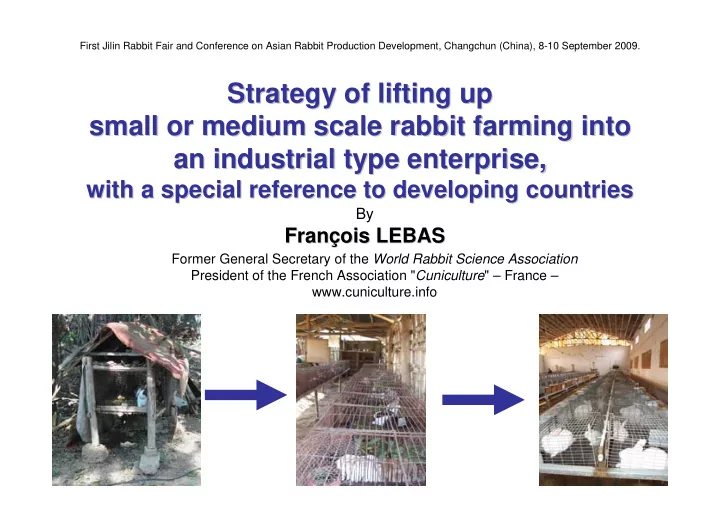
First Jilin Rabbit Fair and Conference on Asian Rabbit Production Development, Changchun (China), 8-10 September 2009. Strategy of lifting up Strategy of lifting up small or medium scale rabbit farming into small or medium scale rabbit farming


slide-1
SLIDE 1

Strategy of lifting up Strategy of lifting up small or medium scale rabbit farming into small or medium scale rabbit farming into an industrial type enterprise, an industrial type enterprise,

with a special reference to developing countries with a special reference to developing countries

By

Fran Franç çois LEBAS

  • is LEBAS

Former General Secretary of the World Rabbit Science Association President of the French Association "Cuniculture" – France – www.cuniculture.info

First Jilin Rabbit Fair and Conference on Asian Rabbit Production Development, Changchun (China), 8-10 September 2009.

slide-2
SLIDE 2

Main target of the different types of rabbit production Main target of the different types of rabbit production

Small & medium scale farming Small & medium scale farming Industrial farming Industrial farming

  • rabbit meat for breeder's family
  • some rabbits for the market

(cash income)

  • organic fertilizer for the farm
  • buffer to face unexpected difficulties
  • f the farm or of the family

A multipurpose unit

  • RABBITS FOR

RABBITS FOR THE MARKET THE MARKET (a job => income)

One only target One only target

slide-3
SLIDE 3

The different types of production possible with rabbits The different types of production possible with rabbits

MEAT FUR WOOL Purebred for SHOWS PETS

slide-4
SLIDE 4

For an industrial production For an industrial production => ONLY ONE TARGET => ONLY ONE TARGET

For this lecture RABBIT MEAT PRODUCTION

Mixture between meat and pet production should be PROHIBITED These 2 productions are conflicting These 2 productions are conflicting

slide-5
SLIDE 5

EVALUATION of the INITIAL SITUATION EVALUATION of the INITIAL SITUATION

Before to propose any type of modification, it is necessary to evaluate the situation in relation with 2 main points:

1/ description and determination of productivity of the existing systems existing systems

2/ elaboration of a fine description of the technical and economical technical and economical

environment environment of the rabbit farms

  • f the rabbit farms, and particularly of the real ability of the

market to absorb the production. Basic Basic hypothesis hypothesis : in a known area some or many farmers produce meat rabbits. They want to produce these rabbits at an industrial scale WHAT WOULD BE THE STRATEGY ?

slide-6
SLIDE 6

Description and determination of productivity

  • f the existing systems

existing systems

BREEDERS RABBITS RAISING FACILITIES

Rabbit production system has 4 main basis,

MARKET

All 4 must be evaluated All 4 must be evaluated

slide-7
SLIDE 7

Description and determination of productivity

  • f the existing systems

existing systems

A photography of the present situation A photography of the present situation The most important point is to determine during a visit :

  • the real motivation of each breeder for rabbit production
  • his will to change something in his production habits

At the occasion of this visit, the description of the setting up of each production unit should be noted in details

slide-8
SLIDE 8

For a group of breeders For a group of breeders 3 key points necessary to go to the industrial level 3 key points necessary to go to the industrial level

the creation of an enterprise by lifting up the existing small and / or medium scale units of production could be viewed with confidence only if all farmers of the group share the same ideal the same ideal which could be summarized in 3 key points : 1 - Autonomy in decision: a group managed by producers in the interest of the producers themselves. Any project with an external centre of decision has very few chances to succeed. 2 - Solidarity between members of the group, to create a common project, a common enterprise. 3 - Training of the farmers: by exchange between farmers and progressive inclusion of new techniques or management methods observed outside of the group, the whole group will progress

slide-9
SLIDE 9

In few words In few words, , the group has to work for itself, the group has to work for itself, but with eyes widely open on but with eyes widely open on the exterior of the group the exterior of the group

For a group of breeders For a group of breeders 3 key points necessary to go to the industrial level 3 key points necessary to go to the industrial level

Determination of each farmer of the group to follow up these 3 key points MUST be determined during the initial step of evaluation

slide-10
SLIDE 10

The 3 key points for the creation of an industrial enterprise The 3 key points for the creation of an industrial enterprise

The initial scale of the breeding units is of few importance if the breeders are well motivated in the success of their production

slide-11
SLIDE 11

A success story in France A success story in France for group of breeders for group of breeders 1981 1981

11 breeders + 1 half time technician 3200 rabbit does 176 000 slaughter rabbits produced during the 1rst year of activity

2008 2008

220 breeders + 45 employees 135 000 breeding does ( x 42) 7.5 millions slaughter rabbits produced / year 1 centre for artificial insemination (30 000 doses per week) 1 centre for selected rabbit lines multiplication (3000 does per week) participation in 2 big rabbit slaughter and commercialization enterprise

Their secret ? a strict application of the 3 keys points Their secret ? a strict application of the 3 keys points The 3 key points for the creation of an industrial enterprise The 3 key points for the creation of an industrial enterprise

slide-12
SLIDE 12

Description and determination of productivity

  • f the existing systems

existing systems

A photography of the present situation A photography of the present situation

  • rabbit’s housing (cages , buildings, …)
  • genotype / phenotype of the rabbits
  • number of reproducing males and females
slide-13
SLIDE 13

Description and determination of productivity

  • f the existing systems

existing systems

A photography of the present situation A photography of the present situation

  • normal management of the rabbitry : delay kindling-mating, weaning age, age at

first mating, weight and age at slaughter time, …

  • time spent per day and /or per week in the rabbitry management.

Who is working in the rabbitry, daily, occasionally ?

  • type of feeding and watering, use of forages, feed’s origin, …
slide-14
SLIDE 14

Description and determination of productivity

  • f the existing systems

existing systems

Measure of rabbitry productivity : recording data / month, duri Measure of rabbitry productivity : recording data / month, during 1 year ng 1 year 1 1 -

  • number of

number of adult rabbit present at the beginning of each calendar month adult rabbit present at the beginning of each calendar month (males and females separately) 2 - number of young adults introduced in the rabbitry during the month and the number of adults culled or dead 3 - number of matings and of kindlings during the month 4 - if possible the number of young born alive during the month (addition of kits born in each litter), 5 - number of young weaned during the month with indication of the variability and average real age at weaning, 6 - if possible the average weight of weaned rabbits, but it is not essential, 7 7 -

  • number and total weight of young rabbit sold

number and total weight of young rabbit sold per month per month (or eaten by the family) and if possible the price and the age of young rabbits

slide-15
SLIDE 15

A computer is very useful to calculate the production parameters from the data recorded in the different farms

slide-16
SLIDE 16

EVALUATION of the INITIAL SITUATION EVALUATION of the INITIAL SITUATION

Before to propose any type of modification, it is necessary to evaluate the situation in relation with 2 main points: 1/ description and determination of productivity of the existing systems existing systems 2/ elaboration of a fine description of the technical and economical technical and economical

environment environment of the rabbit farms

  • f the rabbit farms, and particularly of the real ability
  • f the market to absorb the production.
slide-17
SLIDE 17

A limited geographic area for the group homogeneity in order to facilitate meetings and contacts

A maximum distance of one to one-and- a-half hour of journey between the most external implantations. Distance in km depends of the road quality and type of transport generally used

slide-18
SLIDE 18

EVALUATION of the INITIAL SITUATION EVALUATION of the INITIAL SITUATION

The other aspects concern the possibilities and access to the different supplies and conditions of access to the market. Here the list is long. Some important points :

  • Are fresh or preserved vegetables or forages available, natural or cultivated?
  • Competition with the other animal production for the access to theses forages?
  • Other local feed resources (agricultural or agro-industrial by-products) ?
  • Are specific rabbit pelleted feeds locally available?, quality, price "acceptable" ?
  • Are the roads of good quality ?
  • Is electricity available for all farmers: power, regularity, …at which cost ?
  • Are available drugs specific for rabbit production and rabbitries disinfection?
  • Are extra workers available in the village for some specific tasks in the rabbitry?
  • What is the "normal" presentation of rabbits when sold: alive, in carcasses ?
  • Are one or some rabbit slaughterhouses in activity in the region?
  • Are the rabbit presently sold by farmers at home, at a local market ?
  • Is their some purchasers which come to collect rabbits directly from the farmers ?
  • Etc , etc, etc …
slide-19
SLIDE 19

First step : First step : Lifting of the Lifting of the group's organisation group's organisation

The target is to practice collectively for the group

  • most of the buying activities
  • all selling activities.

Examples of buying activities => lower prices and transport costs, ensured quality

  • Pelleted feeds or raw material
  • Medicines, disinfectants and cleaning products
  • Improved selected rabbits

Examples of collective commercialization of (all) rabbits produced

  • at minimum, rabbits of all farmers are sold at the same price
  • signature of contracts with one or some buyers with determination of

prices and quantities / time unit

  • regular collection of rabbits ready for slaughter from each producer

and to sell them together to one or more purchasers

slide-20
SLIDE 20

Second step : Second step : Lifting of the Lifting of the farmer farmer’ ’s production methods s production methods

An industrial enterprise could be characterised by the regular quality of its production and by its ability to adapt this production to the market's demand. => produce what is quite still sold in advance and no to try to sell a production

  • nly because it arrives at its final step.

An industrial production means also an homogenous and regular high quality

  • production. This implies a regularity of each breeder methods of production

mainly for rabbits age and live weight at slaughter time. Most generally this homogenization of the final product implies also an homogenization of the production methods used by all breeders of the group. The group must be able to know it’s the production in advance and to be able to adapt this production to foreseeable fluctuations of the market. To attain this target an efficient and frequent recording of production data is necessary.

slide-21
SLIDE 21

Second step : Second step : Lifting of the Lifting of the farmer farmer’ ’s production methods s production methods

1- Technicians and technical work Technicians functions during visits in farms

  • To deliver some individual technical advice when necessary
  • Recording of all technical-economical parameters listed above
  • To present and discuss with the farmer the analysis of his previous data

Other functions of technicians

  • To analyse, compare and synthesise performance data of all farms of the group
  • To discuss these results first with group’s staff, and regularly (every 2-3 month)

with the farmers during a common meeting (general or section's meetings). It would be the occasion to point out the better and the worst results and techniques.

slide-22
SLIDE 22

Second step : Second step : Lifting of the Lifting of the farmer farmer’ ’s production methods s production methods

1- Technicians and technical work : new methods promotion The points that could be improved following visits and/or meetings depend widely

  • f the initial situation and of the technical level of farmers. Some examples
  • the quality of the equipment, e.g. modification of the cage floor for a more suitable one,

introduction and utilisation of feeding racks for forages, …

  • the quality of material management, e.g. quality of cage cleaning, of disinfections…
  • the reproduction management, e.g., grouping of mating in only one or two consecutive

days per week which implies grouped kindlings and weanlings, and more, makes possible the adoption of newborn kits between litters and the equalization of litters.

  • an improvement of airing and ventilation of the buildings, or utilisation of open–air

systems could be proposed and tested.

slide-23
SLIDE 23
  • the adoption of controlled and coordinated distribution of pelleted feed and forages.
  • a formation of farmers on the nutritive value (energy, proteins, fibre, …) of the different

forages and by-products locally available, …

  • a formation of farmers to a early diagnostic of the most prevalent rabbit diseases in

the area, and indication of appropriate interventions, …

  • etc, etc … the list is quite infinite.

1- Technicians and technical work : new methods promotion (continuation)

  • the promotion of automatic watering in order to propose to rabbit drinking water of

better quality

slide-24
SLIDE 24

Second step : Second step : Lifting of the Lifting of the farmer farmer’ ’s production methods s production methods

2 - Sale and marketing person, commercialisation The person in charge of the commercialisation of the rabbit is the keystone is the keystone of the enterprise. His work consists in the research a permanent appropriateness of the market demands for rabbits to the possibilities of production of the enterprise, and vice versa At the occasion of the payment of the rabbits sold, the enterprise must take some small (but justified) percentage of the transaction. It would be the main source or frequently the only source of financing of the enterprise to pay it's employees (technicians …) and to finance the general investments make for the community This commercial responsible has also to return to the farmers the remarks made by the real or potential buyers about the quality or quantity of the product

slide-25
SLIDE 25

Seventy small-scale farmers, from four villages in Gilgil a few kilometers from Naivasha in the Rift Valley (Kenya) are making a decent income from the processing and sale of rabbit meat. (~2 000 USD /month) The meat, is mainly sold to the local community in Gilgil and the rest in Nairobi…/… The group processes about 600 kg per month and sells the same at Sh 250 per kg (= 3.26 USD) . “Our members supply the rabbits to the group at Sh 200. Once sold at Sh 250 the group, CIG retains Sh 50 half of which goes into administration and the rest goes to members’ dividend account to be paid later in the

  • year. It takes us 14 days to receive payment from customers on credit customers and another 14 days to pay

the supplying members,” Kihanya said . The group’s objectives include increasing output to 2000 kg by the end of the year 2009.

A success story in Kenya

slide-26
SLIDE 26

Second step : Second step : Lifting of the Lifting of the farmer farmer’ ’s production methods s production methods

3- Functions of the staff of the enterprise

  • General management on the enterprise
  • Finalisation of contract and if possible rebates for the different supplies:

feeds, selected rabbits, medicines, cages, etc….

  • To contact banks to facilitate obtaining of loans for the farmers of the group

which present reasonable projects

  • Initial evaluation and/or promotion of these projects with the help of group’s

technicians.

  • the staff may also propose to the farmers the inclusion of one part of supply
  • r commercialization activity in the normal activities of the enterprise.
slide-27
SLIDE 27

Propositions of the staff for new activities may concern : Propositions of the staff for new activities may concern :

  • the creation of a small

pelleted feeds plant

  • the creation of a slaughter house
  • r participation in an existing one
  • the establishment of a unit for selection or

multiplication of selected rabbits

  • the creation of a centre

for artificial insemination

slide-28
SLIDE 28

CONCLUSION CONCLUSION

Yes it’s possible to transform a group of farmers working at a small or medium scale into an industrial enterprise Among the different conditions the most important is the acceptation by all farmers to work together on a really common project Please keep in mind that this lifting up will be progressive and will need a long time, measured in years not in months. So the determination of farmers must be hard and continuous.

slide-29
SLIDE 29