HEAT WAVES MUD FLOWS VOLCANOES EARTHQUAKES Thurston County has - - PowerPoint PPT Presentation

heat waves mud flows volcanoes earthquakes
SMART_READER_LITE
LIVE PREVIEW

HEAT WAVES MUD FLOWS VOLCANOES EARTHQUAKES Thurston County has - - PowerPoint PPT Presentation

Since October 1956 Washington has had 47 Disaster Declarations and 65 Fire Management Assistance Declarations HEAT WAVES MUD FLOWS VOLCANOES EARTHQUAKES Thurston County has three types of Earthquakes: 1. Subduction Zone - Cascadia 2.


slide-1
SLIDE 1

EARTHQUAKES VOLCANOES MUD FLOWS HEAT WAVES

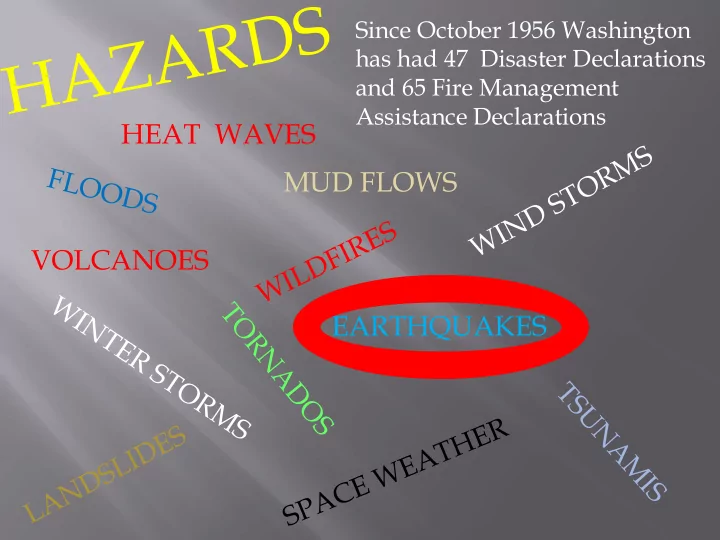
Since October 1956 Washington has had 47 Disaster Declarations and 65 Fire Management Assistance Declarations
slide-2
SLIDE 2

Thurston County has three types of Earthquakes:

  • 1. Subduction Zone - Cascadia
  • 2. Deep Plate/Benioff – Nisqually
  • 3. Crustal - Olympia
slide-3
SLIDE 3

We keep hearing about Cascadia Earthquake

slide-4
SLIDE 4

Geologic history shows that the Cascadia Subduction Zone shakes about every 200 to 500 years. Last time was January 26, 1700 at 9:00 PM, 314 years ago. When will it happen again?

CASCADIA

slide-5
SLIDE 5

The Jan de Fuca plaate subducts under the North America plate along the Cascadia subduction zone, labeled “Deformation Front” in this diagram.

CASCADIA

slide-6
SLIDE 6

Intraplate Earthquakes or Deep Earthquakes 1949, 1965, and 2001 are examples for Thurston County

slide-7
SLIDE 7

Nisqually type earthquake

slide-8
SLIDE 8

Crustal Earthquakes The Olympia Structure

slide-9
SLIDE 9
slide-10
SLIDE 10
slide-11
SLIDE 11

HAZUS is a nationally applicable standardized methodology that contains models for estimating potential losses from earthquakes, floods, and hurricanes. HAZUS uses Geographic Information Systems (GIS) technology to estimate physical, economic, and social impacts of disasters.

REMEMBER - IT IS ONLY A MODEL!

http://www.fema.gov/hazus

slide-12
SLIDE 12
slide-13
SLIDE 13

Cascadia 9.0 Nisqually 7.2 Olympia 6.8

SCALE

slide-14
SLIDE 14
slide-15
SLIDE 15

Again – HAZUS is a model in progress, as is our effectiveness in its use. In our presentation of impacts I’ll focus on Building Stock. We have updated the model with The Assessor database as of April 2013 – approx. 90,370 structures.

slide-16
SLIDE 16

PATTERNS – The colors represent the probability that a structure will be completely damaged.

slide-17
SLIDE 17
slide-18
SLIDE 18

Expected Building Damage

HAZUS uses 5 damage categories – None, Slight, Moderate, Extensive and Complete.

< Olympia 1949 Olympia, 2001 >

slide-19
SLIDE 19

HAZUS Damage State Descriptions

slide-20
SLIDE 20
slide-21
SLIDE 21
slide-22
SLIDE 22
slide-23
SLIDE 23
  • Ok. Computer Model!

Most likely Worst Case. Can it be Less – Yes! Can it be More – Yes!

The model considers liquefaction areas, but not soil saturation. The model is only a single event model, it does not consider aftershocks. Picture Cascadia 9.0 with Olympia 6.8

slide-24
SLIDE 24

What is next with HAZUS?

  • 1. Try to separate buildings by year built – Pre and Post 1997.
  • 2. Sort data by jurisdictions.
  • 3. Conduct individual structure analysis.
  • 4. Shelter Planning – In an Olympia earthquake we may to shelter

about 1,300 people. In a Cascadia earthquake about 500 from Thurston County, but about 11,000 from the coast.

slide-25
SLIDE 25

Good estimate for building stock, next we need to improve impact estimates for transportation, power, gas, pipelines, sewer, and water.

slide-26
SLIDE 26

What HAZUS currently reports:

Nisqually – 1,373 Leaks, 343 Breaks, 11,091 at 7 days Cascadia – 1,373 Leaks, 343 Breaks, 11,091 at 7 days Olympia – 1,373 Leaks, 343 Breaks, 11,091 at 7 days For waste water the patterns is the same: 690 Leaks, 172 Breaks. HAZUS uses 2,963 miles of water and 1,778 miles of waste

slide-27
SLIDE 27
slide-28
SLIDE 28

I Need help from you on acquiring data for water systems and wells.

Type of data that would help our analysis: Well Locations Pipe distribution – AutoCad, GIS file, Hand drawing Pipe type (Hard or Flexible) Or length of pipe in your Utility

slide-29
SLIDE 29

QUESTIONS?