Cleaning and Restoring Water Resources for Our Communities Center - - PowerPoint PPT Presentation

cleaning and restoring water
SMART_READER_LITE
LIVE PREVIEW

Cleaning and Restoring Water Resources for Our Communities Center - - PowerPoint PPT Presentation

Cleaning and Restoring Water Resources for Our Communities Center for Environmental Law and Policy December 5, 2019 Wendy Steffensen Environmental Project Manager LOTT Clean Water Alliance What is LOTT? Regional wastewater utility L


slide-1
SLIDE 1

Cleaning and Restoring Water Resources for Our Communities

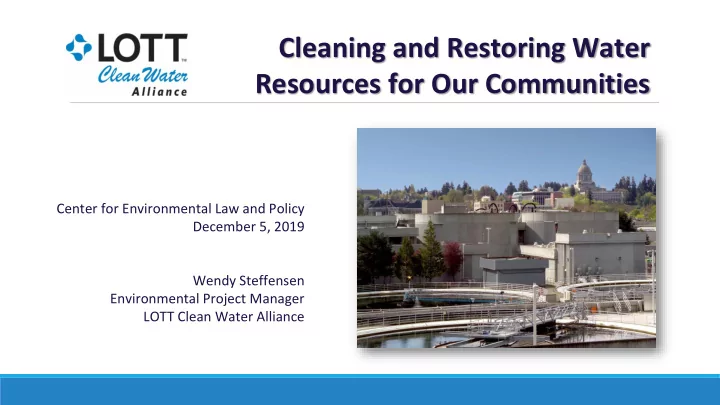
Center for Environmental Law and Policy December 5, 2019 Wendy Steffensen Environmental Project Manager LOTT Clean Water Alliance

slide-2
SLIDE 2

What is LOTT?

 Regional wastewater utility

  • Lacey
  • Olympia
  • Tumwater
  • Thurston County

 Governmental, non-profit corporation  Population served = 125,000

slide-3
SLIDE 3

Seattle Olympia and Budd Inlet Treatment Plant

Where is LOTT?

slide-4
SLIDE 4

Budd Inlet Treatment Plant

slide-5
SLIDE 5

Budd Inlet Reclaimed Water Plant Martin Way Reclaimed Water Plant

slide-6
SLIDE 6

Reclaimed Water

 Treated to a very high standard:

  • Class A Reclaimed Water

 Highly regulated and monitored  Approved for any use except drinking

slide-7
SLIDE 7

Why Reclaimed Water?

Public Values:

 Meet future wastewater needs  Treat wastewater as a valuable resource  Maximize benefits to the environment  Provide multiple community benefits

Long-Term Strategy:

 Expand production and use of reclaimed water  Use reclaimed water to replenish groundwater

slide-8
SLIDE 8

Reclaimed Water Program Framework

LOTT

as the Generator Lacey Olympia Thurston County Tumwater

Use Use

slide-9
SLIDE 9
slide-10
SLIDE 10
slide-11
SLIDE 11
slide-12
SLIDE 12
slide-13
SLIDE 13

Hawks Prairie Ponds and Recharge Basins

slide-14
SLIDE 14
slide-15
SLIDE 15
slide-16
SLIDE 16
slide-17
SLIDE 17

Reclaimed Water Strategy

Original Strategy

Wastewater system capacity as primary driver

► Timing dependent on TMDL and other factors ► Expand incrementally over time ► Small reclaimed water satellite plants

throughout service area

New considerations

Centralized facilities are more cost effective Additional drivers for expansion:

► Partners need for reclaimed water ► Additional community benefit

slide-18
SLIDE 18

Reclaimed Water Strategy

► Treatment

  • Quality and Quantity?
  • New facility?
  • Additional treatment?

► Conveyance and Disposition?

  • Use or infiltration site?
  • What location?
  • Length of pipeline?

► Master planning to update strategy in 2020

  • Department of Ecology TMDL
  • Reclaimed Water Infiltration Study results
  • Partner Needs
  • WRIA 13 Watershed Restoration Needs
slide-19
SLIDE 19
slide-20
SLIDE 20

Reclaimed Water Project Ideas

► Groundwater infiltration

  • Above ground basins
  • Subsurface perforated pipe

► Wetland augmentation ► Streamflow augmentation

Budd Inlet Reclaimed Water Plant Henderson North Site Henderson South Site South Deschutes Site Tumwater Tank

slide-21
SLIDE 21

Opportunities and Barriers

Opportunities:

► Planning effort coincides with:

  • Ongoing work to locate infiltration sites
  • Phase two master planning in 2020
  • RWIS conclusion in 2020

► Multiple community benefits

  • Meet future LOTT system capacity needs
  • Offset impacts of water withdrawals

Barriers:

► Sites that meet multiple benefits challenging to find ► Cost of conveying water is high

  • Pipeline
  • Pumping costs

► Timing may not align for LOTT and offset projects ► Temperature can be an issue for streamflow

slide-22
SLIDE 22

Questions?

Wendy Steffensen

Environmental Project Manager wendysteffensen@lottcleanwater.org

lottcleanwater.org

slide-23
SLIDE 23

Reclaimed Water Infiltration Study

What chemicals are present in wastewater, reclaimed water, groundwater, and surface waters?

When reclaimed water is used to replenish groundwater, what happens to residual chemicals?

Are there risks to public health and the environment?

What can be done to reduce those risks?

slide-24
SLIDE 24

Reclaimed Water Infiltration Study

2015- 2017

  • Water Quality Characterization

2018- 2019

  • Treatment Effectiveness Evaluation

2019

  • Risk Assessment

2019- 2020

  • Cost Benefit Analysis

2020

  • Community Conversations