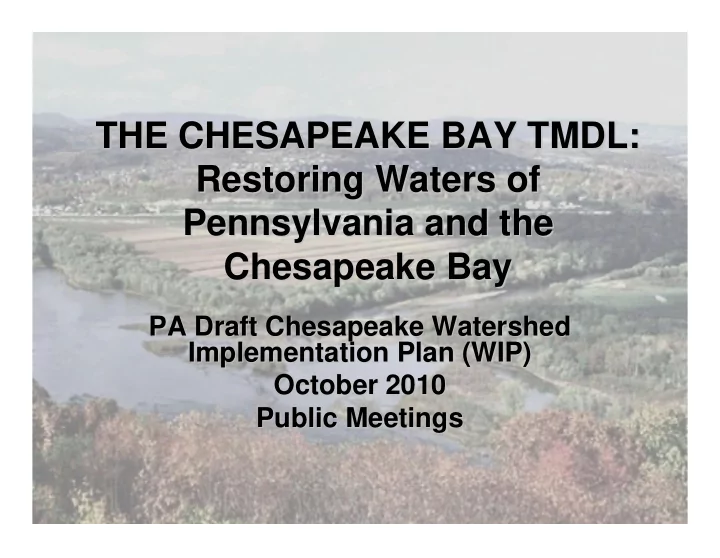
THE CHESAPEAKE BAY TMDL: THE CHESAPEAKE BAY TMDL: Restoring Waters - - PowerPoint PPT Presentation

the chesapeake bay tmdl the chesapeake bay tmdl restoring
SMART_READER_LITE
LIVE PREVIEW

THE CHESAPEAKE BAY TMDL: THE CHESAPEAKE BAY TMDL: Restoring Waters - - PowerPoint PPT Presentation

THE CHESAPEAKE BAY TMDL: THE CHESAPEAKE BAY TMDL: Restoring Waters of Restoring Waters of Pennsylvania and the Pennsylvania and the Chesapeake Bay Chesapeake Bay PA Draft Chesapeake Watershed PA Draft Chesapeake Watershed Implementation


slide-1
SLIDE 1

THE CHESAPEAKE BAY TMDL: THE CHESAPEAKE BAY TMDL: Restoring Waters of Restoring Waters of Pennsylvania and the Pennsylvania and the Chesapeake Bay Chesapeake Bay

PA Draft Chesapeake Watershed PA Draft Chesapeake Watershed Implementation Plan (WIP) Implementation Plan (WIP) October 2010 October 2010 Public Meetings Public Meetings

slide-2
SLIDE 2

2

PA’s Chesapeake Basin

  • PA encompasses 35.2% of the Bay

watershed -- that’s 14,358,159 acres

  • Four PA watersheds

– Susquehanna River (13,298,520 acres, 32.6%) – Potomac River (1,012,222 acres, 2.5%) – Eastern Shore (40,262 acres, 0.1%) – Western Shore (7,155 acres, 0.02%)

  • Impaired PA waters due to major

sources: – Agriculture 3,558 m. – Mine drainage 1,952 m. – Urban runoff/stormwater 518m.

slide-3
SLIDE 3

PA Reduction Target

472.937 1.22656 29.648 Total: 8.937 0.00956 .168 Eastern and Western Shore 64 0.117 1.39 Potomac 400 1.1 28.09 Susquehanna Remaining Reductions 2092.41 2.741 76.76 Total: 23.41 0.011 0.3 Eastern and Western Shore 243 0.42 4.72 Potomac 1,826 2.31 71.74 Susquehanna Draft Allocation 2565.347 3.96756 106.408 Total: 32.347 .02056 0.468 Eastern and Western Shore 307 0.537 6.11 Potomac 2,226 3.41 99.83 Susquehanna 2009 Progress Sediment (S) Phosphorous (TP) Nitrogen (TN) TN & TP in Million Pounds/Year -- S in Million Tons/Year (Phase 5.3 Watershed Model)

slide-4
SLIDE 4

PA Sources: % TN Contribution

  • Wastewater - 12%
  • Agriculture - 56%
  • Urban/Suburban Stormwater – 6%
  • Onsite Wastewater – 3%
  • Forestry – 22%
  • Resource Extraction - <0.5%
  • NOx Deposition to Open Water - 1%

Source: 2009 Chesapeake Watershed Model “progress” run. Values represent the projected TN load delivered to the Bay.

slide-5
SLIDE 5

PA Chesapeake Bay Watershed Implementation Plan (WIP)

  • Built with Significant Public Input:

– Advisory Committee Meetings, etc. – Over 125 Individuals Volunteered for Workgroups

  • WIP Management Team
  • Agriculture Workgroup
  • Urban/Suburban/Rural Workgroup
  • Wastewater Workgroup
slide-6
SLIDE 6

PA Chesapeake Bay Watershed Implementation Plan (WIP)

  • Three Key Elements:

– Milestone Implementation and Tracking – Advanced Technologies & Nutrient Trading – Enhancing Compliance Efforts

slide-7
SLIDE 7

Milestone Implementation & Tracking

  • Chesapeake Bay Model is only reflective of

what is entered.

  • Need more accurate input of BMPs to help

guide decision-making.

  • BMPs are in place that have not been

reported, including agricultural and stormwater BMPs.

  • External groups interested in helping.
slide-8
SLIDE 8

Advanced Technologies & Nutrient Trading

  • PA’s Nutrient Trading Program is a model program that has

generated interest across the country. Nine contracts have been signed and over 3 million Nitrogen credits certified. DEP collaborated with PENNVEST to develop a Nutrient Credit Exchange.

  • Advanced Technology: Cove Area Regional Digester Project –

CARD – Enhanced Digester to process dairy manure in Blair/Bedford – 14 enhanced digesters placed in the top two counties (Lancaster & Franklin) for dairy manure could possibly reduce TN load by about one-third, or 9 million pounds. – 42 digesters in forty counties in PA’s Chesapeake watershed could reduce TN by about 27 million pounds.

  • These technologies are not inexpensive to develop -- they can

require as much as $35 to $50 million in start-up revenue/loans. Nutrient credits, renewable energy credits and selling electricity to the grid are potential funding sources.

slide-9
SLIDE 9

Enhancing Compliance Efforts

  • Agriculture:

– Development of an agricultural water quality initiative focused on 4 elements

  • Expand outreach and technical assistance
  • Continue Existing Regulatory Programs
  • Evaluate and modify regulatory or administrative tools
  • Targeted Watershed Approach to achieve agricultural

compliance

  • Stormwater:

– Regulation and Programmatic Revisions for Chapter 102 and incorporation of Post Construction Stormwater Management requirements and Revisions to PAG-13.

  • Increased technical assistance for professional stormwater

staff, elected officials and the public to assist in identifying

  • pportunities for retrofitting or trading/offsetting to address

existing stormwater problems .

  • Point Sources (Municipal and Industrial Wastewater):

– December 2006 Pa Point Source Strategy does not change

slide-10
SLIDE 10

Other PA WIP Solutions

  • Identify and implement new BMPs such as Legacy Sediment

removal, manure technologies, urban tree canopy.

  • Advance the “Million Pound” Project Initiative.
  • Develop an Urban Nutrient Management Program.
  • Implement innovative approaches for SW management such as

IWRP’s, watershed permitting and offset/trading initiatives.

  • Integrate the State Forestry Assessment & Report.
  • Remediate Acid Mine Drainage (AMD) sites in forested areas.
  • Promote County Initiatives: Lancaster County Clean Water

Consortium; Lycoming County Chesapeake Bay Initiative

  • Advance Air Reductions (State)
  • Glass Melting Furnaces; Cement Kilns; Renewable

Energy/Energy Efficiency (RE/EE) and Demand Reductions

slide-11
SLIDE 11

Next steps:

  • Address EPA’s Comments to remove

backstop TMDL allocations:

– Articulate and quantify existing programs – Expand on new concepts and placeholder BMPs

  • Address submitted Public Comments.

– Comment deadline is November 8,2010.

  • Final WIP to be submitted November

29,2010.

slide-12
SLIDE 12

To Submit Comments on PA’s WIP

  • Written comments: Submit to the

Department of Environmental Protection, Water Planning Office, P. O. Box 2063, Harrisburg, PA 17105-2063.

  • E-mail: ep-

chesapeakebayprogram@state.pa.us . Return name and address must be included.

  • Comments submitted by facsimile will not

be accepted.

slide-13
SLIDE 13

Questions ?

http://www.depweb.state.pa.us “DEP Programs A-Z” click Chesapeake Bay