SHORELINE MANAGEMENT IN THE CHESAPEAKE BAY OPEN TO OTHER IDEAS FOR - - PowerPoint PPT Presentation

shoreline management in the chesapeake bay open to other
SMART_READER_LITE
LIVE PREVIEW

SHORELINE MANAGEMENT IN THE CHESAPEAKE BAY OPEN TO OTHER IDEAS FOR - - PowerPoint PPT Presentation

SHORELINE MANAGEMENT IN THE CHESAPEAKE BAY OPEN TO OTHER IDEAS FOR HARD SUBSTRATE Sadie Drescher, Director of Restoration Programs Chesapeake Bay Trust sdrescher@cbtrust.org, 410-974-2941 xt 105 Chesapeake Bay Trust LIVING SHORELINE


slide-1
SLIDE 1

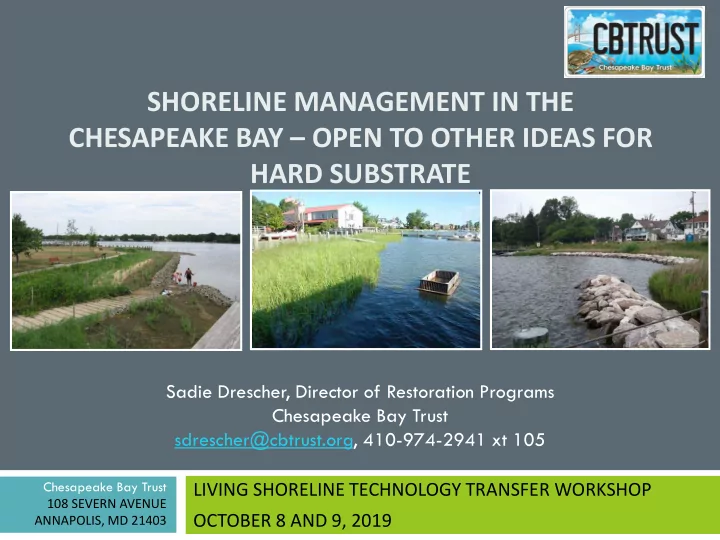
SHORELINE MANAGEMENT IN THE CHESAPEAKE BAY – OPEN TO OTHER IDEAS FOR HARD SUBSTRATE

LIVING SHORELINE TECHNOLOGY TRANSFER WORKSHOP OCTOBER 8 AND 9, 2019 Sadie Drescher, Director of Restoration Programs Chesapeake Bay Trust sdrescher@cbtrust.org, 410-974-2941 xt 105

Chesapeake Bay Trust 108 SEVERN AVENUE ANNAPOLIS, MD 21403

slide-2
SLIDE 2

Living Shorelines defined as “Shoreline Management”

 A continuum of shoreline management practices

that is based on the amount of hard shore armor structure used.

slide-3
SLIDE 3

 Shoreline Management expert panel developed load

reductions for prevented sediment, denitrification, sedimentation, redfield ratio, and default values

 Sediment reduction credit tied to tidal erosion rate

and can be quite high

 Minority dissenting view for prevented sediment –

coarse sand is good for SAV and habitat

 Qualifying conditions to attain “credits”  Credits conservative based on science available  Credits limited to 5 years; need re-inspection  Panel report should update every 2 years – but has not

been done yet

Shoreline Management has TN, TP, and TSS load reduction credits in the Chesapeake Bay

slide-4
SLIDE 4

 Developed load reductions for prevented sediment,

denitrification, sedimentation, and redfield ratio plus default value

 Qualifying conditions  Credits conservative based on science available  Sediment reduction credit tied to tidal erosion rate

and can be quite high

 Credits limited to 5 years; need re-inspection  Panel report update every 2 years  Minority dissenting view for prevented sediment –

coarse sand is good for SAV and habitat

Shoreline Management

slide-5
SLIDE 5

Oysters in Shoreline Practices – slim to none in Maryland

 MD DNR reports 3 practices with oysters  Maryland is “oyster poor”  Perception or real obstacles to get a

permit for living shorelines with oysters

 Oyster laden “reef balls” are an emerging

idea/technology

slide-6
SLIDE 6

One example of “reef balls”

slide-7
SLIDE 7

Oysters growing on concrete balls

slide-8
SLIDE 8

Placing Oyster “Reef Balls” on the Shoreline

slide-9
SLIDE 9

Pooled Monitoring Initiative – Science to answer key restoration questions

 Pool resources to answer restoration questions  Increase power, objectiveness, and ability to know

what works

 Bring science back to those that can use it  Restoration Research award program

 Pooling resources to research “big” questions  Supported 25 projects at $4.1M since FY 15  https://cbtrust.org/grants/restoration-research/

slide-10
SLIDE 10
slide-11
SLIDE 11

Chesapeake Bay Trust is helping meet the Bay’s restoration goals through awards that fund citizen engagement and restoration efforts Visit cbtrust.org for more information.

We look forward to learning together at this conference