heat stress, mobility, and body temperature Kristin Hales, PhD, PAS - - PowerPoint PPT Presentation

heat stress mobility and body temperature
SMART_READER_LITE
LIVE PREVIEW

heat stress, mobility, and body temperature Kristin Hales, PhD, PAS - - PowerPoint PPT Presentation

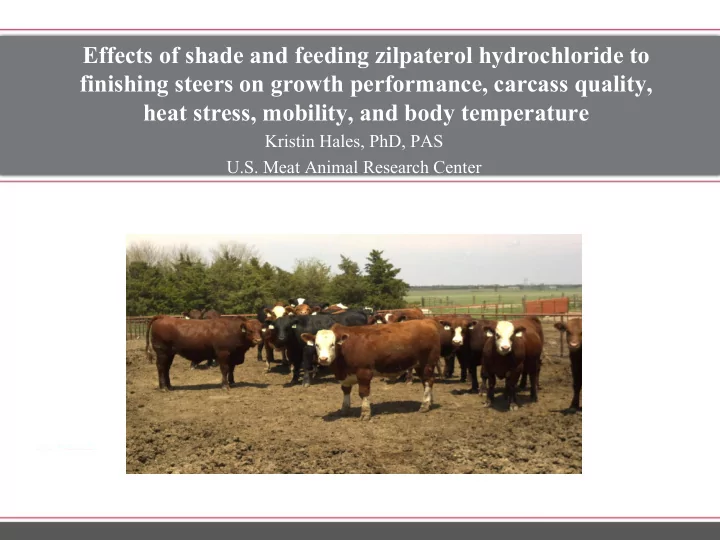
Effects of shade and feeding zilpaterol hydrochloride to finishing steers on growth performance, carcass quality, heat stress, mobility, and body temperature Kristin Hales, PhD, PAS U.S. Meat Animal Research Center Introduction Zilpaterol

slide-1
SLIDE 1

Effects of shade and feeding zilpaterol hydrochloride to finishing steers on growth performance, carcass quality, heat stress, mobility, and body temperature

Kristin Hales, PhD, PAS U.S. Meat Animal Research Center

slide-2
SLIDE 2

Introduction

  • Zilpaterol Hydrochloride first approved for

feeding in the US in 2006 (FDA 2006)

– Zilmax (Merck Animal Health; De Soto, KS)

  • Multiple studies for performance and carcass

characteristics(Vasconelos et al., 2008; Elam et al.,

2009, Motgomery et al., 2009, Hales et al., 2014) – 15 kg increase in HCW – 1.7 % increase in Dressing % – 8 cm2 increase in LM area – 12.6% decrease in yield grade

slide-3
SLIDE 3

Why is this research important?

  • Since the release of Zilmax some have raised

concerns about animal welfare issues – Has since been removed from the market by the manufacturer

  • Little data on heat stress and animal welfare
slide-4
SLIDE 4

Objective

  • The objective of this study is to evaluate the

effects of supplementing zilpaterol hydrochloride to finishing steers during the last 21 days of the feeding period on performance, carcass characteristics, heat stress, mobility and body temperature

slide-5
SLIDE 5

Materials & Methods

  • US Meat Animal Research Center near Clay Center,

Nebraska

  • 480 crossbred beef steers utilized

– 2 blocks of 240 steers each – Heavy weight block harvested in July 15, 2014 – Light body weight block harvested in Aug 12, 2014

  • Four replications per treatment

– Eight pens (30 hd/pen) per block

slide-6
SLIDE 6

Materials & Methods

  • 2 × 2 factorial

arrangement of treatments

– Housing type (Shaded

  • r open lot pens)

– Inclusion of Zilpaterol Hydrochloride (0 or 8.33 mg/kg DM for last 21 days with 3-5 day withdrawal)

slide-7
SLIDE 7

Heat stress measurements

  • Continuous body temperature

(SmartStock; LLC. Pawnee, OK) – Rumen bolus – Body temperatures taken in ten minute intervals for the duration

  • f treatment period.
  • Panting scores and respiration rates

– Cattle adapted to humans being near pens prior to feeding ZH – Taken daily at 13:00 – Half of pen evaluated each day

slide-8
SLIDE 8

Mobility measurements

  • Tyson mobility scoring system

– 0 = no lameness (normal) – 1 = slightly stiff gait – 2 = fails to keep up with the group – 3 = severely lame and reluctant to move – 4 = non ambulatory

  • Taken 8 times per block
  • Split into four time points

– Before feeding ZH (As animals were pulled from their home pen) – End ZH (As animals were pulled from their home pen) – Arrival at packing plant (As animals unloaded off the truck) – Up to restrainer (As animals made their way to restrainer)

slide-9
SLIDE 9

Worst Case Scenario

  • Steers were weighed, blood & feces were

collected, and mobility scores were collected starting at 05:30

  • Steers were taken back to pens and fed
  • Steers were removed from pens at 17:00 and

loaded on trucks to be hauled to packing plant

  • Steers were held at packing plant overnight for

an A shift harvest the next morning

slide-10
SLIDE 10

Growth Performance

Dietary Treatment Housing Type Trait Control Zilmax P-value Open Shade P-value SEM Initial BW (kg)

359 360

0.37

360 358

0.24 3 Final BW (kg)

639 643

0.43

645 636

0.08 7 DMI (kg/d)

9.7 9.6

0.61

9.7 9.7

0.55 0.2 ADG (kg)

1.55 1.56

0.56

1.57 1.54

0.10 0.03 G:F

0.159 0.162

0.44

0.162 0.159

0.39 0.002

slide-11
SLIDE 11

Carcass Characteristics

Dietary Treatment Housing Type Trait Control Zilmax P-value Open Shade P-value SEM HCW (kg)

406 420

<0.01

416 410

0.17 6 Dressing %

63.7 65.4

<0.01

64.5 64.6

0.78 0.2 LM Area (cm2)

88.4 94.8

<0.01

92.9 91.0

0.27 0.1 12th Rib Fat (cm)

1.63 1.55

0.15

1.63 1.57

0.39 0.01 Marbling1

476 469

0.50

472 473

0.92 7 USDA Yield Grade2

3.5 3.2

<0.01

3.4 3.4

0.89 0.06

+14 kg +1.7 % +6.4 cm2

  • 8.57 %
slide-12
SLIDE 12

Main effect of Time on Mobility Score

Averaged across all treatments

slide-13
SLIDE 13

Respiration rate and panting scores

Dietary Treatment Housing Type Trait Control Zilmax P-value Open Shade P-value Interaction SEM Respiration Rate (Breaths/Min)

93.2 100.8 0.05 96.3 96.9 0.88 0.69 2.93

Panting Score1

0.55 0.68 0.10 0.62 0.62 0.99 0.31 0.05

slide-14
SLIDE 14

Body Temperature

Open Shade Measurement Control Zilmax Control Zilmax SEM Interactio n Average

39.13d 38.98a 39.10c 39.08b

0.01 <0.01 Maximum

40.31d 40.12a 40.26c 40.17b

0.02 <0.01 AOC Pen Ave.

340.14c 237.94b 124.49a 122.74a

0.80 <0.01 AUC From Zero

14752d 14711a 14743c 14738b

2 <0.01

slide-15
SLIDE 15

Conclusions

  • No differences were found for dry matter intake,

ADG, or G:F on a live basis when zilpaterol was fed

  • Cattle in the open lot pens tended to have a greater

gain than cattle in the shaded pens

  • Respiration rates for cattle fed zilpaterol were

greater, with no difference due to housing. However, the label of zilpaterol hydrochloride says it will increase respiration rate

slide-16
SLIDE 16

Conclusions

  • Time on feed affected mobility scores, with
  • bservations on the morning of harvest at the

packing plant being the worse for all groups of cattle irrespective of treatment

  • Cattle fed zilpaterol in both shaded and open pens

had lower average & lower maximum, body temperatures

slide-17
SLIDE 17
  • Zilpaterol hydrochloride improved carcass

characteristics with little impact on heat stress or mobility, suggesting that animal welfare was not affected by feeding ZH during the last 21 d of the feeding period.

  • This research was partially funded by the

Nebraska Beef Council.

Take Home Message

slide-18
SLIDE 18

Brief Overview of Feedlot Research at U.S. MARC

slide-19
SLIDE 19

Individual Animal Feed Efficiency (GPE) Growth Technologies Physiology

  • f Feed

Intake

Areas of Feedlot Research

Regulation of Feed Intake

Breed Evaluation Diet Evaluation G × E Interaction Discovery Extreme Tissue Bank Microbiome

Implants β-agonists Regulation of Feed Intake

slide-20
SLIDE 20

Effects of Growth Technologies

  • n Feed Efficiency
  • Determine the effects of moderate and aggressive

implant strategies with β-agonists on performance and carcass characteristics

  • Test for breed and genomic

interactions with these treatments

  • 3325 GPE steers used over 7 years

– 360 Spring-born steers each year – 175 Fall-born steers each year – Treatments applied in Spring of 2014

Looking for G × E Interactions

slide-21
SLIDE 21

Extreme Steer Tissue Library

  • Purpose: To obtain a tissue bank from steers

collected over 2 seasons and 3 years

  • Steers with extreme feed intake and gain

phenotypes

  • To date, we have collected tissue from 64

animals – Spring and Fall born

  • Evaluate gene expression in certain tissues as

it may relate to phenotype

slide-22
SLIDE 22

Tissue Library

slide-23
SLIDE 23

Extreme Steer Microbiome

Gain Intake H:H High High H:L High Low L:L Low Low L:H Low High

Variation in microbial populations were observed for cattle with extreme phenotypes H- H H- L L- L L- H

Differences in specific bacterial groups were

  • ften

associated with gain

slide-24
SLIDE 24

Physiology of Feed Efficiency

  • Determine the association of hormones and

metabolites with feed intake, growth, and efficiency

  • Determine genetic influences on circulating

concentrations of hormones involved in appetite and growth

  • Determine the utility of hormone and metabolite

concentrations in predicting feed intake, growth, and efficiency

– Use in selecting animals

slide-25
SLIDE 25

Physiology of Feed Efficiency

  • Active ghrelin accounted for 6 % and the ratio
  • f active to total ghrelin accounted for 10 % of

the variation in feed intake

Cattle currently being genotyped for a gene that inactivates ghrelin Ghrelin is a gut peptide that signals appetite

slide-26
SLIDE 26

Questions?

Kristin Hales, PhD, PAS Research Animal Scientist USDA-ARS Meat Animal Research Center Clay Center, NE Kristin.Hales@ars.usda.gov

USDA is an equal opportunity employer and provider.