
SLIDE 1
January 1, 2012 (PRESENTATIONS)
2012
Andy Mitchell On behalf of Tom Burns & Sandra Sinfield 1/1/2012
Presentations
This pack has been created using materials from the above Centres of Excellence in Teaching and Learning
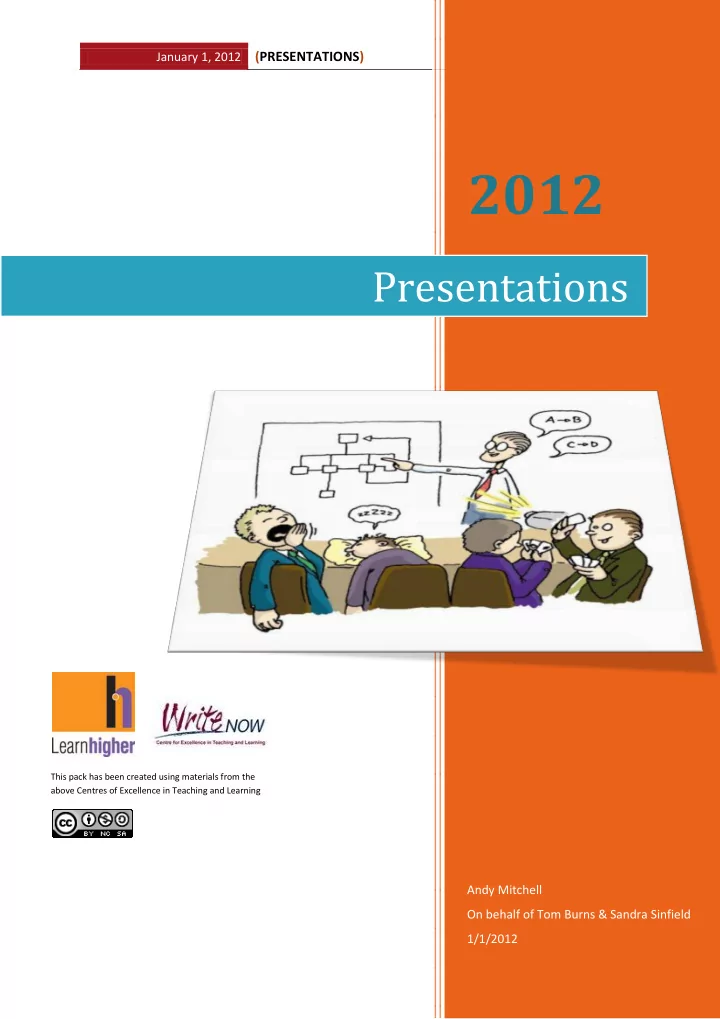
2012 Presentations This pack has been created using materials from - - PDF document
January 1, 2012 (PRESENTATIONS) 2012 Presentations This pack has been created using materials from the above Centres of Excellence in Teaching and Learning Andy Mitchell On behalf of Tom Burns & Sandra Sinfield 1/1/2012 January 1, 2012
January 1, 2012 (PRESENTATIONS)
Andy Mitchell On behalf of Tom Burns & Sandra Sinfield 1/1/2012
This pack has been created using materials from the above Centres of Excellence in Teaching and Learning
January 1, 2012 (PRESENTATIONS)
Student Name Student ID Module Code Module Title
Presentations are good learning
and give you practice in:
Critical thinking Organising your ideas Questioning positions and attitudes Defending a position Explaining clearly Arguing a point Talking through a problem
January 1, 2012 (PRESENTATIONS)
Giving a presentation
Presentations are set by tutors as it helps in the academic learning process. The process of planning, practise, performing and later to reflect on what you have done, helps you to understand and get to grips with learning the material. You will either do them on your own or in groups. Presentations might be given informally in seminars and tutorials or formally, when they will be assessed. Whatever the purpose, you will always want to follow the same approach as any other assignment to prepare. Giving a presentation is considered a skill which will add to your employability. If you plan to get a job after completing your course then it’s very likely that your employer will require you to give a presentation as part of your interview and later as part of your work. Having good oral skills also helps you to get a better job and progress in the workplace.
What is the purpose of giving a presentation?
Presentations can start debates They offer different perspectives It is a skill that can be used for work It allows students to present themselves in a different way It can help develop your self esteem and confidence
The basic rules of presenting Keep it simple Make it as clear as you can Don't read it Don't rush it Use slides Breathe!
January 1, 2012 (PRESENTATIONS)
Activity 1
Spend a few moments thinking about your own work, which of the following are true about you? Yes/No a) I feel more comfortable writing about a subject than speaking about it b) Being able to speak clearly helps me to understand a subject c) I am unable to speak in front of a group without preparing d) It’s easier to talk if I am interested and know something about the subject e) Explaining things to people helps me to understand more clearly Everyone has different strengths, including with writing and speaking at university. Some people prefer written assignments, while others will be better at giving a talk because they find topics easier to explain. Whatever your preferences, most people are wary (or even frightened) of giving presentations - but this does NOT mean that they cannot do well at them. Which is fortunate because preparing and delivering presentations is a method widely used to help students learn course content. It is also widely used as an alternative way of assessing student progress. Further, all courses have their own language or way of saying things. Giving presentations gives you
knowledge, understanding and skills What do presentations require of me? To research a topic To plan content, structure and delivery Prepare visual aids, such as PowerPoint Present to an audience
January 1, 2012 (PRESENTATIONS)
Body – this is the presentation!
Presents information in a logical structure One idea at a time:
Argument
Evidence
Discussion
Point
Audio Visual Aids The body makes up 60% of your presentation
Introduction and Agenda
Tell the audience what is coming in the whole presentation This takes up about 15% of the time allocated
Plan, Prepare, Practise and Present Conclusion
Re-visit arguments
Re-state points
Thank people for listening
Ask for questions This makes up 25% of your presentation
Questions & Answers
Take questions
Answer briefly
Thank again
January 1, 2012 (PRESENTATIONS)
Activity 2
How do you feel about giving a presentation? Consider presentations you have listened to and/or given before, then answer the following questions. What did you like and dislike about the presentations you listened to? Liked Disliked 1 1 2 2 3 3 4 4 5 5 Now consider yourself: What are your strengths and weaknesses when you give a talk? Strong points Weak points 1 1 2 2 3 3 4 4 5 5
January 1, 2012 (PRESENTATIONS) The major steps in oral presentations are:
Planning your presentation
Planning ahead and being thorough with your preparation will help you to give an excellent talk, so before you dive in check that you have all the information you need:
Plan Prepare Practise Present
Planning tips and questions
Time limit: How can you fit the topic into the time you’ve been allocated? What will you have to put in and what will you leave out? Topic and audience: Remember, an audience is made up of real people with real knowledge and expectations of their own. Other questions to consider:
something much shorter?
Action Plan: Now that you have considered all of these things, decide on what you will do next. What will you read? Or find? And what will you make to get your presentation ready?
January 1, 2012 (PRESENTATIONS)
Analyse the question
Decide on your objectives
Analyse the audience
Consider your topic
Brainstorm!
Research the topic
Prepare an outline
Create a draft
Prepare a PowerPoint or
Prepare your notes
Finalise the details
about 1.5 to 2 minutes to complete
Timing
Practise makes perfect!
January 1, 2012 (PRESENTATIONS)
Commonly used criteria for presentations
When giving a presentation there is often a difference between the expectations of the audience and (assessed) criteria of the tutor. Good planning will help you to be successful with both tutor and audience.
Lecturers’ Criteria Audience Criteria
Content knowledge Entertaining Evidence of research/planning Relevant and useful Structure and organisation Knowledgeable Use of audio-visual aids Involved by lecturer Non-verbal communication Well organised Audience involvement Easy to understand
Consider your audience
To make your presentation more effective, think about how you can enlighten, educate and entertain your audience. This will help you build a rapport and calm your nerves. It will also make your presentation more memorable which helps people to learn.
Who you are speaking to makes a difference Who are they? What are they likely to already know about the subject? What do they need to know? What are their attitudes and expectations? What is the best way to develop a rapport with them?
January 1, 2012 (PRESENTATIONS)
Group presentations
Working in groups can be a proper pain and many students will be able to recall a bad experience participating in group assignments. Example You are standing in front of the class, ready to present with three other people. As you begin speaking, you realise that another member has put up the wrong slides. After you finish, you listen to the next speaker and realise her points have nothing at all to do with what you were saying before. By the time the third member speaks, the audience is lost and confused, spoiling the presentation and resulting in a low grade. Group presentations will run smoothly and help to improve your grade if you follow these basic tips:
Working as a group
Have one person take notes and check in with
tasks. Consider your members strengths and
with computers, you might want to assign them the tasks of creating the visual aids. Also, the strongest writers might be most effective in preparing the outline for the presentation. Encourage group participation in preparing the presentation by asking individual members to
Decide on a group goal. This includes a strategy, the purpose of the group and the resources needed for the task. Develop a group presentation plan that everyone agrees on and that clearly states what will be covered.
Preparing the presentation
Decide what each member will do during the
visual aid until they speak. Choose the most confident speakers for the introduction and
body of the talk. Like all presentations, analyse your audience and consider what they need to hear. If the task requires you to introduce each member, decide whether you will do that at the beginning or immediately before they speak. Decide how each section fits together. Practise introductions and transitions when moving from member to member so that the presentation flows smoothly. Remember to learn everybody else’s part in the presentation. Prepare for unforeseen circumstances, such as one member becoming ill or if they do not turn up on the day. Practise, practise and erm... practise!
Group presentations can be challenging because of the effort that it takes to co-ordinate all of the members and different sections, but if you give yourself time to work together you will be more likely to present a talk that is polished and effective.
January 1, 2012 (PRESENTATIONS)
Activity 3
Attitudes towards working in groups Scenario 1 - Speaking up in seminars Your seminar group has a lot of very articulate confident students of all nationalities. You
time to put your point of view forward. What strategies could you adopt? Scenario 2 - Making presentations You are part of a group of students which has to do a joint PowerPoint presentation on personal development planning to the rest of the class. All members of the group are expected to contribute equally. You are very worried about your English speaking skills and are wondering how you can get out of doing the presentation. What strategies could you use to help you feel more positive?
January 1, 2012 (PRESENTATIONS) Scenario 3 - Leading seminar sessions You have been given a list of seminar topics and the dates you are expected to lead the discussion. How will you approach it? Scenario 4 - Group dynamics Your group has 6 members. You, 2 male students and 3 female students. Your group has been given a 3 week deadline to deliver a presentation on organisational hierarchy. At your first meeting you allocated different areas of research to different group members. At your second meeting you have all got together to look at the research and decide how to structure the presentation. The girls have all brought their work with them. The 2 male students haven’t done anything and are more interested in discussing last night’s football results than they are in contribution to the session. What should you do?
January 1, 2012 (PRESENTATIONS)
Preparation
Preparing a presentation requires the same research and hard work that an essay does, plus you have to think about making audio-visual aids (AVA) as well. Analyse the task so you know exactly what you are meant to be doing. Ask yourself what you already know and consider the following steps: Brainstorm the topic. This will help to clarify what you know already Organise the research material into a logical order e.g. chronologically, spatially (diagrams and maps), sequentially (1, 2, 3...) Develop a plan or structure One method used for brainstorming a topic is mindmapping. This has a three-step process: One method used for planning presentations is mind mapping. This has a three-step process:
Plan Prepare Practise Present
Prepare
Mindmap Information Structure Cards Audio Visual Aid
January 1, 2012 (PRESENTATIONS)
Activity 4
Make your own mindmap 1 Get a piece of paper, A4 or larger. Use it in landscape orientation 2 Have some colour pens handy 3 Draw an image in the centre that represents the topic Use at least three colours Keep the central image to about 5cm in diameter 4 Choose your main sub-themes, allocate
each one OR Pick one topic and work on that one before you move on to the next 5 It helps your creative thinking if you add pictures associated with the topic 6 Add as many sub-levels as you need to. If you run out of paper use sellotape and add more 7 Create your mindmap Landscape
January 1, 2012 (PRESENTATIONS) Make a mindmap about summer using the keywords below (they are just in a random order at the moment). ice cream, picnic, sun hat, barbecues, tent, clothes, sun, salad, ball, sun cream, swimming, food, paddling pool, bucket, holiday, t-shirt, spade, yellow, hot, sunglasses, ferry, beach, tennis, caravan, music, sand, cycling, sea, sport, paddling pool, sun hat, shorts, strawberries, fun Start with a central picture, with 4 colours, add in at least 5 more words you associate with the ones given and put in at least 5 pictures as you make the mindmap (use a separate piece of paper if necessary).
January 1, 2012 (PRESENTATIONS)
Preparation tasks
In the build up to giving the presentation consider... 1 What is the title going to be? 2 Research the topic – this well help not only to determine what you will present, but also give you confidence 3 Refine your topic so that the presentation is clearly focused. This will benefit the audience and yourself 4 Write notes on cards to prompt you during the presentation. If using PowerPoint, use the ‘add notes’ pages for each slide 5 Be mindful of how you are being assessed 6 Always check the room/venue you will be presenting in beforehand and make sure it has the correct equipment 7 Decide what visual aids you will use (handouts, OHP, PowerPoint etc) 8 Proofread text and check graphics on visuals. Check your links are working. 9 Practise giving the presentation and time yourself. Use a mirror if no friend or sibling is available. Then, on the day of your presentation... 1 Double-check your prompt cards/notes and any handouts you may have done. Make sure they are up-to-date with any changes you may have made and that they work with your presentation 2 Remember to bring any linked files you are using (e.g. a video file used in PowerPoint) 3 Make sure you have made enough handouts and that any visual aids work in the room/venue where you will be talking 4 Try to relax and breathe. Remember, the audience want you to do well.
January 1, 2012 (PRESENTATIONS)
MINDMAP TEMPLATE
Title:
Topic: ________
Introduction Conclusion
Topic: ________ Topic: ________ Topic: ________
Subtopic Subtopic Diagram Image Subtopic Subtopic
January 1, 2012 (PRESENTATIONS)
When practising your presentation think about these five strategies
Plan Prepare Practise Present
Practising: five things to do
to hear the words spoken
to know your presentation
acquainted with your space
your visuals
First of all, practise on your own to ‘hear’ the words – spoken words work differently from written ones. Change your presentation so it works when SAID. Check how long the presentation takes and revise it if it is too long. If you wrote a script – lose it and develop confidence in your story telling voice. If we read
‘story’, also reading from a script can sound wooden and your script can act as a wall with your audience. Practise again till you KNOW your presentation and can recreate it from just a few prompts - key words or cue sheets. Make sure you know what you have written – and act like you care about what you are saying. Practise in a room similar to the one you will be presenting in. When you feel confident practise in front of a friend and take on board their advice. Finally practise till you can say it as though for the very first time – your presentation must stay fresh and energised or else you will lose your audience. On the day of the presentation, check the room and get acquainted with the space. Make sure the equipment is all there and is working
room – before anyone else gets there. Take control of the space and of your feelings. Act like you are enjoying yourself. It may seem silly, but when people are nervous they tend to take shallow breaths which make their voice sound weak. This often leads to you feeling more nervous. However, you can overcome that by breathing slowly and deeply and breathing out
whenever you feel stressed out beforehand. Many people get the visuals wrong. Do not write an essay on your slides. Use a few words – or better, just use images. Practise using them to make sure they convey the message you want. Once you feel confident using them you are more likely to look at the audience than your slides during the presentation. Then USE your slides – speak to them, let the audience have time to see them – then take them away.
January 1, 2012 (PRESENTATIONS) To make sure your presentation is as good as it can be, follow these tips and tricks of things you can do before and during your presentation.
Before During
Work on being positive! Introduce yourself and your topic Reassure yourself you know your presentation by running through the main points with and without cue cards Give a brief introduction and say your agenda Get to the room early. Rushing in late will increase stress levels Speak slowly and clearly Take control of the environment. Organise the seating for yourself, your group or for the people listening If you get lost, don’t panic! Pause, look at your prompts and carry on Check the equipment is working Remember to use linguistic markers (see below) Use your adrenalin – it will help to think on your feet Make good eye contact – look at everyone in the room If stressed (before or during a presentation) stop; sigh; drop your shoulders; wriggle your toes; unclench fists; take some deep; slow breaths and start again more slowly Use visual aids with confidence and make sure everyone can see them Write your agenda on the board, on a handout,
Remember your conclusion – revisit and restate Thank people for listening and ask for questions Keep your answers short and sweet. Be fair and when finished thank people again After your presentation, review your performance
Plan Prepare Practise Present
January 1, 2012 (PRESENTATIONS)
Linking words/signposts Cause/effect Comparison Contrast Addition Examples Conclusion Time
whenever likewise although/but also for example accordingly as soon as as/as a result similarly alternatively and/and then for instance in brief at the same time because equally besides/despite in addition in other words in short as long as consequently as with however/yet moreover in effect in conclusion at length/at last hence compared to nevertheless too in this case
meanwhile since equivalent to
further in particular to sum up secondly/once so
furthermore specifically throughout first of all/first(ly) thus whereas again such as in all finally/eventually therefore while/whilst the following in the case of
initially/next accordingly in contrast what is more to show that in summary after(wards) until
as well as significantly to conclude subsequently conversely henceforth
When giving presentations you should make it clear when you are moving to a new section and when you are telling the audience something important. This is done through signposting.
January 1, 2012 (PRESENTATIONS)
Signalling phrases
"I want to start by..." "The topic I intend to discuss is..."
"Let me illustrate this by referring to..." "A case in point is..." "Take the case of..." "A good example of this is..." "I'd like to give an example to illustrate my point."
group presentation) "I will now invite (NAME) to " "I will now hand over to (NAME) who will..." "The next section relates to _______, and this will be presented by (NAME)."
"The crux of the matter..." "The next point is crucial..." "Fundamentally..."
"I might just mention..." "Incidentally..." "That reminds me of..."
"To recapitulate..." "To sum up..." "Therefore..." "As a result..." "If I can just sum up..." "Thus we can see..."
"That is to say..." "So now what we have is..." "The point I am making..." "Let me put that another way..." "In other words..." "As I have been saying..."
"Let's now consider..." "I'd like to move on to..." "Now let's have a look at..." "The next aspect of the topic I wish to consider is..."
"That concludes our presentation. However, I am / we are happy to answer any questions." "Are there any questions?" "Please feel free to ask questions." "I am / we are happy to take questions."
January 1, 2012 (PRESENTATIONS)
Assessment form
Presentation title: Name: Date:
Yes No
Was there a useful introduction? (Specific agenda given/not given)
Comment:
Logical structure?
Comment:
Evidence given? Discussed?
Comment:
Was there a conclusion? (Main points restated? Yes/No?)
Comment:
Use of appropriate visual aids (PowerPoint/OHP/etc)?
Comment:
Rapport and eye contact?
Comment:
Positive body language?
Comment:
Use of cue sheets/cards?
Comment:
Sensitive handling of Questions and Answers?
Comment:
Overall thoughts on presentation:
January 1, 2012 (PRESENTATIONS)
Presentation Skills Summary
Content
Should be relevant to the audience Main points should be expressed more
than once
Only present what you know (don’t try to
bullshit your way through it) Audience
Size What experience does the audience have
with the topic?
Interest in the topic Needs Gender balance (content and delivery
may change in a mixed gender audience)
Age range Culture/religion (are there any cultural or
religious factors that may influence the content or delivery?) Venue
Location (geographic) Physical access to the facility and to the
room – it is better for the entrance of the room to be at the back
Lighting (adequate for all to see you) The stage “set” (remove distractions –
any materials from previous sessions should be removed)
Size of the room Seating Temperature (cool is better than warm)
Delivery
Eye contact (make frequent eye contact with the
audience – pick two or three people seated in different places and look at them)
Timing (time of day/time in relation to other
topics/timing of specific remarks/silence can be powerful)
Duration (stick to the time limit) Pace Keep It Short and Simple Voice (volume, tone modulation) Humour (if you are not sure that what is funny to you
will be funny others – don’t try to be funny)
Language (avoid jargon) Gestures (some are better than none – too many
detract) Visual Aids
Keep It Short and Simple Should support and not detract from the
presentation
Be sure all can see it OHP Flipcharts PowerPoint – see
http://www.writing.engr.psu.edu/speaking/rethinkin g_psu.pdf Choreography
OHP (when not in use remove it from the stage or
fold down the mirror)
Flip chart stands (right handed-stage left/left handed-
stage right)
PowerPoint (check it works for everyone presenting) Co-presenters (clarify roles and responsibilities –
follow the plan!)
January 1, 2012 (PRESENTATIONS)
Worksheet 1
Preparing your introduction Instructions: Complete the following questions What is the topic of your presentation? Summarise the topic in five words? 1. 2. 3. 4. 5. Why is the topic interesting and useful to your audience? Optional question: Write a question that you can ask the audience that will highlight their need to listen to your presentation. For example, if your presentation is about ‘how to get a good job after graduation’, you could ask "If you are worried about getting a good job after graduation, please raise your hands." What is the background? (Why did you choose this topic?) What is your objective? (What do you want the audience to know at the end of the presentation?)
January 1, 2012 (PRESENTATIONS)
Worksheet 2
Preparing the main body What is the first main part of your presentation? Summarise the first main point in 5 words or less: 1. 2. 3. 4. 5. (To put on your note cards and slide titles) What is the second main part of your presentation? Summarise the second main point in 5 words or less: 1. 2. 3. 4. 5. (To put on your note cards and slide titles) What is the third main part of your presentation? Summarise the third main point in 5 words or less: 1. 2. 3. 4. 5. (To put on your note cards and slide titles) If you have a fourth main point, type it in here: Summarise the fourth point in 5 words or less: 1. 2. 3. 4. 5. (To put on your note cards and slide titles)
January 1, 2012 (PRESENTATIONS)
Introduction
Instructions: Edit these boxes so that the grammar is correct: Good (choose time) ladies and gentlemen, Welcome to my presentation. My name is The topic of my presentation today is called Optional question here: The reason this topic is useful for you is We are going to talk about (insert number) things today. Firstly, Secondly, Next/Finally, we are going to talk about Finally, we will look at Please feel free to ask me questions at the end. This presentation will last for about minutes.
January 1, 2012 (PRESENTATIONS)
Main body of the Presentation – Point One
Firstly, Write the details of your first point in here: Write up to five words that remind you of the details in here: 1. 2. 3. 4. 5. That’s the end of the first point.
Second Point
Now I will discuss the second point, which is about Write the details of your second point in here: Write up to five words that remind you of the details in here: 1. 2. 3. 4. 5. That’s all for the second point.
January 1, 2012 (PRESENTATIONS)
Third Point
Next/My final point is, Write the details of this point in here: Write up to five words that remind you of the details in here: 1. 2. 3. 4. 5. That’s all for this point.
Fourth Point
My fourth/final point is, Write the details of this point in here: Write up to five words that remind you of the details in here: 1. 2. 3. 4. 5. That’s the end of the final point.
January 1, 2012 (PRESENTATIONS)
Conclusion
In conclusion, in this presentation my objective was to I have covered main points, firstly Secondly, we discussed Next/Finally we discussed Finally, we looked at I hope you have found this presentation useful. Thank you. Do you have any questions, please? If there are no more questions, that is the end of my presentation.