SLIDE 1
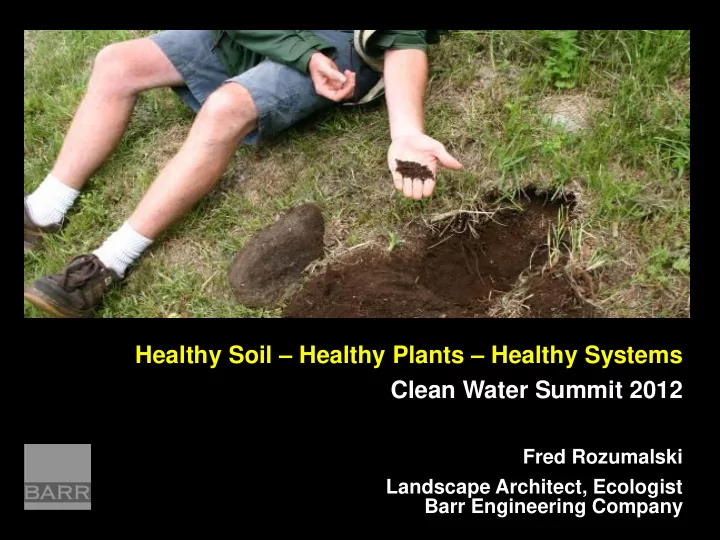
Healthy Soil – Healthy Plants – Healthy Systems Clean Water Summit 2012
Fred Rozumalski Landscape Architect, Ecologist Barr Engineering Company
SLIDE 2 Goal to manage soils to:
- Readily infiltrate stormwater
- Store stormwater in the upper reaches of the soil
profile
SLIDE 3 Goal: To build soils that support resilient plant communities that are:
- Resist insects and disease
- Drought tolerant
- Productive
- Low maintenance
- Long lived
SLIDE 4
How? By building and retaining soil structure.
Pedons
SLIDE 5
SLIDE 6
SLIDE 7
How does soil structure naturally develop?
SLIDE 8 Source: Natural Resources Conservation Service
SLIDE 9
Plants fuel the system that builds soil structure.
SLIDE 10
Mycorrhizal Fungi Bacteria
SLIDE 11
SLIDE 12 Function of Microbes
- Decompose organic matter and develop humus
- Bind soil particles together to form pedons
- Enhance soil permeability
- Promote deeper root growth and therefore greater deep root
water retention
- Protect plants from diseases and parasites
- Retain and convert nutrients into plant available forms
- Convert, degrade, or bind pollutants that find their way into soil
SLIDE 13 Benefits of Mycorrhizae:
- Enhanced water and nutrient uptake
- Reduced irrigation requirements
- Reduced fertilizer requirements
- Better drought resistance
- Better pathogen resistance
- Increased ability to tolerate stress
- Higher transplanting success
SLIDE 14
Protozoa Nematode
SLIDE 15 Source: Natural Resources Conservation Service
SLIDE 16
SLIDE 17 Source: U.S. Post Office
SLIDE 18 Role of Plants in Soil Systems
- Prevents erosion
- Shade the soil which limits desiccation
- Keeps soils cool
- Mechanically opens the soil
- Allow for better water infiltration
- Allow for water storage in the upper soil profile
- Feeds the microbial community
- Deeply inject compost
- Keep nutrients cycling
SLIDE 19 Source: The Robinson Library
SLIDE 20 Root System of Corn 8 Weeks Old
Grid equals one-square-foot boxes.
Root System of Mature Corn Plant
7 Feet 4 Feet Source: Root Development of Vegetable Crops, by John Weaver & Wm. Bruner. 1927
SLIDE 21
Creeping bentgrass roots In ideal growing conditions Kentucky bluegrass roots can grow 14” deep.
SLIDE 22
SLIDE 23 Soil Abuses
- Compaction and crusting
- Fertilizers and Pesticides
- Deicing salts
- Contamination
SLIDE 24 Soil Management
- Prevent soil disturbance
- Prevent soil erosion
- Prevent soil compaction
- Initiate a soil structure building process
SLIDE 25 Building Soil Structure
- De-compact soil
- And deeply incorporate fully decomposed compost
- Introduce microbes via compost tea (maybe)
- Plant nitrogen fixing and nutrient accumulating
plants
- Keep soil mulched
- Add organic matter each year
- PREVENT further soil compaction
SLIDE 26
De-compact soil
SLIDE 27
SLIDE 28
De-compact soil through double digging and incorporating compost
SLIDE 29
SLIDE 31
- Avoid monocultures
- Plant a diversity of species
- Plant nitrogen fixing plants
- Plant dynamic nutrient accumulators
SLIDE 32 Nitrogen-Fixing Bacteria (Rhizobium) Nodules on Soybean Roots
Nitrogen Fixing Plants:
- Hog peanut
- Clovers
- Alfalfa
- Lead plant
- New Jersey tea
- Sweetfern
- Wild indigos
- Vetches
- Black locust
SLIDE 33 Dynamic Nutrient Accumulators:
- Shagbark hickory
- Black walnut
- Lupine
- Black locust
- Sorrels and docks
- Comfreys
- Dandelion
- Basswood
- Vetches
Comfrey
SLIDE 34
Green Manure and Cover Crops
SLIDE 35 Mulch:
- To prevent erosion
- To enhance water percolation
- To retain moisture and nutrients
- To keep soil cool
- To feed the microbial community
SLIDE 36
SLIDE 37
Stay off the soil!
SLIDE 38
SLIDE 39 Conclusion
- Soils are a habitat for living organisms
- Invest in your soils
- Build soil structure
- Feed the system every year
SLIDE 40
Healthy Soil – Healthy Plants – Healthy Systems Clean Water Summit 2012
Fred Rozumalski Landscape Architect, Ecologist Barr Engineering Company