Healthy Sleep Habits Homeostasis Homeostasis: Keeps track of need - - PDF document

healthy sleep habits
SMART_READER_LITE
LIVE PREVIEW

Healthy Sleep Habits Homeostasis Homeostasis: Keeps track of need - - PDF document

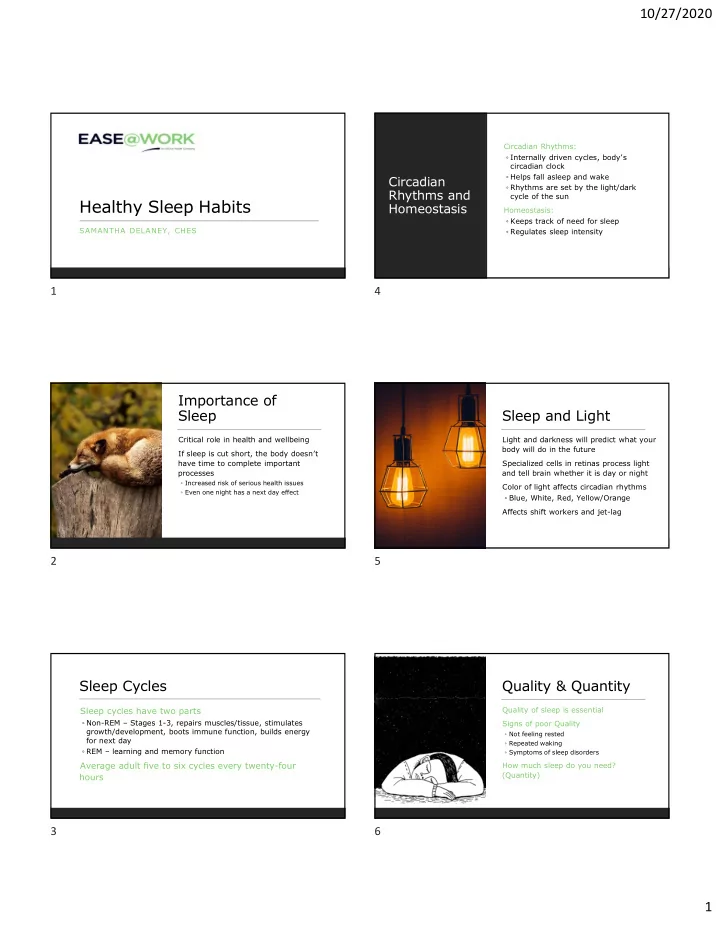
10/27/2020 Circadian Rhythms: Internally driven cycles, bodys circadian clock Helps fall asleep and wake Circadian Rhythms are set by the light/dark Rhythms and cycle of the sun Healthy Sleep Habits Homeostasis Homeostasis:


slide-1
SLIDE 1

10/27/2020 1

Healthy Sleep Habits

SAMANTHA DELANEY, CHES

Importance of Sleep

Critical role in health and wellbeing If sleep is cut short, the body doesn’t have time to complete important processes

  • Increased risk of serious health issues
  • Even one night has a next day effect

Sleep Cycles

Sleep cycles have two parts

  • Non-REM – Stages 1-3, repairs muscles/tissue, stimulates

growth/development, boots immune function, builds energy for next day

  • REM – learning and memory function

Average adult five to six cycles every twenty-four hours

Circadian Rhythms and Homeostasis

Circadian Rhythms:

  • Internally driven cycles, body’s

circadian clock

  • Helps fall asleep and wake
  • Rhythms are set by the light/dark

cycle of the sun Homeostasis:

  • Keeps track of need for sleep
  • Regulates sleep intensity

Sleep and Light

Light and darkness will predict what your body will do in the future Specialized cells in retinas process light and tell brain whether it is day or night Color of light affects circadian rhythms

  • Blue, White, Red, Yellow/Orange

Affects shift workers and jet-lag

Quality & Quantity

Quality of sleep is essential Signs of poor Quality

  • Not feeling rested
  • Repeated waking
  • Symptoms of sleep disorders

How much sleep do you need? (Quantity)

1 2 3 4 5 6

slide-2
SLIDE 2

10/27/2020 2

How Much Sleep Do You Need?

Age Group Recommended Hours of Sleep Per Day Newborn 0–3 months 14–17 hours (National Sleep Foundation) No recommendation (American Academy of Sleep Medicine)

2

Infant 4–12 months 12–16 hours per 24 hours (including naps) Toddler 1–2 years 11–14 hours per 24 hours (including naps) Preschool 3–5 years 10–13 hours per 24 hours (including naps) School Age 6–12 years 9–12 hours per 24 hours Teen 13–18 years 8–10 hours per 24 hours Adult 18–60 years 7 or more hours per night 61–64 years 7–9 hours 65 years and

  • lder

7–8 hours

Common Causes of Insomnia

Stress Anxiety Depression Medical conditions A change in work schedule Medications Shift work

Sleep Hygiene

Healthy Sleep Habits lead to a good night’s sleep Ability to fall asleep and stay asleep Cognitive Behavioral Therapy can help address thoughts and behaviors that prevent sleep

Daytime Behaviors

What you eat and drink Regular physical activity Medications you take Daytime schedule Evening routine

Schedule

Keep consistent! Set a bedtime Make adjustments in 15-minute increments

Physical Environment

Use bed for only sleep and sex Quiet Relaxing Cool temperature Lighting

7 8 9 10 11 12

slide-3
SLIDE 3

10/27/2020 3

Evening Routine

Establish a relaxing bedtime routine Limit bright lighting Turn off electronics 30-60 minutes prior to bedtime Avoid large meals, caffeine, and alcohol 20-minute rule

Relaxation

Find short activities that help to de-stress Try known techniques

  • Breathing exercises
  • Guided imagery
  • Progressive Muscle

Relaxation

Aromatherapy

Therapeutic use of essentials oils made from plant parts Used by being inhaled or applied to the skin Improved sleep and relief from anxiety and depression

Additional Tips

Create relaxing, soothing sounds that send you to sleep. Avoid distracting noises. Get outside for 30 minutes every day. Sunlight/vitamin D helps regulate sleep cycle.

What To Do if You Can’t Sleep

Practice good sleep habits If problems continue, speak with your doctor Keep a sleep diary

Questions?

13 14 15 16 17 18