Healthy Neighborhoods Fund Learning Collaborative Meeting Lerner - - PowerPoint PPT Presentation

healthy neighborhoods fund learning collaborative meeting
SMART_READER_LITE
LIVE PREVIEW

Healthy Neighborhoods Fund Learning Collaborative Meeting Lerner - - PowerPoint PPT Presentation

Healthy Neighborhoods Fund Learning Collaborative Meeting Lerner Center for Public Health Promotion Rebecca Bostwick June 16, 2015 Cross Sector Partners and Collaborators Lerner Center for Public Health Promotion, Syracuse University


slide-1
SLIDE 1

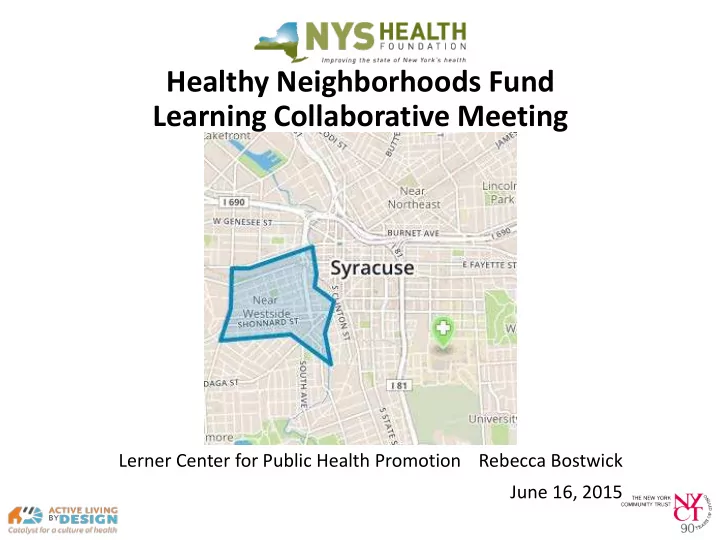
Healthy Neighborhoods Fund Learning Collaborative Meeting

Lerner Center for Public Health Promotion Rebecca Bostwick June 16, 2015

slide-2
SLIDE 2

Cross Sector Partners and Collaborators

  • Lerner Center for Public Health

Promotion, Syracuse University (Lead)

  • Near Westside Initiative (Strategic

Partner)

  • St. Joseph’s Hospital- Primary Care

Center- West (Strategic Partner)

  • Nojaim Brothers Supermarket

(Strategic Partner)

  • Cornell Cooperative Extension

(Grocery store tours and cooking classes)

slide-3
SLIDE 3
  • Understand incentives and barriers to being active including usage levels of neighborhood parks.
  • Understand barriers to healthy eating.
  • Better understand/develop inventory of community colleague short-term projects; goals for future

partnership opportunities.

2 Year Outcomes 100-day Goals

Grant Priority Areas Outcomes Increase availability of healthy affordable foods

  • Decrease purchases of unhealthy foods in Nojaim’s

by 5%.

  • Increase purchases of healthy items by 5%.
  • Increase use of neighborhood data to inform

primary care practices. Improve the built environment

  • Increased accessibility and use of the neighborhood

park. Link community residents to programs that support lifestyle changes

  • Increased knowledge of what constitutes “healthy”

food among residents;

  • Improved skills to cook healthy meals; Increased

knowledge of what physical activity programs and

  • pportunities best resonate with residents.

Bolster economic opportunities

  • Increased number of NWS residents with long-term

employment.

slide-4
SLIDE 4
  • Development of white paper “Take Back

the Streets” based on resident and community colleague meetings with approximately 100 residents and 18 providers to discuss physical activity, neighborhood engagement and concerns.

  • Roll-out plan developed for NuVal and

loyalty card program at Nojaims (inclusive of 4 vendors and technology partners).

  • Commitment from Syracuse City Parks,

Syracuse City Police, and City Hall to move the West-end substation to a renovated fieldhouse at Skiddy Park.

Top Accomplishments

slide-5
SLIDE 5

Lessons Learned

  • Residents’ pressing concerns are more

immediate, focusing on day to day life, not improving their own health.

  • Neighborhood safety is a major barrier to

physical activity.

  • There are limits to current grocery

store technology and using product movement data to inform and track healthy eating interventions.

  • Linking community and clinic level data

involves both technical and cultural

  • change. We need to learn one

another’s language.

slide-6
SLIDE 6

Question Key Challenge

Through our work, we more strongly appreciate the dependence

  • f community engagement on underlying community cohesion.

And we have realized that a sense of security and safety also is grounded in community cohesion. What strategies have been successful in building neighbor to neighbor cohesion, facilitating a sense of security and safety and ultimately, a sustainable framework for community engagement?