Health Workforce Subcommittee Governors Council on Workforce and - - PowerPoint PPT Presentation

health workforce subcommittee
SMART_READER_LITE
LIVE PREVIEW

Health Workforce Subcommittee Governors Council on Workforce and - - PowerPoint PPT Presentation

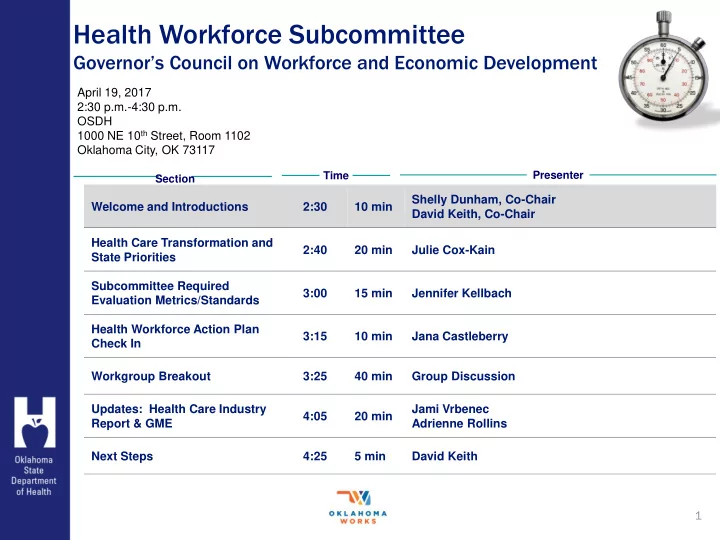
Health Workforce Subcommittee Governors Council on Workforce and Economic Development April 19, 2017 2:30 p.m.-4:30 p.m. OSDH 1000 NE 10 th Street, Room 1102 Oklahoma City, OK 73117 Presenter Time Section Shelly Dunham, Co-Chair Welcome


slide-1
SLIDE 1

1

Health Workforce Subcommittee

Governor’s Council on Workforce and Economic Development

Presenter Section

April 19, 2017 2:30 p.m.-4:30 p.m. OSDH 1000 NE 10th Street, Room 1102 Oklahoma City, OK 73117

Time

Welcome and Introductions 2:30 10 min Shelly Dunham, Co-Chair David Keith, Co-Chair Health Care Transformation and State Priorities 2:40 20 min Julie Cox-Kain Subcommittee Required Evaluation Metrics/Standards 3:00 15 min Jennifer Kellbach Health Workforce Action Plan Check In 3:15 10 min Jana Castleberry Workgroup Breakout 3:25 40 min Group Discussion Updates: Health Care Industry Report & GME 4:05 20 min Jami Vrbenec Adrienne Rollins Next Steps 4:25 5 min David Keith

slide-2
SLIDE 2

2

Meeting Objectives

  • Achieve agreement on evaluation process to ensure

data-informed and evidence-based recommendations

  • Identify priorities areas and update activities

necessary to accomplish objectives in Health Workforce Action Plan

slide-3
SLIDE 3

3

Health Workforce Subcommittee

Governor’s Council on Workforce and Economic Development

Presenter Section Time

Welcome and Introductions 2:30 10 min Shelly Dunham, Co-Chair David Keith, Co-Chair Health Care Transformation and State Priorities 2:40 20 min Julie Cox-Kain Subcommittee Required Evaluation Metrics/Standards 3:00 15 min Jennifer Kellbach Health Workforce Action Plan Check In 3:15 10 min Jana Castleberry Workgroup Breakout 3:25 40 min Group Discussion Updates: Health Care Industry Report & GME 4:05 20 min Jami Vrbenec Adrienne Rollins Next Steps 4:25 5 min David Keith

slide-4
SLIDE 4

HHS HS joint nt ini nitiativ tiatives es to improve e health lth in n Oklah ahom

  • ma:
  • OHIP 2020
  • State Innovation Model (OHIP Road Map)
  • Interagency Governance – DISCUSS/Operational

Committee and Quality and Evaluation Committee HB1386 also requires the HHS agencies to work together to submit new Innovation Waivers (1332 and DSRIP). The Oklah ahoma

  • ma Plan

an is the natural vehicle to help align, prioritize, and pursue these initiatives in a coherent fashion.

The e Ok Oklah ahom

  • ma Plan:

: He Health th and Hu Human an Servi vices ces (HH HHS) ) Agency ency Al Alignmen nment

4

slide-5
SLIDE 5

The Oklahom ahoma Plan Portf tfol

  • lio:

io: This portfolio is the collection of cross-agency programs, projects, and initiatives that will be managed collectively by the various HHS Agencies assigned to these projects. The initiatives contained within the portfolio represent the most significant

  • pportunities the state can pursue to achieve the goals of the Oklahoma Plan.

The e Ok Oklah ahom

  • ma Plan:

: The e Ok Oklah ahom

  • ma Plan Portf

tfoli

  • lio

The

e Oklahoma lahoma Plan Portf tfoli

  • lio

Invest est in Smar art Cover erage age

Pay for Perfor

  • rmanc

anc e

Prese serve & Expan and d Health alth Workfor

  • rce

Impr mprove Comm mmunity ity Health alth Empo mpower er Patien ients ts & Provi vider ers s

5

slide-6
SLIDE 6

He Healthcare care Innovation ation & Rede design gn

Workf kforce ce

  • Align State

Workforce Efforts

  • Robust & timely

healthcare workforce data

  • Pipeline

adequate to meet current and future healthcare demand

  • Delivery

Redesign

(Core Team)

He Health thcar are e Financin ancing

  • Insurance

Coverage

  • Uncompensated

Care

  • State-Purchased

Insurance

  • Pay for Success

(Core Team)

He Health th IT

  • Increased

adoption of HER

  • Increased

attainment of meaningful use

  • Interoperability

Ef Efficien iency cy & & Ef Effectiv ectivene eness ss

  • Use of Clinical

Preventive Services

(prioritized)

  • Care

Coordination/ Team Based Care

  • PCMH
  • Practice

Facilitation

  • NQF goals –

prioritized

  • Outcome Driven

Care Pay for Success Multi-Payer Initiatives Health Access Networks Value-Based Insurance Design Integration of Public Health & Healthcare Prioritization of Outcomes

slide-7
SLIDE 7

Oklahoma Health Improvement Plan

HE HEALTH TH TRAN ANSF SFORMA ORMATION TION CORE MEASU ASURES: RES:

Impr mprove e Populat ation

  • n Health

th – Reduce heart disease deaths by 11% by 2020 (2018 data). Imp mprove e Qualit ity y of Care re – Reduce by 20% the rate, per 100,000 Oklahomans, of potentially preventable hospitalizations from 1656 in 2013 to 1324.8 by 2020 (2019 data). Bend d the Healthcare hcare Cost st Curve – By 2020, limit annual state-purchased healthcare cost growth, through both the Medicaid Program and the State Employee Group Insurance Plan (EGID), to 2% less than the projected national health expenditures average annual percentage growth rate as set by CMS (estimated baseline for annual state-purchased healthcare cost growth = 5.11%).

7

slide-8
SLIDE 8

OKSta StateST eSTAT

Source: http://okstatestat.ok.gov/health

Health thy y Citize izens ns and Stro Strong Families ilies

Oklahoma will strive to provide infrastructure for social stability, access to health care services, preventative care services, and promote overall wellness in order to support healthy people and strong families.

Wellne lness ss

Maternal & Infant Health, Obesity, Rx Drug & Substance Abuse and Tobacco Use

Pre reven enti tion

  • n

Abuse & Injury, Chronic Disease, Food & Water Safety and Immunizations & Infectious Disease

Access ss

Behavioral Health and Health Services

Social cial Stabili bility ty

Aging Services and Child Welfare Services

8

slide-9
SLIDE 9

OKSta StateST eSTAT – Ac Access ss to Care re Go Goals ls

Health alth Care re Cost st Growth th - Limit state-purchased health care cost growth to 2% less than the projected national health expenditures average every year through 2019.

  • Today: OK .72% National 5.5%
  • Target: 2% Below National Average

Uninsured nsured Individ dividuals uals - Decrease the percentage of uninsured individuals from 17.7% in 2013 to 9.5% by 2019.

  • Today: 13.9%
  • Target: 9.5%

Health alth Prof

  • fess

ession ional al Shortage tage Areas as - Increase the percentage of health care access to citizens within designated Primary Care Health Professional Shortage Areas (HPSA) from 64% in 2014 to 74% by 2019.

  • Today: 60%
  • Target: 74%

Medicar dicare e Preventa entabl ble e Hospita pitaliz lizatio ations ns - Decrease the rate of preventable hospitalizations among Medicare beneficiaries from 76.9 per 1,000 in 2013 to 69.21 per 1,000 by 2019.

  • Today: 62.6 per 1,000
  • Target: 69.21 per 1,000

9

slide-10
SLIDE 10

In Inter-Agency ency Gov Gover ernance nance Str Structu ture re

Inter-Agency Governance Operational Committee Quality & Evaluation Committee DISCUSS

10

slide-11
SLIDE 11

Propo roposed sed Ok Oklaho lahoma ma Qu Quality lity Metri rics s - Phase se 1

DRAFT FT – Qualit ity Met etrics ics

  • 0018 - Controlling High Blood Pressure (CBP)
  • 0024 - Weight Assessment and Counseling for Nutrition and Physical Activity for

Children/Adolescents (WCC)

  • 0028 - Preventive Care & Screening: Tobacco Use: Screening & Cessation

Intervention

  • 0034 - Colorectal Cancer Screening (COL)
  • 0041 - Influenza Immunization
  • 0059 - Comprehensive Diabetes Care: Hemoglobin A1c (HbA1c) Poor Control (>9.0%)
  • 0418 - Preventive Care and Screening: Screening for Clinical Depression and Follow-

Up Plan

  • 0421 - Preventive Care and Screening: Body Mass Index (BMI) Screening and Follow-

Up

  • 2372 - Breast Cancer Screening
  • 1959 - HPV for Adolescents
  • SBIRT-like measurement TBD

11

slide-12
SLIDE 12

12

Health Workforce Subcommittee

Governor’s Council on Workforce and Economic Development

Presenter Section Time

Welcome and Introductions 2:30 10 min Shelly Dunham, Co-Chair David Keith, Co-Chair Health Care Transformation and State Priorities 2:40 20 min Julie Cox-Kain Subcommittee Required Evaluation Metrics/Standards 3:00 15 min Jennifer Kellbach Health Workforce Action Plan Check In 3:15 10 min Jana Castleberry Workgroup Breakout 3:25 40 min Updates: Health Care Industry Report & GME 4:05 20 min Jami Vrbenec Adrienne Rollins Next Steps 4:25 5 min David Keith

slide-13
SLIDE 13

Subcommittee Required Evaluation Metrics/Standards

slide-14
SLIDE 14

Governor’s Priority Areas

Wealth Justice Health

14

slide-15
SLIDE 15
slide-16
SLIDE 16

Strengt rength h of Ev Evidence dence

Scientifically Supported

Strategies with this rating are most likely to make a difference. These strategies have been tested in many robust studies with consistently positive results

Some Evidence

Strategies with this rating are likely to work, but further research is needed to confirm effects. These strategies have been tested more than once and results trend positive overall

Expert Opinion

Strategies with this rating are recommended by credible, impartial experts but have limited research documenting effects; further research, often with stronger designs, is needed to confirm effects

Insufficient Evidence

Strategies with this rating are recommended by credible, impartial experts but have limited research documenting effects; further research, often with stronger designs, is needed to confirm effects

Mixed Evidence

Strategies with this rating have been tested more than once and results are inconsistent or trend negative; further research is needed to confirm effects

Evidence of Ineffectiveness

Strategies with this rating are not good investments. These strategies have been tested in many robust studies with consistently negative and sometimes harmful results

Source: University of Wisconsin Population Health Institute. What Works for Health: Policies and Programs to Improve Wisconsin’s Health. http://whatworksforhealth.wisc.edu/rating-scales.php
slide-17
SLIDE 17

Level el of Recomm commen endat dation ion

High Recommendation Class I

There is evidence for and/or general agreement that the intervention is beneficial, useful, and effective. The intervention should be performed.

Moderate Recommendation Class IIa

Weight of evidence/opinion is in favor of usefulness/efficacy. It is reasonable to perform the intervention.

Low Recommendation Class IIb

Usefulness/efficacy is less well established by evidence/opinion. The intervention may be considered.

Not Recommended Class III

There is evidence and/or general agreement that the intervention is not useful/effective and in some cases may be harmful

Source: Mozaffarian, D., et al. (2012). Population Approaches to Improve Diet, Physical Activity, and Smoking Habits: A Scientific Statement From the American Heart Association. Circulation, 126. doi: 10.1161?CIR.0b013e318260a20b. 17

slide-18
SLIDE 18

Sou

  • urce

rces s of

  • f Evide

dence nce to be

  • be Co

Cons nside dered red

Scientif ific ic Evidence ce: findings from published research Or Organiz izatio ational nal Evidence ce: data, facts, and figures gathered from the organizations Experi riential ential Evidence ce: the professional experience and judgment of partners Stakeho eholder lder Evidence ence: The values and concerns of people who may be affected by the decision (implications)

Source: Center for Evidence Based Management. (2014). Evidence-Based Management: The Basic Principles. Retrieved from: https://www.cebma.org/wp-content/uploads/Evidence-Based-Practice-The-Basic-Principles-vs-Dec-2015.pdf.

slide-19
SLIDE 19

Research h to R

  • Recom
  • mme

mendations ndations

Identify Topic Area Research Key Findings Implications / Environment Recommendations

slide-20
SLIDE 20

Subcom

  • mmitt

mittee

  • Determine priority areas
  • Define problems
  • Lead group dialogue
  • Represent industry and region

SC Chairs

  • Facilitate between workgroups

and subcommittee

  • Make formal

recommendations for subcommittee

Work rkgr grou

  • ups

ps

  • Guide research and planning
  • Review group materials
  • Present group-specific

information to subcommittee

OSDH

  • Develop Workgroup materials
  • Gather and present research
  • Facilitate communication
  • Develop issue briefs

Roles es and Resp sponsibili

  • nsibiliti

ties es

20

slide-21
SLIDE 21

Health Workforce Subcommittee

Governor’s Council on Workforce and Economic Development

Presenter Section Time

Welcome and Introductions 2:30 10 min Shelly Dunham, Co-Chair David Keith, Co-Chair Health Care Transformation and State Priorities 2:40 20 min Julie Cox-Kain Subcommittee Required Evaluation Metrics/Standards 3:00 15 min Jennifer Kellbach Health Workforce Action Plan Check In 3:15 10 min Jana Castleberry Workgroup Breakout 3:25 40 min Updates: Health Care Industry Report & GME 4:05 20 min Jami Vrbenec Adrienne Rollins Next Steps 4:25 5 min David Keith

slide-22
SLIDE 22

Health Workforce Action Plan

Moving from Planning to Implementation

slide-23
SLIDE 23

Health th Work rkforce

  • rce Ac

Acti tion

  • n Plan

23

slide-24
SLIDE 24

He Health h Workf

  • rkfor
  • rce

ce Plan n Over vervie view: : Core re Are rea a St Strat rategie gies

  • Integrate health workforce into workforce and economic development efforts
  • Leverage efforts and scale successful demonstration projects

Coor

  • rdination

ination of Workfor

  • rce

e Effor

  • rts

ts

  • Ensure availability of comprehensive, high quality health workforce data
  • Establish centralized health workforce data center

Workfor

  • rce

e Data ta Collec llectio ion and Analy alysis sis

  • Achieve collaboration necessary to support team-based health care delivery
  • Ensure training and education matches the needs of a redesigned health care system
  • Support the utilization of telehealth

Workfor

  • rce

e Redesig design

  • Facilitate collaboration and achieve consensus on statewide strategies for education,

training, and development

  • Align and integrate strategies with economic development priorities

Pipeline, eline, Recruitmen itment t and Ret eten entio tion

24

slide-25
SLIDE 25

Governor’s Council for Workforce and Economic Development Health Workforce Subcommittee

Center for Health Innovation and Effectiveness

“Health Workforce Data Center”

Oklahoma Health Improvement Plan (OHIP) Workforce Workgroup

  • Workforce Investment and

Opportunities Act (WIOA) State Plan

  • Oklahoma Works
  • Develop comprehensive set of

research questions

  • Convene Workgroups
  • Submit recommendations to

Governor’s Council for Workforce and Economic Development

  • Facilitate collaborative research

and planning efforts

  • Establish data warehouse and

research clearinghouse

  • Broad range of health workforce

stakeholders

  • Convene ad hoc subcommittees as

needed

Coo

  • ord

rdinatio nation n of

  • f W

Workf

  • rkfor
  • rce

ce Effo forts ts

slide-26
SLIDE 26

Data Collection and Analysis

Publish long-range outlook based on new models of health care delivery

Identify geographic shortage areas Identify occupational/specialty shortage areas

Develop state-specific criteria to identify existing and predict emerging shortages

Revise assessment process to link broader range of data Redefine rational service areas based on health systems analysis Incorporate APRNs and PAs into state primary care assessment

Identify and prioritize a list of critical health occupations IN PROGRESS

Identify Critical Occupations Create supply and demand forecast for each occupation Identify supply and demand gaps

26

slide-27
SLIDE 27

Workforce Redesign

Assess, evaluate, and thoughtfully address requirements for physician and ancillary health providers to meet the demands of innovative care delivery models Convene interdisciplinary group to guide development of strategy to address regulatory and policy issues that affect health professions Assess barriers to health workforce flexibility and optimization Utilize findings from demonstration projects (e.g., H2O, Comprehensive Care Initiative, Health Access Networks) Develop policy and program recommendations that support health care transformation

Recommend strategies to establish career pathways for new health professions

Review and analyze findings from current research and statewide initiatives IN PROGRESS Define positions and competencies required for emerging health professionals, focusing first on community health workers and care coordinators IN PROGRESS Develop training, policy and reimbursement recommendations that support new and emerging health professionals PLANNED

27

slide-28
SLIDE 28

Workforce Redesign (2)

Increase statewide

  • pportunities

for training and professional development for health professionals

Develop statewide training and education plan for the health care transformation In Progress: Will be included in processes Health Care Industry Report Develop plan to utilize technology to increase statewide opportunities for training and professional development for health professionals on health transformation innovation, including practicing team-based, goal directed care, using EHR to advance population health, and incorporation of telemedicine. Create a plan to leverage existing initiatives to create learning networks, virtual communities of practice, and

  • ther evidence-based practices

Develop business plan to secure resources and sustain effort

Develop a plan to

  • ptimize

telehealth and telemedicine capabilities

Develop a statewide telehealth plan In Progress (ASTHO Technical Assistance) Develop statewide policy recommendations. In Progress (Policy analysis complete) Develop recommendations for public/private health education programs for tobacco cessation, diabetes, and

  • ther chronic disease management initiatives

Convene rural telehealth committee to examine and identify potential telehealth innovations to provide robust support to rural hospitals and health care providers 28

slide-29
SLIDE 29

Recruitment and Retention

Increase the number of physicians trained and retained in Oklahoma Sustain and leverage current state Graduate Medical Education (GME) resources In Progress Expand community-based residencies and rotations In Progress Maximize impact of pipeline, recruitment and retention efforts In Progress Address community factors (e.g., economic viability, community support and quality indicators) In Progress Develop and enhance pipeline, recruitment and retention programs for nurses, physician assistants, and

  • ther ancillary

health care providers Develop a state plan to address provider shortages and integrate inter- professional education, recruitment and retention strategies Increase number of community-based training sites for ancillary providers

29

slide-30
SLIDE 30

Recruitment and Retention (2)

Assess and improve the distribution and accessibility of health professional training and professional development programs Develop objectives to include conducting a needs assessment, identifying barriers to implementation, providing recommendations to overcome policy barriers, and securing a plan for developing resources for implementation Explore shared services for higher education that would increase the distribution and availability of health professions training and professional development programs Develop recommendations to be proposed to the Health Workforce Subcommittee for the Governor’s Council on Workforce and Economic Development

30

slide-31
SLIDE 31
  • GME Recommendations
  • THC Plan and Recommendations
  • Critical Occupations

Workgroup Progress

  • Review goals, strategies and action steps
  • Suggest revisions
  • Prioritize

Revise and Prioritize

Ne Next St Steps ps

31

slide-32
SLIDE 32

32

Health Workforce Subcommittee

Governor’s Council on Workforce and Economic Development

Presenter Section Time

Welcome and Introductions 2:30 10 min Shelly Dunham, Co-Chair David Keith, Co-Chair Health Care Transformation and State Priorities 2:40 20 min Julie Cox-Kain Subcommittee Required Evaluation Metrics/Standards 3:00 15 min Jennifer Kellbach Health Workforce Action Plan Check In 3:15 10 min Jana Castleberry Workgroup Breakout 3:25 40 min Updates: Health Care Industry Report & GME 4:05 20 min Jami Vrbenec Adrienne Rollins Next Steps 4:25 5 min David Keith

slide-33
SLIDE 33

33

  • Jami Vrbenec
  • Jennifer Kellbach

Critical Occupations

Room 1106

  • Spencer Kusi
  • Jana Castleberry

Teaching Health Center

&

Graduate Medical Education

Room 1102

Work rkgr group up Bre reak akout ut

slide-34
SLIDE 34

34

Health Workforce Subcommittee

Governor’s Council on Workforce and Economic Development

Presenter Section Time

Welcome and Introductions 2:30 10 min Shelly Dunham, Co-Chair David Keith, Co-Chair Health Care Transformation and State Priorities 2:40 20 min Julie Cox-Kain Subcommittee Required Evaluation Metrics/Standards 3:00 15 min Jennifer Kellbach Health Workforce Action Plan Check In 3:15 10 min Jana Castleberry Workgroup Breakout 3:25 40 min Updates: Health Care Industry Report & GME 4:05 20 min Jami Vrbenec Adrienne Rollins Next Steps 4:25 5 min David Keith

slide-35
SLIDE 35

Go Goals als for 1st

st Yea

ear: r:

1. Produce a statewide “critical health care occupations” report which includes a supply and demand forecast and identifies skills gaps 2. Develop recommendations for closing the supply and demand gap for health care occupations

Governor’s Council for Workforce and Economic Development

Health Workforce Subcommittee

slide-36
SLIDE 36

36

Identify Critical Occupations Project Supply and Demand Forecast Shortages / Surplus Strategies to Close Supply Gap

Repo port Purpose rpose

slide-37
SLIDE 37

He Health Care re Indu dustr try y Repo port: t: Upd pdat ates

Pas Past

  • Met with Stakeholder group on March 31st
  • Discussed the recommendation to revise the 2006 report

Cur urrent rent

  • Develop MOUs among agencies
  • Gathering data from Stakeholders, creating data inventory
  • Determining “Critical Occupations” list with guidance from Critical

Occupations workgroup

  • List will determine what

t occupa upati tions

  • ns will be include

luded d in the report Next xt Step eps

  • With updated Critical Occupations list:

– Project Supply and Demand – Forecast shortages/surplus – Develop strategies and recommendations to close supply/skills gaps

37

slide-38
SLIDE 38

38

Task 2017 2017 Mar. Apr. May May Jun. Jul. Aug. Sep. ep. Oct. Nov. v. Dec. Ongoing: Stakeholder Engagement Stak akehol eholder er Engag ageme ement nt

Phase e 1: Def efine ine

  • Finalize roles and responsibilities
  • Identify goals and objectives of revised report
  • Ident

ntify ify Critic ical al Occupat ations ions Phase e 2: Develop elop Report t Design gn

  • Project

ect Supply ly and Demand and

  • Foreca

ecast shortages ages / s surplus lus Phase e 3: Refin ine e Data a and Develop elop Surveys if neede ded

  • Analyze data
  • Strategi

egize e and issue recom

  • mmen

endat dation ions to to close e gaps Phase 4: Final alize ze Report

  • Refine report based on data elements

He Health Care re Indu dustr try y Repo port Plan n Timeline line

slide-39
SLIDE 39

39

Current urrent St Stak akeholder eholders

  • Oklahoma State Regents for Higher Education
  • Office of Workforce Development
  • Oklahoma Employment Security Commission
  • Oklahoma Department of Commerce
  • Oklahoma Department of Career and Technical Education
  • Oklahoma Department of Mental Health and Substance

Abuse Services

  • Oklahoma Hospital Association
  • Oklahoma Primary Care Association
  • Oklahoma Osteopathic Association
  • Mental Health Association Oklahoma
  • Oklahoma State Office of Rural Health
  • Oklahoma Association of Health Care Providers
  • Oklahoma Board of Nursing
  • Oklahoma State Medical Association
  • Licensure Boards
slide-40
SLIDE 40

40

Health Workforce Subcommittee

Governor’s Council on Workforce and Economic Development

Presenter Section Time

Welcome and Introductions 2:30 10 min Shelly Dunham, Co-Chair David Keith, Co-Chair Health Care Transformation and State Priorities 2:40 20 min Julie Cox-Kain Subcommittee Required Evaluation Metrics/Standards 3:00 15 min Jennifer Kellbach Health Workforce Action Plan Check In 3:15 10 min Jana Castleberry Workgroup Breakout 3:25 40 min Updates: Health Care Industry Report & GME 4:05 20 min Jami Vrbenec Adrienne Rollins Next Steps 4:25 5 min David Keith