Health & Wellbeing Board - Start time 4.00pm Voting Members: - - PowerPoint PPT Presentation

health wellbeing board start time 4 00pm
SMART_READER_LITE
LIVE PREVIEW

Health & Wellbeing Board - Start time 4.00pm Voting Members: - - PowerPoint PPT Presentation

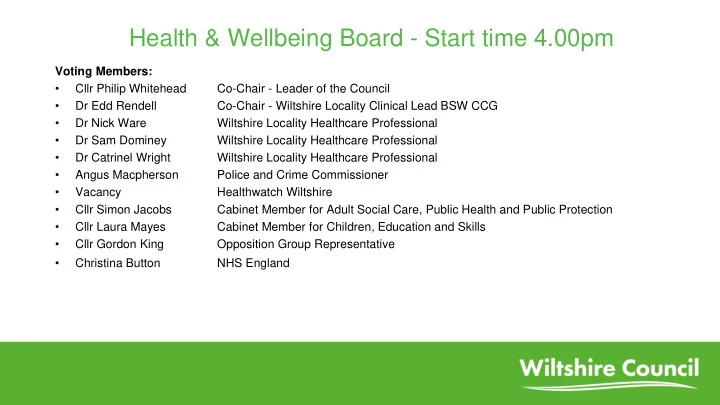
Health & Wellbeing Board - Start time 4.00pm Voting Members: Cllr Philip Whitehead Co-Chair - Leader of the Council Dr Edd Rendell Co-Chair - Wiltshire Locality Clinical Lead BSW CCG Dr Nick Ware Wiltshire Locality


slide-1
SLIDE 1

Health & Wellbeing Board - Start time 4.00pm

Voting Members:

  • Cllr Philip Whitehead

Co-Chair - Leader of the Council

  • Dr Edd Rendell

Co-Chair - Wiltshire Locality Clinical Lead BSW CCG

  • Dr Nick Ware

Wiltshire Locality Healthcare Professional

  • Dr Sam Dominey

Wiltshire Locality Healthcare Professional

  • Dr Catrinel Wright

Wiltshire Locality Healthcare Professional

  • Angus Macpherson

Police and Crime Commissioner

  • Vacancy

Healthwatch Wiltshire

  • Cllr Simon Jacobs

Cabinet Member for Adult Social Care, Public Health and Public Protection

  • Cllr Laura Mayes

Cabinet Member for Children, Education and Skills

  • Cllr Gordon King

Opposition Group Representative

  • Christina Button

NHS England

slide-2
SLIDE 2

Health & Wellbeing Board - Start time 4.00pm

Non-Voting Members:

  • Terence Herbert

Chief Executive, Wiltshire Council

  • Tracey Cox

Accountable Officer, BSW CCG

  • Elizabeth Disney

Wiltshire Locality Chief Operating Officer, BSW CCG

  • Kate Blackburn

Interim Director- Public Health

  • Lucy Townsend

Interim Corporate Director, People (DCS and DASS), Wiltshire Council

  • Cllr Ben Anderson

Portfolio Holder for Public Health and

  • Nicola Hazle

Avon & Wiltshire Mental Health Partnership NHS Trust

  • Dr Gareth Bryant

Wessex Local Medical Committee

  • Tony Fox

Non-Executive Director - South West Ambulance Service Trust

  • Kier Pritchard

Chief Constable, Wiltshire Police

  • Seth Why

Dorset & Wiltshire Fire and Rescue Service

  • Cara Charles-Barks

Chief Executive or Chairman Bath RUH

  • Stacey Hunter

Chief Executive or Chairman Salisbury Foundation Trust

  • Kevin McNamara

Chief Executive or Chairman Great Western Hospital

slide-3
SLIDE 3
  • 1. Chairman’s Welcome
slide-4
SLIDE 4
  • 2. Apologies for absence
slide-5
SLIDE 5
  • 3. Minutes of the Previous meeting
slide-6
SLIDE 6
  • 4. Declarations of Interests
slide-7
SLIDE 7
  • 5. Public Participation
slide-8
SLIDE 8
  • 6. Chair / Chief Executive Representation from Wiltshire

Health and Care

(Pages 11-12 of the agenda pack)

  • Board Membership – Wiltshire Health and Care representation
  • Adult Social Care Reform
slide-9
SLIDE 9
  • 7. Covid-19 Update and NHS Restart Plans

(Pages 13-26 of the agenda pack)

  • Presentation from Elizabeth Disney – NHS Bath and North East Comerset, Swindon

and Wiltshire (CCG) and Emma Legg – Director Access & Reablement, Wiltshire Council

slide-10
SLIDE 10

Health & Wellbeing Board Up-date

Elizabeth Disney & Lucy Townsend

slide-11
SLIDE 11

NHS Bath and North East Somerset, Swindon and Wiltshire CCG

Content:

  • 1. Strategic direction (delivery) and development of the Wiltshire Alliance
  • 2. Impact of COVID-19 on the health and care system: service changes and improvements

to retain

  • 3. An update on BSW response to NHS Phase 3 Planning (recovery and restart)
  • 4. Winter Planning up-date
  • 5. System challenges
slide-12
SLIDE 12

NHS Bath and North East Somerset, Swindon and Wiltshire CCG

Strategic Direction (delivery)

Wiltshire partners will continue to collaborate through the Alliance way of working to maintain and enhance benefits seen during Covid-19 response, and in promoting four areas for improvement to support our winter plans. 1. Promoting Home – Embedding discharge to assess approach to discharge so that support individuals return home after any admission. Fewer long term plans made in hospital. Referrals

  • n Pathway 1 from hospital have increased significantly from May 2020.
slide-13
SLIDE 13

2. Bed Capacity Planning:

  • Need to work to ensure bed closures for social distancing are appropriate (high in RUH currently)

and then mitigate with out of hospital capacity

  • Reduce length of stay in acute hospitals and ensure minimal number of long term planning takes

place on the ward.

  • Pathway 3 referrals increasing after C19 response period. Need to maximise use of D2A beds,

reduce length of stay and move to permanent placement

NHS Bath and North East Somerset, Swindon and Wiltshire CCG

Strategic Direction (delivery)

slide-14
SLIDE 14

3. 7 Day Working – system approach to all services available 7 days 4. Resilient Mental Health, LD & ASD services 5. Proactive primary care and use of population health data

NHS Bath and North East Somerset, Swindon and Wiltshire CCG

Strategic Direction (delivery)

slide-15
SLIDE 15

Wiltshire Alliance Working being maintained via weekly delivery calls across health and social care Discharge Service Process Changes In June and July a review was completed, we jointly agreed to retain the following elements of the joint discharge service:

  • Integrated Brokerage service
  • All discharge referrals managed via a single integrated Patient flow hub Flow Hub (WHC Managed)
  • Aligned rehabilitation/reablement staffing capacity from WHC and Wiltshire Council to reduce handovers and simplify

pathway via 3 localities across Wiltshire – North South and West We are now working to implement the changes and also to understand the impact of the new National Guidance issued at the end of August:

  • 6 weeks funding post discharge from NHS C19 funding remains in-place until 31 March 2021
  • Delayed Transfer of Care reporting remains suspended
  • Restart of Continuing Heath Care (CHC) processes

NHS Bath and North East Somerset, Swindon and Wiltshire CCG

Health & Care Changes as a result of COVID-19

slide-16
SLIDE 16

Impact from Infection control and social distancing measures Key impacts are detailed below, all health & care services are reviewing as part of restore and recovery planning

NHS Bath and North East Somerset, Swindon and Wiltshire CCG

Health & Care Changes as a result of COVID-19

Area Plans MIU Chippenham open and Trowbridge to open in Oct 2020 Appointments to be booked via NHS 111, promoting the plan to shift services to a ‘Talk before you walk’ model Primary Care routine work All requests for appointments are now triaged, GP surgeries continue with ‘Hot and Cold’ sites Care Home Support Council Care Home support team to remain in-place, Public Health Local Outbreak Plans and Virtual ward rounds being tested Bed reduction in hospitals (acute and community) Locality planning on capacity to support in care homes (additional 41 beds) and additional Home First / Reablement capacity to be maintained Mental Health services (all age) IAPT services fully resumed, will continue via telephone. 24/7 helplines will remain in-place until March 2021 plan to then move to a fully developed Crisis Model. Learning Disability Health checks for everyone with LD fell significantly now a focus to improve with primary care and limited national funding received (50% target) Increased social work capacity in the community In line with national guidance social care staff have been redeployed from the acute hospitals and now supporting a discharge to assess approach Expand short term live in care support to avoid placements being made Opportunity to provide overnight care for a limited period to support a discharge home therefore avoiding placement if not needed in the long term Use of virtual methods of communication with individuals, families and care providers Development of virtual wards to support care homes. Increasing options for practitioners to undertake assessments using digital technology

slide-17
SLIDE 17

NHS Bath and North East Somerset, Swindon and Wiltshire CCG

NHS Phase 3 Planning – up-date on BSW response

  • 1st submission of our narrative plan, supported by activity, performance, and finance templates

submitted on 1st September

  • Focus on recovery of elective activity in hospitals including cancer services, primary &

community care, mental health

  • System wide process involving all partners, this is continuing, it will be a system plan
  • At 1st stage submission demand and capacity planning not fully completed for winter and hot
  • ff the press for elective – modelling will be agreed for Wiltshire via the weekly alliance calls

and will include Covid-19 scenarios

  • Increase focus on health inequalities
  • More work for final plan will confirm and provide additional assurance in relation to Elective

Care and Winter Planning, deadline 21st September to NHSI/E

slide-18
SLIDE 18

NHS Bath and North East Somerset, Swindon and Wiltshire CCG

NHS Phase 3 Summary of Risk & Constraints

Risk Mitigation

Workforce - Our workforce plans identify additional staffing requirements to support the plan. Particular risks relate to recruitment to key roles e.g. Home First Expansion and NHS 111 First , primary care resilience and ability to recruit from overseas. 7 day working within social care currently dependent on goodwill of staff Redeployment of staff & shared recruitment initiatives between partners More flexible use of national monies for additional roles re-imbursement scheme would be beneficial Review of travel bans nationally Capacity Shortfalls – reduced bedded capacity in Acute & Community Services compared to 19/21 levels Demand - exceeds 19/20 historic levels due to latent built up demand Community non bedded alternatives including Discharge Support Beds and Home First Expansion Implementation of NHS 111 First and alternative pathways e.g. GP FIT testing Funding – additional funds will be required to mitigate against losses in capacity across Acute & Community care due to social isolation measures and to support Adopt and Adapt approaches to restoring elective care Review of BCF Fund expenditure and scope of Hospital Discharge Scheme (6 weeks funding post discharge NHS) Urgent publication of Financial Regime for Phase 3 – still pending Second wave of COVID or significant local community outbreaks and/or flu

  • utbreaks

Robust COVID LOMPs with Public Health and LA partners. Further scenario planning to be Included within demand and capacity planning Robust system plan for flu Building work and equipment provision – may be delayed and impact on capacity and start dates. Tight project management Fragility of key providers – key providers such as Hospices, Care Sector & some voluntary sector partners are financially challenged and may need to reduce historic service provision & support Work with service providers to assess risks and opportunities for system support Public do not engage with COVID-19 measures; Think NHS 111 First etc. Comprehensive communications campaign working with community partners Support with managing Choice requested

slide-19
SLIDE 19

NHS Bath and North East Somerset, Swindon and Wiltshire CCG

Winter Planning up-date

  • Overlaps with Phase 3 planning and the work already done in Wiltshire on out of hospital

demand and capacity planning

  • All age planning has been led by the BSW Urgent Care & Flow Board with all system partners.

(18 partner organisations represented including acute Trusts, Local Authority, Community partners, Mental Health LD & ASD)

  • Clear message that BSW will not receive any additional winter funding – providers under Covid-

19 are funded to winter levels and discharge service funding (6 weeks) will then support systems

  • Final Plan will be shared when completed
  • BSW have agreed priority plans – next slides details these and Wiltshire's primary and

community services response

slide-20
SLIDE 20

NHS Bath and North East Somerset, Swindon and Wiltshire CCG

Winter Planning up-date

202/21 BSW 10 Priorities Wiltshire Plans

  • 1. Out of Hospital Capacity plan to support system C19 bed reductions
  • Beds – care homes and adult community
  • Home - Home first re-ablement – therapy capacity out of hospital

Already agreed a plan with system partners – 105 beds, 60 Intensive Rehab, 40 D2A and 5 Delirium. 41 additional beds from previous re-C19 levels Maintain joint heath and social care team working. Plans to sustain increased domiciliary care provision and agree longer term plan. SFT plan on therapy.

  • 2. Think 111 Mobilisation

Mobilisation Group established and dedicated project support

  • 3. Discharge service (7 day support) – maintaining national standards

Sustain discharge service changes – 7 day Flow Hub and Single Brokerage

  • 4. Virtual frailty wards

Care Home support team in Council to continue, Care Home advisory Group in place, Starting virtual frailty ward pilots in Care Homes in Wiltshire, linked to plan to improve Re-ablement / Home First capacity which can then be used to provide this enhanced offer

  • 5. A&E Capital bids (+acute critical care capacity)

RUH & SFT have received capital funding to change A&E to allow for the management of social distancing and to reduce ambulance handover delays

  • 6. Mental Health, LD and ASD – crisis support and escalation (mental health

transport) Demand and capacity planning completed – plan for 30% increase in activity 24/7 Help Lines, Focus on LD Health Checks, in Wiltshire Capital Bid for funding for ‘Crisis Pads’ possibly 3 in Wiltshire, Suicide prevention with funding for Assertive sign-posting element by AWP and Person Safety Planning (3rd Sector), Dedicated support for personality disorder (new), Enhanced acute in-reach teams.

  • 7. BSW System Wide Escalation Response Plan (use of SHREWD)

Work to develop Wiltshire escalation response and link to BSW new escalation

  • approach. Community partners; WHC and social care have adopted SHREWD

8.Primary care resilience – maintaining C19 Hot Hubs Robust plan in-place for primary care, funding for 2020/21 agreed to give primary care certainty on which to plan

  • 9. Public Engagement and communication planning

Wiltshire specific communications on Flu plan and CCG, LA and Providers to agree joint plans

  • 10. Flu vaccination plan

Plan in-place to commence as soon as vaccine available.
slide-21
SLIDE 21
  • Transitioning from the beds used for COVID-19 response was required, changing need and to plan for

winter

  • Completed an out of hospital modelling exercise on demand and capacity in June and July
  • The new model has been agreed through alliance discussions with all partners and taking the learning from

COVID-19. Continue with some Discharge to Assess beds (40 beds), look to develop Intensive Rehabilitation beds (60 beds) in a fewer number of homes and keep some beds for delirium beds (5 beds)

  • Plan to have Intensive Rehabilitation beds in fewer homes as a result of care home infection risk e.g.

limiting professional in reach

  • This has required council decommissioning of extended contracts and working with the care homes who

were awarded the Intermediate Care contract in April 2020 to achieve the new model and CCG review of Clinical Cover arrangements

NHS Bath and North East Somerset, Swindon and Wiltshire CCG

Summary of Care Home Bed Plan

slide-22
SLIDE 22

NHS Bath and North East Somerset, Swindon and Wiltshire CCG

Location of Care Home Bed Plan (4)

  • 15 IR beds are currently out to

tender – to go live November 1st

  • 5 delirium beds are currently out to

tender –to go live November 1st

slide-23
SLIDE 23
  • Capacity within dom care and other community providers to deliver required capacity and/or recruit additional

workforce

  • Risk of increasing infection rates within care homes (care home and visiting staff testing) and for primary care
  • Significant culture change required to deliver discharge to assess model including restart of CHC and other

assessment processes

  • Changing funding models e.g. Hospital Discharge Programme (6 weeks)
  • Health capacity restrictions acute, primary care and community as a result of social distancing
  • Backlog of demand within all health and social care services
  • Flu vaccination plan for 2020/21, readiness for mass vaccination

NHS Bath and North East Somerset, Swindon and Wiltshire CCG

Continuing System Challenges

slide-24
SLIDE 24
  • 8. Impact of Covid-19 on Mental Health Demand
  • Update from the Kier Pritchard – Police, Tracey Cox – NHS and Claire Edgar –

Wiltshire Council

slide-25
SLIDE 25

Mental Health Update: Impact of COVID-19 on Mental Health Demand

Assessment report co-produced by Wiltshire Police, OPCC and BSW Clinical Commissioning Group September 2020

slide-26
SLIDE 26
  • Covid has had a significant impact on communities and services alike. It has led to new and

emerging pressures placing increasing demands on services.

  • This report illustrates the impact COVID has had on Mental Health demand as it relates to

Wiltshire Police.

  • The report outlines the wider impacts and demand across the system experienced during Covid.
  • It describes the activity in place across the Crisis Care Concordat, led by the CCG, to understand,

model and accurately predict future demand from Mental Health and how it will impact across different services.

  • This report has been co-produced by Wiltshire Police, BSW CCG and supported by the Wiltshire

Office of the Police and Crime Commissioner.

In Introductio ion

slide-27
SLIDE 27

28/09/20 27

@wiltshirepolice

WILTSHIRE POLICE

Proud to serve and protect our communities

Mental Health and Policing

slide-28
SLIDE 28

28/09/20 28

@wiltshirepolice

WILTSHIRE POLICE

Proud to serve and protect our communities

  • A review in 2019 revealed that approximately 6% of
  • verall Policing demand is Mental Health related.
  • During Apr-July 2020, all crime and incident demand

largely decreased (17% and 2% respectively) compared to 2019 levels. Mental Health crimes & incidents however saw a 3% increase compared to the same period in 2019. Some of this may be due to improvements in recording of MH incidents.

  • Swindon had highest volumes (931) followed by

Trowbridge (318) and Salisbury (308).

Demand during Covid: Mental Hea ealth Cri rime & In Incidents

slide-29
SLIDE 29

28/09/20 29

@wiltshirepolice

WILTSHIRE POLICE

Proud to serve and protect our communities

  • S.136 arrests increased by 22% (144) during March - July compared to 2019 (118).
  • There were more people presenting with psychosis during lockdown than normally expected suggesting

an increased level of acuity in mental ill health. Typically, each month 75% of all S136 detentions involve those displaying suicidal ideation, the remainder showing signs of psychosis.

Demand during Covid: S.1 .136

  • In

April this changed to 45% displaying suicidal ideation, the remainder showing signs of psychosis. An increased number

  • f

those presenting had not been known to services previously.

  • In May, 58% displayed suicidal

ideation and by June the proportion had returned to a more typical level

  • f 76%.
slide-30
SLIDE 30

28/09/20 30

@wiltshirepolice

WILTSHIRE POLICE

Proud to serve and protect our communities

  • There

have been 41 suspected suicides in Wiltshire & Swindon from January to July 2020.

  • 32 occurred since start of lockdown.
  • Significant increase in Wiltshire whereas numbers

in Swindon remain stable other than brief spike in April.

  • Currently a lack of evidence to suggest direct link

to COVID although in several cases a decline in subject’s mental health since lockdown was reported.

Demand during Covid: Suspected Suicides

slide-31
SLIDE 31

28/09/20 31

@wiltshirepolice

WILTSHIRE POLICE

Proud to serve and protect our communities

NHS Bath and North East Somerset, Swindon and Wiltshire CCG

Wil iltshire Poli lice Pla lace of f Safety

  • Wiltshire Police has access to an excellent Place of Safety (Bluebell PoS) at Green Lane Hospital

with sufficient capacity for Swindon & Wiltshire residents. However, capacity is under constant strain due to pressures from other areas, notably BNSSG

  • Since the start of 2020, each month between 33% and 50% of all detainees to Bluebell have come

from outside Swindon & Wiltshire. This remained the same during COVID

  • At the start of COVID, an addendum to operating procedure was introduced to divert BANES

detainees to Bluebell. This has not had a significant impact on capacity with on average only 10%

  • f detainees in Bluebell coming from this locality
  • The COVID addendum also stipulated that Bluebell would not take the overflow from BNSSG but

this was quickly eroded due to pressures within BNSSG and consequently capacity at Bluebell has remained strained

  • There was further pressure recently on Bluebell capacity after S140 MHA was invoked and

Bluebell was closed for nearly 2 weeks

  • This left officers and detainees waiting in Emergency Departments or at other locations for a total
  • f 38.5 hours during this period
slide-32
SLIDE 32

28/09/20 32

@wiltshirepolice

WILTSHIRE POLICE

Proud to serve and protect our communities

  • Between April and July, Wiltshire Police experienced a consistent demand from mental health

incidents, but a change in the type of presentation. S.136 arrests increased and there was an increase in suspected suicides.

  • Level of acuity was different suggesting a potential Covid related cause
  • There continues to be significant pressure on the POS leading to increased demand on Police

and others and a poor service experience for some local residents.

  • The crime profile is changing with new and complex risks that may impact people’s long term

mental wellbeing.

  • It is inferred that similar increases and pressures would be experienced in the event of a further

local or national lockdown and/or continued impacts on access to services.

  • Horizon scanning suggests many sources are describing a significant impact in Mental Health

issues some of which will impact Policing demand.

So What Mig ight th this Mean?

slide-33
SLIDE 33

NHS Bath and North East Somerset, Swindon and Wiltshire CCG

Mental Health Services

slide-34
SLIDE 34

NHS Bath and North East Somerset, Swindon and Wiltshire CCG

Current posit ition

  • Growth in all age activity across end to end pathway including third sector , primary

care and secondary MH providers. Referral levels reverting back to pre-covid levels.

  • Increase in acute crisis presentations for complex LD/ASD combined with rapid loss of

national capacity

  • Particular increase in late eating disorder presentations across BSW . At Cotswold

House Adult Eating Disorder Inpatient Unit, all 6 NHSE beds currently taken up by Wiltshire patients which is unprecedented.

  • Mental health liaison activity increased by 60% for children and young people. Hot

spots are GWH and RUH. GWH 125% increase on last year

  • Increase in acuity seen across all services, particularly inpatients, intensive teams and

section 136/135 pathway, with sustained out of area placements particularly for

  • PICU. Increase in those presenting with psychosis. This has been seen amongst those

in crisis in the community and those in police custody

  • Increase in suspected suicides
slide-35
SLIDE 35

What could be the new demand? – national pic icture over next xt 5 years

National NHS Horizon Scanning:

  • Lower estimates of children affected indicate between 7,000 and 15,000 will be affected by

anxiety and depression respectively, worst case upper estimate rising to 40,000 and 140,000.

  • Up to 4,000 frontline healthcare staff affected
  • Between 23,000 and 74,000 additional working aged people suffering with anxiety and or
  • depression. Between 6,000 and 19,500 older people affected.
  • Relapse in psychosis for 769 people in the first six months and 1,537 in the second six

months

  • Estimated increase of 1,400 domestic abuse cases
slide-36
SLIDE 36

Mental Health – fu future demand

  • Each month 16,000 patients receive Mental Health support across BSW
  • Activity levels dipped during initial lockdown but recovered when restrictions started to ease (May)
  • Unlike the COVID19 infection rate curve there is no national predefined “mental health need curve”
  • Up to 30% increase in mental health demand over next 5 years previously suggested by NHS
  • England. Acknowledged by Claire Murdoch, National NHS Lead for Mental Health that this figure

may be too high and needs to be reviewed. Locally, have seen an increase in acuity of presentation but no significant change in demand

  • Predicting how this demand is realised is difficult due to complex and multifactorial nature of mental

health need

  • Our approach has identified sub-groups of need. Any increase in demand likely to vary between
  • groups. Analysis ongoing to determine what expected demand will look like – time table in place to

undertake this demand and capacity work by service line

slide-37
SLIDE 37

Review of f im impact on Services

Service Delivery Date IAPT Proposed Delivery Date CAMHS Inpatient by Bed Type (AWP only) End Sept Community Mental Health Liaison End Sept Section 136 / POS End Sept Perinatal Services End Sept Community Eating Disorders End Sept ADHD End Sept Autism End Sept LD End Sept Memory Services End Sept Care Home Liaison Mid October Third sector End October

  • A timetable of planned

review work to understand the future impact of covid

  • n each service is in place.
  • The impact on different

services is expected to be varied.

  • Key reviews that will provide

insight on potential policing demand are highlighted in Blue

slide-38
SLIDE 38

Mental Health – Im Impact of f Covid on subgroups of f need

slide-39
SLIDE 39

What is is the system doing proactively together ?

  • Weekly BSW MH system calls continue to monitor temperature and agree rapid proactive actions
  • Dedicated section 136, suicide prevention and BSW MH recovery and restoration meetings in place
  • Multi-agency deep dive review into ten BSW section 136 detentions to capture thematic learning for

earlier intervention – led by person with lived experience and Wiltshire police

  • Weekly system wide AWP inpatient review meetings to monitor flow and co-create solutions including

third sector community provision – wellbeing houses

  • Mental health campaigns – already run on social media and local press encouraging people to seek help
  • early. Radio campaign next week
  • Targeted engagement comms in south Wiltshire including primary care as part of suicide prevention co-

developed actions

  • Proactive planning around reduction in PICU beds due to urgent safety work
  • Continued universal and targeted work with schools and educational psychologists to prepare for

demand surge with restart of schools – CaMHS link workers for secondary schools and mental health support teams in place. Oxford Health have developed a number of self-help videos for CYPF and professionals https://www.oxfordhealth.nhs.uk/camhs/carers/self-help/

slide-40
SLIDE 40

What is is the system doing proactively together ? Part rt 2

  • Locality complex case reviews being undertaken to capture learning – themes collated & shared across BSW
  • Service line level demand and capacity planning across the whole MH pathway to map the predicted 30%

surge over next one to five years – IAPT drafted, Emergency Department presentations next to be completed

  • New BSW personality service coming on line October 2020
  • Restart of single point of access for adult MH out of hours via 111 July 2020 – plans to expand to CYP 2020/21
  • Exploring potential changes to ‘front door’ of MH and improved access
  • Improved advice and guidance for primary care
  • Winter Planning co-created by all system partners – being reviewed at weekly BSW multi-agency system
  • meetings. Development of all age MH OPEL status early warning system by end of October straddling third

sector, community and secondary care MH services along with agreed proactive actions

  • Agreed continuation of BSW wellbeing/ crisis houses to support step up and step down flow
  • Agreed continuation of emotional wellbeing and 24/7 helplines during winter – task and finish group in place

to monitor activity and capture thematic learning

  • Review of additional community wrap around support for LD/ASD to reduce preventable crisis (CYP and adults)

– mitigating national shortage of beds and ongoing reduction in capacity

slide-41
SLIDE 41
  • 9. Gypsy and Traveller Strategy

(Pages 27-102 of the agenda pack)

  • Report from Dr Michael Allum
  • The Board is asked to acknowledge the Health Needs Assessment; and
  • Approve the Gypsy, Roma Traveller & Boater Strategy for implementation
slide-42
SLIDE 42

10 SEND Inclusion Strategy

(Pages 103-152 of the agenda pack)

  • Report and presentation from Alison Enever – Head of Special School Transformation,

Wiltshire Council

slide-43
SLIDE 43

Wiltshire SEND Inclusion Strategy 2020 - 2023

ALISON ENEVER, HEAD OF SPECIAL SCHOOL TRANSFORMATION CATE MULLEN, HEAD OF SEND AND INCLUSION

slide-44
SLIDE 44

A partnership Strategy

 Led by parent carers through

consultation in October and November 2019

 Built on a review by external consultants  Prioritising Inclusion based on

conversations with children and young people with SEND

 Drawing together all our professional and

community activity

slide-45
SLIDE 45

The Vision

Key Principles

Underpinning this, stakeholders set out some key principles that must run through the implementation of the strategy that all children and young people should:

Be safe and feel safe when trying new things

Be able to learn from each other and grow together with all children and young people

Be able to have choice wherever possible

Have access to information and communication for themselves and the people around them that helps them along

Experience joined up help and support because this strategy is being coproduced

Have additional needs identified early so support can start ASAP

Be educated as close to home as possible

“All children and young people with SEND and their families will have a voice that is heard. They will know how to access, and be able to access the joined-up support they need to thrive in their communities, to enjoy life and reach their full potential”

slide-46
SLIDE 46

Underpinning commitments

 The vision and principles for this strategy is built on the commitments that have been

developed by stakeholders and partners over the last few years, including Wiltshire’s Health and Wellbeing Partnership (2019 -2022)

 “People in Wiltshire live in thriving communities that empower and enable them to live longer,

fulfilling healthier lives”

 And the vision set out in Wiltshire’s Transformation plan for children and young people’s

mental health and wellbeing (2015 - 2020)

 ‘All children and young people have the opportunity to thrive and enjoy good mental health

now and throughout their lifetimes, they are resilient and equipped to manage the ups and downs which life throws at them. Those with emotional wellbeing and mental health needs can seek the right support, recover and participate in welcoming, inclusive and supportive communities”.

slide-47
SLIDE 47

National Issues

 The Implementation of the 2014 Children and Families Act  The Funding pressures and lack of resources  Partnership working  The rise in tribunals and adversarial solutions  The rising number of children and young people with SEND

choosing to Home educate, because they feel the system is insufficient

 The rising number of Education, Health and Care Plans (EHCP)

and reduction in SEN Support plans

slide-48
SLIDE 48

Wiltshire Picture

The Challenges

Overstretched provision

Manging significant and growing financial pressures

Greater integration and real cultural change

Reducing the focus on diagnosis and increasing the focus on early help

Supporting Schools to make inclusion a whole school programme

Continued rapid growth in EHCPs without the funding

The Successes

A strong parent carer representation body (WPCC)

Improving picture in educational attainment and progress for many, but not all children and young people with SEND

A positive SEND Local Area inspection in 2018 (and Good Children’s Services Ofsted 2019)

The FACT programme is continuing to set a transformational partnership agenda

New funds for both SEND and particularly mental health

slide-49
SLIDE 49
slide-50
SLIDE 50

Priorities developed through the consultation

 Developing holistic plans with children/young people  Inclusion and removing exclusion in education  Inclusion and wellbeing in the community  Improving the range and quality of provision  Achievement and progress  Well planned transitions

slide-51
SLIDE 51

How we will do this and how will we know it is working?

Working with children and young people with SEND so that they can tell us how we are doing

Setting up a SEND and Inclusion board involving representatives of all the people and organisations who got involved in the consultation and can help us make this strategy happen

Using the joint agency Families and Children Transformation Programme (FACT) and the Health and Wellbeing Board to support change and make things happen through all the relevant organisations

Working closely with schools/colleges/nurseries on a regional basis to improve inclusion

Setting up a monitoring process which lets us know if we are achieving our vision linked to each of the priority areas (a SEND Dashboard)

Creating a budget recovery plan that links to the strategic priorities and supports improvements in quality

Reporting to everyone about the money to ensure that we can afford these plans

Developing Quality Assurance e.g. through self-evaluation and peer evaluation for services

slide-52
SLIDE 52

10 SEND Inclusion Strategy

(Pages 103-152 of the agenda pack)

  • The Board is asked to approve the SEND Inclusion Strategy 2020-2023
slide-53
SLIDE 53
  • 11. Update from Healthwatch Wiltshire

(Pages 153-168 of the agenda pack)

  • Report and presentation from Julie Brown – Acting Manager of Healthwatch Wiltshire
slide-54
SLIDE 54

Healthwatch Wiltshire Update

Annual Report in Brief, Volunteer Led Military Families Project, Response to COVID- 19 and Priorities, Young Healthwatch Project

slide-55
SLIDE 55

Our Annual Report in brief – Our activities

55

40 volunteers supported us giving 1,750 hours of their time Listened to 3,792 comments from people about health and care services There were 281,652 engagements with us on social media. Published 8 reports Attended 142 events

slide-56
SLIDE 56

Some of our Key Projects

Evaluating GP Improved Access Dementia Community Services Dementia Community Servi Community Cash Funds

56

Volunteer Led Military

Families Project

slide-57
SLIDE 57

Our Volunteer Led Military Families Project

57

Chas – Background in education, with experience in business and voluntary sectors Deborah –previously worked for the army in Germany as a civilian nurse and married a soldier who retired in 2012 Hazel – Trained as a nurse with the army. Service in Germany looking after families of servicemen. Continued nursing in the UK as a boarding school senior nurse Meg – Retired headteacher with an interest in children with special needs. Also working with Carer Support on a group for bereaved carers and is a member of her PPG Our Volunteer Team Led the project and took part in all aspects of the planning, question development, approach, engagement, reporting and presentation of the project.

slide-58
SLIDE 58

Key Findings

  • GP registration was an easy and straightforward

process

  • Significant issues with communication and transfer of

records

  • Process of transferring on to a waiting list when

moving from another area seemed inconsistent.

  • Lack of continuity in transitioning between specialist

services

  • Dentists – nearly 40% could not find an NHS dentist
  • Mental Health support is not always accessible or

consistent for adults or children and young people

  • A need for greater understanding of military life

amongst health and care services and that this affected their experience of using these services.

58

slide-59
SLIDE 59

Recent Work during the COVID-19 Pandemic

59

➢ Greater focus providing advice to the public and supporting the local response to COVID-19. ➢ Created a dedicated coronavirus advice and information pages on our website that was regularly updated. This included:

General government and Public Health England information. A community support page Information of how to stay in touch with people in hospital Page for mental health support and for children and young people’s mental health

During this time, we saw an increase in visits to our website and interaction with social media posts. ➢ We also continued to gather the views of local people and regularly shared these through our reports. We heard from 375 people who gave us 466 comments about health, care and community services. ➢ We regularly shared these views and through our reports during this time with key commissioners and providers of health and care services.

slide-60
SLIDE 60

60

Some of the things people told us:

Want to express my thanks to all involved with me being able to continue to receive my cancer

  • treatment. I will be eternally grateful

A huge thank you to all the staff at the surgery during such a difficult time. I have had 4 telephone consultations during the Covid-19 outbreak and cannot fault the service. The receptionists making the appointments were efficient and kind and the appointments offered quickly and in amazing time! Treatment booked was cancelled due to covid19. No communication about reinstatement of

  • treatment. Still waiting for the treatment.

Due to closures of almost everything, my autistic daughter's mental health has plummeted. I am being contacted every two weeks by phone by the diabetic specialist nurse. They are excellent and I feel that they would be there for me if I needed help. My mum went into care just as Lockdown happened, therefore we were not able to help settle her in. Although normal activities and visits were stopped the Care Home was great at informing us of what was happening and keeping mum active and well. Feeling very lonely and isolated and found people don't really want you to say anything other than "I'm OK", even when you are not. It was excellent. A really efficient and helpful service. It is good to see younger people involved with volunteering and befriending isolated people. I hope that this continues after the pandemic is over.

slide-61
SLIDE 61

Our priorities and workplan

61

Our revised workplan taking into account locals people’s views and changes to how services run due to COVID-19

  • Primary Care - A project looking at people’s experiences of

different types of GP Services including virtual, phone, face to face.

  • Autism - Hearing views of people living with Autism around

Service Provision and Community Support

  • Mental Health and wellbeing - engaging people regarding

mental health and wellbeing including working in partnership with other organisations to develop an online forum.

  • Young People - A Mystery Shopping Project that evaluating

mental health websites for young people. Linking with commissioners and partners to develop these projects to ensure that their useful and can support service development.

slide-62
SLIDE 62

Young Healthwatch Mystery Shopping Project

We have set up Young Healthwatch, a group of young volunteers, who want to make a difference to their community and have an interest in the wellbeing of young people in Wiltshire. Their first project involves reviewing selected mental health websites from a young person’s point of view. Our young volunteers are involved with designing the approach, question development, engagement activity, collation of results and final reporting.

62

Our Young Healthwatch Volunteers talk about their work on this project.

slide-63
SLIDE 63
  • 12. Urgent Items
slide-64
SLIDE 64

Meeting concluded

Thank you for joining the meeting- if you have any feedback about the quality of the broadcast, please contact committee@wiltshire.gov.uk.

slide-65
SLIDE 65

Please note that the meeting has paused and will resume shortly.