10/12/2018 Undocumented Migrants and Mental Health in the Context of - - PDF document

10 12 2018
SMART_READER_LITE
LIVE PREVIEW

10/12/2018 Undocumented Migrants and Mental Health in the Context of - - PDF document

10/12/2018 Undocumented Migrants and Mental Health in the Context of the S.P.R.A.R. (Protection Service for Refugees and Asylum seekers) of Bologna (Italy) Vincenzo Spigonardo, MD Coordinator Ethnopsychiatry and Cultural Consultation Service


slide-1
SLIDE 1

10/12/2018 1

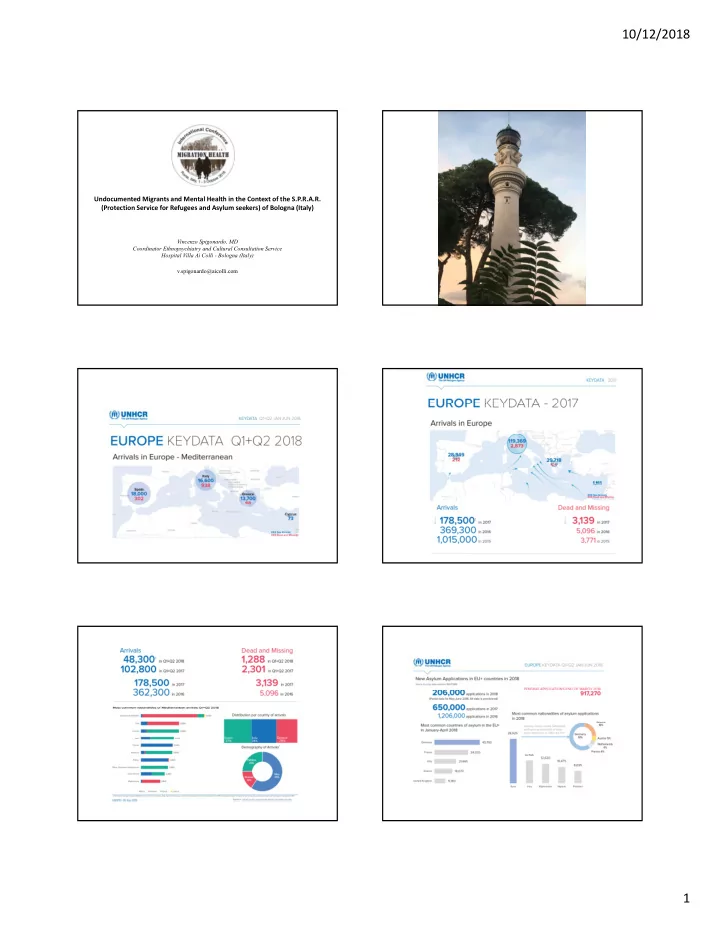
Undocumented Migrants and Mental Health in the Context of the S.P.R.A.R. (Protection Service for Refugees and Asylum seekers) of Bologna (Italy)

Vincenzo Spigonardo, MD Coordinator Ethnopsychiatry and Cultural Consultation Service Hospital Villa Ai Colli - Bologna (Italy) v.spigonardo@aicolli.com

slide-2
SLIDE 2

10/12/2018 2

Italy Sea Arrivals

Relocation by Ministry of Internal Affairs

70% Relocated in Italy

S.P.R.A.R.

(Protection Service Refugees and Asylum seekers) run by

the local Municipalities 27.731 Migrants

C.A.S.

(Center for Extraordinary Reception)

run by the Ministry of Internal Affairs 132.286 Migrants

30% Relocated in Europe Second line of intervention First line of intervention Hotspots

Source: Ministry of Internal Affairs, 31 July 2018

slide-3
SLIDE 3

10/12/2018 3

Source: Ministry of Internal Affairs , 31 July 2018

Distribution of Migrants housed at regional level (percentage ‐ %)

Migrants hosted in Bologna 31 July 2018

Adult

  • Hub (Hotspot):
  • 400 people
  • 50 days stay/average
  • 25.555 people arrived from

2014

  • CAS: 1.159 people
  • SPRAR:
  • 865 people
  • 70% Male

Unaccompained Minors

  • Hub: 80 people
  • stay/average 37 days
  • 80 Male vs 0 female
  • SPRAR:
  • 208 people
  • mostly male ‐ 2% female
  • Stay/average 3 months
  • No CAS available for

Unaccompained Minors

Source: Ministry of Internal Affairs, 30 June 2018

Prefecture (Department of Internal Affairs)

Local Health Unit +

Municipality

  • f Bologna

S.E.C.C. + Hospital Villa Colli

Private Social Services

Ethnopsychiatry and Cultural Consultation Service (S.E.C.C.) Liason Activities

slide-4
SLIDE 4

10/12/2018 4

Ethnopsychiatric & Cultural Consultation Service Ethnopsychiatric & Cultural Consultation Service Cultural Consultation: Psychopathological Assessment Cultural Consultation: Psychopathological Assessment

No Referral and Follow-Up (3 clinical interviews) No Referral and Follow-Up (3 clinical interviews) Referral To GP and Follow- Up (3 clinical interviews) Referral To GP and Follow- Up (3 clinical interviews)

Referral To Department of Mental Health Referral To Department of Mental Health Admission to the Hospital Villa Colli Admission to the Hospital Villa Colli

Ethnopsychiatry: Admission to the Hospital and clinical evaluation (30-40 days) Ethnopsychiatry: Admission to the Hospital and clinical evaluation (30-40 days)

Discharge and Referral To GP Discharge and Referral To GP Discharge and Referral To Department of Mental Health Discharge and Referral To Department of Mental Health From January 2015 to July 2018: 97 patients (95 Adults + 2 AC) 81 Male + 16 Female

2 4 6 8 10 12 14

S.E.C.C. Patients-Nationality

10 20 30 40 50 60 70 No documents Immigrant Resident Asylum Seeker Refugee

Legal Status

No documents Immigrant Resident Asylum Seeker Refugee 10 20 30 40 50 60 70 80 90 100 Farmacological Clinical Interview Liason Support Legal documentation 86.21 93.1 75.86 3.45

Types of Clinical Resources Used

Reasons for Consultation

10 20 30 40 50 60 70 80 90 100

5 10 15 20 25 30 35 40 45 50 Psychosis Schizophrenia Personality Disorders PTSD Drug Addiction (*comorbility)

Diagnosis

Male Female
slide-5
SLIDE 5

10/12/2018 5

5 10 15 20 25 30 35 40

Institutional Sources of Cultural Evaluation Request

Social Services

  • Min. Internal Affairs

Emergency-General Hospital Department of Mental Health

Use of Cultural Broker

Cultural Broker vehicular language

Use of Cultural Broker Critical Issues

  • Usually they provide linguistic support rather

than cultural insight

  • They tend to have a low educational

background and an history of traumatic migration

  • They can be seen as threat by the patient

(stigma/ethnicity)

  • Costs

Working with Culture: Clinical Implications

Ethnopsychiatry

  • Have in charge the patient
  • The patient is the expert
  • Use the “objects” of the

patient

  • Cultural levers &

Countertransference

  • Trauma, Brief Psychotic

Episode, Depression, and somatization

  • Risk of ghettoization

Cultural Consultation

  • Consultation
  • We are the “experts” as

liaison service & legal impact

  • Define Cultural and Social

frame of the patient

  • Barriers to care and equality
  • Misdiagnosis, use of cultural

brokers, transfer knowledge

V.Spigonardo, MD

THANK YOU

Vincenzo Spigonardo, MD Coordinator Ethnopsychiatry and Cultural Consultation Service Hospital Villa Ai Colli - Bologna (Italy) S.P.R.A.R. – Municipality of Bologna v.spigonardo@aicolli.com