Health and Disability Risks with Lifetime History of TBI John D. - - PDF document

health and disability risks with lifetime history of tbi
SMART_READER_LITE
LIVE PREVIEW

Health and Disability Risks with Lifetime History of TBI John D. - - PDF document

John D. Corrigan, PhD Ohio State University Health and Disability Risks with Lifetime History of TBI John D. Corrigan, PhD Professor Department of Physical Medicine and Rehabilitation Director Ohio Brain Injury Program CDC estimates At


slide-1
SLIDE 1

John D. Corrigan, PhD Ohio State University 1

Health and Disability Risks with Lifetime History of TBI

John D. Corrigan, PhD

Professor Department of Physical Medicine and Rehabilitation Director Ohio Brain Injury Program

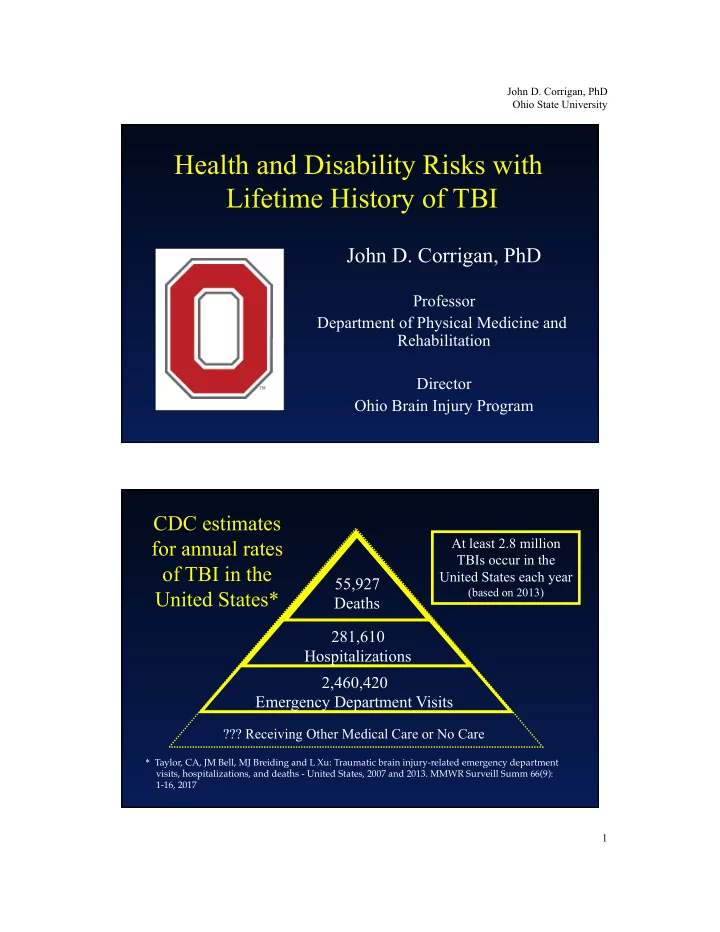
CDC estimates for annual rates

  • f TBI in the

United States*

55,927 Deaths 281,610 Hospitalizations 2,460,420 Emergency Department Visits

??? Receiving Other Medical Care or No Care At least 2.8 million TBIs occur in the United States each year

(based on 2013)

* Taylor, CA, JM Bell, MJ Breiding and L Xu: Traumatic brain injury-related emergency department visits, hospitalizations, and deaths - United States, 2007 and 2013. MMWR Surveill Summ 66(9): 1-16, 2017

slide-2
SLIDE 2

John D. Corrigan, PhD Ohio State University 2

Lifetime History of TBI:

Any TBI TBI with LOC Mod/ Severe TBI OEF/OIF veterans (Fortier, et al.) [including combat related] 32% [67%] 22% [38%] 4% Prisoners (*Shrioma et al; ** Bogner & Corrigan) 60%* 50%* 14%** SUD treatment (Corrigan & Bogner) 65% 53% 17% Psychiatric inpatients (Burg et al.) 68% 36% 20% Homeless (*Hwang et al.; **Bremner et al.,

Solliday-McRoy et al. )

53%* 47%** 12%*

What About Prevalence of TBI in the General Population?

  • Disability due to TBI
  • Lifetime TBI as “exposure”

– Prevalence? – Consequences?

slide-3
SLIDE 3

John D. Corrigan, PhD Ohio State University 3

Prevalence of Disability Due to TBI

55,927 Deaths 275,000 Hospitalizations 2,460,420 Emergency Department Visits

??? Receiving Other Medical Care or No Care

CDC estimates for annual rates of TBI in the United States*

At least 2.8 million TBIs occur in the United States each year (based on 2013)

* Taylor, CA, JM Bell, MJ Breiding and L Xu: Traumatic brain injury-related emergency department visits, hospitalizations, and deaths - United States, 2007 and 2013. MMWR Surveill Summ 66(9): 1-16, 2017

281,610 Hospitalizations

Colorado and South Carolina Follow-up Studies

slide-4
SLIDE 4

John D. Corrigan, PhD Ohio State University 4

Prevalence of Disability Due to TBI

  • Projected from 1 year outcomes following

hospitalization

  • Datasets did not include children
  • Made assumptions about persistence of

disability and mortality ü In 1996, based on Colorado data: 2.0% ü In 2005, based on South Carolina data: 1.1%

Survey Data & Disability Due to TBI

  • Whiteneck et al.: if disability is not limited to

TBIs requiring hospitalization, rate could be 3 x larger.

  • Jourdan et al. from the French National

Disability and Health Survey:

slide-5
SLIDE 5

John D. Corrigan, PhD Ohio State University 5

Survey Data & Disability Due to TBI

  • Whiteneck et al.: if disability is not limited to

TBIs requiring hospitalization, rate could be 3 x larger.

  • Jourdan et al. from the French National

Disability and Health Survey: 0.7%

Summary: Prevalence of Disability Due to TBI

  • Estimates have ranged from 0.7%–2.0%
  • US studies likely underestimates due to:

– Starting with disability 1 year after hospitalization – Having to make assumptions about permanence and mortality – Not including TBIs occurring in childhood

  • What if the effect of the TBI is not apparent

immediately but in time results in disability?

slide-6
SLIDE 6

John D. Corrigan, PhD Ohio State University 6

Prevalence of “Exposure” to TBI

“Exposure” to TBI

The study of toxic exposures considers the nature of the relationship between exposure and effect. If TBI was a chemical we would ask:

  • what is the relationship between the dose of the exposure and

the effect on the person?

  • does a single exposure of any dose cause the effect?
  • can there be cumulative effects of repeated exposures?
  • how does development interact with both exposure and the

manifestation of the effect?

slide-7
SLIDE 7

John D. Corrigan, PhD Ohio State University 7

Traumatic Brain Injury (TBI)

“...an insult to the brain caused by an external force that results in an altered state of consciousness.”

Conceptualizing “Exposure” to TBI

  • Has a person’s head been exposed to sufficient

forces to result in TBI?

  • Has a person ever had altered consciousness due

to external forces?—i.e., ever exposed to a TBI

  • Has a person ever had a TBI of a certain

magnitude of altered consciousness?—i.e., severity as dose

slide-8
SLIDE 8

John D. Corrigan, PhD Ohio State University 8

Conceptualizing “Exposure” to TBI (continued)

  • How many TBIs has a person had?—i.e.,

number as the source of cumulative effects

  • What was the timing of those TBIs?—i.e.,

spacing as the source of cumulative effects

  • How old was a person when TBI occurred?—

i.e., interaction with the stage of development

What do we know about prevalence

  • f exposure to TBI?
  • Not enough!
  • Research on exposure to g forces is marked by

inconsistencies and would appear to be impractical for getting lifetime prevalence data.

  • Research on TBI during one’s lifetime has used

self-report based on single item elicitation of “yes/ no” using a variety of case definitions.

  • Use of standardized instruments for elicitation has

been limited, at least to date.

slide-9
SLIDE 9

John D. Corrigan, PhD Ohio State University 9

Prevalence in Single Item Surveys

10% (1998); 13% (1999) –New Hampshire BRFSS “ever diagnosed with a concussion or a brain injury that was the result of trauma or drowning?” 37%–2001 Colorado BRFSS “how many times have you ever been injured where you were knocked out or unconscious?” 9%–New Haven Connecticut “experienced a severe head injury that was associated with a LOC or confusion?” 17%–2011 Ontario survey "head injury that resulted in being unconscious (knocked out) for at least 5 minutes, or requiring a stay in the hospital for at least one night?” 6%–2 Australian cities "TBI in your lifetime that resulted in 15 minutes or longer LOC?”

Lifetime History of TBI in General Population Surveys using Standardized Instruments

Colorado: CDC funded survey of 2,701 adult, non-

institutionalized residents of Colorado ≥ 18 years old. Conducted from 2008-2010 and weighted to 2010 census

  • data. CATI of the OSU TBI Identification Method research

version.

Ohio: State optional module included in 2014 BRFSS

administered to 6,998 adult, non-institutionalized Ohioans ≥ 18 years old. Used adapted OSU TBI Identification Method.

slide-10
SLIDE 10

John D. Corrigan, PhD Ohio State University 10

Prevalence of TBI in the Adult, General Population

% with Any TBI 42.5% n/a % with Loss of Consciousness 24.4% 21.7% % with Moderate or Severe TBI 6.0% 2.6% % with Loss of Consciousness before age 15 6.7% 9.1% % either LOC < 15 or mod/sev TBI 11.5% 10.8%

Summary: Prevalence of TBI Exposures

  • “Exposure” is a paradigm shift in previous

approaches to prevalence

  • Accounts for effects of TBI that are not immediate

and continuous

  • May be more important when considering the public

health burden of TBI

  • Do not know enough about prevalence of exposure
  • What do we know about consequences of lifetime

exposure?

slide-11
SLIDE 11

John D. Corrigan, PhD Ohio State University 11

Consequences of Exposure to TBI

Province of Ontario (Ilie et al. 2015a,b,c)

Lifetime history of TBI with ≥ 5 minutes loss of consciousness or hospital stay

  • More likely to smoke cigarettes (AOR=2.15) use cannabis

(AOR=2.80) and use nonprescription opioids (AOR=2.90)

  • More likely to be experiencing psychological distress

(AOR=1.97)

  • More likely to screen + for ADHD (AOR=2.49) or have

been diagnosed with ADHD (AOR=2.64)

  • More likely to have had a motor vehicle crash with injuries

(AOR=1.79)

  • More likely to have engaged in serious driver aggression

during past 12 months (AOR=4.39)

*Adjusted for sex, age and education

slide-12
SLIDE 12

John D. Corrigan, PhD Ohio State University 12

Colorado: Relative Prevalence of Activity Limitations and Poor Physical Health

3.89 3.18 3.06 1.98 2.66 2.00 1.87 1.89 1.45 1.36 1.00 1.00 0.00 0.50 1.00 1.50 2.00 2.50 3.00 3.50 4.00 4.50

Ac/vity Limita/on Poor Physical Health

Severe TBI Moderate TBI Mild TBI w/LOC Mild TBI no LOC Injury No TBI No Injury (Ref)

Compared to those with no injuries after controlling for age, gender, race and treatment received (i.e., hospital, ED, office, none)

Colorado: Relative Prevalence of Poor Balance, Memory and Concentration

7.8 5.3 3.8 5.7 3.4 2.9 2.7 2.2 2.6 2.2 1.8 1.8 1.7 1.5 1.5 1.0 1.0 1.0 0.00 1.00 2.00 3.00 4.00 5.00 6.00 7.00 8.00

Poor Balance Poor Memory Poor Concentra;on

Severe TBI Moderate TBI Mild TBI w/LOC Mild TBI no LOC Injury No TBI No Injury (Ref)

Compared to those with no injuries after controlling for age, gender, race and treatment received (i.e., hospital, ED, office, none)

slide-13
SLIDE 13

John D. Corrigan, PhD Ohio State University 13

Adjusted Odds* of Income by Severity of Worst Lifetime TBI

1.5 1.2 1.0 0.9 2.5 2.2 2.2 1.1 5.3 3.6 1.7 2.2 0.0 1.0 2.0 3.0 4.0 5.0 6.0

< $15,000 $15,000-$24,999 $25,000-$34,999 $35,000-$49,999 mild TBI: < 5 mins LOC mild TBI: 5-30 mins. LOC moderate or severe TBI

*Compared to Ohioans with no TBI with loss of consciousness, adjusted for age, gender and race/ethnicity

Adjusted Odds* of Unemployment by Severity of Worst Lifetime TBI

0.7 2.1 1.3 3.4 2.6 3.1

0.0 1.0 2.0 3.0 4.0

seeking employment unable to work mild TBI: < 5 mins LOC mild TBI: 5-30 mins. LOC moderate or severe TBI

*Compared to Ohioans with no TBI with loss of consciousness, adjusted for age, gender and race/ethnicity

slide-14
SLIDE 14

John D. Corrigan, PhD Ohio State University 14

Adjusted Odds* of Unhealthy Conditions by Severity of Worst Lifetime TBI

1.8 1.3 1.7 1.9 2.6 2.7 1.3 2.6 3.5

0.0 1.0 2.0 3.0 4.0

Heavy drinking past month Current smoker Days of pain** mild TBI: < 5 mins LOC mild TBI: 5-30 mins. LOC moderate or severe TBI

*Compared to Ohioans with no TBI with loss of consciousness, adjusted for age, gender and race/ethnicity **4th quartile vs 1st + 2nd quartile

Adjusted Odds* of Disability by Severity of Worst Lifetime TBI

1.8 2.0 1.9 1.9 2.5 1.9 1.8 3.1 4.0 3.8 4.2 3.4 2.7 3.1 5.3 3.2 5.4 3.4

0.0 1.0 2.0 3.0 4.0 5.0 6.0

Blind/serious vision difficulty Difficulty with mobility Difficulty in self- care Independence in the community Serious difficulty with cogniIon Any disability endorsed

mild TBI: < 5 mins LOC mild TBI: 5-30 mins. LOC moderate or severe TBI

*Compared to Ohioans with no TBI with loss of consciousness, adjusted for age, gender and race/ethnicity

slide-15
SLIDE 15

John D. Corrigan, PhD Ohio State University 15

Early childhood TBI, even if mild, may pre-dispose to later behavioral problems.

Developmental Contributions

Natural History of TBI to Age 25

(McKinlay et al., 2008)

  • 1,265 children born in 1977 in Christchurch, New

Zealand and followed to age 25

  • Annual assessments from 4 months to age 16, then at

18, 21 and 25

  • Verified through medical records all TBI’s diagnosed

by a professional (MD office, ED, hospitalized)

  • 79.3% successfully followed through age 25
slide-16
SLIDE 16

John D. Corrigan, PhD Ohio State University 16

Early Injury as Predictor of Later Problems

Compared to no TBI and outpatient only, by early adolescence (10-13 y.o.) those hospitalized with a mild TBI before age 6 were: – More hyperactive and inattentive as rated by parent and teacher – More likely dx’d with ADHD, conduct disorder or

  • ppositional defiant behavior

– More likely to have substance abuse problems – More likely to demonstrate mood disorders

Early Injury as Predictor of Later Problems

(continued)

By late adolescence to early adulthood (16-25 years old): – Those hospitalized with 1st TBI before age 6, 3 times more likely to have a diagnosis of either alcohol or drug dependence by age 25 – Those hospitalized with 1st TBI 16-21, 3 times more likely to be diagnosed with drug dependence – TBI highly associated with likelihood of arrest

slide-17
SLIDE 17

John D. Corrigan, PhD Ohio State University 17

Association between TBI and Arrests

3.0 1st TBI 0-5 2.5 2.0 1.5 1.0 0.5 1st TBI 6-15 Mean Number of Arrests

Reference Outpatient Inpatient

5.46** 1.63* 1.65* 3.52** Relative Risk Ratios

* p<0.05 ** p<0.01

Developmental

Swedish Population Registry

  • 1.1 million Swedish citizens born between 1973 and

1985 and followed to 2013

  • 9.1% had a medically treated TBI by age 25
  • Compared outcomes to general population, siblings

without TBI and persons with orthopedic injuries

  • Looked at likelihood of the following outcomes:

– psychiatric treatment – disability from work – psychiatric hospitalization – receiving welfare benefits – premature mortality – low educational attainment

slide-18
SLIDE 18

John D. Corrigan, PhD Ohio State University 18

Adjusted Odds of Negative Consequences Compared to Uninjured Siblings

Any TBI Mild TBI Mod/Sev TBI Recurrent TBI

Disability pension

1.49 1.36 2.06 2.22

Psychiatric visit

1.31 1.31 1.34 1.24

Psychiatric hospitalization

1.57 1.51 1.75 1.53

Premature mortality

1.40 1.26 1.92 1.59

Low education

1.28 1.25 1.37 1.28

Welfare recipiency

1.19 1.18 1.21 1.13

  • Adj. Odds of Negative Consequences

x Age at 1st Injury

Ages 0-4 Ages 5-9 Ages 10-14 Ages 15-19 Ages 20-24 Disability pension

1.39 1.37 1.58 1.85 1.97

Psychiatric visit

1.18 1.19 1.40 1.60 1.78

Psychiatric hospitalization

1.24 1.33 1.68 2.04 2.47

Premature mortality

1.28 1.40 1.45 1.76 2.25

Low education

1.32 1.24 1.43 1.73 1.67

Welfare recipiency

1.33 1.35 1.40 1.56 1.70

slide-19
SLIDE 19

John D. Corrigan, PhD Ohio State University 19

  • Adj. Odds Negative Consequences x Age 1st Injury

Compared to Uninjured Siblings

Ages 0-4 Ages 5-9 Ages 10-14 Ages 15-19 Ages 20-24 Disability pension

1.29 1.28 1.49 1.73

Psychiatric visit

1.11 1.28 1.24 1.53

Psychiatric hospitalization

1.42 1.62 1.92

Premature mortality

1.24 1.59

Low education

1.10 1.22 1.41 1.34

Welfare recipiency

1.19 1.20 1.24

The “Fingerprint” of TBI

Frontal areas of the brain, including the frontal lobes, are the most likely to be injured as a result of TBI, regardless the point of impact to the head

Pathophysiology

slide-20
SLIDE 20

John D. Corrigan, PhD Ohio State University 20

The brain is set into motion along multiple axial planes

Pathophysiology

Interior Skull Surface

Bony ridges Injury from contact with skull

Pathophysiology

slide-21
SLIDE 21

John D. Corrigan, PhD Ohio State University 21

Loss of gray matter one year post-injury (Bigler, 2007) Areas of contusion in (Courville, 1950)

Pathophysiology

Simplified Brain Behavior Relationships

Frontal Lobe

Parietal Lobe Occipital Lobe Temporal Lobe

Cerebellum

Frontal Lobes

  • Initiation
  • Problem solving
  • Judgment
  • Inhibition of impulse
  • Planning/anticipation
  • Self-monitoring
  • Motor planning
  • Personality/emotions
  • Awareness of self
  • Organization
  • Concentration
  • Mental flexibility
  • Speaking
slide-22
SLIDE 22

John D. Corrigan, PhD Ohio State University 22

Summary

  • Significant associations between lifetime history of

TBI and health and social consequences supports an “exposure” approach to examining the public health burden of TBI.

  • There is much to learn about dose, cumulative and

developmental effects.

  • Research on how to measure exposure will be needed.
  • BRFSS data could contribute to a body of research that

will advance our knowledge of TBI exposure.

THANK YOU

John D. Corrigan, PhD Ohio State University corrigan.1@osu.edu