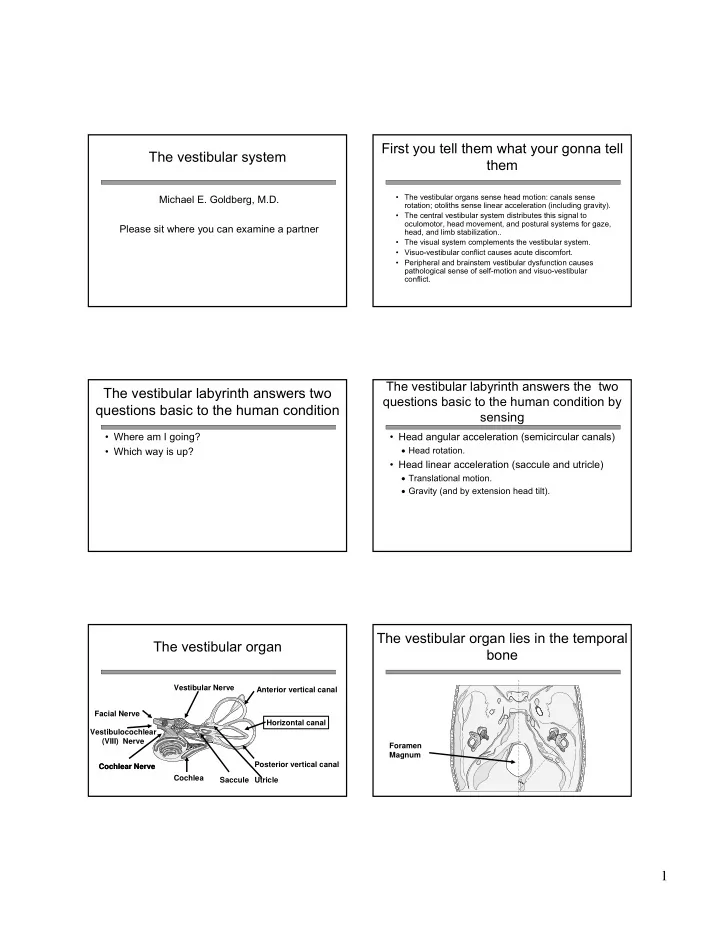

SLIDE 1
1 The vestibular system
Michael E. Goldberg, M.D. Please sit where you can examine a partner
First you tell them what your gonna tell them
- The vestibular organs sense head motion: canals sense
rotation; otoliths sense linear acceleration (including gravity).
- The central vestibular system distributes this signal to
- culomotor, head movement, and postural systems for gaze,
head, and limb stabilization..
- The visual system complements the vestibular system.
- Visuo-vestibular conflict causes acute discomfort.
- Peripheral and brainstem vestibular dysfunction causes
pathological sense of self-motion and visuo-vestibular conflict.
The vestibular labyrinth answers two questions basic to the human condition
- Where am I going?
- Which way is up?
The vestibular labyrinth answers the two questions basic to the human condition by sensing
- Head angular acceleration (semicircular canals)
- Head rotation.
- Head linear acceleration (saccule and utricle)
- Translational motion.
- Gravity (and by extension head tilt).