HDFC Top 100 Fund (An open ended equity scheme predominantly - - PowerPoint PPT Presentation

hdfc top 100 fund
SMART_READER_LITE
LIVE PREVIEW

HDFC Top 100 Fund (An open ended equity scheme predominantly - - PowerPoint PPT Presentation

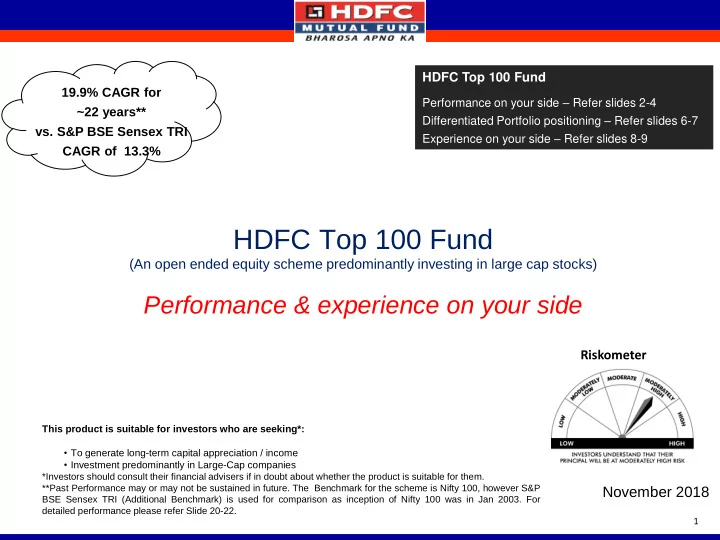
HDFC Top 100 Fund 19.9% CAGR for Performance on your side Refer slides 2-4 ~22 years** Differentiated Portfolio positioning Refer slides 6-7 vs. S&P BSE Sensex TRI Experience on your side Refer slides 8-9 CAGR of 13.3% HDFC Top


slide-1
SLIDE 1

HDFC Top 100 Fund

(An open ended equity scheme predominantly investing in large cap stocks)

Performance & experience on your side

November 2018

Riskometer

This product is suitable for investors who are seeking*:

  • To generate long-term capital appreciation / income
  • Investment predominantly in Large-Cap companies

*Investors should consult their financial advisers if in doubt about whether the product is suitable for them. **Past Performance may or may not be sustained in future. The Benchmark for the scheme is Nifty 100, however S&P BSE Sensex TRI (Additional Benchmark) is used for comparison as inception of Nifty 100 was in Jan 2003. For detailed performance please refer Slide 20-22.

19.9% CAGR for ~22 years**

  • vs. S&P BSE Sensex TRI

CAGR of 13.3%

1

HDFC Top 100 Fund

Performance on your side – Refer slides 2-4 Differentiated Portfolio positioning – Refer slides 6-7 Experience on your side – Refer slides 8-9

slide-2
SLIDE 2

2

HDFC Top 100 Fund – Strong peergroup performance

In 5 year periods since 2001, HDFC Top 100 Fund has been in 1st / 2nd Quartile of peergroup 14 times out of 15

(period refer to fiscal periods) Quartile For the period ended 31st Mar 2001 2002 2003 2004 2005 2006 2007 2008 2009 2010 2011 2012 2013 2014 2015 2016 2017 2018 2019 YTD Number

  • f

Times in Q1/Q2 1 year Q3 Q2 Q2 Q2 Q1 Q1 Q2 Q3 Q1 Q1 Q1 Q3 Q3 Q1 Q4 Q4 Q1 Q4 Q1 12/19 3 years Q2 Q2 Q1 Q1 Q1 Q2 Q2 Q1 Q1 Q1 Q2 Q3 Q3 Q3 Q2 Q2 Q1 14/17 5 years Q2 Q2 Q1 Q1 Q1 Q1 Q1 Q1 Q1 Q1 Q2 Q3 Q2 Q2 Q1 14/15

Disclaimer: Past Performance may or may not be sustained in the future. The above returns are of regular plan - growth option. All dividends declared prior to the splitting of the Scheme into Dividend & Growth Options are assumed to be reinvested in the units of the Scheme at the then prevailing NAV (ex-dividend NAV). HDFC Mutual Fund/AMC is not guaranteeing any returns on investments made in this Fund. For detailed performance please refer Slide 20-22.

slide-3
SLIDE 3

3

HDFC Top 100 Fund – Ideal for long term investments

HDFC Top 100 Fund - Outperformance vs S&P BSE Sensex TRI (CAGR) Year ended 1 year 3 year 5 year 7 year 10 year Mar 98 9.7 Mar 99 38.8 Mar 00 8.6 20.0 Mar 01

  • 9.1

9.1 Mar 02 19.4 3.6 11.3 Mar 03 12.5 5.3 11.8 Mar 04 52.5 24.2 11.3 15.0 Mar 05 12.3 21.7 11.9 15.4 Mar 06 7.4 21.7 19.2 11.2 Mar 07

  • 9.2

2.6 12.1 8.3 11.7 Mar 08 5.0 0.0 10.1 12.4 11.3 Mar 09 7.4 2.3 4.9 10.3 8.1 Mar 10 15.7 9.1 4.9 10.5 8.6 Mar 11 4.6 8.9 4.5 5.9 11.2 Mar 12 2.7 6.4 6.7 4.5 9.2 Mar 13

  • 5.6

0.6 4.6 2.7 7.0 Mar 14

  • 0.2
  • 0.9

2.4 4.0 3.7 Mar 15 8.3 0.4 1.8 4.4 3.3 Mar 16

  • 1.9

1.5 0.4 2.4 2.4 Mar 17 11.5 5.2 1.9 2.4 4.3 Mar 18

  • 5.9

0.7 1.8 0.9 3.2 Periods HDFC Top 100 Fund

  • utperformed

15 18 17 15 12 Total Number of periods 21 19 17 15 12

Outperformance in periods HDFC Top 100 Fund (%) 71% 95% 100% 100% 100%

HDFC Top 100 Fund has outperformed

  • n a rolling financial year basis vs S&P

BSE Sensex TRI over 5 years, 7 years and 10 years since 1998 The Fund is thus ideal for long term investment

Outperformance is the excess return generated by the scheme over the returns generated by S&P BSE Sensex TRI Disclaimer: Market scenarios are not the reliable indicators for current or future performance. The same should not be construed as investment advice or as any research report/research recommendation. Above chart is for illustrative purpose only. Past Performance may or may not be sustained in future. For detailed performance please refer Slide 20-22. The above

  • utperformance is based on returns of regular plan - growth option. For Outperformance table S&P BSE Sensex TRI additional benchmark has been considered as scheme benchmark ( Nifty

100) is not available since scheme inception date

slide-4
SLIDE 4

HDFC Top 100 Fund – Adding value across market cycles in 22 years

Rs 10,000 invested in HDFC Top 100 Fund at inception has grown to ~Rs 5.5 lacs at a CAGR 19.9% Rs 10,000 invested in S&P BSE Sensex at scheme inception would have grown to ~Rs 1.6 lacs at a CAGR 13.3% 4 Rs 10,000 invested in NSE 100 in Jan 2003 would have grown to ~Rs 1.35 lacs at a CAGR 17.8%

Benchmark Inception – Jan 2003

0.00 1.00 2.00 3.00 4.00 5.00 6.00 96 97 98 00 01 02 03 04 05 06 07 08 09 10 11 13 14 15 16 17 18 Value of Rs 10,000 invested in 1996 HDFC Top 100 Fund SENSEX TRI NSE 100 TRI

Disclaimer: Past Performance may or may not be sustained in the future. Returns as on 31st Oct 18. For detailed performance please refer Slide 20-22. The above returns are of regular plan - growth

  • ption. All dividends declared prior to the splitting of the Scheme into Dividend & Growth Options are assumed to be reinvested in the units of the Scheme at the then prevailing NAV (ex-

dividend NAV). HDFC Mutual Fund/AMC is not guaranteeing any returns on investments made in this Fund. In view of the individual circumstances and risk profile, each investor is advised to consult his / her professional advisor before making a decision to invest in the Scheme. Historical performance indicators and financial market scenarios are not the reliable indicators for current

  • r future performance. Scheme Inception date – October 11, 1996.
slide-5
SLIDE 5

HDFC Top 100 Fund – Consistent Dividends

5

22 Dividends in 19 years since 2000, Average yield ~10.65%

^ Past performance may or may not be sustained in the future. All dividends are on face value of Rs. 10 per Unit. There is no assurance or guarantee to unit holders as to rate/quantum of dividend distribution nor that the dividends will be paid regularly. After payment of the dividend, the per Unit NAV falls to the extent of the payout and statutory levy, if any. Please log on to www.hdfcfund.com for Dividend history details.

Record Date 07-Jan-00 24-Mar-00 25-Aug-00 23-Feb-01 15-Mar-02 15-Jul-03 31-Oct-03 08-Mar-04 15-Dec-04 17-Feb-06 07-Feb-07 07-Feb-08 06-Mar-09 Per Unit 2.5 2.5 2.1 2 1.2 2 2.5 1.5 3 4.5 5 5 3 Record Date NAV 25.81 24.81 16.03 13.84 12.44 16.272 19.899 21.959 24.066 36.309 42.968 48.129 20.364 Dividend Yield (%) 10% 10% 13% 14% 10% 12% 13% 7% 12% 12% 12% 10% 15% Record Date 11-Mar-10 11-Mar-11 07-Mar-12 08-Mar-13 07-Mar-14 05-Mar-15 03-Mar-16 09-Mar-17 06-Mar-18 Per Unit 4 4 4 4 4 5 3.5 4.5 6 Record Date NAV 46.578 43.633 42.778 39.247 38.484 58.076 43.228 52.759 54.454 Dividend Yield (%) 9% 9% 9% 10% 10% 9% 8% 9% 11%

slide-6
SLIDE 6

HDFC Top 100 Fund – Differentiated Portfolio positioning

6

HDFC Mutual Fund/AMC is not guaranteeing any returns on investments made in this Fund. The above statements / analysis should not be construed as an investment advice or a research report or a recommendation to buy or sell any security covered under the respective sector/s . In view of the individual circumstances and risk profile, each investor is advised to consult his / her professional advisor before making a decision to invest in the Scheme. Sectors referred above are illustrative and are not recommended by HDFC Mutual Fund/AMC. The Fund may or may not have any present or future positions in these sectors. For Compete portfolio please visit www.hdfcfund.com Sector HDFC Top 100 Fund (% Exposure) Average % Exposure of Other Large cap schemes Consumer Discretionary 0.1 10.8 Consumer Staples 6.1 9.2 Corporate Banks & Financials 27.2 11.2 Energy 13.9 7.5 Health Care 3.3 5.7 Industrials 8.5 6.8 Information Technology 14.0 11.3 Materials 7.4 6.1 Real Estate NIL 0.04 Retail Banks & Financials 9.2 21.0 Telecommunication Services NIL 0.8 Utilities 10.2 1.9 Cash & NCA 0.3 7.6 100.0 100.0

HDFC Top 100 Fund is overweight in sectors with earnings recovery and is underweight in high P/E sectors HDFC Top 100 Fund portfolio is positioned differently from other Large cap schemes

Source: NAV India, Portfolio details as on Oct 31, 2018

Key overweight sectors Corporate Banks & Financials

  • Recognition phase of NPAs is largely over
  • With falling slippages and increasing resolution of NPAs

provisioning costs are expected to fall sharply

Utilities

  • Capacity led growth

Key underweight sectors Consumer Discretionary

  • Weak demand growth
  • Rich valuations

Consumer Staples

  • Rich valuations
slide-7
SLIDE 7

HDFC Top 100 Fund – Valuations of key overweight & underweight sectors

7

18 23 28 33 38 43 Nov 09 Nov 10 Nov 11 Nov 12 Nov 13 Nov 14 Nov 15 Nov 16 Nov 17 Nov 18

NIFTY FMCG Index

Rolling 12 months PE Ratio (Bloomberg Consensus EPS) 8 10 12 14 16 18 20 22 Nov 12 Nov 13 Nov 14 Nov 15 Nov 16 Nov 17 Nov 18

NIFTY Auto Index

Rolling 12 months PE Ratio (Bloomberg Consensus EPS) 0.5 1 1.5 2 2.5 3 Nov 09 Nov 10 Nov 11 Nov 12 Nov 13 Nov 14 Nov 15 Nov 16 Nov 17 Nov 18

BSE PSU Bank Index

Rolling 12 months PB Ratio(Trailing Book value) 12 13 14 15 16 17 18 19 20 21 22 Nov 10 Nov 11 Nov 12 Nov 13 Nov 14 Nov 15 Nov 16 Nov 17

BSE Power Index

Rolling 12 months PE Ratio (Bloomberg Consensus EPS) Source: Bloomberg, Deutche Research

slide-8
SLIDE 8
  • The portfolio always remains diversified across key sectors and economic variables and aims to take active positions

in a controlled manner and thereby reduce risk (slide 6)

  • Fund has successfully navigated bubbles / market excesses in IT (~ year 2001), Power / Real Estate (~ year 2007)
  • Low portfolio turnover – a result of the Fund’s long term approach to investing

The current investment strategy is subject to change without prior notification. For latest scheme portfolio visit our website www.hdfcfund.com

HDFC Top 100 Fund – Experience of 22 years / 3 market cycles on your side

A consistent approach to investing has worked well for HDFC Top 100 Fund across market cycles in last ~ 22 years since inception Outperformance across market cycles since Inception in 1996

1996 - 2000 (4 years) : IT stocks were market leaders, NAV up 1.9 times vs. 1.2 times of Sensex TRI 2001 - 2007

(6 years) : Old economy stocks were market leaders, NAV up 11.2 times vs. 5.8 times of Sensex TRI

2008 - 2016

(8 years) : Pharma / FMCG stocks were market leaders, NAV up 2 times vs. 1.5 times of Sensex TRI

2017 - ? : Fund overweight in Corporate Banks, Industrials, Utilities, IT 8

Past Performance may or may not be sustained in the future. For detailed performance please refer Slide 20-22. Historical performance indicators and financial market scenarios are not reliable indicators of current or future. Sectors referred above are illustrative and are not recommended by HDFC Mutual Fund/AMC. The Fund may or may not have any present or future positions in these sectors. Source : Bloomberg & Internal

slide-9
SLIDE 9

9

HDFC Top 100 Fund – Disciplined approach helps to avoid bubbles / market excesses

Track record of successfully navigating through bubbles / market excesses

IT (2000-01) : NSE IT Index down 66% from high in a year, Sensex TRI down 25% **, HDFC Top 100 Fund down 38% Real Estate (2008-09) : BSE Real Estate TR Index down 87% from high in a year, NSE100 TRI down 57%, HDFC Top 100 Fund down 48% Power (2008-09) : BSE Power TR Index down 60% from high in a year, NSE100 TRI down 53%, HDFC Top 100 Fund down 45% Long term approach to investing leads to a Low portfolio turnover Portfolio Turnover (%) FY13 FY14 FY15 FY16 FY17 FY18 17.2 29.0 42.3 50.8 30.8 34.1 HDFC Top 100 Fund has delivered a CAGR 19.9% (vs Sensex TRI CAGR 13.3%) in the last 22 years since inception. This period witnessed different governments, several global and local crises like ASEAN crisis, 9/11, global financial crisis post Lehman, European debt issues etc., periods of high and low interest rates, periods of high and low oil prices, bubbles / market excesses etc.

**BSE Sensex TRI is used for comparison as inception of Nifty 100 was in Jan 2003. BSE 200 was down 41% (benchmark of the scheme during this period)

Past Performance may or may not be sustained in the future. For detailed performance please refer Slide 20-22. Historical performance indicators and financial market scenarios are not reliable indicators of current or future performance. Sectors referred above are illustrative and are not recommended by HDFC Mutual Fund/AMC. The Fund may or may not have any present or future positions in these sectors. Source : Bloomberg & Internal

slide-10
SLIDE 10

10

Indian Economy : Strong fundamentals, improving growth outlook

* FY19E CAD is based on oil price at USD 80/bbl vs current oil price at USD 60/bbl

Improving macros FY13 FY14 FY15 FY16 FY17 FY18 FY19E GDP at market price (% YoY) 5.5 6.4 7.5 8 7.1 6.7 7.3 Centre's fiscal deficit (% GDP) 4.8 4.4 4.1 3.9 3.7 3.5 3.5 Current Account Deficit (CAD) (% GDP) 4.7 1.7 1.3 1.1 0.7 1.9 3.2 * Net FDI (% of GDP) 1.1 1.2 1.5 1.7 1.6 1.2 1.2 Consumer Price Inflation (CPI) (Average) 9.9 9.4 6 4.9 4.5 3.6 3.9 India 10 year Gsec Yield % (at yearend) 7.9 8.8 7.8 7.6 6.8 7.4 7.8 (Current)

Source: CEIC, Kotak Institutional Equities; Economic Survey, E-Estimates

Credit growth in double digits continues to outpace deposit growth

RBI expects GDP growth of 7.4% and 7.6% in FY19 and FY20 respectively vs. 6.7% in FY18

Source: RBI

8.9% 14.6% 2.0% 4.0% 6.0% 8.0% 10.0% 12.0% 14.0% 16.0% Apr-17 Jul-17 Oct-17 Jan-18 Apr-18 Jul-18 Oct-18

Deposit growth % Credit growth %

Capacity utilization is improving

slide-11
SLIDE 11

Stable macro, improving micro

11

Source: Bloomberg HDFC Mutual Fund/AMC is not guaranteeing any returns on investments made in this Fund. FY13 FY14 FY15 FY16 FY17 FY18 NIFTY EPS CAGR 13-18 FY19E FY20E NIFTY EPS CAGR 18-20E NIFTY EPS 377 410 398 384 439 448 3.5 511 660 21.4 Growth % 8.8

  • 2.9
  • 3.5

14.4 2.0 14.1 29.2

Stable Macro

  • India basket for crude in FY19YTD has been near USD 74 vs FY18 average of USD 56, this may result in some deterioration in

macroeconomic parameters like current account deficit, inflation etc.

  • However, growth is expected to improve. RBI expects GDP growth of 7.4% and 7.6% in FY19 and FY20 respectively vs 6.7% in FY18
  • US interest rates, geo political developments, rising crude oil prices, global capital flows are key variables

Micro : The worst is behind, strong improvement ahead Last 5 years were characterized by improving macro and weak micro Next few years should be characterized by healthy macro and improving micro

Source: Kotak Institutional Equities E: Estimates

slide-12
SLIDE 12

India’s External situation – Stable, despite some deterioration

Source: CMIE, CEIC, Kotak Institutional Equities estimates, E-Estimates

12

FY17 was an outlier year External situation is stable and better than FY12 / FY13 Oil prices / FII flows (Debt and Equity) are key variables

* As on 9th Nov, 2018, Forex cover = Forex Reserve / Average Monthly Imports in past 12 months

Situation 5 years back Outlier year Current situation Comment % GDP FY12 FY13 FY14 FY17 FY18 FY19E Current account deficit

  • 4.3%
  • 4.8%
  • 1.7%
  • 0.7%
  • 1.9%
  • 3.2% **

CAD widening but significantly lower than FY13 Net Oil imports / Crude ($/barrel) 5.4% / 114 5.6% / 110 5.5% / 108 2.4% / 49 2.7% / 58 4.1% / 80.0 Oil imports much lower than around 5.5% in FY12-FY14 Gold imports 3.1% 2.9% 1.5% 1.2% 1.3% 1.2% Gold imports continue to moderate Non-oil-non-gold exports 13.7% 13.2% 13.6% 10.7% 10.3% 10.6% Non oil non gold exports have declined Non-oil-non-gold Trade Deficit

  • 2.1%
  • 2.4%
  • 1.1%
  • 1.6%
  • 2.3%
  • 2.4%

Net FDI flows / (US$ bn) 1.2% / 22 1.1% / 20 1.2% / 22 1.6% / 36 1.2% / 30 1.2% / 32 FDI flows continue to remain strong FII flows / (US$ bn) 0.9% / 17 1.5% / 27 0.3% / 5 0.3% / 8 0.8% / 22

  • 0.4% / -10

Balance of payment

  • 0.7%

0.2% 0.8% 0.9% 1.7%

  • 1.3%

BoP adjusted for NRI deposits & Banking capital was around -1% in FY14 Forex reserves (US$ bn) 294 292 304 370 424 393* Forex cover at 9.3 months is higher than 6.7 months in 2013

** FY19E CAD is based on oil price at USD 80/bbl vs current oil price at USD 60/bbl

slide-13
SLIDE 13

13

INR depreciation or USD appreciation ?

Source: Bloomberg

Historically, INR has depreciated vs USD in line with inflation differential between India and the US CPI - CAGR % Last 10 years Last 20 years 1973-2018 YTD India 8.0 6.7 7.7 United States 1.7 2.1 4.0 Differential 6.3 4.5 3.8 INR depreciation vs USD 6.5 3.2 5.1

Source : World Bank, Bloomberg, Last 10 years and Last 20 years data is 2007- till Oct 31, 2018 and 1997-till Oct 31, 2018 respectively

1.00 1.50 2.00 2.50 3.00 3.50 Apr-16 Oct-16 Apr-17 Oct-17 Apr-18 Oct-18 %

US 10 Year Yield Current USD appreciation is due to:

  • Rising interest rates in the US
  • Strong US economy
  • Proposed regulation for special low tax rate for

repatriation of profits by US corporates All major currencies have depreciated vs the USD in FY19 YTD

Source: Bloomberg

  • 30.0
  • 25.0
  • 20.0
  • 15.0
  • 10.0
  • 5.0

0.0 Turkish Lira South African Rand Russian Ruble Indian Rupee Brazilian Real Mexico Chinese Yuan Indonesian Rupiah Pound Euro Australian dollar South Koran Won Japanese Yen Canadian Dollar

Movement of Major currencies vs USD

FY19 YTD till Oct 31

slide-14
SLIDE 14

Equity Markets Outlook – Strong earnings growth in FY19 / FY20

14

  • Earnings outlook is improving with improvement in operating margins, peaking NPA’s and higher steel prices
  • Successful resolution in NCLT will positively impact banks, private capex and steel etc.
  • Markets are trading at CY20(e) p/e of ~15x, which is reasonable, especially given improving earnings outlook
  • Global developments, sharp increase in US rates, sharp deterioration in local / FII flows, setback to NCLT etc. can lead to increased volatility

Marketcap to GDP at 60% is attractive, specially at time when NIFTY EPS growth is estimated at 21.4% CAGR over FY18-20E

India market cap to GDP ratio, calendar year-ends 2005-20E (%)

Data Source: Kotak Institutional Equities, updated till 31st Oct, 2018, Market Cap to GDP for 2018E and 2019E are based on current market cap to GDP and GDP estimate by Kotak Institutional Equities. From 2005-18, NIFTY50 PE is based on 12 month forward estimated EPS. For 2019 and 2020, Kotak has calculated PE based on estimates as of Mar 20 and Mar 21 end

69 88 149 56 99 98 61 71 64 81 76 72 92 74 67 60 13 15 23 11 17 16 13 14 16 20 18 17 19 17 16 14

  • 5

10 15 20 25 20 40 60 80 100 120 140 160 2005 2006 2007 2008 2009 2010 2011 2012 2013 2014 2015 2016 2017 2018E Current 2019E Current 2020E Current Mcap/GDP (%) NIFTY 12M forward P/E (X)

slide-15
SLIDE 15

INR depreciation – Actually positive for NIFTY 50 earnings

15

Source:. Bloomberg HDFC Mutual Fund/AMC is not guaranteeing any returns on investments made in this Fund. The above statements / analysis should not be construed as an investment advice or a research report or a recommendation to buy or sell any security covered under the respective sector/s . In view of the individual circumstances and risk profile, each investor is advised to consult his / her professional advisor before making a decision to invest in the Scheme. Sectors referred above are illustrative and are not recommended by HDFC Mutual Fund/AMC. The Fund may or may not have any present or future positions in these sectors. For Compete portfolio please visit www.hdfcfund.com

Sector NSE 50 weight % Impact of depreciating INR on earnings Information Technology 14.6 Energy 12.9 Materials 7.4 Consumer Staples 8.4 Weak INR = Higher Inflation = Higher Nominal growth Health Care 3.1 Total % with Positive Impact 46.4 Retail Banks & Financials 26.7 Corporate Banks & Financials 9.6 Consumer Discretionary 8.1 Few Indian Auto companies will benefit due to exports Industrials 4.2 Communication Services 2.1 Utilities 3.0 Total % with Neutral Impact 53.7

Positive Neutral

slide-16
SLIDE 16

Source: Sensex : www.bseindia.com, Election Commission of India for election years, Returns computation internal

Elections and equity returns Spot the pattern* !

*As can be noticed there is no pattern in Sensex returns during the year in which elections were held or in years before or after the elections **The base year of Sensex is 1978-79 and the base value is 100

HDFC Mutual Fund / AMC is not guaranteeing or promising or forecasting any returns on investments

Represents year of elections

Year Ending BSE S&P Sensex** 1 year absolute returns Mar-79 100 Mar-80 129 29 Mar-81 173 35 Mar-82 218 26 Mar-83 212

  • 3

Mar-84 245 16 Mar-85 354 44 Mar-86 574 62 Mar-87 510

  • 11

Mar-88 398

  • 22

Mar-89 714 79 Mar-90 781 9 Mar-91 1168 50 Mar-92 4285 267 Mar-93 2281

  • 47

Mar-94 3779 66 Mar-95 3261

  • 14

Mar-96 3367 3 Mar-97 3361 Mar-98 3893 16 Mar-99 3740

  • 4

Mar-00 5001 34 Mar-01 3604

  • 28

Mar-02 3469

  • 4

Mar-03 3049

  • 12

Mar-04 5591 83 Mar-05 6493 16 Mar-06 11280 74 Mar-07 13072 16 Mar-08 15644 20 Mar-09 9709

  • 38

Mar-10 17528 81 Mar-11 19445 11 Mar-12 17404

  • 10

Mar-13 18836 8 Mar-14 22386 19 Mar-15 27957 25 Mar-16 25342

  • 9

Mar-17 29621 17 Mar-18 32969 11

Worried about elections ?

16 Above chart is illustrative and for general information. Historical performance indications and financial market scenarios are not the reliable indicator for current or future performance. HDFC Mutual Fund/AMC is not guaranteeing any returns on investments made in this Fund. In view of the individual circumstances and risk profile, each investor is advised to consult his / her professional advisor before making a decision to invest in the Scheme.

slide-17
SLIDE 17

Summary

17

  • Strong outlook for economic growth and earnings growth
  • Markets are trading at CY20(e) p/e of ~14x and Marketcap to GDP ratio of 60% CY20e, which is attractive
  • Strong earnings growth, steady local flows, and reasonable valuations lead to a positive view of markets
  • With NIFTY EPS growth estimated at 21.4% CAGR over FY18-20E, outlook for largecaps is positive
  • HDFC Top 100 Fund has a differentiated portfolio positioning vs. other Large cap Funds and is overweight in sectors etc. with

improving outlook like Corporate Banks & Financials, Utilities (slide 6)

  • HDFC Top 100 Fund has a healthy track record of performance vs the benchmark and peers (slide 1-3 and slide 20)

Source: Kotak Institutional Equities; Economic Survey, E-Estimates Past Performance may or may not be sustained in future. For detailed performance please refer Slide 20-22

19.9% CAGR for ~22 years** vs. BSE Sensex TRI CAGR of 13.3% In 5 year periods since 2001, Fund has been in Q1/Q2 in 14 out of 15 such periods (periods refer to fiscal periods) Fund has outperformed SENSEX TRI in all 5 year periods since 1998 (periods refer to fiscal periods)

slide-18
SLIDE 18

HDFC Top 100 Fund – Proven track record over 3 market cycles (refer slide 7) in ~ 22 years

Key statistics since inception Track Record ~ 22 years Outperformance vs. Sensex TRI * 16 out of 21 Calendar years Alpha generation Close to 6.6% CAGR (Since inception) (19.9% scheme CAGR vs 13.3% additional benchmark CAGR) Wealth creation 55 times vs 16 times in additional benchmark SIP of Rs 10,000 since inception has become Rs 3.51 crores at a CAGR of 19.7% (Refer Slide 21) Dividends 22 Dividends in 19 years since 2000, Average yield ~10.65% (Refer Slide 5) Annual Portfolio Turnover Ratio 25.49% as on October 2018 Weighted average portfolio Market capitalization ~Rs 2,42,000 crores (Source: Capitaline) Segment-wise Breakup of Equity Holding (% of Net Assets) Large Cap - 89.74% Mid Cap - 9.71% Small cap – 0.23%

18

  • Owing to unavailability of NIFTY 100 TRI index since inception of scheme, performance vis-à-vis additional benchmark S&P BSE Sensex TRI is
  • considered. Data as on October 31, 2018.

Past Performance may or may not be sustained in future. For detailed performance please refer Slide 20-22. For detailed dividend history, please refer www.hdfcfund.com.

slide-19
SLIDE 19

HDFC Top 100 Fund – Asset Allocation Pattern

19

Types of Instruments Minimum Allocation (% of Total Assets) Maximum Allocation (% of Total Assets) Risk Profile

Equity and Equity related instruments

  • f

large cap companies 80 100 High Equity and Equity related instruments other than above 20 High Debt Securities (including securitised debt) and money market instruments 20 Low to Medium Units issued by REITs and InvITs 10 Medium to High Non-convertible preference shares 10 Low to Medium The investment universe of "Large Cap" shall comprise companies as defined by SEBI from time to time. The list of stocks

  • f Large Cap companies prepared by AMFI in this regard will be adopted.

The Scheme may invest in the schemes of Mutual Funds in accordance with the applicable extant SEBI (Mutual Funds) Regulations as amended from time to time. The Scheme may invest up to 35% of its total assets in foreign securities. The Scheme may invest upto 100% of its total assets in Derivatives.

Under normal circumstances, the asset allocation (% of total assets) of the Scheme’s portfolio will be as follows :

slide-20
SLIDE 20

HDFC Top 100 Fund – Scheme Performance summary

20

Value of Rs 10,000 invested Scheme Returns (%)$$ Benchmark Returns # (%) Additional Benchmark Returns ## (%) Scheme $$ Benchmark (Rs)# Additional Benchmark (Rs)##

Last 1 year

  • 1.57

0.09 4.91 9,843 10,009 10,491 Last 3 years 11.17 10.53 10.33 13,746 13,511 13,436 Last 5 years 14.80 12.91 11.75 19,948 18,360 17,430 Since inception (Oct 11, 1996) 19.92 N.A. 13.29 550,376 NA 157,003

# NIFTY 100 Total Returns Index. ## S&P BSE SENSEX Total Returns Index. N.A. – Not Available. The above scheme is managed by Prashant Jain, the fund manager since June 20, 2003. Past performance may or may not be sustained in the future. The above returns are of Regular Plan – Growth Option. Returns greater than 1 year period are compounded annualized (CAGR). Load is not taken into consideration for computation of performance. Different Plans viz. Regular Plan and Direct Plan have a different expense structure. The expenses of the Direct Plan under the Scheme will be lower to the extent of the distribution expenses / commission charged in the Regular Plan. $$ All dividends declared prior to the splitting of the Scheme into Dividend & Growth Options are assumed to be reinvested in the units of the Scheme at the then prevailing NAV (ex-dividend NAV). Returns as on 31st October, 2018. Scheme Inception Date – October 11, 1996.

slide-21
SLIDE 21

HDFC Top 100 Fund – SIP Performance summary

21

The above scheme is managed by Prashant Jain, the fund manager since June 20,2003. Past performance may or may not be sustained in the future. CAGR returns are computed after accounting for the cash flow by using XIRR method (investment internal rate of return) for Regular Plan - Growth Option. The above investment simulation is for illustrative purposes only and should not be construed as a promise

  • n minimum returns and safeguard of capital. Load is not taken into consideration for computation of performance. Different Plans viz. Regular Plan and Direct Plan

have a different expense structure. The expenses of the Direct Plan under the Scheme will be lower to the extent of the distribution expenses / commission charged in the Regular Plan. Scheme Inception Date – October 11, 1996. $$ All dividends declared prior to the splitting of the Scheme into Dividend & Growth Options are assumed to be reinvested in the units of the Scheme at the then prevailing NAV (ex-dividend NAV). # NIFTY 100 Total Returns Index. ## S&P BSE SENSEX Total Returns

  • Index. Returns as on 31st October, 2018.

Particulars 1 year 3 Years 5 Years 10 Years Since Inception Total Amount Invested (` )

120,000 360,000 600,000 1,200,000 2,650,000

Mkt Value As on October 31, 2018 (`)

118,950 420,090 784,030 2,355,390 35,189,410

Returns (Annualised) (%)$$

  • 1.62

10.29 10.64 12.94 19.73

Benchmark Returns (Annualised) (%) #

  • 6.06

9.42 10.07 12.13 NA

  • Addl. Benchmark Ret. (Annualised) (%)

##

  • 1.80

10.92 10.01 11.66 14.11

HDFC Top 100 Fund – Assuming Investment of Rs. 10,000 on the first Business Day of every Month.

slide-22
SLIDE 22

Other schemes managed by Prashant Jain, fund manager of HDFC Top 100

22

Scheme Managing Scheme Since 1 year 3 year 5 year CAGR (in %) CAGR (in %) HDFC Equity Fund June 20, 03

  • 2.79

10.66 16.31 NIFTY 500 Total Returns Index

  • 3.17

10.39 14.04 HDFC Balanced Advantage Fund June 20, 03

  • 3.84

9.85 16.54 NIFTY 50 Hybrid Composite Debt 65:35 Index 2.10 9.08 10.78 HDFC Hybrid Debt Fund # Dec 26, 03

  • 2.33

6.87 10.23 NIFTY 50 Hybrid Composite Debt 15:85 Index 1.86 7.02 8.81

Past performance may or may not be sustained in the future. The above returns are of Regular Plan - Growth Option. Load is not taken into consideration for computation of performance. # The scheme is co managed by Prashant Jain (Equities) and Shobhit Mehrotra (Debt). Returns as on 31st October, 2018. Different Plans viz. Regular Plan and Direct Plan have a different expense structure. The expenses of the Direct Plan under the Scheme will be lower to the extent of the distribution expenses/ commission charged in the Regular Plan.

Past performance may or may not be sustained in the future. Returns greater than 1 year period are compounded annualised (CAGR). Inception date is March 22, 2016. The performance is not comparable with the performance of the aforementioned scheme(s) of HDFC Mutual Fund due to differing investment objective/s and fundamental differences in asset allocation, investment strategy and the regulatory environment. The said disclosure is pursuant to SEBI Circular no. Cir/IMD/DF/7/2012 dated February 28, 2012 pertaining to Regulation 24(b) of SEBI (Mutual Funds) Regulations, 1996. FPI - Foreign Portfolio Investor.

PERFORMANCE OF CATEGORY I - FPI PORTFOLIO

Managing Portfolio Since Returns (%) (As on October 31, 2018) 1 year 3 year 5 year CAGR (in %) CAGR (in %) Category I - FPI Portfolio (managed under a bilateral agreement under

Regulation 24(b) and subject to applicable laws) Mar 22, 16 2.58 NA NA Benchmark- MSCI India (Total Returns) 0.31 NA NA

slide-23
SLIDE 23

23

The presentation dated 27th November 2018 has been prepared by HDFC Asset Management Company Limited (HDFC AMC) based on internal data, publicly available information and other sources believed to be

  • reliable. Any calculations made are approximations, meant as guidelines only, which you must confirm

before relying on them. The information given is for general purposes only. Past performance may or may not be sustained in future. The statements are given in summary form and do not purport to be complete. The views / information provided do not have regard to specific investment objectives, financial situation and the particular needs of any specific person who may receive this information. The information/ data herein alone are not sufficient and should not be used for the development or implementation of an investment strategy. The statements contained herein are based on our current views and involve known and unknown risks and uncertainties that could cause actual results, performance or events to differ materially from those expressed or implied in such statements. Stocks/Sectors referred in the presentation are illustrative and should not be construed as an investment advice or a research report or a recommended by HDFC Mutual Fund / AMC. The Fund may or may not have any present or future positions in these sectors. HDFC Mutual Fund/AMC is not guaranteeing any returns on investments made in the Scheme(s). The data/statistics are given to explain general market trends in the securities market, it should not be construed as any research report/research recommendation. Neither HDFC AMC and HDFC Mutual Fund nor any person connected with them, accepts any liability arising from the use of this

  • document. The recipient(s) before acting on any information herein should make his/her/their own

investigation and seek appropriate professional advice and shall alone be fully responsible / liable for any decision taken on the basis of information contained herein. MUTUAL FUND INVESTMENTS ARE SUBJECT TO MARKET RISKS, READ ALL SCHEME RELATED DOCUMENTS CAREFULLY

Disclaimer