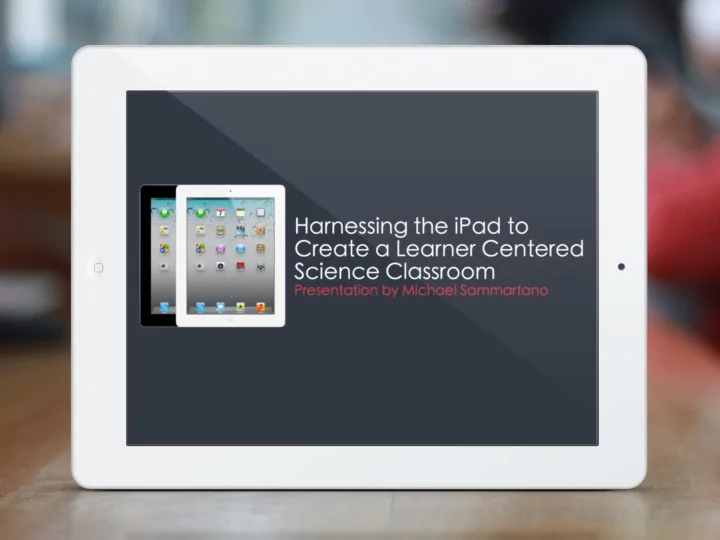
Harnessing the iPad to Create a Learner Centered Science Classroom - - PowerPoint PPT Presentation

harnessing the ipad to create a learner centered science
SMART_READER_LITE
LIVE PREVIEW

Harnessing the iPad to Create a Learner Centered Science Classroom - - PowerPoint PPT Presentation

Harnessing the iPad to Create a Learner Centered Science Classroom Presentation by Michael Sammartano Before we begin... Please locate and tap on the app called Scan in the productivity #1 folder. Introductions b Michael Sammartano


slide-1
SLIDE 1
slide-2
SLIDE 2
slide-3
SLIDE 3

Harnessing the iPad to Create a Learner Centered Science Classroom

Presentation by Michael Sammartano
slide-4
SLIDE 4

Before we begin...

Please locate and tap on the app called Scan in the productivity #1 folder.

slide-5
SLIDE 5
slide-6
SLIDE 6

Introductions

b

slide-7
SLIDE 7 ★ Earth Science Teacher ★ Apple Distinguished Educator ★ Google Certified Teacher ★ AppoLearning Expert

Michael Sammartano

slide-8
SLIDE 8
slide-9
SLIDE 9 ★ Why iPads in Education? ★ Educational Apps for Science ★ Teacher-Created Content ★ Student-Created Content ★ iPads as Assessment Tools ★ Planning and Brainstorming

Workshop Agenda

slide-10
SLIDE 10

Mirroring iPads

slide-11
SLIDE 11

Why iPads?

technology

slide-12
SLIDE 12

Papal Conclave 2005 Papal Conclave 2013

120,000 Pope-Related Tweets per minute

slide-13
SLIDE 13
slide-14
SLIDE 14
slide-15
SLIDE 15
slide-16
SLIDE 16
slide-17
SLIDE 17
slide-18
SLIDE 18
slide-19
SLIDE 19

“Proficiency with technology allows students to succeed in college and careers. The Common Core Standards include basic technology skills to help them succeed; but in the bigger picture, they call for students to use technology to help them learn in all areas.”

“Whether it be using tools to solve math problems, to

access information, or to promote literacy and communication skills, technology is part of the learning solution. It needs to be viewed that way rather than a separate competency.”

  • James Brock
slide-20
SLIDE 20

Why technology?

slide-21
SLIDE 21

Why technology?

  • 1. Engagement in education
  • 2. College and career-readiness
  • 3. New literacies
  • 4. Independent learning
  • 5. Communication and collaboration
  • 6. Real-world connections
slide-22
SLIDE 22

Why technology?

  • 1. Engagement in education
  • 2. College and career-readiness
  • 3. New literacies
  • 4. Independent learning
  • 5. Communication and collaboration
  • 6. Real-world connections
slide-23
SLIDE 23
slide-24
SLIDE 24

Why technology?

  • 1. Engagement in education
  • 2. College and career-readiness
  • 3. New literacies
  • 4. Independent learning
  • 5. Communication and collaboration
  • 6. Real-world connections
slide-25
SLIDE 25

Why technology?

  • 1. Engagement in education
  • 2. College and career-readiness
  • 3. New literacies
  • 4. Independent learning
  • 5. Communication and collaboration
  • 6. Real-world connections
slide-26
SLIDE 26

Why technology?

  • 1. Engagement in education
  • 2. College and career-readiness
  • 3. New literacies
  • 4. Independent learning
  • 5. Communication and collaboration
  • 6. Real-world connections
slide-27
SLIDE 27
slide-28
SLIDE 28

Why technology?

  • 1. Engagement in education
  • 2. College and career-readiness
  • 3. New literacies
  • 4. Independent learning
  • 5. Communication and collaboration
  • 6. Real-world connections
slide-29
SLIDE 29

“The need to know the capital of Florida died when my phone learned the answer.” “...The students of tomorrow need to be able to think creatively: they will need to learn on their own, adapt to new challenges and innovate on-the-fly.”

  • Anthony Chivetta
slide-30
SLIDE 30
slide-31
SLIDE 31
slide-32
SLIDE 32
slide-33
SLIDE 33
slide-34
SLIDE 34
slide-35
SLIDE 35

Why technology?

  • 1. Engagement in education
  • 2. College and career-readiness
  • 3. New literacies
  • 4. Independent learning
  • 5. Communication and collaboration
  • 6. Real-world connections
slide-36
SLIDE 36

Why technology?

  • 1. Engagement in education
  • 2. College and career-readiness
  • 3. New literacies
  • 4. Independent learning
  • 5. Communication and collaboration
  • 6. Real-world connections
slide-37
SLIDE 37
slide-38
SLIDE 38

Why technology?

  • 1. Engagement in education
  • 2. College and career-readiness
  • 3. New literacies
  • 4. Independent learning
  • 5. Communication and collaboration
  • 6. Real-world connections
slide-39
SLIDE 39

Why technology?

  • 1. Engagement in education
  • 2. College and career-readiness
  • 3. New literacies
  • 4. Independent learning
  • 5. Communication and collaboration
  • 6. Real-world connections
slide-40
SLIDE 40

Why technology?

  • 1. Engagement in education
  • 2. College and career-readiness
  • 3. New literacies
  • 4. Independent learning
  • 5. Communication and collaboration
  • 6. Real-world connections
slide-41
SLIDE 41

Why technology?

slide-42
SLIDE 42

Why iPads?

slide-43
SLIDE 43

It took...

...590 days to sell 1 million iPods.

slide-44
SLIDE 44

It took...

...74 days to sell 1 million iPhones.

slide-45
SLIDE 45

It took...

...28 days to sell 1 million iPads.

slide-46
SLIDE 46

900,000

apps available

slide-47
SLIDE 47

50,000,000,000

app downloads

slide-48
SLIDE 48

iPads 82%

Other Tablets 18%

Web Browsing

slide-49
SLIDE 49

65%

  • f schools are either piloting
  • r deploying iPads
slide-50
SLIDE 50
slide-51
SLIDE 51
  • 1. Apps, apps, apps!
  • 2. Content Consumption/Creation
  • 3. Constantly Connected
  • 4. Modern Textbook
  • 5. Intuitive and user-friendly
  • 6. Endless possibilities

Why iPads?

slide-52
SLIDE 52
  • 1. Apps, apps, apps!
  • 2. Content Consumption/Creation
  • 3. Constantly Connected
  • 4. Modern Textbook
  • 5. Intuitive and user-friendly
  • 6. Endless possibilities

Why iPads?

slide-53
SLIDE 53
  • 1. Apps, apps, apps!
  • 2. Content Consumption/Creation
  • 3. Constantly Connected
  • 4. Modern Textbook
  • 5. Intuitive and user-friendly
  • 6. Endless possibilities

Why iPads?

slide-54
SLIDE 54
  • 1. Apps, apps, apps!
  • 2. Content Consumption/Creation
  • 3. Constantly Connected
  • 4. Modern Textbook
  • 5. Intuitive and user-friendly
  • 6. Endless possibilities

Why iPads?

slide-55
SLIDE 55
  • 1. Apps, apps, apps!
  • 2. Content Consumption/Creation
  • 3. Constantly Connected
  • 4. Modern Textbook
  • 5. Intuitive and user-friendly
  • 6. Endless possibilities

Why iPads?

slide-56
SLIDE 56
  • 1. Apps, apps, apps!
  • 2. Content Consumption/Creation
  • 3. Constantly Connected
  • 4. Modern Textbook
  • 5. Intuitive and user-friendly
  • 6. Endless possibilities

Why iPads?

slide-57
SLIDE 57
  • 1. Apps, apps, apps!
  • 2. Content Consumption/Creation
  • 3. Constantly Connected
  • 4. Modern Textbook
  • 5. Intuitive and user-friendly
  • 6. Endless possibilities

Why iPads?

slide-58
SLIDE 58
slide-59
SLIDE 59

Why iPads?

slide-60
SLIDE 60

Why iPads?

slide-61
SLIDE 61

iPad Apps for Science

slide-62
SLIDE 62
  • Mr. Sun
slide-63
SLIDE 63
slide-64
SLIDE 64
slide-65
SLIDE 65
slide-66
SLIDE 66

SolarWalk

slide-67
SLIDE 67
slide-68
SLIDE 68
slide-69
SLIDE 69
slide-70
SLIDE 70

StarWalk

slide-71
SLIDE 71
slide-72
SLIDE 72
slide-73
SLIDE 73

SeeLevel

slide-74
SLIDE 74
slide-75
SLIDE 75
slide-76
SLIDE 76

Hurricane HD

slide-77
SLIDE 77
slide-78
SLIDE 78
slide-79
SLIDE 79
slide-80
SLIDE 80

Spacecraft 3D

slide-81
SLIDE 81
slide-82
SLIDE 82
slide-83
SLIDE 83
slide-84
SLIDE 84

How do I find and evaluate apps?

slide-85
SLIDE 85

How do I find and evaluate apps?

  • 1. Online resources
  • 2. Explore and experiment
  • 3. Have students write app reviews
  • 4. Hold an “Appy Hour” at work
  • 5. Use an evaluation rubric
slide-86
SLIDE 86
  • 1. Online resources
  • 2. Explore and experiment
  • 3. Have students write app reviews
  • 4. Hold an “Appy Hour” at work
  • 5. Use an evaluation rubric

How do I find and evaluate apps?

slide-87
SLIDE 87
  • 1. Online resources
  • 2. Explore and experiment
  • 3. Have students write app reviews
  • 4. Hold an “Appy Hour” at work
  • 5. Use an evaluation rubric

How do I find and evaluate apps?

slide-88
SLIDE 88
  • 1. Online resources
  • 2. Explore and experiment
  • 3. Have students write app reviews
  • 4. Hold an “Appy Hour” at work
  • 5. Use an evaluation rubric

How do I find and evaluate apps?

slide-89
SLIDE 89
  • 1. Online resources
  • 2. Explore and experiment
  • 3. Have students write app reviews
  • 4. Hold an “Appy Hour” at work
  • 5. Use an evaluation rubric

How do I find and evaluate apps?

slide-90
SLIDE 90
  • 1. Online resources
  • 2. Explore and experiment
  • 3. Have students write app reviews
  • 4. Hold an “Appy Hour” at work
  • 5. Use an evaluation rubric

How do I find and evaluate apps?

slide-91
SLIDE 91

Bloom’s Taxonomy

slide-92
SLIDE 92

Knowledge Comprehension Application Analysis Synthesis Evaluation

slide-93
SLIDE 93

Remembering Understanding Applying Analyzing Evaluating Creating

slide-94
SLIDE 94
slide-95
SLIDE 95
slide-96
SLIDE 96

Remembering Understanding Applying Analyzing Evaluating Creating

slide-97
SLIDE 97

Creating

slide-98
SLIDE 98

Student-Created Content

slide-99
SLIDE 99

How can I have my students express their learning through iPad content creation?

slide-100
SLIDE 100

How We Learn...

10% of what we READ 20% of what we HEAR 30% of what we SEE 50% of what we SEE and HEAR 70% of what is DISCUSSED with OTHERS 80% of what is EXPERIENCED PERSONALLY

95% of what we TEACH TO SOMEONE ELSE

  • William Glasser
slide-101
SLIDE 101

How can my students become teachers?

slide-102
SLIDE 102

iPad Apps for Creation

slide-103
SLIDE 103

Keynote

slide-104
SLIDE 104
slide-105
SLIDE 105
slide-106
SLIDE 106
slide-107
SLIDE 107

iStopMotion

slide-108
SLIDE 108
slide-109
SLIDE 109
slide-110
SLIDE 110

Videolicious

slide-111
SLIDE 111
slide-112
SLIDE 112
slide-113
SLIDE 113

Teacher-Created Content

slide-114
SLIDE 114

How can I easily create content that students can explore on the iPad?

slide-115
SLIDE 115

The iBooks Workflow

Create interactive textbooks for students to explore on the iPads.

slide-116
SLIDE 116

The LinkViewer Workflow

Create linked pdf documents for students to explore on the iPads.

slide-117
SLIDE 117
slide-118
SLIDE 118

The Keynote Workflow

Create linked presentations for students to explore on the iPads.

slide-119
SLIDE 119
slide-120
SLIDE 120 Bay of Fundy Bay of Fundy, Canada Bay of Fundy, Canada Date Time Tidal Height (ft) 3:55 AM 38.1 Dec 1, 2007 10:23 AM 7.5 Dec 1, 2007 4:19 PM 38.1 10:52 PM 6.9 4:54 AM 37.1 Dec 2, 2007 11:21 AM 8.5 Dec 2, 2007 5:19 PM 36.7 11:50 PM 8.2 5:52 AM 36.4 Dec 3, 2007 12:21 PM 8.9 6:19 PM 35.8 12:47 AM 8.9 Dec 4, 2007 6:48 AM 36.1 Dec 4, 2007 1:19 PM 9.2 7:15 PM 35.4 1:43 AM 9.5 Dec 5, 2007 7:39 AM 36.1 Dec 5, 2007 2:14 PM 8.9 8:07 PM 35.1 Mamaroneck Harbor Mamaroneck Harbor
  • neck Harbor, USA
Date Time Tidal Height (ft) 5:06 AM 7 Dec 1, 2007 11:23 AM 0.8 Dec 1, 2007 5:34 PM 6.8 11:51 PM 0.7 6:07 AM 7.1 Dec 2, 2007 12:24 PM 0.8 6:36 PM 6.7 12:46 AM 0.8 Dec 3, 2007 7:02 AM 7.2 Dec 3, 2007 1:20 PM 0.6 7:32 PM 6.7 1:38 AM 0.8 Dec 4, 2007 7:53 AM 7.3 Dec 4, 2007 2:13 PM 0.4 8:23 PM 6.7 2:25 AM 0.8 Dec 5, 2007 8:40 AM 7.4 Dec 5, 2007 3:01 PM 0.2 9:10 PM 6.7 INSTRUCTIONS: Draw two line graphs on the axis provided on the next
  • page. Using one color graph
the tidal height for the Bay of Fundy and with another color, plot the tidal heights at
  • Mamaroneck. Be sure to
write in the axis labels using the appropriate scale. Mark the colors of each line in the key on the bottom right corner of the graph. When your graph is complete, work
  • n the questions on the
following page. Name: ___________________________________________________ Date: ___________________ Period: _____ Lab #: _______
slide-121
SLIDE 121

Differentiation

slide-122
SLIDE 122
slide-123
SLIDE 123
slide-124
SLIDE 124
slide-125
SLIDE 125

How did the iPads change how you learned science this year?

slide-126
SLIDE 126

iPads as Assessment Tools

slide-127
SLIDE 127

iPads as Assessment Tools

slide-128
SLIDE 128

Sample Multiple Choice Question

Which of the following objects does the Earth revolve around?

  • A. Mars
  • B. The Moon
  • C. A Black Hole
  • D. The Sun
slide-129
SLIDE 129

Sample Multiple Choice Question

Which part of the cell controls the activities inside the cell?

  • A. Cytoplasm
  • B. Nucleus
  • C. Cell membrane
  • D. Cell wall
slide-130
SLIDE 130

iPads as Assessment Tools

slide-131
SLIDE 131

iPads as Assessment Tools

Please launch Safari and type the following url into the address bar: student.infuselearning.com

slide-132
SLIDE 132
slide-133
SLIDE 133

iPads as Assessment Tools

slide-134
SLIDE 134

The SAMR Model

slide-135
SLIDE 135

The SAMR Model

slide-136
SLIDE 136

The SAMR Model SUBSTITUTION

slide-137
SLIDE 137

The SAMR Model AUGMENTATION SUBSTITUTION

slide-138
SLIDE 138

The SAMR Model MODIFICATION AUGMENTATION SUBSTITUTION

slide-139
SLIDE 139
  • The SAMR Model
slide-140
SLIDE 140
slide-141
SLIDE 141
  • Google Earth
slide-142
SLIDE 142
  • Use Google Earth to locate a place
  • n Earth (instead of using an atlas).
slide-143
SLIDE 143
  • Use the Google Earth ruler tools

to measure the distance between two locations.

slide-144
SLIDE 144
  • Use the Google Earth layers to

gather research on earthquake and volcano locations.

slide-145
SLIDE 145
  • Create a narrated Google Earth

tour of major tectonic landmarks and share the tour online.

slide-146
SLIDE 146
slide-147
SLIDE 147

Brainstorming and Planning

J

slide-148
SLIDE 148

Mike Sammartano

★ MikeSammartano.com ★ iPadClassroom.com ★ KeynoteClassroom.com ★ HMXEarthScience.com ★ Twitter: @MikeSammartano ★ Email: Sammartano@me.com
slide-149
SLIDE 149

Thanks

slide-150
SLIDE 150