Hands-On: Diet Puzzle What is the secret of your long life? a man - - PowerPoint PPT Presentation

hands on diet puzzle
SMART_READER_LITE
LIVE PREVIEW

Hands-On: Diet Puzzle What is the secret of your long life? a man - - PowerPoint PPT Presentation

Logic in Prolog Sequent Calculus in Prolog First-Order Logic Free Variables Iterative Deepening Skolemization Logic in Prolog Sequent Calculus in Prolog First-Order Logic Free Variables Iterative Deepening Skolemization Hands-On: Diet


slide-1
SLIDE 1

Logic in Prolog Sequent Calculus in Prolog First-Order Logic Free Variables Iterative Deepening Skolemization

Build Your Own First-Order Prover

Part 2a: Implementing a Propositional Prover Jens Otten

University of Oslo

Jens Otten (UiO) Build Your Own First-Order Prover — Part 2 CADE Tutorial, August ’19 1 / 33 Logic in Prolog Sequent Calculus in Prolog First-Order Logic Free Variables Iterative Deepening Skolemization

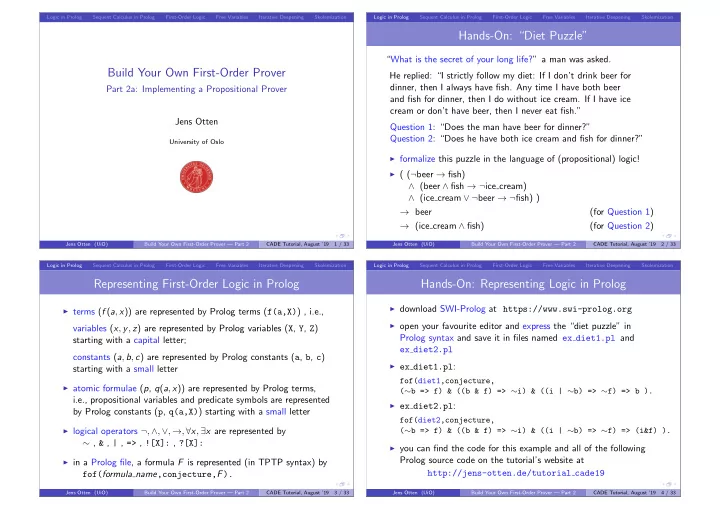
Hands-On: “Diet Puzzle”

“What is the secret of your long life?” a man was asked. He replied: “I strictly follow my diet: If I don’t drink beer for dinner, then I always have fish. Any time I have both beer and fish for dinner, then I do without ice cream. If I have ice cream or don’t have beer, then I never eat fish.” Question 1: “Does the man have beer for dinner?” Question 2: “Does he have both ice cream and fish for dinner?”

◮ formalize this puzzle in the language of (propositional) logic! ◮ ( (¬beer → fish)

∧ (beer ∧ fish → ¬ice cream) ∧ (ice cream ∨ ¬beer → ¬fish) ) → beer (for Question 1) → (ice cream ∧ fish) (for Question 2)

Jens Otten (UiO) Build Your Own First-Order Prover — Part 2 CADE Tutorial, August ’19 2 / 33 Logic in Prolog Sequent Calculus in Prolog First-Order Logic Free Variables Iterative Deepening Skolemization

Representing First-Order Logic in Prolog

◮ terms (f (a, x)) are represented by Prolog terms (f(a,X)) , i.e.,

variables (x, y, z) are represented by Prolog variables (X, Y, Z) starting with a capital letter; constants (a, b, c) are represented by Prolog constants (a, b, c) starting with a small letter

◮ atomic formulae (p, q(a, x)) are represented by Prolog terms,

i.e., propositional variables and predicate symbols are represented by Prolog constants (p, q(a,X)) starting with a small letter

◮ logical operators ¬, ∧, ∨, →, ∀x, ∃x are represented by

∼ , & , | , => , ![X]: , ?[X]:

◮ in a Prolog file, a formula F is represented (in TPTP syntax) by

fof(formula name,conjecture,F).

Jens Otten (UiO) Build Your Own First-Order Prover — Part 2 CADE Tutorial, August ’19 3 / 33 Logic in Prolog Sequent Calculus in Prolog First-Order Logic Free Variables Iterative Deepening Skolemization

Hands-On: Representing Logic in Prolog

◮ download SWI-Prolog at https://www.swi-prolog.org ◮ open your favourite editor and express the “diet puzzle” in

Prolog syntax and save it in files named ex diet1.pl and ex diet2.pl

◮ ex diet1.pl:

fof(diet1,conjecture, (∼b => f) & ((b & f) => ∼i) & ((i | ∼b) => ∼f) => b ).

◮ ex diet2.pl:

fof(diet2,conjecture, (∼b => f) & ((b & f) => ∼i) & ((i | ∼b) => ∼f) => (i&f) ).

◮ you can find the code for this example and all of the following

Prolog source code on the tutorial’s website at http://jens-otten.de/tutorial cade19

Jens Otten (UiO) Build Your Own First-Order Prover — Part 2 CADE Tutorial, August ’19 4 / 33

slide-2
SLIDE 2

Logic in Prolog Sequent Calculus in Prolog First-Order Logic Free Variables Iterative Deepening Skolemization

How to Implement a Calculus in Prolog?

Remember: A (proof) calculus consists of

◮ axioms of the form

w

◮ rules of the form

w1 w2 · · · wn w (w1, . . . , wn are the premises, w is the conclusion)

It can be implemented in Prolog in the following way:

◮ axioms: prove(w). ◮ rules:

prove(w) :- prove(w1), prove(w2), ..., prove(wn).

◮ query “is there a proof for w ′?”:

?- prove(w’).

Proof search (with backtracking) is done (implicitly) by Prolog.

◮ for a complete proof search, iterative deepening has to be added ◮ first optimization: bottom-up proof search

Jens Otten (UiO) Build Your Own First-Order Prover — Part 2 CADE Tutorial, August ’19 5 / 33 Logic in Prolog Sequent Calculus in Prolog First-Order Logic Free Variables Iterative Deepening Skolemization

Representing Sequents in Prolog

Remember: A sequent has the form Γ = ⇒ ∆

with Γ = {A1, . . . , An}, ∆ = {B1, . . . , Bm}

and is represented in Prolog by two lists: Γ > ∆ with Γ= [A1,...,An], ∆= [B1,...,Bm]

◮ the predicate select1(A,G,G’) succeeds if A is element of list G and

returns G’ as G without A, e.g. select1(b,[a,b,c],L) L=[a,c]

◮ a rule of the form

A′, Γ′ = ⇒ ∆ A, Γ′ = ⇒ ∆

with Γ={A}∪Γ′ is implemented by prove(G > D) :- select1(A,G,G’), prove([A’|G’] > D).

◮ the proof search of formula A is invoked by ?- prove([] > [A]). ◮ implementation of the select1 predicate:

select1(X,L,L1) :- append(L2,[X|L3],L), append(L2,L3,L1).

Jens Otten (UiO) Build Your Own First-Order Prover — Part 2 CADE Tutorial, August ’19 6 / 33 Logic in Prolog Sequent Calculus in Prolog First-Order Logic Free Variables Iterative Deepening Skolemization

Hands-On: Getting Started

◮ definition of the logical operators and the select1 predicate ◮ new operators are defined with: op(Precedence,Type,Name) ◮ leanseq v0.pl:

:- op( 500, fy, ∼). % negation :- op(1000, xfy, &). % conjunction :- op(1100, xfy, ’|’). % disjunction :- op(1110, xfy, =>). % implication :- op( 500, fy, !). % universal quantifier: ![X]: :- op( 500, fy, ?). % existential quantifier: ?[X]: :- op( 500,xfy, :). % ------------------------------------------------------- prove0(F) :- prove([] > [F]). % ------------------------------------------------------- % some space for the actual prover % ------------------------------------------------------- select1(X,L,L1) :- append(L2,[X|L3],L), append(L2,L3,L1). % -------------------------------------------------------

Jens Otten (UiO) Build Your Own First-Order Prover — Part 2 CADE Tutorial, August ’19 7 / 33 Logic in Prolog Sequent Calculus in Prolog First-Order Logic Free Variables Iterative Deepening Skolemization

Sequent Calculus – Axiom

◮ the only axiom

axiom

Γ1, A = ⇒ A, ∆1

◮ leanseq v1.pl:

% axiom prove(G > D) :- member(A,G), member(A,D).

Jens Otten (UiO) Build Your Own First-Order Prover — Part 2 CADE Tutorial, August ’19 8 / 33

slide-3
SLIDE 3

Logic in Prolog Sequent Calculus in Prolog First-Order Logic Free Variables Iterative Deepening Skolemization

Sequent Calculus – Rules for ∧

◮ rules for ∧ (conjunction)

Γ1, A, B = ⇒ ∆

∧-left

Γ1, A ∧ B = ⇒ ∆ Γ = ⇒ A, ∆1 Γ = ⇒ B, ∆1

∧-right

Γ = ⇒ A ∧ B, ∆1

◮ leanseq v1.pl:

% conjunction prove(G > D) :- select1(A&B,G,G1), prove([A,B|G1] > D). prove(G > D) :- select1(A&B,D,D1), prove(G > [A|D1]), prove(G > [B|D1]).

Jens Otten (UiO) Build Your Own First-Order Prover — Part 2 CADE Tutorial, August ’19 9 / 33 Logic in Prolog Sequent Calculus in Prolog First-Order Logic Free Variables Iterative Deepening Skolemization

Sequent Calculus – Rules for ∨

◮ rules for ∨ (disjunction)

Γ1, A = ⇒ ∆ Γ1, B = ⇒ ∆

∨-left

Γ1, A ∨ B = ⇒ ∆ Γ = ⇒ A, B, ∆1

∨-right

Γ = ⇒ A ∨ B, ∆1

◮ leanseq v1.pl:

% disjunction prove(G > D) :- select1(A|B,G,G1), prove([A|G1] > D), prove([B|G1] > D). prove(G > D) :- select1(A|B,D,D1), prove(G > [A,B|D1]).

Jens Otten (UiO) Build Your Own First-Order Prover — Part 2 CADE Tutorial, August ’19 10 / 33 Logic in Prolog Sequent Calculus in Prolog First-Order Logic Free Variables Iterative Deepening Skolemization

Sequent Calculus – Rules for →

◮ rules for → (implication)

Γ1 = ⇒ A, ∆ Γ1, B = ⇒ ∆

→-left

Γ1, A → B = ⇒ ∆ Γ, A = ⇒ B, ∆1

→-right

Γ = ⇒ A → B, ∆1

◮ leanseq v1.pl:

% implication prove(G > D) :- select1(A=>B,G,G1), prove(G1 > [A|D]), prove([B|G1] > D). prove(G > D) :- select1(A=>B,D,D1), prove([A|G] > [B|D1]).

Jens Otten (UiO) Build Your Own First-Order Prover — Part 2 CADE Tutorial, August ’19 11 / 33 Logic in Prolog Sequent Calculus in Prolog First-Order Logic Free Variables Iterative Deepening Skolemization

Sequent Calculus – Rules for ¬

◮ rules for ¬ (negation)

Γ1 = ⇒ A, ∆

¬-left

Γ1, ¬A = ⇒ ∆ Γ, A = ⇒ ∆1

¬-right

Γ = ⇒ ¬A, ∆1

◮ leanseq v1.pl:

% negation prove(G > D) :- select1(

∼A,G,G1),

prove(G1 > [A|D]). prove(G > D) :- select1(

∼A,D,D1),

prove([A|G] > D1).

Jens Otten (UiO) Build Your Own First-Order Prover — Part 2 CADE Tutorial, August ’19 12 / 33

slide-4
SLIDE 4

Logic in Prolog Sequent Calculus in Prolog First-Order Logic Free Variables Iterative Deepening Skolemization

The Complete Prover for Propositional Logic

prove0(F) :- prove([] > [F]). prove(G > D) :- member(A,G), member(A,D). % axiom prove(G > D) :- select1(A&B,G,G1), % conjunction prove([A,B|G1] > D). prove(G > D) :- select1(A&B,D,D1), prove(G > [A|D1]), prove(G > [B|D1]). prove(G > D) :- select1(A|B,G,G1), % disjunction prove([A|G1] > D), prove([B|G1] > D). prove(G > D) :- select1(A|B,D,D1), prove(G > [A,B|D1]). prove(G > D) :- select1(A=>B,G,G1), % implication prove(G1 > [A|D]), prove([B|G1] > D). prove(G > D) :- select1(A=>B,D,D1), prove([A|G] > [B|D1]). prove(G > D) :- select1(

∼A,G,G1),

% negation prove(G1 > [A|D]). prove(G > D) :- select1(

∼A,D,D1),

prove([A|G] > D1). select1(X,L,L1) :- append(L2,[X|L3],L), append(L2,L3,L1).

Jens Otten (UiO) Build Your Own First-Order Prover — Part 2 CADE Tutorial, August ’19 13 / 33 Logic in Prolog Sequent Calculus in Prolog First-Order Logic Free Variables Iterative Deepening Skolemization

Hands-On: Run Your Prover

◮ $> swipl

% start SWI-Prolog

◮ [leanseq v1].

% load your prover

make.

% reload prover after changing the source code

◮ prove0(a=>a).

prove0(hello). prove0(to be | ∼to be). prove0(to be & ∼to be). prove0(p & (p => q) => q).

◮ [ex diet1].

% load the diet puzzle (question 1)

fof(diet1, ,F).

% check the loaded formula

fof(diet1, ,F), prove0(F).

% solve the 1st question

◮ [ex diet2].

% load the diet puzzle (question 2)

fof(diet2, ,F).

% check the loaded formula

fof(diet2, ,F), prove0(F).

% solve the 2nd question

◮ halt.

% exit SWI-Prolog

Jens Otten (UiO) Build Your Own First-Order Prover — Part 2 CADE Tutorial, August ’19 14 / 33 Logic in Prolog Sequent Calculus in Prolog First-Order Logic Free Variables Iterative Deepening Skolemization

Invertible Rules

◮ in general all applicable (alternative) rules of a calculus have to

be applied during the proof search (on backtracking)

◮ e.g., for “(p ∧ q), (q → r) =

⇒ r ”, ∧-left and →-left can be applied

◮ order of rule applications impacts search space and provability ◮ a rule

w1 w2 · · · wn w

is invertible, if whenever w is provable (valid) so are w1, w2, ..., wn (opposite direction obviously holds)

◮ in case of invertible rules, no alternative rules need to be applied,

i.e. proof search can be cut off, resulting in smaller search space

◮ all rules of the presented propositional calculus are invertible ◮ e.g., the rule Γ =

⇒ A, B, ∆

∨-right

Γ = ⇒ A ∨ B, ∆

is invertible

◮ example for non-invertible rule is Γ =

⇒ A, ∆

∨-right1-Gentzen

Γ = ⇒ A ∨ B, ∆ (e.g., “q = ⇒ p ∨ q” is provable, but “q = ⇒ p” is not)

Jens Otten (UiO) Build Your Own First-Order Prover — Part 2 CADE Tutorial, August ’19 15 / 33 Logic in Prolog Sequent Calculus in Prolog First-Order Logic Free Variables Iterative Deepening Skolemization

Hands-On: Optimize Invertible Rules

◮ try to prove the formula in ex pigeon3.pl with leanseq v1.pl ◮ try to refute the formula in ex invalid.pl with leanseq v1.pl ◮ add a cut “!” in the axiom and in each rule after “select1” ◮ leanseq v2.pl:

% axiom prove(G > D) :- member(A,G), member(A,D), !. % conjunction prove(G > D) :- select1(A&B,G,G1), !, prove([A,B|G1] > D). % ... add "!" to seven more rules

◮ try to prove the formula ex pigeon3.pl with leanseq v2.pl ◮ try to refute the formula ex invalid.pl with leanseq v2.pl

Jens Otten (UiO) Build Your Own First-Order Prover — Part 2 CADE Tutorial, August ’19 16 / 33

slide-5
SLIDE 5

Logic in Prolog Sequent Calculus in Prolog First-Order Logic Free Variables Iterative Deepening Skolemization

Build Your Own First-Order Prover

Part 2b: Implementing a First-Order Prover Jens Otten

University of Oslo

Jens Otten (UiO) Build Your Own First-Order Prover — Part 2 CADE Tutorial, August ’19 17 / 33 Logic in Prolog Sequent Calculus in Prolog First-Order Logic Free Variables Iterative Deepening Skolemization

Hands-On: “Barber Puzzle”

“There is a man in Natal who shaves all the men in Natal who do not shave themselves.” Question: “Does some man in Natal shave himself.”

◮ formalize this puzzle in the language of (first-order) logic! ◮ ∃x ∀y (¬s(y, y) → s(x, y)) → ∃z s(z, z) ◮ express the “barber puzzle” in Prolog syntax! ◮ ex barber.pl:

fof(barber,conjecture, ?[X]: ![Y]: ( ∼s(Y,Y) => s(X,Y) ) => ?[Z]: s(Z,Z) ).

Jens Otten (UiO) Build Your Own First-Order Prover — Part 2 CADE Tutorial, August ’19 18 / 33 Logic in Prolog Sequent Calculus in Prolog First-Order Logic Free Variables Iterative Deepening Skolemization

Sequent Calculus – Rules for ∀-left and ∃-right

◮ rules for “universally quantified” variables

Γ, A[x\t], ∀x A = ⇒ ∆

∀-left

Γ, ∀x A = ⇒ ∆ Γ = ⇒ ∃x A, A[x\t], ∆ ∃-right Γ = ⇒ ∃x A, ∆

◮ A[x\t] is the formula A in which all free occurrences of x have been

replaced by the term t; t is an arbitrary term

◮ the formula ∀x A is preserved in the premise of the rule ∀-left and

formula ∃x A is preserved in the premise of the rule ∃-right

◮ when applying these rules we have to make a wise choice for t ◮ Example: ∀x p(x) → p(a)

??

p(b), ∀x p(x) = ⇒ p(a)

∀-left

∀x p(x) = ⇒ p(a)

→-right

= ⇒ ∀x p(x) → p(a)

axiom

p(a), ∀x p(x) = ⇒ p(a)

∀-left

∀x p(x) = ⇒ p(a)

→-right

= ⇒ ∀x p(x) → p(a)

Jens Otten (UiO) Build Your Own First-Order Prover — Part 2 CADE Tutorial, August ’19 19 / 33 Logic in Prolog Sequent Calculus in Prolog First-Order Logic Free Variables Iterative Deepening Skolemization

Using Free Variables

◮ instead of guessing the right term t for the variable x, we delay

this choice until an axiom is reached, i.e., we use “free variables”

◮ rules for “universally quantified” variables using free variables

Γ, A[x\x′], ∀x A = ⇒ ∆

∀-left

Γ, ∀x A = ⇒ ∆ Γ = ⇒ ∃x A, A[x\x′], ∆ ∃-right Γ = ⇒ ∃x A, ∆

◮ A[x\x′] is a copy of the formula A in which all free occurrences of x

have been replaced by the new variable x′

◮ axiom using free variables

axiom

Γ, A = ⇒ A′, ∆

◮ the two formulae A and A′ need to

“unify” under a single substitution

◮ Example:

axiom’ (x′=a x′\a)

p(x′), ∀x p(x) = ⇒ p(a)

∀-left’

∀x p(x) = ⇒ p(a)

→-right

= ⇒ ∀x p(x) → p(a)

Jens Otten (UiO) Build Your Own First-Order Prover — Part 2 CADE Tutorial, August ’19 20 / 33

slide-6
SLIDE 6

Logic in Prolog Sequent Calculus in Prolog First-Order Logic Free Variables Iterative Deepening Skolemization

Implementing Free Variables – Quantifier Rules

◮ rules for “universally quantified” variables using free variables

Γ1, ∀x A, A[x\y] = ⇒ ∆

∀-left

Γ1, ∀x A = ⇒ ∆ Γ = ⇒ ∃x A, ∆1, A[x\y] ∃-right Γ = ⇒ ∃x A, ∆1

◮ A1=A[x\y] is copy of formula A with x replaced by new variable y

◮ leanseq v3.pl:

% universal quantifier prove(G > D,FV) :- member((![X]:A),G), copy_term((X:A,FV),(Y:A1,FV)), prove([A1|G] > D,[Y|FV]). % existential quantifier prove(G > D,FV) :- member((?[X]:A),D), copy_term((X:A,FV),(Y:A1,FV)), prove(G > [A1|D],[Y|FV]).

◮ copy term(S,T) creates copy T of Prolog term S with fresh variables ◮ free variables in A must not be renamed; a list of these variables FV is

added to all rules (and axiom); the free variable Y is added to this list

Jens Otten (UiO) Build Your Own First-Order Prover — Part 2 CADE Tutorial, August ’19 21 / 33 Logic in Prolog Sequent Calculus in Prolog First-Order Logic Free Variables Iterative Deepening Skolemization

Adding List FV of Free Variables

◮ the list FV of free variables is added as argument to the Prolog

predicate prove , i.e., prove(G > D,FV) instead of prove(G > D)

◮ this argument is also added to the prove predicate that invokes

the actual prover; at the beginning this list is empty

◮ leanseq v3.pl:

prove(F) :- prove([] > [F],[]). % conjunction prove(G > D,FV) :- select1(A&B,G,G1), !, prove([A,B|G1] > D,FV). prove(G > D,FV) :- select1(A&B,D,D1), !, prove(G > [A|D1],FV), prove(G > [B|D1],FV). % ... add argument "FV" to six more rules

Jens Otten (UiO) Build Your Own First-Order Prover — Part 2 CADE Tutorial, August ’19 22 / 33 Logic in Prolog Sequent Calculus in Prolog First-Order Logic Free Variables Iterative Deepening Skolemization

Implementing Free Variables – Axiom

◮ axiom using free variables

axiom

Γ, A = ⇒ B, ∆

◮ the two formulae A and B need to

“unify” under a single substitution

◮ leanseq v3.pl:

% axiom prove(G > D,_) :- member(A,G), member(B,D), unify_with_occurs_check(A,B).

◮ unify with occurs check(A,B) is a built-in Prolog predicate that

implements sound term unification

◮ the unification also ensures that A and B have the same predicate

Jens Otten (UiO) Build Your Own First-Order Prover — Part 2 CADE Tutorial, August ’19 23 / 33 Logic in Prolog Sequent Calculus in Prolog First-Order Logic Free Variables Iterative Deepening Skolemization

Hands-On: Run Your Prover

◮ $> swipl

% start SWI-Prolog

◮ [leanseq v3].

% load your prover

make.

% reload prover after changing the source code

◮ prove( p => p ).

prove( p(f(a)) => p(f(a)) ). prove( ![X]:p(X) => p(a) ). prove( ![X]:p(X) => p(a) & p(b) & p(f(a,g(b,c))) ). prove( ![X]: p(X) => ?[Y]: p(Y) ).

◮ last formula fails as Prolog uses an incomplete depth-first search ◮ halt.

% exit SWI-Prolog

◮ the resulting prover leanseq v3.pl is sound and complete for

formulae with at most one universally quantified variable

◮ an iterative deepening proof search is necessary in order to regain

completeness

Jens Otten (UiO) Build Your Own First-Order Prover — Part 2 CADE Tutorial, August ’19 24 / 33

slide-7
SLIDE 7

Logic in Prolog Sequent Calculus in Prolog First-Order Logic Free Variables Iterative Deepening Skolemization

Iterative Deepening

◮ number I specifies maximum number of free variables in sequents ◮ this number is increased step by step, i.e., if a proof with I ≤ 1

does not succeed, I is increased to 2, afterwards to 3, and so on

◮ this guarantees that all possible and alternative rule applications

are considered during the proof search and yields completeness

◮ a loop is implemented around the predicate that invokes the

actual prover; it also prints the number I of the current iteration

◮ leanseq v4.pl:

prove(F) :- prove(F,1). prove(F,I) :- print(iteration:I), nl, prove([] > [F],[],I). prove(F,I) :- I1 is I+1, prove(F,I1).

Jens Otten (UiO) Build Your Own First-Order Prover — Part 2 CADE Tutorial, August ’19 25 / 33 Logic in Prolog Sequent Calculus in Prolog First-Order Logic Free Variables Iterative Deepening Skolemization

Adding Free Variable Limit

◮ the maximum limit I of free variables in a sequent is added as

argument to the predicate prove , i.e., prove(G > D,FV,I) instead of prove(G > D,FV)

◮ a check if this limit is reached is added to the quantifier rules

introducing free variables; length(L,N) returns size N of list L

◮ leanseq v4.pl:

% axiom prove(G > D,_,_) :- member(A,G), member(B,D), unify_with_occurs_check(A,B). % universal quantifier prove(G > D,FV,I) :- member((![X]:A),G),

\+ length(FV,I),

copy_term((X:A,FV),(Y:A1,FV)), prove([A1|G] > D,[Y|FV],I). % the same line is added to the existential quantifier rule % the argument "I" is added to all eight propositional rules

Jens Otten (UiO) Build Your Own First-Order Prover — Part 2 CADE Tutorial, August ’19 26 / 33 Logic in Prolog Sequent Calculus in Prolog First-Order Logic Free Variables Iterative Deepening Skolemization

Hands-On: Run Your Prover

◮ $> swipl

% start SWI-Prolog

◮ [leanseq v4].

% load your prover

make.

% reload prover after changing the source code

◮ prove( p(a) => p(a) ).

prove( ![X]:p(X) => p(a) & p(b) ). prove( ![X]: p(X) => ?[Y]: p(Y) ).

◮ obeserve that the proof search for the last formula succeeds ◮ halt.

% exit SWI-Prolog

◮ the resulting prover leanseq v4.pl is sound and complete for

formulae that contain only universally quantified variables, i.e., no Eigenvariables are allowed

Jens Otten (UiO) Build Your Own First-Order Prover — Part 2 CADE Tutorial, August ’19 27 / 33 Logic in Prolog Sequent Calculus in Prolog First-Order Logic Free Variables Iterative Deepening Skolemization

Sequent Calculus – Rules for ∃-right and ∀-left

◮ rules for “existentially quantified” variables (Eigenvariables)

Γ, A[x\a] = ⇒ ∆

∃-left∗

Γ, ∃x A = ⇒ ∆ Γ = ⇒ A[x\a], ∆ ∀-right∗ Γ = ⇒ ∀x A, ∆

◮ Eigenvariable condition for these rules: constant a must not occur in

the conclusion, i.e., in Γ, ∆, or A

◮ when applying these rules we have to respect the Eigenvariable

condition; usually Eigenvariable rules have to be applied first

◮ Example: ∀x p(x) → ∀y p(y)

??

∀-right∗

p(a), ∀x p(x) = ⇒ ∀y p(y)

∀-left

∀x p(x) = ⇒ ∀y p(y)

→-right

= ⇒ ∀x p(x) → ∀y p(y)

axiom

p(a), ∀x p(x) = ⇒ p(a)

∀-left

∀x p(x) = ⇒ p(a)

∀-right∗

∀x p(x) = ⇒ ∀y p(y)

→-right

= ⇒ ∀x p(x) → ∀y p(y)

◮ using free variables, this condition has to be checked during unification

Jens Otten (UiO) Build Your Own First-Order Prover — Part 2 CADE Tutorial, August ’19 28 / 33

slide-8
SLIDE 8

Logic in Prolog Sequent Calculus in Prolog First-Order Logic Free Variables Iterative Deepening Skolemization

Using Dynamic Skolemization

◮ instead of a constants a, we replace the variable x by a Skolem

term fsk(x1, ..., xn) in which fsk is a new function symbol and x1, ..., xn are the free variables in the sequent of the conclusion

◮ this yields a mechanism that fails during unification if the

Eigenvariable is assigned to one of its free variables x1, ..., xn

◮ rules for Eigenvariables using Skolemization

Γ, A[x\tsk] = ⇒ ∆

∃-left∗

Γ, ∃x A = ⇒ ∆ Γ = ⇒ A[x\tsk], ∆ ∀-right∗ Γ = ⇒ ∀x A, ∆

◮ where tsk is the Skolem term fsk(x1, ..., xn) as described above

◮ Example: ∀x p(x) =

⇒ ∀y p(y)

x′ = fsk1(x′) fails

axiom(?)

p(x′), ∀x p(x) = ⇒ p(fsk1(x′)) ∀-right∗ p(x′), ∀x p(x) = ⇒ ∀y p(y)

∀-left

∀x p(x) = ⇒ ∀y p(y) x′ = fsk1() succeeds

axiom

p(x′), ∀x p(x) = ⇒ p(fsk1())

∀-left

∀x p(x) = ⇒ p(fsk1()) ∀-right∗ ∀x p(x) = ⇒ ∀y p(y)

Jens Otten (UiO) Build Your Own First-Order Prover — Part 2 CADE Tutorial, August ’19 29 / 33 Logic in Prolog Sequent Calculus in Prolog First-Order Logic Free Variables Iterative Deepening Skolemization

Implementing Skolemization – Quantifier Rules

◮ rules for Eigenvariables using Skolemization

Γ1, A[x\tsk] = ⇒ ∆

∃-left∗

Γ1, ∃x A = ⇒ ∆ Γ = ⇒ A[x\tsk], ∆1

∀-right∗

Γ = ⇒ ∀x A, ∆1 where tsk is the Skolem term fsk(x1, ..., xn)

◮ leanseq v5.pl:

% universal quantifier prove(G > D,FV,I,J,K) :- select1((![X]:A),D,D1), !, copy_term((X:A,FV),(f_sk(J,FV):A1,FV)), J1 is J+1, prove(G > [A1|D1],FV,I,J1,K). % existential quantifier prove(G > D,FV,I,J,K) :- select1((?[X]:A),G,G1), !, copy_term((X:A,FV),(f_sk(J,FV):A1,FV)), J1 is J+1, prove([A1|G1] > D,FV,I,J1,K).

◮ counter for Skolem terms is added that is increased if rules are applied

Jens Otten (UiO) Build Your Own First-Order Prover — Part 2 CADE Tutorial, August ’19 30 / 33 Logic in Prolog Sequent Calculus in Prolog First-Order Logic Free Variables Iterative Deepening Skolemization

Adding a Counter for Skolem Terms

◮ the counters J and K are added as argument to the Prolog

predicate prove , i.e., prove(G > D,FV,I,J,K) instead of

prove(G > D,FV,I)

◮ these arguments are also added to the prove predicate that

invokes the actual prover; at the start the counter is set to 1

◮ leanseq v5.pl:

prove(F,I) :- print(iteration:I), nl, prove([] > [F],[],I,1, ). % conjunction prove(G > D,FV,I,J,K) :- select1(A&B,G,G1), !, prove([A,B|G1] > D,FV,I,J,K). prove(G > D,FV,I,J,K) :- select1(A&B,D,D1), !, prove(G > [A|D1],FV,I,J,J1), prove(G > [B|D1],FV,I,J1,K). % ... add arguments "J" and "K" to six more rules

Jens Otten (UiO) Build Your Own First-Order Prover — Part 2 CADE Tutorial, August ’19 31 / 33 Logic in Prolog Sequent Calculus in Prolog First-Order Logic Free Variables Iterative Deepening Skolemization

Implementing Skolemization – Updating the Axiom

◮ in order to keep soundness, the axiom can only be applied to

atomic formulae and not to arbitrary formulae anymore

◮ counter example is the invalid formula ∀x p(a) → ∀y p(y) ◮ leanseq v5.pl:

% axiom prove(G > D,_,_,J,J) :- member(A,G), A\=(_&_), A\=(_|_), A\=(_=>_), A\=(

∼_), A\=(!_), A\=(?_),

member(B,D), unify_with_occurs_check(A,B).

◮ the resulting prover leanseq v5.pl is sound and complete for

(classical) first-order logic

Jens Otten (UiO) Build Your Own First-Order Prover — Part 2 CADE Tutorial, August ’19 32 / 33

slide-9
SLIDE 9

Logic in Prolog Sequent Calculus in Prolog First-Order Logic Free Variables Iterative Deepening Skolemization

Hands-On: Run Your Prover

◮ $> swipl

% start SWI-Prolog

◮ [leanseq v5].

% load your prover

make.

% reload prover after changing the source code

◮ prove( p(a) => p(a) ).

prove( ![X]:p(X) => p(a) & p(b) ). prove( ![X]: p(X) => ?[Y]: p(Y) ). prove( ?[X]: p(X) => ![Y]: p(Y) ). prove( ![X]: ?[Y]: p(X,Y) => ?[U]: ![V]: p(V,U) ).

◮ [ex barber].

% load the barber puzzle

fof(barber, ,F).

% check the loaded formula

fof(barber, ,F), prove(F).

% solve puzzle

◮ halt.

% exit SWI-Prolog

Jens Otten (UiO) Build Your Own First-Order Prover — Part 2 CADE Tutorial, August ’19 33 / 33