
SLIDE 1
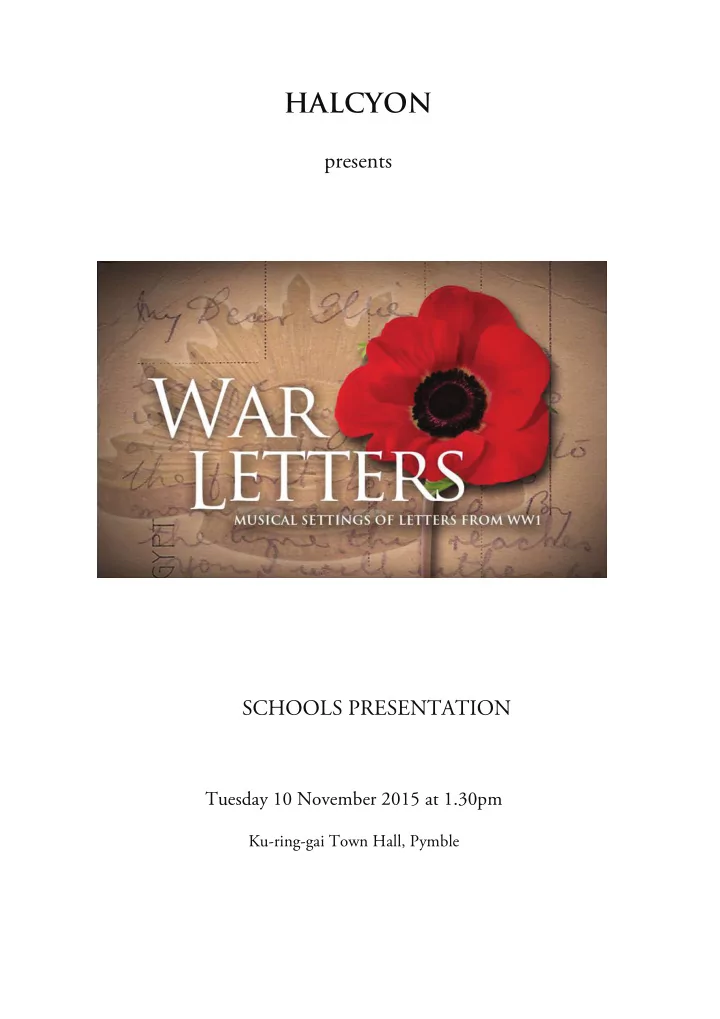
HALCYON presents SCHOOLS PRESENTATION Tuesday 10 November 2015 at - - PDF document
HALCYON presents SCHOOLS PRESENTATION Tuesday 10 November 2015 at 1.30pm Ku-ring-gai Town Hall, Pymble A WORD OF INTRODUCTION FROM DIANA BLOM One doesnt have to dig too deeply to find that many people have a family connection to WW1, with
One doesn’t have to dig too deeply to find that many people have a family connection to WW1, with relatives returning or not. A locket, which belonged to my grandmother, was given to me many years ago and in it is a photo of Frank Nestor Robinson. The only son in a family with seven daughters, his death at Gallipoli is said to have taken the light out of my great-grandfather’s eyes. But it was finding three letters he’d written to my grandmother as he sailed to, then arrived in, Suez, Egypt, awaiting action in Gallipoli in the Wellington Mounted Rifles, that was the impetus for this project. Halcyon is a musically adventurous and highly evocative professional contemporary classical music performance group. I thought they would respond to such a project and they did. Four composers of different generations were selected and once we heard funding had been received from an ANZAC Centenary Local Grants Program, the project was on the road. Composers and performers have responded with the music you’ll hear today and recording for a CD over the following weekend.. The support from Ku-ring-gai Council and others in the Bradfield Electorate has been tremendous and we thank them for this.
War Letters has been a fascinating project for Halcyon. Performing new commissions is part of the ensemble’s raison d’être, but to perform brand new works with century old texts is an unusual experience; usually the chosen poems or words are far more contemporary in tone. The thoughts, reflections and feelings expressed in these personal letters are as fresh today as they were 100 years
letters written by members of their own extended family. And from these personal memories we can reflect on the enormous impact of war, as it continues in our present lives, and truly empathise with those individuals who are speaking to us from both the past and the present.
I had originally asked Peter Sculthorpe to write for the War Letters project and he loved the idea of writing a song for Halcyon based on a WW1 letter. He said to me that: ‘growing up in the aftermath of WWI deeply affected me. The contours of bugle calls, especially The Last Post are present in much of my music’. Peter was thinking of writing about his Uncle Tom, who, ‘after immigrating to Tasmania in 1913, …then volunteered to go to the war. When he reached England he was interned with Spanish ‘flu. He felt so ashamed of not being able to fight for his country, that he invented an elaborate story about fighting in the trenches and catching the ‘flu there. The whole family believed that this was true… I keep thinking about [his story]. I don’t think there are any letters. I’ll call it Tom’s Story. …I’m well-aware that he could never have let his Yorkshire mother know that he’d never actually fought in the war, not to mention his two younger sisters, who regarded him as a hero. If I should choose to write about my Uncle Tom, it would be for narrator (bass) and singer (soprano), piano and just a little percussion’. Peter, in his 80s at the time of our communication, died last year and the song was never written. Diana Blom
ELLIOTT GYGER Un poilu australien (2015)
Clive Birch, Jenny Duck-Chong, James Wannan, Kaylie Dunstan, Jo Allan
NICOLE MURPHY ‘Dearest Mother...’ (2015)
Alison Morgan, James Wannan, Jo Allan
LARRY SITSKY Letter from the Trenches (2015)
Jenny Duck-Chong, James Wannan, Kaylie Dunstan, Jo Allan
DIANA BLOM Triptych (war letters) (2015)
Alison Morgan, Jenny Duck-Chong, Clive Birch, James Wannan, Kaylie Dunstan, Jo Allan
HALCYON Alison Morgan - soprano Jenny Duck-Chong - mezzo soprano Clive Birch - bass James Wannan - viola Kaylie Dunstan – percussion Jo Allan – piano Geoffrey Gartner – conductor A CD of the War Letters program will be recorded at Western Sydney University in mid-November and released by Wirripang Pty. Ltd (australiancomposers.com.au) in early 2016.
ANZAC Centenary Local Grants Program for funding for the War Letters project
Councillor Cheryl Szatow, Mayor of Ku-ring-gai Councillor Jennifer Anderson, Emeritus Mayor (former Mayor) of Ku-ring-gai through whom Council supported the project with the venue for rehearsal and performances and a substantial marketing contribution Professor Peter Hutchings, Dean of the School of Humanities and Communication Arts, Western Sydney University – WSU recording studio and Steinway piano for the CD release Roderick D. White, Hornsby RSL Sub Branch
words by Jacques Playoust
Jacques Playoust was born in Flanders in 1884, and emigrated to Australia with his family at the age of five. When World War I broke out, he returned to France along with his brothers, to fight in the French army. His experience of the war had some similarities with that of the young Australian volunteers, but where they enlisted in the service of a mother country most of them had never seen, Jacques was in a very real sense defending his homeland. He survived the war, although two of his brothers, and numerous other friends and relatives, were not so lucky. His letters, laced with a wryly subversive sense of humour and a pervasive sense of human decency, were later collected and published by his daughter, Jacqueline Dwyer, who has graciously given permission for me to use them in this work. Un poilu australien is scored for two singers, accompanied by viola, marimba and piano. The mezzo- soprano sings extracts from Jacques’ letters to his French relatives, written in French, while the bass sings extracts from those written to his younger siblings in Australia. While these are mostly in English, here too Jacques occasionally lapses into French, at which points the two voices sing together. The extracts are arranged chronologically into five movements, sketching out a trajectory from initial patriotic enthusiasm, through disillusionment and trauma, to moments of despair. The music draws on two sources: the French national anthem (La Marseillaise), and an extremely popular song among the Australian troops in World War I entitled Australia Will Be There. The latter is an almost Ivesian collage of fragments from other melodies, some clearly intentional (Auld Lang Syne), others perhaps fortuitous (Advance Australia Fair, It’s a Long Way to Tipperary); the instrumental intro unambiguously quotes La Marseillaise and Rule, Brittania side by side. My use of these sources is for the most part heavily distorted and disguised, subsumed into a new musical landscape in which familiar elements are glimpsed
Elliott Gyger AVIS. ANNOUNCEMENT. La mobilisation a été décrétée Mobilisation has been announced par le Gouvernement français by the French Government et a commencé le 2 Août. and commenced on August 2nd. Tous les Français en état de servir All Frenchmen in fit state to serve doivent, par conséquent, rejoindre à leurs frais, must consequently join at their own expense leur corps d'affectation dans le plus bref délai. the corps of their choice with the shortest possible delay. Le prochain départ pour MARSEILLE aura lieu, The next departure for MARSEILLE will take place, à moins d'avis contraire, in the absence of notice to the contrary, le 29° de ce mois.
Sydney, le 2 Août 1914 Sydney, August 2nd, 1914 My very dear Brothers and Sisters, A line to wish you again good-bye & as elder brother permit me to give you a little advice. In a critical moment like this everybody has got to do his little best. You need not worry but the greatest economy est a l'ordre du jour. (is the order of the day) My heartfelt sympathy is with Marguerite but let her bear up & think that her husband is doing his duty. If he does go to the front there is only a very small percentage of them that get hurt. With very best love to you all. I remain your devoted brother Jacques
Un petit "piou-piou" Français A little French foot-slogger qui vient vous souhaiter le bonjour. Comes to wish you good day. Voila 15 jours que je suis arrive. It is now a fortnight since I arrived. Pouvez-vous me donner des nouvelles? Can you give me news ? Je m'habitue assez bien à mon nouveau metier. I am getting well enough used to my new job. On prepare un nouveau convoie A new convoy is being prepared qui doit partir sous peu. which has to leave soon. Si je dois partir avec eux If I must go with them bien que je suis loin de connaitre le metier a fond even though I am far from knowing my job thoroughly je tacherai de me debrouiller I will try to manage et de faire mon devoir en bon Francais. and to do my duty as a good Frenchman. Tres affectueux souvenir, Very affectionate greetings, Jacques Playoust Jacques Playoust __________________________________________________________________________ Hotel Metropole, 37 Rue Francois 1er Champs-Elysées Dear Ninie, As you will see by the above address I am now in Paris. How pleased I am you can't imagine. Mother spoils and pets me like she never did. Under this regime I am progressing satisfactorily. Mother appears to be a very busy woman. Parcels for her soldiers take time. She has a big stock of all sorts of things, buiscuits, figs, caramels, butter and jam in tubes etc. A young grocers shop in fact. She gets things by the dozen. "It’s cheaper", she says. Dear Marguerite, I have just got a note from poor Paroissien. He has earned the Croix de Guerre but paid very dearly for it. More than 14 wounds, his face disfigured, most of his teeth knocked out, arms, hand, legs badly endommagés. (damaged) After six weeks in bed he is again on the mend and has a morale excellent. (excellent morale) Chere Marie, Dear Marie, Içi nous avons vu le soleil de temps en temps Here we have seen the sun from time to time mais son apparition a été tres ephemère. but its appearance has been very fleeting. Nous sommes au repos We are at rest une 10ne de kilometres du front. about ten kilometres from the front. Nous sommes logés dans des granges, We are lodged in barns, dans des écuries. in stables. Mon logement est de ces derniers bien aéré, My lodging is one of the latter, well ventilated, il y a des trous de tous les cotés. there are holes on every side. Les "totos" pourtant sont moins terribles. The lice, however, are less terrible.
Ces braves petites bête These fine little beasts n'aiment pas beaucoup l'engrais. don’t much like manure. Nous nous organisons We are organising ourselves pour une nouvelle offensive. for a new offensive. Ce n'est pas fort amusant It is not much fun mais puis qu'il faut avoir du courage, but as it is necessary to have courage, nous tacherons d'en avoir. we are trying to have some. Dear Ninie It will be some time before the North is rid from the Germans. We who are in front of this splendid combination and trenches and fortins (little forts) have no longer any illusions specially after our last attack, we advanced t'is true but not without enormous losses. We are going to win, I have not the slightest doubt but its going to take sometime yet. It will not be a brilliant victory but by usure. (attrition) Winter has started. It is cold Le courrier The message and it snowed all the morning que je viens de recevoir which I have just received n'est pas fort gai. is not very happy. Dear Marguerite, Cette pauvre Marguerite That poor woman Marguerite What a brave little woman you are! vient de recevoir ces tristes nouvelles, has just received the sad news, et combien de jeunes femmes se trouvent and how many young women are finding themselves dans le meme cas. in the same situation. Ne réfléchissons pas. C'est mieux. Let’s not think about it. It’s better. May your sacrifice be of avail. Je t'embrasse bien affectueusement. I embrace you with true affection. We have still very heavy work in front of us. __________________________________________________________________________ Dear Brothers & Sisters This mail from Australia has found me still safe & sound but after the most terrible week I have ever spent. Even now I can’t realise how I’m still alive to tell the tale. We went into line at the now famous dead man hill. Sunday the 10th I will never forget. Hardly had we got into position than a terrific bombardment started. For 12 solid hours it lasted, & we remained crouched in our battered trench with our bags on our heads. We did not eat & even the heaviest smoker did not think of lighting his pipe.
Towards 8 things quietened down & we set to work feverishly to build up again our trench. Scarcely had we started than the Boches attacked on our left with inflamable liquid & bombs. For a couple of hours we did not know whether we would be cut off. During the night we were relieved. As guide I had to go & get the fresh troops a couple of miles away. They only arrived at dawn & I had to hurry to get them in position before the Boches could see them. I could not get away in time & had to remain another day in hell. I got away at sunset that night. I had been 3 solid days with one meal, & 1 hours nervous sleep. We were indeed, what remained of us, in a sorry plight when we returned covered with mud & haggard. I’m still, especially morally, upset. Many have gone mad at less. I wonder is it possible to get through this war unscathed? Dear Brothers & Sisters Your mail of the middle of May has brought a little sunshine in my little hole here in 1st. line. The only link that remains
I did not appreciate how happy I was. Still I ought not to complain. __________________________________________________________________________ 14 Juillet 1916 July 14th 1916 Dear Brothers & Sisters, For the last 5 days Chère Marie Dear Marie, we have had quite an exciting time. The Boches suddenly woke up on the 12th by blowing 4 mines in front of our lines. Notre bon secteur n'existe plus. Our beautiful sector no longer exists. On the 13th July at 10 p.m. Hier les Boches nous ont envoyé Yesterday the Boches sent us as a sort of cheering for the national day They started to bombard us heavilly. une degelée d'obus de tout calibre a hail of artillery of every calibre pour la retraite. for the retreat. We answered with vim. Nous avons amelioré le feu d'artifice We improved the fireworks avec nos pieces with our guns
The fireworks must have been splendid et de 10h a minuit les feus d'artifice and from 10 until midnight the fireworks etaient très jolis. were very pretty. but I was quite content to stop at the bottom of my dugout. Things quietened down towards midnight & we were able to celebrate our fete nationale. (national day) Vive la France! Long live France! Rations were increased, Elle nous paie aujourd'hui Today she pays us 3 quarts of pinard supplémentaire, 3 quarts of extra red wine, 100 grammes de jambon, 100 grams of ham, 2 ciggars / 1 cigar, 1 cigar, 2 biscuits / des bisquits, some biscuits, 150 grammes of tinned vegetables des petits pois en conserve, small peas in syrup, a bottle of sparkling wine for 4. une bouteille de champagne pour quatre. a bottle of champagne for four. We had a real jollification & yesterday some had a little mal au cheveu. (headache) A current saying amongst the Poilus is Encore une que les Boches n’auront pas (another one the Boches won’t get) when they empty a bottle. __________________________________________________________________________ 23 August 1916 Dear Brothers & Sisters I am en route again. Demain une étape of 20 kilometres. (tomorrow a march) Quite enough when you have to carry 20 lbs. on your back. Then ‘attaque attaque’ for 3 months. (attack attack) Many of us will not see it through. Enfin espérons. Still let us hope. It would not be so bad it was the last effort that would be required of us. People can’t imagine the life that we are leading. At time the morale gets pretty low. What we would give for a broken leg, arm, now. Many would sacrifice either to be finished once & for all. I suppose it is right that the lives of millions should be sacrificed for the general welfare. Mais au point de vue personnel But from a personal point of view c’est atroce, c’est injuste. it is cruel, it is unjust.
Elliott Gyger was born in Sydney, and holds degrees in composition from the University of Sydney and Harvard
the multilayered interplay of music and text. Recent works include the celesta concerto Angels and Insects (2010); an hour-long solo piano work inspired by Dante, Inferno (2013), for Michael Kieran Harvey; and a tenor saxophone concerto entitled Smoke and Mirrors (2014), premiered in December 2014 by soloist Joshua Hyde with the Thailand Philharmonic Orchestra. His “dialogue for
performances with the SSO under Vladimir Ashkenazy in March 2012. giving voice (2012), for mezzo-soprano and five instruments, won the 2013 Paul Lowin Song Cycle Award, and was premiered by Jenny Duck-Chong with Halcyon in July 2014. 2015 to date has seen Sydney Chamber Opera’s critically acclaimed seasons of his chamber
From Joyous Leaves for Zubin Kanga and Arcko Symphonic Ensemble. Elliott is also active as a conductor, teacher and writer on new music. He was Assistant Professor of Music at Harvard from 2002 to 2007, and has taught at the University of Melbourne since 2008, where he is currently Senior Lecturer in Composition. He has been a tutor for young composer development programs with Halcyon, the Tasmanian Symphony Orchestra, and National Music Camp. He has written extensively on Australian composer Nigel Butterley, including a book on his music published by Wildbird Press in April 2015.
Edith (‘Queenie’) Florence Avenell (-1936) was a hospital nurse and matron born in the Queensland town
embarking from Sydney aboard the Mooltan on 15 May 1915. The ship travelled along the southern coastline of Australia to Fremantle, then departed for Egypt. During the war Queenie was stationed in Egypt, France and England, before returning home and being discharged from the Australian Army Nursing Service on 17 January 1919. The collection of letters that Queenie wrote to her mother during her years of service demonstrate insight into the life of a vibrant, young nurse who is passionate about the patients under her care. The early letters paint the picture of an excited, inquisitive young woman, experiencing new places and cultures, and socialising with the other servicemen and women. As the war continues, Queenie endures the cold European winters and becomes increasingly more worn down by the reality of war. Dearest Mother… uses text taken from ‘Queenie: Letters from an Australian Army Nurse, 1915-1917’, with kind permission from Pat Richardson, Anne Skinner, and Queenie’s family. Nicole Murphy I - Leaving Home Dearest Mother, We’ve been at sea now since Monday. The weather is simply beautiful, simply beautiful. We had a dance last night, dipping, dipping and stepping. A waltz… I even ragged! Dipping and stepping and dipping and stepping. A waltz… I even ragged. You will think we are all thinking of pleasure, but it’s so funny at sea not hearing any war news. Our letters are to be strictly censored so it will be very hard to write. The sea is like a mill pond and so blue, it is so blue. There are hundreds of little flying fish, shoals of porpoises, jumping, jumping and racing us. I can’t get over the calmness of the sea. It’s just like the Brisbane River. I have such lots to tell you, I do wish you were here, but never mind, wait ‘till I get home. II - Egypt Dear Mum, We were terribly busy today, getting ready for new patients. Poor beggars, poor beggars. All the arms and legs, with shrapnel wounds. Poor beggars, poor beggars.
My patients all have nightmares, on return from Gallipoli. My patients all have nightmares, killing Turks, yelling out. I’m on the go all the time, and my feet are sore. My feet are sore. Dearest Mother, Poor old boys look awful. Just shattered wrecks, awful. Just shattered wrecks. I feel sorry for Australia, it will be nothing but broken men after the war. The leaves are all dropping, soon the trees will be bare. It is so cold now and I am scared to think what it will be like at Christmas. III - France Mum, I met such a nice friend. Such a nice, nice, friend. Lieutenant Cunningham. So good to me, so nice. We go out, we have such gay, gay times. Lieutenant Cunningham. So good to me, so nice. Lieutenant Cunningham. He went to the front, I got three letters from him. This week, his pal wrote to say he is killed. IV - England Dearest Mum and all at home, It’s a bitter cold windy day. I can’t get warm sitting over a fire. I can hardly hold this pen, it’s so darned cold. Mum, I sometimes wonder, if we should ever get home again. It’s only a matter of time and they will all be killed. It’s awful to hear, but it’s only too true. We are not the fresh creatures of two years ago.
Australian composer Nicole Murphy is the recipient of various awards, including the Theodore Front International Orchestral Prize (2013), the Definiens C3 International Composer’s Award (2011), the Alan Lane Award for Composition (2004), the Collusion/QCGU Composition Prize (2004), and the A.G. Francis Prize for Composition (2001). Her music has been performed at festivals in various countries, including the Norfolk Chamber Music Festival (Connecticut, USA), the 30th Asian Contemporary Music Festival (Tel Aviv, Israel), the Gamper Contemporary Music Festival (Maine, USA), the Soundstream New Music Festival (Adelaide, Australia), the Dallas Festival of Modern Music (Texas, USA) and the Atlantic Music Festival (Maine, USA). Nicole has been commissioned by eminent arts organisations including the Australian Ballet, the Melbourne Symphony Orchestra, Orchestra Victoria, Wild Rumpus (San Francisco), Chamber Sounds (Singapore) and the Definiens Project (Los Angeles). Her music has been performed by ensembles such as the Tasmanian Symphony Orchestra, Ars Nova (Dallas), Halcyon (Sydney), Soundstream (Adelaide) and Chronology Arts (Sydney). Nicole completed her Master of Music degree at the Queensland Conservatorium of Music in 2011, under the tutelage of Dr. Gerardo Dirié. During her undergraduate degree she studied under Gerard Brophy, graduating in 2004 with a Bachelor of Music (Composition) with First Class Honours. She is represented as an Associate Artist by the Australian Music Centre and holds the position of Composer-in- Residence at the Queensland Academy for Creative Industries. She is currently completing a PhD at the University of Queensland.
When I received the commission to compose my piece, my initial response was to set an actual letter written from the front. But then, having read and searched through a number, I found it dramatically
extracting sentences from them, the sentences that resonated with my inner ear. I then arranged all of the sentences I had extracted into a particular order, to suit my musical demands. The net result is a kind of letter from a soldier Everyman, distilling and compressing the various experiences I had read. I chose a mezzo voice as a soloist (particularly the voice of the wonderful Jenny Duck-Chong), underlining the youth of so many of the soldiers. The instrumental line-up was dictated by Halcyon. The work began life as a set of short songs, eventually morphing into a sort of concert aria. Larry Sitsky The first thing you notice is the smell. The stench was terrible. It’s a smell of gas, sadness, fear and rotting flesh. Raw sewage from the open cesspit, body odour from men who haven’t washed for weeks. Dead bodies rotting in shallow graves and laying out in the open in no-man’s land. The smell of exploded bombs, the odour of mustard gas, stagnant mud, cigarette smoke. Death is all around. Dead and wounded Germans and Australians lying twisted and mangled beyond recognition. I noticed about six dead men, all rotting in the mud in a heap, Whether our or German it was hard to tell. You could see an arm or a leg pushing out of the mud. Bodies are strung along the rows of barbed wire. The dead lie unburied. I sleep next to dead people. With each explosion, the dead bodies roll back into the trenches. I have to wear my helmet over my face when I sleep, to stop the rats from eating my eyes out. The rats are of immense size. The whole floor is smothered in them. They live on the dead bodies. I have seen men so shattered by mortar, concussion that all they could do is sit and weep by the hour. The mud acts like quick-sand. We lost some men who were sucked into it while alive. I have seen my closest friends die in front of my eyes. Another’s trench foot turned gangrenous, and had to be amputated. Two of our own men were shot through the head by our own people. But things like that are not talked of in the papers. At night the front line is just one blaze of light, but it’s still freezing. Bitter cold. The snow lies thick. Gas! Gas! There aren’t enough gas masks. My hair is crawling with lice. There is no glory. All the propaganda are lies. We kill people just like us. It is barbaric and a futile waste of human life. I feel no pride in fighting and dying for my country. I am scared, my darling. I long for your warm embrace. Pray for my life and well being. I fear I won’t see you again. The enemy’s trenches are only a few feet distant. The valiant dead who once fought against each other have long been sleeping as comrades. On Christmas eve the guns fell silent, and then, after a few minutes, we heard a faint singing. The boys in
As daybreak approached, most of the men left in the trenches, greeting the enemy with a handshake. There was very little firing for the next two hours.
Born in China of Russian-Jewish parents, Larry Sitsky travelled to Australia in 1951, settling in Sydney. He studied piano from an early age and was granted a scholarship to the New South Wales Conservatorium of Music, where he graduated in piano and composition in 1955. In 1959 he won a scholarship to the San Francisco Conservatory, where he studied with the great Egon Petri for two years. He returned to Australia to join the staff of the Queensland Conservatorium of Music. In 1966 he was appointed Head of Keyboard Studies at the School of Music in Canberra (now part of the Australian National University), where he is now Distinguished Visiting Fellow, as well as Emeritus Professor.
Larry Sitsky has received many awards for his compositions and has had works commissioned by many leading Australian and International bodies. 1993 marked a huge national success with his opera The Golem, which is soon to be broadcast by the ABC and released online. In recognition of his various achievements, he was granted a Personal Professorial Chair at the Australian National University, and was awarded the University’s very first Higher Doctorate in Fine Arts in 1997. This year he received an APRA/AMCOS Lifetime Achievement Award for services to Australian Music. Currently he is working on a melodrama based on Yeats' play PURGATORY, intended for on-line viewing. He considers this a little warm-up piece for his major effort for next year, a grand opera for on-line viewing, based on Thomas Mann's blockbuster novel DOKTOR FAUSTUS, in which the composer Adrian Leverkuen sells his soul to the devil in exchange for a string of masterpieces. The work will be realized for flat screen computer viewing as well as a 3-D version.
Triptych (war letters) begins with letters written by Frank Nestor Robinson, my great-uncle, to one of his sisters, Ellie, my grandmother, as he left from New Zealand to fight in Gallipoli, 1915. They tell of why he enlisted – a duty call and friends were enlisting - waiting around for action, then in Egypt, the realisation from news brought back by the wounded, that where he and his fellow soldiers are to be sent, Gallipoli, is a field of fierce fighting and death and he will either be one of the lucky or unlucky ones. He was one of the unlucky ones. The middle part of the triptych is a December 1969 excerpt from the war diary of David Wilkins who served with Australian forces in Vietnam. He and his troop are not getting a Christmas break, fed up, and about to embark on a 7 week operation. And the third part is excerpts of Andrew Hastie’s emails (modern war letters) sent home while serving for Australia in Afghanistan, 2009. They move between descriptions of events and personal thoughts. Threaded throughout the work are three musical associations – the rolling compound metre of British/Australian nursery song, a rhythmic motive from a traditional Vietnamese musical genre, and the 7 beat grouping of an Afghan festival music. Diana Blom Gallipoli letter – Ellie, Frank Robinson Dear Ellie, Just a few lines to let you know my news. I have joined the expeditionary force for abroad and we mobilise in Palmerston North either on Tuesday or Wednesday next, with instructions to be ready to go abroad at an early date. Dear Ellie, At first I did not intend to go but on thinking it over I felt that it was a real duty call and I practically made up my mind to go. … so we talked it over and decided to go and now we are just waiting for orders. Mother and Father quite realise that it is my duty to go and so although I can see that they are sad they are both keeping cheerful and helping to keep me from being a coward. I would very much have liked to have seen you before I went, as one must face the possibilities, but it is impossible so this letter must suffice. My dear Ellie, Just a line in haste as we have just got orders to proceed to the front tomorrow morning at 2.30. By the time this reaches you I will either be lucky or else unlucky but I am quite willing to take my chances … everything is just what we hear from chaps who are wounded. Well I must stop. Love to all Frank [Post Card Egypt undated (August, 1915)] Vietnam diary – Great bloody Xmas break, David Wilkins Great bloody “Xmas” break we are getting – spending all the “break” in the bloody bush. The digs are even chiming “so many killing days to Xmas.” To top it off we are about to embark from this great rest onto our last operation of the tour – and it is to be over LONGEST – 7 WEEKS. Man’s a bloody robot! [17 December 1969]
Afghan emails – Bread and kids, Andrew Hastie I'm keeping well, as are my soldiers. We are a bit tired and the guys are flat after the death of Dan. … That was quite a shock, although I haven't had a much of an opportunity to process it all. [21 July 2009] I'm enjoying doing business with the Afghans. It is one of my natural inclinations to round up 'investors' and then order bread through … interpreters. It … goes to the local soldiers who then purchase in the
Already I have been exposed to some things that caught me off guard. …I find my faith gives me a lot of strength and I don't worry too much. … Pray that I would remain a cool head … The sun, and sand and sweat get to you and can coerce you into decisions that you otherwise wouldn't make. [26 June 2009] The kids are very cute. They run up to your vehicle whenever you stop and beg for pens and water
traditional clothes that made them seem like miniature grown-ups, except their little faces showed such
[19 June 2009] Diana Blom, a composer and pianist, has scores and CDs published by Wirripang Pty. Ltd., Orpheus Music and Wai-te-Ata Press. She has music degrees from Canterbury University (New Zealand) University of Michigan and the University of Sydney and was a composition student of Peter Sculthorpe. This year she wrote Remembrances Four for soprano and piano, setting words of Australian and Turkish Gallipoli survivors, which is about to be released on CD by Wirripang; Calling the cows – 7 variations for solo trombone, commissioned by the Risounanze Festival; and Smoke and Mirrors for tenor saxophone and
words of David Malouf, Helen Garner, Jennifer Rumsey, Lloyd Jones, Fiona Kidman, Basil Dowling, Tim Malfroy, Robyn Ravlich and Jocelyn Ortt-Saeed; plus a children’s opera libretto by Chitra Fernando. Recently curated projects, with commissioned compositions, performances, score and CD publications (released by Wirripang) include Antarctica – new music for piano and/or toy piano, Childhood in Music – new music for solo piano, and Shadows and Silhouettes – new music for solo piano with a Western-Chinese confluence all in collaboration with Italian pianist, Antonietta Loffredo; Australia East and West – new music for viola and piano curated and performed with Dawn Bennett; and Playing with Fire – new music for piano and electroacoustics, played by pianist Tamara Cislowska, and co-curated with Ian Stevenson. Diana is Associate Professor in Music at the Western Sydney University. She has research publications on issues in university music performance, the artist as academic, student popular songwriters and preparing new music for performance. Music Composition Toolbox, a co-authored composition textbook is published by Science Press.
Frank Nestor Robinson
ARTISTS BIOGRAPHIES
Regarded as a leading light in the field of new music, Halcyon presents stunning performances of vocal chamber music from around the world, with a special emphasis on Australian content. Over the past 17 years the ensemble has commissioned many works for voice and instruments, performing new repertoire around Australia at music festivals, through its own concert series and at industry events such as the AMC/APRA Classical Music Awards and the Paul Lowin Awards, where it has been associated on many occasions with short-listed and winning pieces. Halcyon has been tireless in its role as mentor to emerging musicians and composers, presenting concerts and workshops to secondary and tertiary composition students both locally and interstate. Recent appearances include a performance with Synergy Percussion of Steve Reich’s Music for 18 Musicians at the Opera House in the presence of the composer and a performance
by Larry Sitsky and Andrew Schultz, concert programs A Rhythm that Dances in May, Winter Moon Secrets, Ditties and Paradise in September and War Letters in November plus studio recordings of Schultz and soon to come the entire War Letters program. 2015 will also see several important CD releases: Kingfisher – Songs for Halcyon on the Tall Poppies label, featuring 21 songs commissioned by Halcyon for its 15th birthday and Waves III, featuring commissions by Nigel Butterley and Raffaele Marcellino, the third in Halcyon’s series of Waves self-releases. With a career spanning more than 25 years, mezzo soprano Jenny Duck-Chong has established herself as a versatile and intelligent musician with extensive experience in a broad range of classical repertoire. She has worked with Sydney's finest vocal ensembles, including Opera Australia, Pinchgut Opera, The Song Company and Cantillation including tours and festival performances within Australia, Europe and Asia. She is the director of acclaimed new music ensemble Halcyon, with whom she has been active in commissioning, premiering and performing Australian and international repertoire of the highest calibre for the last seventeen years. A passionate advocate of vocal chamber music Jenny has run classes, seminars and workshops for secondary and tertiary students and has and built relationships with composers, performers and institutions both in Australia and around the globe. Also an avid recitalist, Jenny has recorded numerous concerts for broadcast by the ABC and 2MBS-FM and in the recording studio, has featured as a soloist for ABC Classics and Walsingham labels as well as in film and TV scores and numerous other recordings with Cantillation, Pinchgut Opera, The Song Company, The Renaissance Players and Halcyon’s own recordings. Clive Birch has been a singer all his life but started singing in earnest whilst studying for a music degree at Huddersfield Polytechnic after which he concentrated on pure singing at the Guildhall School of Music in London where he won the Gold Medal in 1977. He has worked in the fields of opera and oratorio and since moving to Australia in 1987 he was a member of the Song Company until his retirement in 2014. Since then he has worked as writer and speaker for the Moorambilla Festival and with the renowned sculptor and artist Ken Unsworth. Soprano Alison Morgan is one of Australia's foremost interpreters of contemporary vocal music. In a career spanning over twenty years she has performed as a soloist with the Sydney Symphony Orchestra, The Australian Ballet, Pinchgut Opera, The Song Company, Ensemble Offspring, Synergy Percussion and Cantillation, with whom she has featured in numerous recording projects for ABC Classic FM. Among her many projects, Alison has appeared at the Four Winds Festival, the Canberra International Chamber Music Festival and on tour with Musica Viva and has performed regularly at industry events, including the APRA/AMC Arts Music Awards and the Peggy Glanville Hicks Address. As co-artistic director of acclaimed new music ensemble Halcyon, Alison has been instrumental in commissioning and performing a wealth of new Australian chamber music, most recently premiering the works of Australian composers Katy Abbott, Nigel Butterley, Nicholas Vines, Elliott Gyger, Andrew Ford and Andrew Schultz. Her international repertoire includes the virtuosic works of Kaija Saariaho, Harrison Birtwistle, George Crumb, Unsuk Chin, Trevor Wishart and Steve Reich. Halcyon’s latest venture, Kingfisher, heralds new songs by 21 of Australia’s finest composers for voice, to be released on CD in 2015. Alison has recently left the ensemble to pursue new directions, but is returning as guest artist for several projects this year. Violist James Wannan is Co-Artistic Director of the Australia Piano Quartet and an Associate of Sydney Chamber
Vienna with Marianne Rônez. He explores his passion for music from ancient to contemporary on a number of instruments. 2015 has seen James perform as violin soloist in Elliott Gyger's opera Fly Away Peter featured at the Melbourne Festival, record a CD of music by Jack Symonds, collaborate on 5 Australian commissions with APQ as part of their University of Technology Sydney residency and tour to Europe with APQ and China with the Sydney Symphony.
2016 will see James perform oud in the Sydney Festival with SCO and viola d'amore soloist in the Biennale. He will premier a new viola d'amore concerto at the Bendigo New Music Festival and record the Sonatas of Brahms with pianist Ben Kopp. As a soloist James has worked with orchestras including the Melbourne Chamber Orchestra, the Tasmanian Symphony Orchestra, and the Melbourne Symphony Orchestra. He has performed as a viola d’amore soloist in festivals in Austria and Germany, and has been invited to perform as guest principal viola with the Hong Kong Philharmonic Orchestra. He toured Europe as principal viola of the Asia Pacific United Orchestra. Noted Australian pianist Jo Allan is much in demand for her chamber music and ensemble playing, and regularly collaborates with leading singers and instrumentalists. Originally from Canberra, Jo undertook undergraduate studies there, and subsequently completed her Postgraduate Diploma in Accompaniment in Sydney. As the Sydney Symphony Orchestra’s Principal Keyboard, she has performed under many of the world’s finest conductors, including Lorin Maazel, Charles Dutoit, and Edo de Waart. She is experienced in a wide variety of styles ranging from classical to jazz and music theatre. Josephine has worked with many past and present fine Australian musical organisations, including the Australia Ensemble, the Australian String Quartet, Alpha Ensemble, the Seymour Group, the Song Company, Cantillation, Halcyon, the Melbourne Symphony Orchestra, the Australian Opera and Ballet Orchestra, the Tasmanian Symphony Orchestra, the Australian Chamber Orchestra, and Opera Australia, and has also had a long term association with both the Sydney Conservatorium of Music and the Sydney Philharmonia Choirs. Kaylie Dunstan completed her undergraduate degree in percussion at the Sydney Conservatorium of Music under Daryl Pratt and Richard Miller. She subsequently went overseas to Germany and completed a one year diploma course at the Hochschule für Musik in Detmold, followed up by a two-year bachelor course at the Hochschule für Musik in Stuttgart. During her time overseas, she participated in several festivals including the Zeltsman Marimba Festival in Amsterdam, ‘Percussion Week’ in Stuttgart and and Marimba days in Detmold. She also toured with the Talking Drums Percussion group and played with the Bruchner Symphony Orchestra. Kaylie relocated to Sydney at the beginning of 2013 and is completing her masters of performance research with supervisors Daniel Rojas and Claire Edwardes. Kaylie’s research explores percussion music merged with elements of theatre such as the use of vocals, physical gesture and acting. In 2014, Kaylie was chosen as a performing artist in the New Music Network’s Mini Series giving a solo recital in Sydney, which involved performing the duet Seasons by Toru Takemitsu with Hilary Engel in the United States via live streaming. Geoffrey Gartner’s performances are known for their drama and intensity. Solo and chamber music is his
performs with the voices of Halcyon, and this year toured Australia playing ambulatory cello with Sydney Dance Company in its production De Novo. Always the versatile musician, Geoffrey conducts, plays cello and piano and loves singing choral communion at St Mark’s, Darling Point. He is a product of Sydney Conservatorium and University of California, San Diego.
Edith ‘Queenie’ Florence Avenell