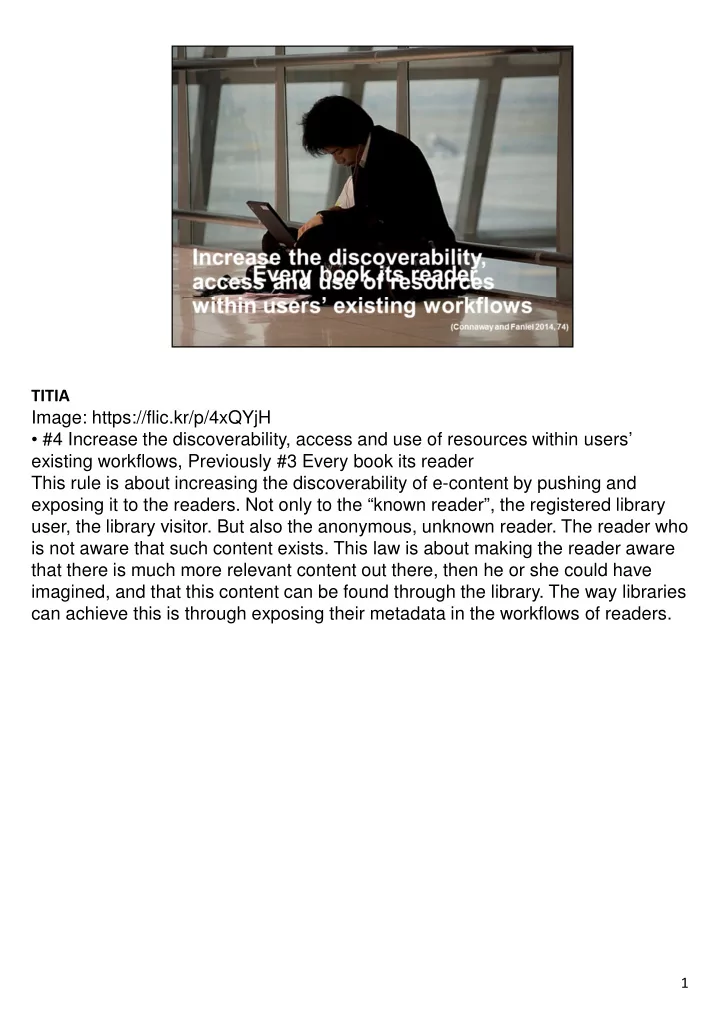
SLIDE 1 TITIA Image: https://flic.kr/p/4xQYjH
- #4 Increase the discoverability, access and use of resources within users’
existing workflows, Previously #3 Every book its reader This rule is about increasing the discoverability of e-content by pushing and exposing it to the readers. Not only to the “known reader”, the registered library user, the library visitor. But also the anonymous, unknown reader. The reader who is not aware that such content exists. This law is about making the reader aware that there is much more relevant content out there, then he or she could have imagined, and that this content can be found through the library. The way libraries can achieve this is through exposing their metadata in the workflows of readers.
1
SLIDE 2
Libraries are increasingly becoming aware that discovery happens elsewhere. This is even true for Research Libraries trying to reach their own users: students and scholars are by-passing the library discovery tools.
2
SLIDE 3
They are going directly to the databases they need: Scopus, Google Scholar, PubMed, Web of Science … via their preferred Search Engine (such as Google).
3
SLIDE 4
And they find the articles they need, without making use of the library discovery tool. They find the content they need and then expect the library to deliver the content.
4
SLIDE 5 This is what we call Syndication: exposing library metadata to the SEs, other discovery services and environments, in an effort to bring the metadata within the user’s
- workflows. In this way libraries reach their registered users, and potentially a much
larger audience of users. Syndication is a way to make content discoverable.
5
SLIDE 6
OCLC Research has invested much effort in developing syndication practices. It has adopted Schema.org as the method for exposing library metadata, thereby adhering to a format that can be consumed by the large SE’s.
6
SLIDE 7
What we are trying to achieve is to expose authoritative and good quality library metadata that SE’s like Google will be happy to re-use in their discovery features – such as the Knowledge Cards.
7
SLIDE 8
How successful are we?
8
SLIDE 9
Syndication implies we are freeing library metadata from their containers
9
SLIDE 10
10
SLIDE 11
11
SLIDE 12
12
SLIDE 13
13
SLIDE 14
14
SLIDE 15
15
SLIDE 16
16
SLIDE 17
17
SLIDE 18
18
SLIDE 19
19