
- 081020 Bibliotheca Alexandrina Compiled by Ahmed Ghazi, Ghada El-Abbady & Manar Badr
1
- mer’s life is a shadow in the mists of ancient history.
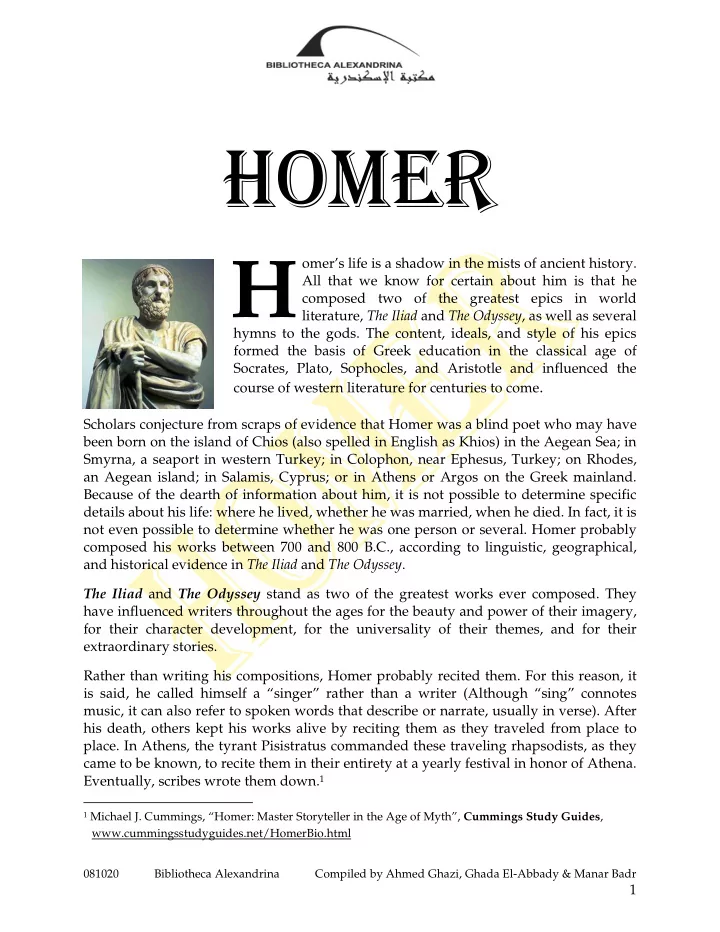
All that we know for certain about him is that he composed two of the greatest epics in world literature, The Iliad and The Odyssey, as well as several hymns to the gods. The content, ideals, and style of his epics formed the basis of Greek education in the classical age of Socrates, Plato, Sophocles, and Aristotle and influenced the course of western literature for centuries to come. Scholars conjecture from scraps of evidence that Homer was a blind poet who may have been born on the island of Chios (also spelled in English as Khios) in the Aegean Sea; in Smyrna, a seaport in western Turkey; in Colophon, near Ephesus, Turkey; on Rhodes, an Aegean island; in Salamis, Cyprus; or in Athens or Argos on the Greek mainland. Because of the dearth of information about him, it is not possible to determine specific details about his life: where he lived, whether he was married, when he died. In fact, it is not even possible to determine whether he was one person or several. Homer probably composed his works between 700 and 800 B.C., according to linguistic, geographical, and historical evidence in The Iliad and The Odyssey. The Iliad and The Odyssey stand as two of the greatest works ever composed. They have influenced writers throughout the ages for the beauty and power of their imagery, for their character development, for the universality of their themes, and for their extraordinary stories. Rather than writing his compositions, Homer probably recited them. For this reason, it is said, he called himself a “singer” rather than a writer (Although “sing” connotes music, it can also refer to spoken words that describe or narrate, usually in verse). After his death, others kept his works alive by reciting them as they traveled from place to
- place. In Athens, the tyrant Pisistratus commanded these traveling rhapsodists, as they
came to be known, to recite them in their entirety at a yearly festival in honor of Athena. Eventually, scribes wrote them down.1
- 1 Michael J. Cummings, “Homer: Master Storyteller in the Age of Myth”, Cummings Study Guides,
www.cummingsstudyguides.net/HomerBio.html
- H