
SLIDE 1
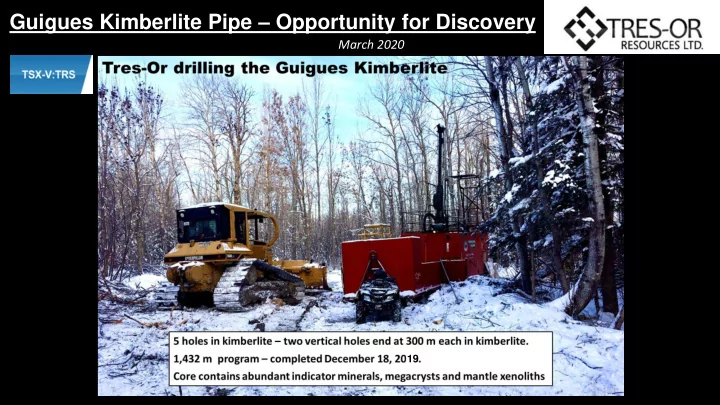
Guigues Kimberlite Pipe Opportunity for Discovery March 2020 19 - - PowerPoint PPT Presentation
Guigues Kimberlite Pipe Opportunity for Discovery March 2020 19 Cautionary Notes Forward-Looking Statements This presentation contains projections and forward-looking information that involve various risks and uncertainties, including
This presentation contains projections and forward-looking information that involve various risks and uncertainties, including without limitation, statements regarding the potential extent of mineralization, resources, reserves, exploration results and plans and
geological data available, the uncertain reliability of drilling results and geophysical and geological risks and data and the interpretation thereof and the need for adequate financing for future exploration and development efforts. There can be no assurances that such statements as described above will prove to be accurate. Actual results and future events could differ materially from those anticipated in such statements. These and all subsequent written and oral forward-looking statements are based on the estimates and opinions of management on the dates they are made and are expressly qualified in their entirety by this notice. The Company assumes no obligation to update forward-looking statements should circumstances or management’s estimates or
Disclosure of a scientific or technical nature related to the Company’s projects and exploration activities was prepared under the supervision of Dr. Harrison O. Cookenboo, Ph.D., P.Geo., an independent Qualified Person (as such term is defined in National Instrument 43-101), and Ms. Laura Lee Duffett, P.Geo., the Company’s President and CEO, who is a non-independent Qualified Person, both of whom have reviewed and approved the technical and scientific portions of this presentation. All amounts are in Canadian dollars, unless otherwise indicated.
Powerline Farm road
Guigues Kimberlite
De Beers Victor Mine
De Beers/Tri-origin
Drill program 2019/2020
95-2 Kimberlite
w/ diamonds!
+/- 6.6;
reported in Sage, 1996)
(Evaluation methods summarized in Cookenboo and Grütter, 2010)
G10s
(Evaluation methods summarized in Cookenboo and Grütter, 2010)
G10s
Tres-Or analyzed kimberlite indicator minerals (KIMs) by electron microprobe from three RC drill holes Guigues Kimberlite in Quebec during October, 2010. The three holes were from the north (4202-1), central (4303-3) and southern (4204-1) parts of the pipe. The electron microprobe analyses were conducted at the Department of Earth and Ocean Sciences at the University of British Columbia (UBC), Vancouver, B.C., using a Cameca SX-50 electron microprobe. Indicator minerals were selected for electron microprobe analysis to help evaluate the chemical potential of the mantle source region to carry diamonds. The selected grains were mounted on resin plugs, polished to microprobe standards, and coated with carbon before being analyzed by electron microprobe. The elements analyzed for oxide indicator minerals are Mg, Al, Si, Ca, Ti, V, Cr, Mn, Fe, and Ni. For silicates, the elements are Mg, Al, Si, Ca, Ti, Na, Cr, Mn, and, Fe, with double count times on Na to increase sensitivity at trace concentration levels. All elements are reported as weight percent oxides. Analytical parameters followed the established electron microprobe procedures at UBC, including extended count times for Na in garnet, as summarized below: the electron microprobe analytical routine designed for a fully automated CAMECA SX-50 instrument, operating in the wavelength-dispersion (WDS) mode:
excitation voltage - 15 kV; beam current - 30 nA; peak count time - 10 s (60 s for Na!); background count-time, 5 s (30 s for Na!); spot diameter, 5 m. Pulse height analysis (integral mode) for all elements use baseline = 0.5 V, open window. The following standards, X-ray lines, crystals, and background positions (+/ sin 105) were used for the elements listed: albite, NaK, TAP, 700/700; grossular, AlK, TAP, 800/-800; diopside, MgK, TAP, 1500/1500; grossular, SiK, TAP, 700/700; grossular, CaK, PET, 750/750; rutile, TiK, PET, 650/600; synthetic magnesiochromite, CrK, LIF, 700/700; synthetic rhodonite, MnK, LIF, 300/200; synthetic fayalite, FeK, LIF, 700/1400. Oxygen was calculated from stoichiometry. Data reduction was done using the 'PAP' (Z) method (Pouchou & Pichoir 1985). Software used was XMAS Plus by SAMx. Reference:
Cookenboo, H.O., and Duffett, L.L., 2010. ASSESSMENT REPORT ON THE RC DRILL PROGRAM FOR RECOVERY AND ANALYSIS OF KIMBERLITE INDICATOR MINERALS, GUIGUES KIMBERLITE PIPE, QUEBEC. Filed with Quebec government, 8 p.
300 m 300 m
Cookenboo, H.O., and Grütter, H.S., 2010. Mantle-derived indicator mineral compositions as applied to diamond exploration. Geochemistry: Exploration, Environment, Analysis 2010; v. 10; p. 81-95 Grütter, H.S., Latti, D. and Menzies, A. 2006. Cr-saturation arrays in concentrate garnet compositions from kimberlite and their use in mantle barometry. Journal of Petrology, v. 47, p. 801–820. Sage, R.P., 1996. Kimberlites of the Lake Timiskaming Structural Zone. ONTARIO GEOLOGICAL SURVEY Open File Report 5937, 435 p. Smit, K.V., Pearson, D.G., Stachel. T., ad Seller, M., 2014. Peridotites from Attawapiskat, Canada: Mesoproterozoic Reworking of Palaeoarchaean Lithospheric Mantle beneath the Northern Superior Superterrane. Journal of Petrology, v. 55, p. 1829 to 1863. Stachel, T., Banas, A., Aulbach, S., Smit, K.V., Wescott, P., Chinn, I., Fischer, D., and Wong, J., 2017. The Victor Diamond Mine (Superior Craton, Canada) – A new paradigm for exploration in unconventional settings. 11th International Kimberlite Conference Extended Abstract No. 11IKC-4453, 3 p. Wood, B.D, Scott Smith, B.H., and Rameseder, B., 2013. The Victor Diamond Mine, Northern Ontario, Canada: Successful Mining of a Reliable Resource Proceedings of 10th International Kimberlite Conference, Volume 2, Special Issue of the Journal of the Geological Society of India, p. 19 to 33.