Guidelines for Presentation - Problem / Solution / Evaluation Topic - - PDF document

guidelines for presentation problem solution evaluation
SMART_READER_LITE
LIVE PREVIEW

Guidelines for Presentation - Problem / Solution / Evaluation Topic - - PDF document

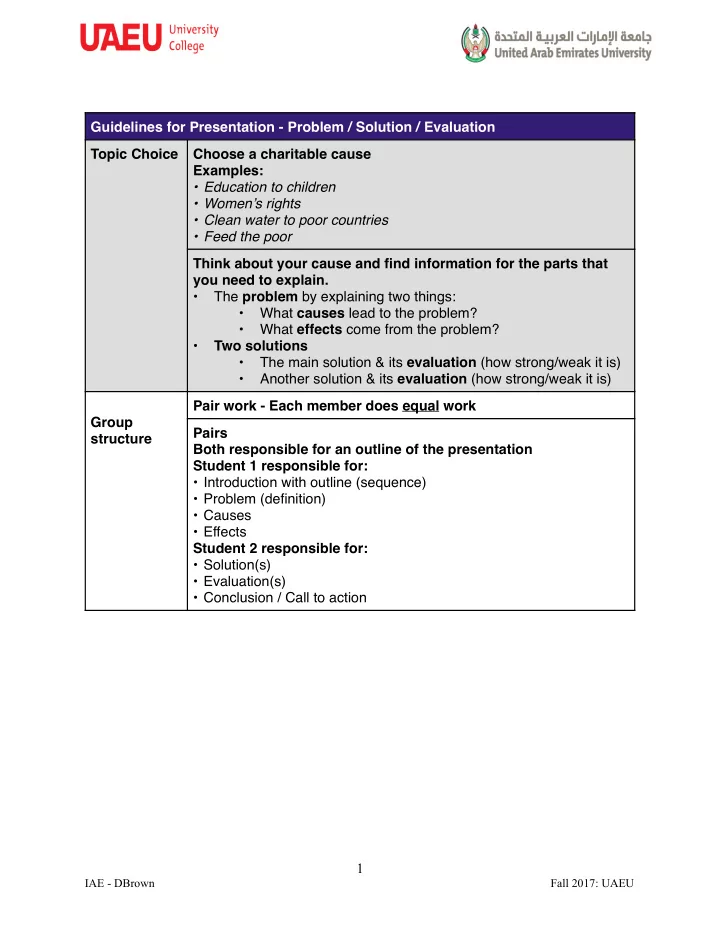
Guidelines for Presentation - Problem / Solution / Evaluation Topic Choice Choose a charitable cause Examples: Education to children Womens rights Clean water to poor countries Feed the poor Think about your cause and find


slide-1
SLIDE 1

Guidelines for Presentation - Problem / Solution / Evaluation Topic Choice Choose a charitable cause Examples:

  • Education to children
  • Women’s rights
  • Clean water to poor countries
  • Feed the poor

Think about your cause and find information for the parts that you need to explain.

  • The problem by explaining two things:
  • What causes lead to the problem?
  • What effects come from the problem?
  • Two solutions
  • The main solution & its evaluation (how strong/weak it is)
  • Another solution & its evaluation (how strong/weak it is)

Group structure Pair work - Each member does equal work Pairs Both responsible for an outline of the presentation Student 1 responsible for:

  • Introduction with outline (sequence)
  • Problem (definition)
  • Causes
  • Effects

Student 2 responsible for:

  • Solution(s)
  • Evaluation(s)
  • Conclusion / Call to action
  • 1

IAE - DBrown Fall 2017: UAEU

slide-2
SLIDE 2

Organization & content Organization:

  • Clearly state the plan in an introduction outline slide
  • Group & order your information
  • Clearly show & say what each part of your presentation is
  • Include titles on slides & tell us what you will say for that part
  • Clearly inform the audience of each part when you transition from
  • ne part of the presentation to another part
  • Example: from causes to effects / from a solution to its

evaluation

  • Make sure each point on a slide supports the purpose of that slide

Content: Provide paraphrased information in the outline & on the slides:

  • Give explanations
  • Give examples
  • Conclude each point to transition to the next

Check correctness of all information Provide citations next to points that are:

  • data
  • expert opinions
  • research
  • definitions

Important Notes:

  • Not all points & text from your outline & research will be on the

slides

  • You must give full explanations & examples that you know & are

prepared to give

  • 2

IAE - DBrown Fall 2017: UAEU

slide-3
SLIDE 3

Presentation Skills Preparedness

  • Prepared: Does not read slides (full marks)
  • knows what she wants to say
  • slides simply an aid
  • Not prepared: Reads slides (0 marks)
  • reads only
  • uses slides as a crutch to give presentation - seems unsure

Fluency

  • Pausing
  • Showing natural breaks between presenting each point,

explanation & example

  • When transitioning, give a pause to help audience understand

the transition is happening

  • Projection of voice and body language to class
  • Loud enough for audience to hear at all times
  • Faces audience & presents to them, not the slides

Visuals Structure of PPT & Slides:

  • Exact # of slides based on outline:
  • 1. Title Slide
  • 2. Introduction (plan)
  • 3. Problem (definition)
  • 4. Causes
  • 5. Effects
  • 6. Solution - Evaluation
  • 7. Solution - Evaluation
  • 8. Conclusion - Call to Action
  • Number of points on slides:
  • Title
  • 4 points maximum
  • Each point should have a maximum of 4 words
  • 1 image per slide

Professional Design of PPT & Slides:

  • Clear & Clean
  • Good spacing
  • Font size & color appropriate & consistent
  • Information spelled correctly on slides
  • Note form of information only

Time Time requirement per student: 4 - 6 minutes

  • 3

IAE - DBrown Fall 2017: UAEU

slide-4
SLIDE 4

Summary Topic:

  • Charitable Cause - Global Problem & Solutions
  • Causes / Effects of the Problem
  • Solution 1 + Evaluation of Solution
  • Solution 2 + Evaluation of Solution

Organization:

  • Include plan (outline)
  • Each part has title
  • Clear transitions between parts
  • Points on a slide support that part

Content (information):

  • Paraphrased
  • Correct
  • Explanations + Examples for each point
  • Citations with data, expert opinions, research, & definitions

Presentation Skills:

  • Preparedness
  • Does not read slides / knows what she wants to say
  • Uses slides as help only
  • Pausing
  • Takes time between points to allow audience to follow easily
  • Projection
  • Projects voice (audience can hear easily)
  • Presenter looks at audience & faces them

Visuals

  • Structure of PPT & Slides
  • Exact number of slides, points, and images - given above
  • Design of PPT & Slides
  • Professional design
  • Spacing
  • Font size & color
  • Note form of information
  • 4

IAE - DBrown Fall 2017: UAEU