
SLIDE 1
Irish Residential Properties REIT plc Report and Financial Statements
For the period 2 July 2013 (date of incorporation) to 31 December 2014
Growth and Opportunity Profile Irish Residential Properties REIT plc - - PDF document
Irish Residential Properties REIT plc Report and Financial Statements For the period 2 July 2013 (date of incorporation) to 31 December 2014 Growth and Opportunity Profile Irish Residential Properties REIT plc (the Company or I-RES )
For the period 2 July 2013 (date of incorporation) to 31 December 2014
Irish Residential Properties REIT plc (the “Company” or “I-RES”) is a growth-oriented Real Estate Investment Trust (“REIT”) that
non-governmental residential landlords in Ireland, the Company is focused on acquiring and professionally managing interests in multi-unit rental residential properties in Ireland. The Company’s shares are listed
visit the Company’s website at www.iresreit.ie.
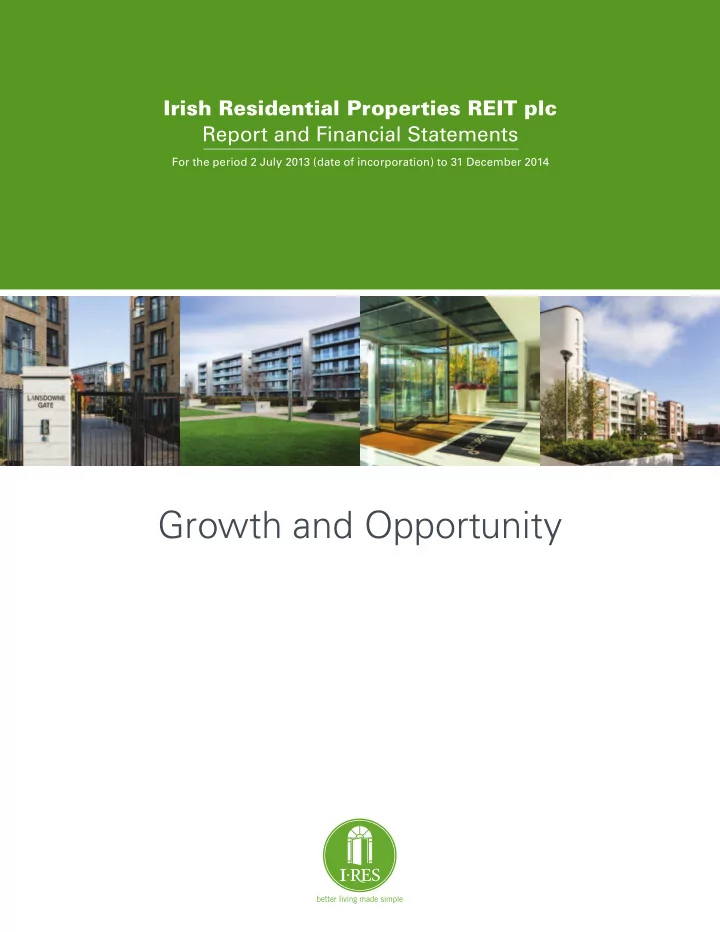
On the cover (from left to right): Lansdowne Gate, Charlestown, Beacon South Quarter, Camac Crescent.
Irish Residential Properties REIT plc Report and Financial Statements
1
Review 2 Financial and Operating Highlights 4 I-RES at a Glance 6 Chairman’s Statement 9 Chief Executive Officer’s Statement 13 IRES Fund Management, Investment Advisor and Property Manager’s Statement 14 Portfolio Overview 20 Investment Policy and Strategy Governance 24 I-RES Board of Directors 26 CAPREIT and IRES Fund Management Senior Management 27 Corporate Governance Statement 33 Report of the Audit Committee 35 Report of the Remuneration Committee 38 Report of the Nomination Committee 39 Report of the Directors 50 Statement of Directors’ Responsibilities Financial Statements 51 Independent Auditors’ Report to the members of Irish Residential Properties REIT plc 56 Statement of Financial Position 57 Statement of Profit or Loss and Other Comprehensive Income 58 Statement of Changes in Shareholders’ Equity 59 Statement of Cash Flows 60 Notes to Financial Statements 78 Glossary of Terms 78 Forward-Looking Statements 79 Shareholder Information Lansdowne Gate
2
Irish Residential Properties REIT plc Report and Financial Statements
Continued shortage of housing supply helps support the rental market
HOUSING REQUIRED 2011 – 2021
ANNUALLY
Ireland Dublin
HOUSING STARTS 2013
>4,500
ANNUALLY HOUSING STARTS 2013
838
ANNUALLY HOUSING REQUIRED 2011 – 2021
ANNUALLY
Operating performance since acquisition
Average Monthly Rent
(Initial Portfolio)
Occupancy
(Initial Portfolio)
NRI Margin
€1,117 €900
Total Portfolio Initial Portfolio
71% 81%
for H2 2014 (2)
77%
to Sept 2014 (1) Initial Portfolio at acquisition in September 2013 Initial Portfolio as at 31 December 2014 Total Portfolio (1) For the period 2 July 2013 to 30 September 2014 (2) For the six months to December 2014
93% 100%
Irish Residential Properties REIT plc Report and Financial Statements
3
to 31 December 2014
borrowings under credit facility within six months
valued at €323.6 million as at 31 December 2014
ended 31 December 2014
paid on 31 March 2015
For the period 2 July 2013 to 31 December 2014 (1) Revenue € 9.7m Gross Initial Yield 6.1% Net Initial Yield 5.0% Net Profit € 7 .9m Loan to Value 37 .6% EPRA NAV per share € 0.995 Pro-forma NAV per share € 1.032 Occupancy Rate 99.7% Average Monthly Rent € 1,250
(1) Trading since September 2013
since 31 December 2014
shares raising gross proceeds
Rockbrook Portfolio consisting
credit facility
4
Irish Residential Properties REIT plc Report and Financial Statements
1 9 4 10 3 5 6 8 11
The Marker Beacon South Quarter Charlestown Bakers Y ard Lansdowne Gate Rockbrook Portfolio
6 7 8 9 10 11
Kings Court
1
Grande Central
2
Priorsgate
3
Camac Crescent
4
The Laurels
5
2 7
with a track record of growth and value creation in the residential sector
a variety of different sellers
real estate
Dublin office, supplemented by the CAPREIT platform
Building Date Number of Property Location Y ear Built Class Acquired Suites Owned
1 Kings Court Smithfield 2006 Luxury 10 Sep 2013 83 2 Grande Central Sandyford 2007 Luxury 10 Sep 2013 65 3 Priorsgate Tallaght 2007 Luxury 10 Sep 2013 102 4 Camac Crescent Inchicore 2008 Luxury 10 Sep 2013 90 5 The Laurels Tallaght 2007 Mid-tier 27 Jun 2014 19 6 The Marker Docklands 2012 Luxury 18 Jul 2014 84 7 Beacon South Quarter Sandyford 2007/2008 Luxury 7 Oct 2014 217 8 Charlestown Finglas 2007 Luxury 7 Oct 2014 235 9 Bakers Yard Portland Street North 2007/2008 Mid-tier 7 Oct 2014 85 10 Lansdowne Gate Drimnagh 2005 Luxury 7 Oct 2014 224 T
1,204 11 Rockbrook Portfolio Sandyford 2007 Luxury 31 March 2015 270 T
1,474
Irish Residential Properties REIT plc Report and Financial Statements
5
The Company appointed Gandon Alternative Fund Management Limited as its alternative investment fund man- ager (the “AIFM”) in accordance with the European Union (Alternative Investment Fund Managers) Regulations, 2013 (the “AIFM Regulations”), until such time as IRES Fund Management Limited (“IRES Fund Management”) becomes authorised by the Central Bank as an alternative investment fund manager under the AIFM Regulations. The Company is externally managed by IRES Fund Management, an indirect wholly owned subsidiary of CAPREIT . CAPREIT is listed on the Toronto Stock Exchange and is one of the largest REITs in Canada with a portfolio of 41,688 residen- tial suites, a gross asset value of C$5.9 billion and a market capitalisation of C$2.8 billion as at 31 December 2014. The Company paid a maiden dividend in March 2015 as I-RES has grown its operating platform and effectively de- ployed the initial offering proceeds.
Financial Results
The period since April 2014 has been a very active one for the Company. During this time I-RES has acquired a further 866 residential suites, bringing its total number of residential suites to 1,204 as at 31 December 2014, and is now one of the largest non-governmental residential landlords in Ireland. As at 31 December 2014, the Company had invested a total
area, funded by the net proceeds from the initial offering to- gether with €125 million of debt. The Company has generated strong growth in all key per- formance metrics during the period with occupancy levels closeto100%andstrongrentalgrowthacrosstheportfolio, withaveragerentalincreasesof10%–15%asat31December 6
Irish Residential Properties REIT plc Report and Financial Statements
I AM PLEASED TO PRESENT the Company’s results for the period from incorporation on
2 July 2013 to 31 December 2014. The Company began trading in September 2013 when it completed its first acquisition, consisting of 338 suites across four multi-unit residential properties in Dublin. In April 2014 the Company completed a successful €200 million initial offering through a listing
2014, mirroring the strong market fundamentals in the resi- dential rental sector in Ireland. The Company’s property portfolio was valued at €323.6 million as at 31 December 2014 with total net borrowings of €125million.TheCompany’sloantovalueratiowas37 .6%, wellwithinthe45%–50%limitcurrentlyconsideredprudent by the Company’s board of directors (the “Board”). The NAV and EPRA NAV were €201 million, with NAV and EPRA NAV per share of €0.995, as at 31 December 2014. This is a positive outcome in such a short period as the Company has substantially recovered the expenses incurred as part of the initial offering in April 2014 and the cost of acquisition of prop- erties through fair value appreciation. As acquisition activity has been relatively significant over the six-month period to 31 December 2014, adjusting for these transaction costs, which amount to €0.037 NAV per share, the Company’s pro-forma NAV per share for 31 December 2014 would have been €1.032, which demonstrates the value growth achieved over the period and the continued strength we are seeing in the under- lying rental market. Basic EPS and EPRA Basic EPS for the period were €0.083 and €0.016, respectively.
Investment Advisor and Property Manager
The Board is pleased with the significant contribution that the Company’s investment advisor and property manager, IRES Fund Management, as well as senior manage- ment and other staff of CAPREIT have made to the Company during the period. IRES Fund Management as well as senior management and other staff at CAPREIT have brought a wealth of professional experience in the management of multi-unit residential properties to the Company. We believe
Irish Residential Properties REIT plc Report and Financial Statements
7 that IRES Fund Management and CAPREIT’s contributions will continue to generate further improvement in the Company’s operating results.
Pipeline Agreement
In addition to CAPREIT’s investment in the Company, CAPREIT has also demonstrated its willingness to provide support for the development of I-RES through the entering into by CAPREIT Limited Partnership (“CAPREIT LP”), a wholly owned subsidiary of CAPREIT , of the pipeline agree- ment in November 2014, as amended on 9 February 2015 (the “Pipeline Agreement”). The Pipeline Agreement was amendedtoincludeanunderwritingfeeof1%ofthepur- chase price of each property investment acquired under the Pipeline Agreement as part of the acquisition price payable by the Company to CAPREIT LP for each such property in- vestment under the Pipeline Agreement. Under the terms of the Pipeline Agreement, CAPREIT LP made available up to €150 million of funding, which it agreed to use to acquire and hold properties that fell within the Company’s investment policy until such time as the Company raises sufficient equity
LP . The Pipeline Agreement is considered to be a related party transaction under the listing rules of the Irish Stock Exchange (the “Listing Rules”) and was therefore approved by share- holders at an extraordinary general meeting on 25 March 2015. The €150 million facility commitment provided by CAPREIT LP to I-RES under the Pipeline Agreement terminated on 26 March 2015 on completion of the Capital Raise (as de- fined below). The facility commitment may be reauthorised by CAPREIT’s board of trustees at a later date. The Pipeline Agreement allowed the Company the oppor- tunity to participate in certain auction processes at a time when it did not have the cash resources or debt capacity to do so otherwise.
Events Since the End of the Period
On 28 January 2015, under the terms of the Pipeline Agreement, IRES Residential Properties Limited, an indirect wholly owned subsidiary of CAPREIT LP (the “Rockbrook SPV”), acquired a portfolio of 270 residential suites and approximately 50,000 square feet of mixed-use Beacon South Quarter
8
Irish Residential Properties REIT plc Report and Financial Statements
commercial space located in Dublin, Ireland (the “Rockbrook Portfolio”) for approximately €87 .3 million (including VAT, but excluding other acquisition costs of approximately €2.5 million). The portfolio includes an approximate 2.8-acre development site with associated basement car parking. On 26 March 2015, the Company issued 215,000,000
In connection with the completion of the Company’s Capital Raise, CAPREIT indirectly made a further investment of €23.5 million. Pursuant to the terms of the Pipeline Agreement, the Company acquired the Rockbrook Portfolio via the acquisition
from the Capital Raise. The Rockbrook Portfolio represents a strategic acquisition consisting of 270 residential suites, some
a number of residential suites. Pursuant to the terms of the Company’s credit agreement,
from the Capital Raise and repaid €43.0 million of the €55.0 mil- lion of borrowings drawn down under the revolving facility.
Outlook
Since the initial offering in April 2014 and ongoing, the Company has been in a rapid growth stage, with a significant level of investment activity taking place in the period between the initial offering and 31 December 2014, which it is contem- plated will continue going forward. The trading results for the period to 31 December 2014 are therefore not representa- tive of a full year’s contribution from the Company’s existing investments. The Board is pleased with the Company’s progress and performance and in particular the timely execution of its stated investment strategy. We also believe the positive outlook for Ireland and its property market will lead to increased demand in the residen- tial rental sector and an increase in the value of our property portfolio. The Board believes that the Company is well positioned to become one of the leading consolidators of multi-unit resi- dential rental properties in Ireland. As the Company’s portfolio increases in size and scale, we are confident this external growth will be augmented by organic growth in cash flows through the implementation of IRES Fund Management’s property and asset management programmes. We look for- ward to the year ahead as we build on our initial success. Colm Ó Nualláin Chairman
Chairman’s Statement (cont’d)
Irish Residential Properties REIT plc Report and Financial Statements
9 As at 31 December 2014, our total property portfolio in- cluded approximately 7 ,699 square meters of commercial
brook Portfolio by the Company, our total property portfolio includes approximately 12,364 square meters of commercial space as of the date of this Report. As at 31 December 2014, our total property portfolio had a current asset value of approximately €323.6 million and the Rockbrook Portfolio had a current asset value of approximately €88.93 million. Our total investment as at 31 December 2014 was approximately €317 million, which was funded through a com bination of the net proceeds from the initial offering and €125 million of debt drawn from our €130 million credit facility. Pursuant to the terms of the Company’s credit agreement,
ings of €70.0 million under the bridge facility out of the net IT HAS BEEN A BUSY PERIOD since April 2014 when we completed the €200 million initial offering
through a listing on the Irish Stock Exchange. Since then we have made significant progress with the acquisition of a further 866 residential suites which, together with the 338 residential suites acquired in September 2013, brought the total number of residential suites to 1,204 as at 31 December 2014. The acquisition of the Rockbrook Portfolio by the Company on 31 March 2015 brings the total number of residential suites to 1,474 as of the date of this Report.
proceeds from the Capital Raise and repaid €43.0 million of the €55.0 million of borrowings drawn down under the revolv- ing facility. As at 31 December 2014, the Company’s property portfolio had an annualised passing rent of €18.9 million, representing a netinitialyieldofapproximately5.0%.Occupancywasclose to100%asat31December2014andthenetrentalincome marginforthepastsixmonthswasapproximately81%. The Company’s investment advisor and property manager, IRES Fund Management, an indirect wholly owned subsidiary
Dublin with 20 property professionals as at the date of the Report, led by Charles Coyle as Vice President, Acquisitions and Daniel Mack as Associate Vice President, Operations, both of whom bring a significant level of industry expertise to the Company. The team is supported by a number of CAPREIT’s Canadian staff who are also frequently in Ireland.
10
Irish Residential Properties REIT plc Report and Financial Statements
Financial Results
The Company’s results for the period ended 31 December 2014 clearly demonstrate that I-RES’ growth strategy is working. We have invested the proceeds from our initial offering, as well as the majority of our available credit lines. As the Company is currently in a rapid growth stage of its development cycle, and considering the significant level of investment activity that took place in the last six months of the period being reported on, the trading results are therefore not representative of a full year’s contribution from the Company’s existing investments. The Company has generated strong growth in all key per- formance metrics during the period, with occupancy levels closeto100%andstrongrentalgrowthacrosstheportfolio, withaveragerentalgrowthof10%to15%asat31December 2014, mirroring the strong market fundamentals in the resi- dential rental sector in Ireland. The average monthly rent for the Company increased to €1,250 per suite as at 31 December 2014 from €1,070 per suite as at 30 June 2014, largely as a result of the acquisition of the Marker Residences and the Orange portfolio, where average monthly rents are higher compared to the other properties in the Company’s property portfolio, and due to an increase in rental rates.
The NAV and EPRA NAV were €201 million, with NAV and EPRA NAV per share of €0.995, as at 31 December 2014. This is a positive outcome in such a short period as we have substantially recovered the expenses incurred as part of the initial offering in April 2014 and the cost of acquisition of properties through fair value appreciation. The increase in fair value reflects a combina- tion of the increased rents achieved on the Company’s property portfolio together with the continued increasing demand for high-quality rental accommodation in our chosen markets. For the six-month period 30 June 2014 to 31 December 2014, NAV per share grew by €0.013. This growth was impacted by certain
Residences and the Orange portfolio. As acquisition activity has been relatively significant over the six-month period to 31 December 2014, adjusting for these costs, which amount to €0.037 per share, our pro-forma NAV per share for 31 December 2014 would have been €1.032, which demonstrates the value growth achieved over the period and the continued strength we are seeing in the underlying rental market. TheCompany’sloantovalueratiowas37 .6%asat31De- cember2014,wellwithinthe45%–50%limitcurrentlycon- sidered prudent by the Board. It remains the Board’s intention to use debt financing to fund investments. Basic EPS was €0.083 and EPRA Basic EPS was €0.016 for the period ended 31 December 2014.
Chief Executive Officer’s Statement (cont’d)
Irish Residential Properties REIT plc Report and Financial Statements
11
Property Management and Investment Strategy
The Company’s goal is to become the residential landlord of choice in Ireland through the application of a four-pillar approach to property management: (i) professional property management, (ii) a rigorous focus on maintaining our properties, (iii) building and maintaining good relations with
(iv) responding quickly and efficiently to tenant needs. We are bringing a dedicated professionalism to the rental residential sector that has not previously existed in the Irish
follow those which have been developed and successfully implemented in Canada by CAPREIT over the past 18 years. We are confident that through our attention to detail, we can continue to maintain high occupancy levels and achieve
and improve shareholder value in the future. Priorsgate We have proven that we can source and complete accre- tive acquisitions and we will continue to build on this success going forward. Ireland’s economy is expected to grow in 2015, with con- sumer demand, trade and investment expected to increase during the year. Consumer confidence is recovering and is now at its highest level since the economic crisis began, boding well for the Irish real estate market as improvements in consumer confidence are likely to lead to increased demand for property in this market sector, leading to increases in residential property
leading to competitive bidding taking place for such properties in Dublin.
12
Irish Residential Properties REIT plc Report and Financial Statements
In addition to expected growth from existing properties, there are exciting acquisition opportunities on the horizon. In addition, the Company, with the acquisition of the Rockbrook Portfolio, has potential planning permissions for completion
as garages, in place, the Company intends to pursue the sale
development opportunities.
Dividends
Under the Irish REIT regime, subject to having sufficient distrib- utable reserves, the Company will be required to distribute to shareholdersatleast85%ofthepropertyincomeofitsprop- erty rental business for each accounting period. Accordingly, in February 2015, the directors of the Board (the “Directors”) resolved to pay a maiden dividend of 0.48 cent per share in the form of an interim dividend, which was paid on 31 March 2015 to shareholders on record as at 20 February 2015.
Market Overview
We continue to see strengthening fundamentals in the Irish and Dublin multi-unit rental residential business. Ireland’s GNP is improving, unemployment is falling and the population is grow-
rental rates and high occupancy levels as demand continues to significantly outpace supply in the Irish housing market, with new housing starts expected to remain well under forecasted requirements over the next few years. We are well positioned to capitalise on what we are confident will continue to be increasing demand for high-quality rental accommodation in
Outlook
It has been a very busy period since our initial offering in April 2014, but we believe we have just begun to grow and prosper. In a few short months, we have assembled an outstanding portfolio which will serve as our platform going forward. We believe we have built the right team and are well positioned in a strengthening market with very solid and improving fun- damentals. Looking ahead, we believe there are significant opportuni- ties to continue building our business on an accretive basis and increasing long-term shareholder value. We are excited about our future and look forward to keeping you apprised of our progress. David Ehrlich Chief Executive Officer
Chief Executive Officer’s Statement (cont’d)
Irish Residential Properties REIT plc Report and Financial Statements
13 On completion of the I-RES initial offering, CAPREIT,
est in the Company, fully aligning CAPREIT’s interest with that
the Company’s Capital Raise on 26 March 2015, CAPREIT indi- rectly made a further investment of €23.5 million. Accordingly, as of the date of this Report, CAPREIT’s beneficial interest in theCompanyis15.7%. As a further example of CAPREIT’s commitment to the growth and success of I-RES, CAPREIT LP , a subsidiary of CAPREIT , entered into a €150 million Pipeline Agreement with I-RES whereby CAPREIT LP , at the request of I-RES, agreed to indirectly acquire certain targeted properties in Ireland that meet I-RES’ criteria and investment policies. The €150 million facility commitment provided by CAPREIT LP to I-RES under the Pipeline Agreement terminated on 26 March 2015 on completion of the Capital Raise. The facil- ity commitment may be reauthorised by CAPREIT’s board of trustees at a later date. WE ARE PLEASED WITH our progress to date in growing I-RES’ portfolio and enhancing its property
are compelling, and we believe there are significant opportunities going forward to continue increasing the size and scale of the Company’s property portfolio and generating solid organic growth across all of its properties.
Unitholders who invested in CAPREIT’s IPO in November 1997 have received a total returnof937%to31January2015,compared to244%fortheoverallTSXindex.
1,000% 800% 600% 400% 200% 0% 97 98 99 00 01 02 03 04 05 06 07 08 09 10 11 12 13 14 15
CAPREIT Total Unitholder Return Since IPO
CAPREIT
937%
S&P TSX
244%
The first transaction completed under this innovative Pipeline Agreement was the purchase by I-RES on 31 March 2015 of the Rockbrook Portfolio from CAPREIT LP via the acquisition of the Rockbrook SPV, comprising 270 residen- tial suites, 4,665 square meters of commercial space and 1.13 hectares of development land centrally located in Dublin, strategically located in the same development as other currently held I-RES suites. We look forward to working with the Board and I-RES’ management team to further grow and enhance the Company’s property portfolio while generating industry-leading operating performance. Thomas Schwartz President and CEO Canadian Apartment Properties REIT
2014
The following table provides an overview of the Company’s property portfolio as at 31 December 2014.
Commercial Space Occupancy Total Suites Owned by the Company Average
Construction Acquisition Owned by Total Suites in in the Development Monthly Owned by the Date of Property Date the Company Development
Rent (1),(3) Company (1),(3) Development
Initial Properties KingsCourt 10-Sep-13 83 83 6,093 566 1,161 100.0% 2006 Grande Central 10-Sep-13 65 (2) 195 n/a n/a 1,366 100.0% 2007 Priorsgate 10-Sep-13 102 198 27 ,316 2,538 932 100.0% 2007 CamacCrescent 10-Sep-13 90 110 n/a n/a 1,104 100.0% 2008 Subtotal/WeightedAverage 340 586 33,409 3,104 1,117 100.0% Property Acquisitions since Initial Offering TheLaurels 27-Jun-14 19 19 2,045 190 1,011 100.0% 2007 TheMarkerResidences 18-Jul-14 84 105 13,111 1,218 2,228 98.8% 2012 The Orange Portfolio BeaconSouthQuarter 7-Oct-14 217 850 25,777 2,395 1,375 100.0% 2007/2008 Charlestown 7-Oct-14 235 285 n/a n/a 1,093 98.7% 2007 BakersYard 7-Oct-14 85 132 8,525 792 1,154 100.0% 2007/2008 LansdowneGate 7-Oct-14 224 280 n/a n/a 1,187 100.0% 2005 Subtotal/WeightedAverage 864 1,671 49,458 4,595 1,303 99.5% T
1,204 2,257 82,867 7 ,699 1,250 99.7%
Note 1: As at 31 December 2014 Note 2: This includes two additional suites purchased in August and October 2014, respectively. Note 3: Based on residential suites
14
Irish Residential Properties REIT plc Report and Financial Statements
Initial Properties The Company acquired the initial properties in September 2013 for a cash consideration of approximately €42.4 million (including VAT of €3.7 million but excluding other acquisition costs of €1.8 million). The initial properties consist of 338 residential suites and approximately 3,104 sq. m. (33,409 sq. ft.) of commercial space across four separate locations in the greater Dublin area in proximity to major roads and/or urban transportation infrastructure.
Irish Residential Properties REIT plc Report and Financial Statements
15
Grande Central
65 residential suites Sandyford, Dublin 18 Grande Central was constructed in 2007 and is a residential development located within the suburb of Sandyford, Dublin 18, approximately 8 km south of Dublin City
are site and consists of a purpose-built apartment block with 195 residential suites,
(which includes two additional residential suites that were acquired in August and October, 2014). The entire development is constructed over a common basement with a single car park space per residential suite. The Company’s 65 residential suites consist of 10 one-bedroom, 34 two-bed- room and 21 three-bedroom residential
was valued at €18.6 million and the annu- alised rent roll at that time was €1.1 million, givingagrossyieldof5.7%(grossyield
price including VAT but excluding other acquisition costs) and occupancy was at approximately100%.
Priorsgate
102 residential suites Tallaght, Dublin 24 Priorsgate was constructed in 2007 and is a residential development on a 2.6-acre site located in Tallaght, Dublin 24 approximately 10 km southwest of Dublin City Centre. The development consists of 198 residen- tial suites dispersed over three blocks, of which 102 are owned by the Company. The Company also owns eight adjacent com- mercial units with a total of 2,538 sq. m. (27 ,316 sq. ft.). The entire development is constructed over a common basement with a single car park space per residential suite. Included with the property is an adjoining detached building on a site of 0.18 hectare (0.44 acre) known as Bruce House Site. The Company’s 102 residential suites, which are dispersed over the three blocks, consist of 49 one-bedroom, 47 two-bedroom, five three-bedroom and
31 December 2014 the property was val- ued at €17 .0 million. The annualised rent roll at that time for both residential and com- mercial was €1.3 million, giving a gross yieldof7 .6%(grossyieldof14%based
VAT but excluding other acquisition costs) and
proximately100%. from left to right: Kings Court; Grande Central; Priorsgate
Kings Court
83 residential suites Smithfield, Dublin 7 Kings Court was constructed in 2006 and is a residential development located at 45-48 North King Street, Dublin 7 . The de- velopment consists of 83 residential suites dispersed over four blocks and 566 sq. m. (6,093 sq. ft.) of commercial space, all of which is owned by the Company. The entire development is constructed over a com- mon basement with 65 car park spaces. The Company’s 83 residential suites consist of 25 one-bedroom, 54 two-bed- room and four three-bedroom residential
was valued at €16.3 million and the annu- alised rent roll at that time for both residen- tial and commercial was €1.2 million, giving agrossyieldof7 .4%(grossyieldof10% based on the original purchase price includ- ing VAT but excluding other acquisition costs) and occupancy for residential suites wasatapproximately100%.
16
Irish Residential Properties REIT plc Report and Financial Statements
The Laurels
19 residential suites Tallaght, Dublin 24 The Company acquired the Laurels, lo- cated in Tallaght, Dublin 24, in June 2014. The development was constructed in 2007 and consists of 19 residential suites, all
The Company also owns 190 sq. m. (2,045 sq. ft.) of commercial space in the form of one large unit which could be split into two units. The purchase price of €2.1 million (including VAT of €0.2 million but excluding other acquisition costs of €0.1 million) was funded by the Company’s cash on hand. The property is situated in close proximity to Priorsgate, a property included in the Initial Portfolio. The Laurels consists of four one- bed room, 13 two-bedroom and two three-bedroom residential suites. At 31 December 2014 the property was valued at €2.7 million. The annualised rent roll at that time for both residential and commercial was €0.2 million, giving a gross yieldof8.6%(grossyieldof11%based
VAT but excluding other acquisition costs) and
atapproximately100%.
Property acquisitions from the Company’s initial offering to 31 December 2014
During the period from the Company’s ini- tial offering in April 2014 to 31 December 2014, the Company has acquired an addi- tional 866 residential suites (in aggregate), as well as potential future development sites at certain properties plus ancillary commercial space, being the Laurels, the Marker Residences, the Orange portfolio and two additional residential suites at Grande Central, for an aggregate purchase price of approximately €263.9 million (in- cluding VAT of €16.9 million but excluding
€7 .6 million). As at 31 December 2014, the Com- pany’s property portfolio was comprised
commercial units, generating a current an- nualised residential rental income (net of vacancies) of approximately €18.1 million, and annualised commercial income (net of vacancies) of €0.8 million, making it one
landlords in Ireland. In addition, the Compa- ny has potential future development sites at certain properties. The Company continues to generate increases in rental income arising from renewals and turnovers of residential suites within its overall property portfolio
ber 2014. The total property portfolio
monthly rent was €1,250 per suite as at 31 December 2014. The increased rental income together with the effectiveness of the professional cost management programmes of IRES Fund Management are reflected in the Company’s current net operating margin of approximately81%(yeartodateapproxi- mately79%)asat31December2014.
Camac Crescent
90 residential suites Inchicore, Dublin 8 Camac Crescent was constructed in 2008 and is a residential development on a 0.56-hectare site located in Inchicore, Dub- lin 8, approximately 3 km west of Dublin City Centre. The development consists
six blocks, of which 90 are owned by the
structed over a common basement with a single car park space per residential suite. The Company’s 90 residential suites consist of 21 one-bedroom, 49 two-bed- room and 20 three-bedroom residential
was valued at €16.1 million. The annualised rent roll at that time was €1.2 million, giving agrossyieldof7 .4%(grossyieldof12% based on the original purchase price includ- ing VAT but excluding other acquisition costs) and occupancy was at approximate- ly100%. The Laurels Camac Crescent
Portfolio Overview (cont’d)
Irish Residential Properties REIT plc Report and Financial Statements
17
The Marker Residences
84 residential suites Grand Canal Dock, Dublin The Company acquired the Marker Residences, located in the Grand Canal Dock area of Dublin 2, in July 2014. The development consists of 102 luxury resi- dential suites, of which 84 were acquired by the Company, and approximately 1,218 sq. m. (13,111 sq. ft.) of commercial space, all of which was acquired by the
mately €50.1 million (VAT not applicable and excluding other acquisition costs of €1.7 million) was funded by the Company’s cash on hand. The Company’s 84 residential suites are all two-bedroom residential suites. At 31 December 2014 the property was valued at approximately €54.8 million. The annual- ised rent roll at that time for both residential and commercial was €2.5 million, giving a grossyieldof4.6%(grossyieldof5% based on the original purchase price includ- ing VAT but excluding other acquisition costs) and occupancy for the residential suiteswasatapproximately98.8%.
The Orange Portfolio
The Company acquired the Orange Portfo- lio, the first residential portfolio brought to market by National Asset Management Agency (“NAMA”) in October 2014. The development consists of 1,547 residential suites, of which the Company acquired 761 residential suites, in four properties located in the greater Dublin area neigh- bourhoods of Charlestown, Lansdowne Gate, Beacon South Quarter and Bakers Yard, as well as a total of approximately 3,187 sq. m. (34,302 sq. ft.) of commercial space located at two of the properties and development lands at two locations. The purchase price of approximately €211.3 mil- lion (including VAT of €16.7 million but excluding other acquisition costs of €5.8 million) was funded by the Company’s cash on hand and by drawing down €125 million under the New Credit Facility.
Beacon South Quarter
217 residential suites Sandyford, Dublin 18 Beacon South Quarter was constructed in 2007/2008 and is a landmark mixed- use development on 13 acres located in Sandyford, Dublin 18. A number
mediate neighbourhood, including Voda- fone, Merrill Lynch and Microsoft, and the development is adjacent to the LUAS light rail line to the city centre. The Beacon South Quarter development includes many high-end occupiers includ- ing private medical care, leisure and a selection of food and lifestyle shops. The Beacon South Quarter The Marker Residences (continued on page 18)
18
Irish Residential Properties REIT plc Report and Financial Statements
development consists of 850 luxury resi- dential suites, of which 217 are owned by the Company. The Company also owns approximately 2,395 sq. m. (25,777 sq. ft.)
with planning consent for 132 residential suites and 6,847 sq. m. (73,701 sq. ft.) of commercial space. The Company’s 217 residential suites consist of 26 one-bedroom, 165 two- bedroom and 26 three-bedroom resi- dential suites. At 31 December 2014 the property was valued at €76.2 mil-
time for both residential and commercial was €3.9 million, giving a gross yield of 5.1%(grossyieldof5%basedonthe
excluding other acquisition costs) and
atapproximately100%.
Bakers Y ard
85 residential suites Portland Street North, Dublin 1 Bakers Yard was constructed in 2007/2008 and is a multi-unit development on 1.4 acres adjacent to Dublin City Centre in Dublin 1. It is within walking distance of many large government and private sector employ- ers, as well as local and national public transport infrastructure. The development consists of 132 residential suites, of which 85 are owned by the Company. The Com- pany also owns approximately 792 sq. m. (8,525 sq. ft.) of ancillary commercial space within the development. In addition, the Com pany owns an adjoining 0.45-acre site with planning consent for a further 55 residential suites and three ground floor commercial units. The Company’s 85 residential suites consist of 13 one-bedroom, 60 two-bed- room and 12 three-bedroom residential
was valued at approximately €19.3 million. The annualised rent roll at that time for both residential and commercial was €1.2 million, givingagrossyieldof6.5%(grossyieldof 7%basedontheoriginalpurchaseprice including VAT but excluding other acquisi- tion costs) and occupancy for the residential suiteswasatapproximately100%.
Charlestown
235 residential suites Finglas, Dublin 11 Charlestown was constructed in 2007 and is a mixed-use development set on 40 acres in Finglas, Dublin 11. The prop- erty consists of 285 residential suites, of which 235 are owned by the Company. The overall development comprises facili- ties for tenants including a shopping centre, a medical centre and a variety of leisure and restaurant operators. The property is located approximately 9.5 km from Dublin City Centre and 8 km from Dublin airport and is adjacent to the main M50 and M2 transportation corridors. The Company’s 235 residential suites consist of 36 one-bedroom, 164 two-bed- room and 35 three-bedroom residential
was valued at approximately €47 .8 million. The annualised rent roll at that time was €3.1million,givingagrossyieldof6.5% (grossyieldof6%basedontheoriginal purchase price including VAT but excluding
atapproximately98.7%. Charlestown Bakers Yard (continued from page 17)
Portfolio Overview (cont’d)
Irish Residential Properties REIT plc Report and Financial Statements
19
Lansdowne Gate
224 residential suites Drimnagh, Dublin 12 Lansdowne Gate was constructed in 2005 and is a superior quality development on 5.5 acres in Drimnagh, Dublin 12. The property is located adjacent to the LUAS light rail system, 5 km from the city centre and within walking distance of numerous larger employers, as well as shopping and leisure facilities. The development consists
benefit of a centralised district heating sys- tem, landscaped gardens and a children’s playground. The Company’s 224 residential suites consist of 23 one-bedroom, 146 two- bedroom and 55 three-bedroom resi- dential suites. At 31 December 2014 the property was valued at €54.8 million. The annualised rent roll at that time was €3.2million,givingagrossyieldof5.8% (grossyieldof5%basedontheoriginal purchase price including VAT but excluding
atapproximately100%.
Properties acquired since 31 December 2014 The Rockbrook Portfolio
The Rockbrook Portfolio was acquired
from a receiver on behalf of NAMA and Allied Irish Banks p.l.c. (“AIB”) (as secu- rity trustee for AIB and KBC Bank Ireland plc) for a purchase price of approximately €87 .3 million (including VAT but excluding
The acquisition of the Rockbrook Portfolio was the first transaction under the Pipe- line Agreement. The Rockbrook Portfolio consists of 270 residential suites and mixed-use commercial space of ap- proximately 4,665 sq. m. (50,214 sq. ft.) generating rental income. The portfo- lio also includes a development site of approximately 1.13 hectares (2.8 acres) and associated basement car parking. Based on the rent roll information avail- able on the acquisition date of the Rock- brook Portfolio, being 28 January 2015, the properties acquired by Rockbrook SPV were95%occupiedandhadgrosspassing residential rents of approximately €4.4 mil- lion and commercial rents of €0.3 million (total €4.7 million). At 31 December 2014 the property was valued at €88.93 million, givingagrossyieldof5.3%(grossyieldof 5.4%basedontheoriginalpurchaseprice including VAT but excluding other acqui- sition costs). The rents in the Rockbrook Portfolio are considered to be below mar- ket and on acquisition by the Rockbrook SPVon28January2015itwas95%occu- pied, compared to the Company’s suites in thesamedevelopmentwhichwere98.9%
The Rockbrook Portfolio was acquired by the Company on 31 March 2015 via the acquisition of the Rockbrook SPV. Lansdowne Gate Rockbrook
20
Irish Residential Properties REIT plc Report and Financial Statements
Investment Policy
The Company’s aim is to assemble a portfolio within its focus activity of acquiring, holding and managing investments primarily focused on multi-unit residential real estate located in Ireland and ancillary and/or strategically located commercial property, for third party rental, in Ireland principally within the greater Dublin area and other major urban centres in Ireland (the “Focus Activity”). The vast majority of such properties acquired will form the Company’s property investment portfolio for third party rental. The Company may also acquire properties and portfolios which include other assets, subject alwaystoamaximumlimitof20%oftheoverallgrossvalue
in connection with such assets which have been deemed non-strategic and do not meet the Company’s investment
. The Board intends to focus on creating both sustainable income and strong capital returns. Based on the assumption, which the Directors and senior management team believe to be reasonable in the circumstances, that the current growth in rents that the Company is achieving will continue in the near term,theCompanytargetsatotalshareholderreturnof10% to15%perannum(pre-taxation)oncethenetproceedsofthe Capital Raise completed in March 2015 are fully invested and gearingisatornearthemaximumpermittedlevel(being50% LTV) for a period of at least 12 months. This is a target return
There can be no assurance that this target can or will be met and it should not be seen as an indication of the Company’s expected or actual results or
whether or not the target return is reasonable or achievable and should not place any reliance on this target return in deciding whether to invest in the shares, or assume that the Company will make any distributions at all. The Company may also acquire indebtedness secured by properties (including in respect of buy-to-let properties) within its Focus Activity where it intends to gain title to and control
tion of the Company’s portfolio that consists of indebtedness secured by properties.
IRES Fund Management applies the following professional business model to the growing I-RES property portfolio: (i) make strategic and accretive acquisitions to diversify and expand the size and scale
(ii) apply proven property operating programmes to increase cash flows. (iii) reduce operating costs through efficient energy management initiatives and sophisticated purchasing programmes. (iv) employ a “hands-on” approach to managing properties to maximise occupancies, with steady increases in monthly rents.
Irish Residential Properties REIT plc Report and Financial Statements
21 The Board intends to focus on properties which require active management and which are expected to benefit from the expertise of its management team, which includes employees
eam”). The Company will also have the ability to enter into a variety
ducing purposes in the ordinary course of business, within the parameters stipulated in the Irish REIT regime. There is no limit imposed on the proportion of the Company’s portfolio that may be held through such structures. TheCompanywillnotinvestmorethan20%ofitsgross assets, directly or indirectly, in a single underlying asset, or in
than20%exposedtothecreditworthinessorsolvencyofany
Investment Criteria and Portfolio Characteristics The Board intends that the portfolio of real estate assets already acquired (and to be acquired) by the Company al- ready have (and will normally have) a majority of the following characteristics: (a) Multi-unit residential properties across the affordable, mid- tier and luxury accommodation sectors and ancillary and/
greater Dublin area and other urban centres in Ireland; (b) Scope for short- and medium-term value enhancement through active asset management; (c) Opportunities to enhance the quality of the property; (d) Opportunities to create tangible value by undertaking initia- tives to develop a sense of community amongst tenants consistent with the Management Team’s Canadian prac- tices and expertise; (e) Properties at capitalisation rates that the Company believes are attractive considering all factors including growth po- tential, location, building quality, market and economic con- ditions and other relevant considerations, having regard to the Target Shareholder Return; (f) Properties which can be acquired close to (and ideally below) replacement cost; (g) Properties which have strong prospects of generating income in the short to medium term in order to support the Company’s dividend policy; (h) Properties providing value enhancement opportunities through intensification, redevelopment or project comple- tion, such properties to be held for the purposes of the Company’s property rental business, where the AIFM and IRES Fund Management believe that this can be effected
subject always to the aggregate costs to be incurred in respect of assets under development at any time not ex- ceeding15%oftheCompany’smostrecentlypublished net asset value; and (i) Properties in markets where there is strong and/or improv- ing demand for multi-unit residential rental accommoda- tion and ancillary and/or strategically located commercial property. Investment Sourcing Many members of the Management Team have track records in acquiring multi-unit residential real estate investments which they have demonstrated in Canada, where they have grown CAPREIT’s property holdings from 2,900 residen- tial suites located primarily in Ontario and Nova Scotia to 41,688 residential suites from coast to coast in Canada as at 31 December 2014. The Directors believe that the Company is well placed to secure properties which meet its invest- ment criteria due to the Management Team’s acquisition experience, established relationships and availability of equity capital and debt financing. The Board is currently evaluating a number of potential property investments in line with the Investment Policy.
22
Irish Residential Properties REIT plc Report and Financial Statements
Banking Institutions/Receivers/Borrowers The excessive use of gearing in the development of Irish residential real estate, particularly in the middle part of the last decade, and the subsequent severe re-pricing in values has resulted in banking institutions that provided credit for such developments having significant legacy exposure, both directly and indirectly, to Irish residential real estate assets. The Board believes that, based on the Central Bank of Ireland’s quarterly resolution targets for mortgage arrears, the banks
to their legacy real estate exposures and multi-unit residential real estate assets that have not been transferred to NAMA. The Board also believes that assets may become available directly from Irish banks and the Irish operations of non-Irish banks, from receivers appointed over the assets, from bor- rowers who are selling under the guidance of the banks or receivers and from private owners. In addition, legislation was enacted in February 2013 providing for the winding-up
Irish Bank). The Board believes that property sales by any or all of these entities could result in opportunities for the Com- pany to acquire Irish multi-unit residential real estate assets at attractive price levels. National Asset Management Agency (“NAMA”) NAMA was established in December 2009 as one of a number
which arose in Ireland’s banking sector as the result of exces- sive property lending, to acquire loan assets from participating Irish financial institutions. The Directors believe that NAMA ’s current activities are fo- cused on asset management, on management of debtors and on maximising the proceeds to be realised from asset portfolio sales. NAMA is understood to be assessing a number
tain of its assets, which it has implemented over the last few months, including the sale of the Orange Portfolio, and which it is continuing. According to the NAMA Annual Statement, it has reviewed business plans for all debtor connections and has agreed upon schedules for asset sales by debtors (Source: NAMA Annual Statement 2014). In 2014 NAMA oversaw as- set sales which generated proceeds of €7 .8 billion, a figure equivalentto42%ofNAMA ’stotalassetsalessinceitsincep-
asset and loan portfolios will be offered to the market in 2015 (Source: NAMA End of Year review for 2014). The Company expects NAMA ’s orderly disposal of certain of its real estate asset-backed loan portfolios to create further liquidity within the Irish property investment market. Purchasers of such portfolios may also seek to dispose of some or all of the un- derlying real estate assets acquired. Moreover, the Directors believe that the disposal of real estate assets held by debtors
will also be a source of opportunities for the Company. Private Equity Investors A number of institutions, including Lloyds Banking Group, Allied Irish Bank and NAMA, have sold Irish real estate and asset-backed loan portfolios in the past 24 months to international private equity firms and to the Company. The Board believes that further Irish real estate asset-backed loan portfolios will be sold and they anticipate some of these portfolios will be acquired by private equity firms due to significant market interest from such investors for loan
firms will seek to dispose of some or all of the underlying real estate assets which should provide a source of investment
its investment criteria. Gearing The Company seeks to use gearing to enhance shareholder returns over the long term. The level of gearing is monitored carefully by the Board in light of the cost of borrowing and the Company may seek to use hedging where considered appropriate to mitigate interest rate risk. The Board intends that gearing, represented by the Com- pany’s aggregate borrowings as a percentage of the market valueoftheCompany’stotalassets,willnotexceedthe50% maximum permitted under the Irish REIT regime. The Board reviews the Company’s gearing policy (including the level of gearing) from time to time in light of then-current economic conditions, relative costs of debt and equity capital, fair value
and other factors the Board may deem appropriate, with the result that the Company’s level of gearing may be lower than 50%.Giventhestabilityofthemulti-unitresidentialsector,a rangeof45%to50%gearingiscurrentlyconsideredprudent by the Board.
Investment Policy and Strategy (cont’d)
Restrictions Pursuant to the Irish REIT regime, the Company is required, among other things, to conduct a property rental business consisting of at least three properties, with the market value of anyonepropertybeingnomorethan40%ofthetotalmarket value of the properties in the Company’s property rental busi-
date of becoming an Irish REIT to comply with these require- ments. The Company complies with these requirements as at the date of this Report as it already owns multi-unit residential properties in 10 separate locations, none of which currently accountsformorethan40%oftheaggregatemarketvalue
Further,undertheIrishREITregimeatleast75%oftheCom- pany’s annual aggregate income must be derived from its propertyrentalbusinessandatleast75%ofthemarketvalue
property rental business. Warehousing and Pipeline Arrangements If the Company is unable to participate in sales processes for property investments because it has insufficient funds and/or debt financing available to it, including where its gearing is at or close to the maximum permitted level under the Irish REIT regime, the Company is permitted to acquire property investments that meet the criteria specified in its Investment Policy (including the acquisition of shares in property holding companies) from time to time in accordance with the terms of warehousing or pipeline arrangements (including the Pipeline Agreement) entered into or to be entered into by it with third parties, in each case, without shareholder approval and for a price calculated on a basis that has been approved in advance by the Directors of the Company.
Irish Residential Properties REIT plc Report and Financial Statements
23
Key Performance Indicators To assist investors in monitoring and evaluating the Company’s achievement of its objectives, the Company has defined a number of key operating and performance indicators to measure the success
Key Operating and Performance Indicators Occupancy Average Monthly Rents Net Rental Income EPRA NAV per Share As at 31 December 2014 99.7% €1,250 79% €0.995 Through a focused, hands-on approach to the business, IRES Fund Management strives to achieve occupancies that are in line with, or higher than, market conditions while enhancing the overall qualitative profile of the Company’s resident base. Through active property management strategies, the lease administration system and proactive capital investment programs, IRES Fund Management strives to achieve average monthly rents in accordance with local market conditions. By applying proven property operating programmes, IRES Fund Management strives to achieve an annual net operating income marginthatisapproximately80%ofoperatingrevenues. Focus on growing asset value and maximising shareholder value through active and efficient asset and property management.
24
Irish Residential Properties REIT plc Report and Financial Statements
Declan Moylan
Independent Non-Executive Director
APPOINTED: 31 March 2014 NATIONALITY: Irish COMMITTEE MEMBERSHIP:
Audit, Remuneration and Nomination (Chair) Declan Moylan is a solicitor admitted in Ireland, with over 40 years’ experience in business law practice, and in practice management. From 1999 until 2008, Mr Moylan served as managing partner of Mason Hayes & Curran, and subsequently as chairman
until his retirement from that position in 2013. Mr Moylan is currently of counsel to Mason Hayes & Curran. Mr Moylan is a member of the Law Society of Ireland, the Law Society of England and Wales, the International Bar Association and the Irish Centre for European Law. Mr Moylan is a director of several Irish companies and is a member of the Board of Trust- ees of Dublin City University Educa- tional Trust. Aidan O’Hogan
Independent Non-Executive Director
APPOINTED: 31 March 2014 NATIONALITY: Irish COMMITTEE MEMBERSHIP:
Audit (Chair), Remuneration and Nomination Aidan O’Hogan is a fellow of the Society of Chartered Surveyors Ireland and past president of the Irish Association of Valuers Institute. In 2009, Mr O’Hogan retired as chairman of Savills Ireland after 40 years as a real estate professional. Mr O’Hogan is currently chairman of Property Industry Ireland. Mr O’Hogan was previously managing director and chairman of Hamilton Osborne King for almost 20 years. Colm Ó Nualláin
Independent Non-Executive Chairman
APPOINTED: 31 March 2014 NATIONALITY: Irish COMMITTEE MEMBERSHIP:
Audit, Remuneration (Chair) and Nomination Colm Ó Nualláin recently retired after more than 20 years as Finance Director of Grafton Group plc, a lead- ing builders merchant group quoted
Mr Ó Nualláin is a qualified Chartered Accountant with international experi- ence and has previously held senior financial positions in a number of public and semi-state companies.
estimated total asset value of approxi- mately C$5.9 billion as at 31 December
and government affairs and is currently
the Board of Directors of Chartwell Seniors Housing REIT; the Board of Directors of REALpac; and the Board
member of the Schulich School of BusinessAdvisoryCouncil–Program in Real Estate and Infrastructure. David Ehrlich
Executive Director
APPOINTED: 31 March 2014 NATIONALITY: Canadian COMMITTEE MEMBERSHIP:
Small Transactions David Ehrlich is Chief Executive Officer of I-RES. Mr Ehrlich graduated from Dalhousie Law School in 1977 and has been a member of the Nova Scotia Barristers Society since 1979 (and a continuing member of the Law Society of Upper Canada since 1986). For over 10 years, until 31 December 2013, Mr Ehrlich was a senior partner at Stikeman Elliott LLP , a leading Canadian business law firm with of- fices in the principal cities of Canada
Irish Residential Properties REIT plc Report and Financial Statements
25 Thomas Schwartz
Non-Executive Director (Nominee of IRES Fund Management)
APPOINTED: 31 March 2014 NATIONALITY: Canadian COMMITTEE MEMBERSHIP:
Small Transactions Thomas Schwartz, with over 35 years
director of IRES Fund Management. Mr Schwartz qualified as a Chartered Accountant in 1975 and went on to pursue a career in real estate develop-
Projects to specialise in the develop- ment of new housing projects in mature communities. Intraurban has built and developed over 2,500 housing units serving all market segments and through York Heritage Properties has participated in the development, construction and management of over 600,000 sq. ft. of commercial space. In 1997 , Mr Schwartz founded CAPREIT , Canada’s first apartment real estate investment trust. Mr Schwartz is cur- rently President and Chief Executive Officer of CAPREIT and has supervised CAPREIT’s growth from 2,900 resi- dential units to 41,688, with an as well as New York, London and
ing as a lawyer Mr Ehrlich acted for a number of Canada’s leading real estate investment trusts, investment banks, life insurance companies, banks, pension funds, developers, property owners, asset managers and governmental agencies. Since 1986, he has focused his practice on the public real estate markets and was involved in creating the real estate investment trust industry in Canada from its inception, including the formation of CAPREIT . Mr Ehrlich has been involved in all significant aspects
and capital market activities and has worked closely with all of its senior
Trustee of CAPREIT .
in New York in 1997 , and holds a bach- elor of law degree from the University
arts degree from York University. Charles Coyle
Vice President, Acquisitions
IRES Fund Management has appoint- ed Charles Coyle as Vice President,
Mr Coyle was employed in a senior position with NAMA. Prior to that, Mr Coyle worked with Goodbody Stockbrokers sourcing, structuring, financing and managing property transactions on behalf of private cli-
Mr Coyle has been involved in prop- erty transactions valued at in excess
Scott Cryer
Chief Financial Officer
Scott Cryer joined CAPREIT in 2009 and is currently Chief Financial
the position of Vice President, Financial Reporting. Prior to joining CAPREIT , Mr Cryer had an 11-year career with increasing responsibility in the Real Estate Assurance and Advisory practice of Deloitte & Touche LLP . Mr Cryer received his Chartered Accountant designation in 2000 and holds a bachelor of eco- nomics degree from the University
Corinne Pruzanski
General Counsel and Corporate Secretary of CAPREIT
Corinne Pruzanski joined CAPREIT as General Counsel and Corporate Sec- retary in 2011, with responsibility for all legal and governance matters relat- ing to CAPREIT , including CAPREIT’s acquisitions, dispositions, financing arrangements and compliance with
, Ms Pruzanski was a partner at the law firm Stikeman Elliott LLP , which she joined as an associate in 2004 after working as a lawyer in New York for seven years. Ms Pruzanski was admit- ted to the Bar in Ontario in 1996 and Thomas Schwartz
President and Chief Executive Officer of CAPREIT
See Board of Directors’ profiles for further details. Mark Kenney
Chief Operating Officer
With over 24 years of experience in the multi-unit residential rental property sector and as Chief Operat- ing Officer of CAPREIT , Mark Kenney is actively involved in creating and implementing company policy, direct- ing the property management team,
and energy initiatives, and performing
in 1998, Mr Kenney held a senior posi- tion at Realstar Management Partner- ship, overseeing portfolios in Western Canada and Northern Ontario, as well as leadership roles at Greenwin Prop- erty Management and Tridel, where he managed various property portfolios in the Greater Toronto Area. Mr Kenney is the vice-chairman of the Federation
and was a founding director of the Greater Toronto Apartment Associa- tion from 1998 to 2009. Mr Kenney holds a bachelor of economics degree from Carleton University. 26
Irish Residential Properties REIT plc Report and Financial Statements
Irish Residential Properties REIT plc Report and Financial Statements
27
Introduction
The Board is committed to developing and maintaining a high standard of corporate governance. This is the first period of operation for the Company and accordingly the Company has worked during the period to ensure that all relevant procedures are in place. From the date of admission
Admission”), the Company has sought to achieve compliance with the relevant requirements and procedures as set out by the Irish Corporate Governance Annex to the UK Corporate Governance Code (“Irish Annex”) (found at www.ise.ie/ Products-Services/Sponsors-and-Advisors/Irish-Corporate- Governance-Annex.pdf), UK Corporate Governance Code 2012 (“UK Code”) (found at www.frc.org.uk/Our-Work/Publications/ Corporate-Governance/UK-Corporate-Governance-Code- September-2012.aspx) and the Association of Investment Companies Code of Corporate Governance (“AIC Code”) (found at www.theaic.co.uk/sites/default/files/uploads/ files/AICCodeofCorporateGovernanceFeb15.pdf), except as
To this end, the Board has established an Audit Committee, a Remuneration Committee and a Nomination Committee, each as described in the Report, composed of independent non-executive directors. Certain requirements of the codes have not been fully implemented to date due to the short period since Initial
to ensure that all the relevant requirements are complied with
This Report, including the Corporate Governance Statement, can be accessed electronically on our website at www.iresreit.ie.
The Board of Directors
The Board is responsible for providing governance and stewardship to the Company and its business. This includes establishing goals for management and monitoring the achievement of these goals. The Company has entered into an AIFM agreement between the Company and the AIFM dated 1 April 2014, as amended and restated with effect from 1 November 2014 (the “AIFM Agreement”), to provide the Company with portfolio management, risk management and other services in relation to assets or properties which may be acquired or held or disposed of by the Company (“Investments”) and to act with day-to-day authority, power and responsibility for the Investments. The AIFM has also entered into a delegation agreement with IRES Fund Management dated 1 April 2014, as amended and restated with effect from 1 November 2014 (the “Delegation Agreement”), to provide the AIFM with certain asset and property management services for which the AIFM has responsibility under the AIFM Agreement. The Board oversees the performance of the AIFM and the Company’s activities. The AIFM has discretionary authority to enter into transactions for and on behalf of the Company, save for certain matters which require the consent of the Board. The Board is at all times free to offer ideas to the AIFM and IRES Fund Management relating to the structure of a transaction so as to provide the Company the greatest value. Directors are expected to participate in all scheduled Board meetings as well as each annual general meeting. All Directors are furnished with information necessary to assist them in the performance of their duties. The Board meets at least four times each calendar year and, prior to such meetings taking place, an agenda and board papers are circulated to the Directors so that they are adequately prepared for the meetings. The Company Secretary is responsible for the procedural aspects of the Board meetings. Directors are, where appropriate, entitled to have access to independent professional advice at the expense of the Company. Any director appointed to the Board by the Directors will be subject to election by the shareholders of the Company at the first annual general meeting after his or her appointment. Furthermore, under the Articles of Association, all Directors must retire each year and may seek re-election. Details of the remuneration of Directors are set out in the Directors’ remuneration report on page 36. The Articles of Association of the Company provide that the number of directors that may be appointed cannot be more than nine (9) nor less than two (2) and that two Directors present at a directors’ meeting shall be a quorum. The size and composition of the Board is reviewed regularly to ensure that the Board has an appropriate mix of expertise and experience.
On appointment, new directors are provided with induction
Company’s property portfolio with the Chief Executive Officer
der to familiarise themselves with the Company’s operations, property management and a segment of the property portfo- lio. This meeting also provides Directors with an opportunity to ask any questions they may have on the nature and operations
business strategy. The Board also intends to arrange for pre- sentations from IRES Fund Management and the Company’s external valuators, legal and other advisors on matters relevant to the Company’s business. The Board intends to assess the training needs of the Directors on an annual basis. The Board plans to carry out an evaluation of its performance on an annual basis. The first such evaluation, which was internally managed, took place in the first quarter of 2015. The evaluation reviewed the balance of skills, experience, independence and knowledge of the Board and the effectiveness of the Board and its committees in its workings. Directors were also evaluated individually to assess their contribution and effectiveness. The evaluation was facilitated using a questionnaire-based approach and the Chair of the Nomination Committee reported
in March. The Board considers that the use of individual questionnaires and follow-up meetings, if deemed necessary, ensures the most robust and objective approach possible. The senior independent non-executive director (the “Senior Independent Director”) also met with the non-executive Directors (other than the Chairman) to appraise the Chairman’s performance. As at the date of this Report, there are five (5) Directors on the Board. The Chief Executive Officer, David Ehrlich, is an Executive Director. Colm Ó Nualláin, Aidan O’Hogan, Declan Moylan and Thomas Schwartz are Non-Executive Directors. The biographies of all the Directors appear in this Report on pages 24 to 25. Colm Ó Nualláin (the Chairman), Aidan O’Hogan and Declan Moylan are each considered independent for the purposes
notwithstanding that Declan Moylan was a partner in Mason Hayes & Curran and remains of counsel to that firm, which has had a material business relationship with the Company, he may be considered to be independent as he has retired from the partnership of Mason Hayes & Curran and the Directors are satisfied that his prior membership of the partnership of that firm and current role as of counsel to that firm will not adversely affect the independence of his views and contribution as a Director. Declan Moylan is the Senior Independent Director within the meaning of the Listing Rules. Thomas Schwartz is not considered to be independent due to his connection with CAPREIT LP , which is a significant shareholder of the Company. Thomas Schwartz is a trustee and the chief executive officer and president of CAPREIT and a director of IRES Fund Management. Pursuant to the terms
Company and IRES Fund Management dated 11 April 2014 and amended and restated with effect from 1 November 2014 (the “Investment Management Agreement”) (the Investment Management Agreement is conditional upon and will take effect 30 days after IRES Fund Management is authorised by the Central Bank of Ireland as an alternative investment fund manager under the AIFM Regulations or at such later date as may be agreed to in writing between the Company and IRES Fund Management), IRES Fund Management is entitled to nominate and require the Company to appoint one person as a non-executive director. Thomas Schwartz has been deemed to be IRES Fund Management’s nominee. The number of directors is currently considered by the Company to be sufficiently small to allow efficient management of the Company while being large enough to ensure an appropriate mix of skills and experience. The Board has a strong focus
a good knowledge base. As highlighted in the biographies
brings a different set of skills and experience to the Board and all have a good knowledge of the real estate sector. The Directors’ diverse skill sets facilitate the consideration of issues at meetings of the Board from a range of perspectives. The division of responsibilities between the Chairman and the Chief Executive Officer has been clearly established, set out in writing and agreed to by the Board. 28
Irish Residential Properties REIT plc Report and Financial Statements
Corporate Governance Statement (cont’d)
Irish Residential Properties REIT plc Report and Financial Statements
29 Senior Independent Director The Company has appointed Declan Moylan as the Senior Independent Director. The role of the Senior Independent Director is mainly to:
an intermediary for the other Directors when necessary;
normal channels of Chairman, the AIFM or IRES Fund Management has failed to resolve any concerns, or for which such contact is inappropriate;
annually (and on such other occasions as are deemed appropriate) to appraise the Chairman’s performance, taking into account the view of the executive Directors (if any); and
shareholders to listen to their views in order to help develop a balanced understanding of the issues and concerns of major shareholders.
Committees of the Board
As recommended by the UK Code, the Board has established the following three committees: the Audit Committee, the Remuneration Committee and the Nomination Committee. The duties and responsibilities of each of these committees are set out clearly in written terms of reference, which have been approved by the Board. The Board fulfils the responsi- bilities typically undertaken by a management engagement
management engagement committee of the Board as pro- posed by the AIC Code has not been considered necessary. These duties and responsibilities include the regular review
the AIFM and IRES Fund Management. In the case of IRES Fund Management, only the independent non-executive direc- tors are involved in undertaking such review. Other commit- tees have been and may be established from time to time in accordance with the Company’s Memorandum and Articles
Audit Committee Membership: Colm Ó Nualláin, Declan Moylan and Aidan O’Hogan (Chair) The main roles of the Audit Committee are set out in the Report of the Audit Committee on pages 33 to 34. Remuneration Committee Membership: Colm Ó Nualláin (Chair), Declan Moylan and Aidan O’Hogan The main roles of the Remuneration Committee are set out in the Report of the Remuneration Committee on pages 35 to 37. Nomination Committee Membership: Colm Ó Nualláin, Declan Moylan (Chair) and Aidan O’Hogan The main roles of the Nomination Committee are set out in the Report of the Nomination Committee on page 38. Small T ransactions Committee Membership: David Ehrlich and Thomas Schwartz The main roles of the Small Transactions Committee are to consider, negotiate and complete the purchase of one-off properties in residential developments in which the Company currently owns units up to a maximum value of €1 million.
Internal controls
The Board acknowledges that it is responsible for maintaining the Company’s system of internal control and risk management in order to safeguard the Company’s assets. Such a system is designed to identify, manage and mitigate financial, operational and compliance risks inherent to the Company. The system is designed to manage rather than eliminate the risk of failure to achieve business objectives and can only provide reasonable, but not absolute, assurance against material misstatement
30
Irish Residential Properties REIT plc Report and Financial Statements
The Board has adopted a comprehensive signing authority and delegation policy which governs the day-to-day operation
levels and responsibilities of employees of the Company, the AIFM, IRES Fund Management and CAPREIT LP . It details the authorisations required to effect certain transactions to ensure that only appropriately authorised individuals in any of the Company, the AIFM, IRES Fund Management or CAPREIT LP can approve a transaction. The Board is also reliant on the AIFM and IRES Fund Management, which have detailed policies and procedures in place including those in relation to risk management, compliance, property valuations, internal and financial controls. An annual operating budget will be reviewed and approved by the Board. This budget along with financial results will be presented to the Board each quarter for review. In addition, the semi-annual report and the annual report will be reviewed by the Audit Committee and approved by the Board. The Board has reviewed the effectiveness of the Company’s system of internal control. This review took account of the principal risks facing the Company, the controls in place to manage those risks and the procedures in place to monitor them. The Board is satisfied that the controls and procedures in place are effective at the end of the period covered by the Report.
Accountability and relationship with the AIFM, IRES Fund Management and the Depository
The Statement of Directors’ Responsibilities is set out on page 50. The Board has contractually delegated to the AIFM and the Depository, respectively, portfolio and risk management of the investment portfolio and custodial services (which include the safeguarding of assets). Each of these contracts was entered into after full and proper consideration by the Board
the control systems in operation in so far as they relate to the affairs of the Company. The AIFM has in turn delegated asset management, property management and day-to-day accounting and administration to IRES Fund Management. The AIFM has been appointed to provide portfolio and risk management services to the Company. With respect to portfolio management, the AIFM has appointed IRES Fund Management to research and evaluate opportunities for possible investments by the Company, negotiate suitable terms for the acquisition and disposal of investments, carry
procure the provision of various accounting, administrative, reporting, record keeping, regulatory and other services to the Company. The AIFM has discretionary authority to enter into transactions for and on behalf of the Company subject to the following reserved matters listed below that require the consent of the Directors: (i) any acquisition/disposal of a property investment or entry into any agreement to acquire/dispose of a property investment; (ii) any new financing or refinancing, including associated hedging arrangements, entered into in respect of a prop- erty investment; (iii) any capital expenditure on a property investment in ex- cess of an approved budget; (iv) any proposed lease event where the rent referable to therelevantleaseisgreaterthan7 .5%oftheaggregate rental income of the Company; (v) any acquisition or entry into any agreement to acquire any property investment through a joint venture or co-investment structure; (vi) any hedging or use of derivatives, including related to debt facilities, interest or property investments (which may only be used to the extent (if any) permitted by any regulatory requirements applicable to the Company and/
(vii) the entry by the Company into any transaction for the purchase of assets from, or provision of services of a material nature by, any AIFM affiliate, or for the sale of assets or provision of services of a material nature to any AIFM affiliate; (viii) any disposal of any right, title or interest in any of the Company’s properties at less than its acquisition costs; and (ix) in relation to the valuation of the Company’s properties, any variation from the RICS Red Book.
Corporate Governance Statement (cont’d)
Irish Residential Properties REIT plc Report and Financial Statements
31 The AIFM, together with IRES Fund Management, ensures that all Directors receive, in a timely manner, all relevant management, regulatory and financial information. Representatives of the AIFM and IRES Fund Management also attend Board meetings as required by the Board, further enabling the Directors to prove any matters of concern.
Risk management
The Board has overall responsibility for maintaining the Company’s risk management function and considers risk management to be a very important matter. The Board, together with the AIFM, deals with risk management on behalf of the Company as part of its regular monitoring of the business. The AIFM has put policies and procedures in place which were designed to identify, measure, manage and monitor appropriately all risks relevant to the investment strategy and to which the Company is or may be exposed. These procedures are carried out as part of the duties of the AIFM under the AIFM Agreement and are kept under review by the
authority and delegation policy which details authority and signatory levels, dealings with suppliers and the operation
The AIFM has established a permanent risk management function and has appointed a Chief Risk Officer (“CRO”) who is independent from those persons involved in the operations
The CRO is responsible for developing a risk management programme and for implementing appropriate risk management controls to ensure that risks relating to the Company’s activities, processes and systems are managed and monitored on an ongoing basis. A risk register is maintained in which risks are identified and assessed and any gaps are considered for mitigation. The risk register is updated and reviewed by the Board at least annually
responsible for monitoring:
cies and procedures;
work; and
address any deficiencies in such a risk management framework or procedures, including failures to comply with the risk management framework or to follow such procedures. On an annual basis the CRO reviews the risk management policies and procedures of the AIFM and makes recommen- dations to the AIFM and the Board for any improvements. The CRO will independently escalate specific matters to the Board if required. No specific matters have been escalated to the Board as of this date. The Board receives presentations and reviews reports from the AIFM and IRES Fund Management. The Board also has an annual process to ensure that appropriate measures are taken to consider and address any shortcomings identified or measures recommended by the independent auditors. The Company is satisfied that the risk management function has the necessary authority, resources, expertise and access to relevant information to fulfil its role. Further information on the principal risks is given on pages 41 to 44.
32
Irish Residential Properties REIT plc Report and Financial Statements
Internal audit
The Company has reviewed the business model under which it operates in the context of its activities and, in particular, the external management model it has put in place to manage its business operations. Having undertaken such a review, and in light of the nature, scale, complexity and range of operations
an internal audit function and instead will rely on internal audit functions of key service providers, on external audit reports and on its own and the AIFM’s and IRES Fund Management’s internal monitoring procedures. As an internal audit function has not been established, the Audit Committee will consider annually (in accordance with the UK Code) whether there is a need for an internal audit function and make a recommendation to the Board.
Model Code on Share dealing
The Company must comply with the Model Code on Directors’ dealing in securities set out in the Listing Rules (“Model Code”), which imposes restrictions on share dealings for the purposes of preventing the abuse, or suspicion of abuse, of inside information by Directors and other persons discharging managerial responsibilities within the Company. The Board is responsible for taking all proper and reasonable steps to ensure compliance with the Model Code by the Directors and
The Company has in place a share dealing code which gives guidance to the Directors, the AIFM, IRES Fund Management, CAPREIT LP , any persons discharging managerial responsi- bilities as defined in regulation 12(8) of the Market Abuse Regulations and persons identified by the Board to fulfil this role, and anyone listed on the Company’s insider list on the pre-clearance notification procedures to be followed when dealing in the shares of any class of the Company or any
Communications with shareholders
The Company recognises the importance of communications with shareholders. Presentations are made to both existing and prospective institutional shareholders, principally after the release of the interim and annual results. The Company issues an interim management statement twice yearly. Major acquisitions are also announced to the market and the Company’s website (www.iresreit.ie) provides the full text
interim reports and incorporates audio and slide show investor
shareholders by the Chief Executive Officer and IRES Fund Management both formally and informally. Furthermore, relevant feedback from investor meetings is provided to the Board on a regular basis. In addition, the Chairman has met with certain shareholders and communicated the views of the shareholders to the Board.
Corporate Governance Statement (cont’d)
Irish Residential Properties REIT plc Report and Financial Statements
33 Members: Colm Ó Nualláin, Declan Moylan and Aidan O’Hogan (Chair) The Audit Committee is chaired by Aidan O’Hogan, who is also an independent non-executive director. Aidan O’Hogan and Colm Ó Nualláin are considered by the Board to have recent and relevant financial experience. All members of the Audit Committee are independent non-executive directors, appointed by the Board for a period of up to three (3) years and extendable by no more than two additional three-year periods so long as members continue to meet the criteria for member- ship in the committee. The Audit Committee is constituted in compliance with the UK Code, the AIC Code, the Irish Annex and the Articles of Association regarding the composition of the Audit Committee. The Chief Executive Officer also attends the Audit Committee as required. The Audit Committee intends to meet at least four times per year and as otherwise required. The Audit Committee met twice with the external auditors during the period from Initial Admission to 31 December 2014. The terms of reference established for the Audit Commit- tee were approved and adopted by the Board on 31 March 2014 and amended on 2 April 2015. Prior to the adoption
matters delegated to the Audit Committee. The roles and responsibilities delegated to the Audit Committee can be accessed electronically at http://investorrelations.iresreit.ie/ corporate-governance.aspx. The Audit Committee’s principal duties include: (a) to monitor and keep under review the scope and effec- tiveness of the Company’s financial reporting and internal control policies and procedures for the identification, as- sessment and reporting of risks and shall ensure that it receives regular reports on such matters from the Com- pany’s investment manager, internal auditor (if any) and management; (b) to monitor the integrity of the financial statements of the Company, including its annual and half-yearly financial reports and any other formal announcement relating to its financial performance, reviewing and reporting to the Board on summary financial statements, significant financial returns to regulators and any financial information contained in certain other documents, such as announce- ments of a price sensitive nature; (c) to keep under review the adequacy and effectiveness
control and risk management, whether these are carried
vider, such as the Company’s AIFM; (d) to oversee the Company’s relations with the external audi- tors and to consider and make recommendations on the appointment, reappointment and removal of the external auditors; (e) to ensure the independence and objectivity of the external auditors annually; (f) to ensure that the provision of non-audit services by the external auditors does not impair the external auditors’ independence or objectivity; and (g) to review with the external auditors the findings of their work, including any major issues that arose during the course of the audit and have subsequently been resolved and those issues that have been left unresolved.
34
Irish Residential Properties REIT plc Report and Financial Statements
The independence and objectivity of the auditors was ad- dressed by the Audit Committee in conjunction with the level of fees for non-audit services in the reporting period. Following discussion with the auditors, the Audit Commit- tee determined that while the fees for non-audit services are significantly higher than the audit fees for the period to 31 December 2014, there are mitigating factors which reduce the potential threat to independence and objectivity. These factors include the following:
substantial relative to the overall size of Pricewaterhouse- Coopers’ firm-wide fee income.
different from those involved in the audit.
work associated with the initial offering, the imbalance between non-audit and audit fees is likely to be less sig- nificant in future periods. The Audit Committee concluded that the independence and
The level of non-audit services provided will be reviewed on an annual basis and, in conjunction with the external auditors, the impact on independence and objectivity will be assessed.
Report of the Audit Committee (cont’d)
PricewaterhouseCoopers have expressed their willingness to continue in office and are eligible for reappointment as the Company’s auditors. They will continue in office in ac- cordance with Section 160(2) of the Companies Act 1963 and are deemed to be reappointed as the Company’s auditors in the absence of a resolution for their removal. A resolution to authorise the Directors to determine the auditors’ remunera- tion will be proposed at the 2015 Annual General Meeting. Initially, the Audit Committee reviewed the audit plan, and noted the focus of the audit, the principal risks and issues for the first financial period and the terms of engagement of the auditors. The main focus of the audit was on the Com- pany’s valuation of investment properties and transactions with related parties. At the conclusion of the audit fieldwork and prior to release of the preliminary results of the Financial Statements, the Audit Committee reviewed the audit sum- mary report with the external auditors. In addition, the Audit Committee met again with the auditors at the conclusion of the audit in conjunction with the Report and Financial State-
The Audit Committee has considered the Report and Financial Statements and has concluded that taken as a whole, it is fair, balanced and understandable and that it provides the neces- sary information for shareholders to assess the Company’s performance, business model and strategy. The Report and Financial Statements were approved by the Audit Committee
Irish Residential Properties REIT plc Report and Financial Statements
35 Members: Colm Ó Nualláin (Chair), Declan Moylan and Aidan O’Hogan The Remuneration Committee is chaired by Colm Ó Nualláin, who is also the independent non-executive Chairman. All members
executive directors, appointed by the Board for a period of up to three (3) years and extendable by no more than two additional three-year periods so long as members continue to meet the criteria for membership in the committee. The Remuneration Committee is constituted in compliance with the UK Code, the Irish Annex, the AIC Code and the Articles of Association regarding the composition of the Remuneration Committee. The Remuneration Committee meets at least once per year and as otherwise directed. The Remuneration Committee met two times during the period from Initial Admission to 31 December 2014. The terms of reference for the Remuneration Committee were approved and adopted by the Board on 31 March 2014. Prior to the establishment of the Remuneration Committee, the Board was responsible for all matters delegated to the Remuneration
Remuneration Commiittee can be accessed electronically at http://investorrelations.iresreit.ie/corporate-governance.aspx. The Remuneration Committee’s principal duties include: (a) to determine and agree to with the Board the framework
and the chairman, including pension rights and any compensa- tion payments, and to recommend and monitor the level and structure of remuneration for senior management; (b) to take into account all factors which it deems necessary in determining any such remuneration policy; (c) to liaise with the Nomination Committee to ensure that the remuneration of newly-appointed executives is within the Company’s overall policy; (d) to determine the policy for and scope of pension arrange- ments, service agreements, termination payments and compensation commitments for the executive directors; (e) to approve the design of, and determine targets for, any performance-related pay schemes operated by the Com- pany, approving the total annual payments made under such schemes and asking the Board, when appropriate, to seek shareholder approval for any long-term incentive arrangements; and (f) to review the design of all share incentive plans for approval by the Board and shareholders, and for any such plans, to determine each year whether awards will be made and, if so, the overall amounts of such awards, the individual awards to eligible individuals as it so determines and the performance targets to be used. No Director shall be involved in any decisions in respect of his
Statement on Remuneration Policy
Executive Compensation The Company’s policy is to ensure that executive compensa- tion includes a mix of base salary and short-term and long- term incentive awards. The mix of executive compensation should be designed to reflect the relative impact of the execu- tive’s role on the Company’s performance and should consider how the compensation mix aligns with long-term shareholder value creation. In determining the target mix of compensation, the Remu- neration Committee considers market compensation data available for comparator real estate investment trusts, which shall include real estate investment trusts in jurisdictions inside and outside of Ireland (including countries where exec- utives are employed and paid by the real estate investment trust), to ensure that the compensation mix is competitive with comparator real estate investment trusts and appropriate in light of the Company’s business strategy. Non-Executive Director Fees The remuneration of the non-executive directors shall be de- termined by the Board as a whole. No director shall be involved in any decisions in respect of his or her own remuneration. Levels of remuneration for non-executive directors reflect the time commitment and responsibilities of the role. The fees paid to non-executive directors should therefore be set at a level which aims to attract individuals with the necessary experience and ability to make a significant contribution to the Company and to compensate them appropriately for their role. The Board will review its performance on an annual basis and will review the remuneration level of the directors during the term of their respective appointments.
36
Irish Residential Properties REIT plc Report and Financial Statements
Remuneration Policy of the AIFM
The AIFM has established a remuneration policy which it ap- plies in accordance with the requirements of the Directive 2011/61/EU of the European Parliament and of the Council
(“AIFMD”) and the guidelines on sound remuneration poli- cies under AIFMD as issued by the European Securities and Markets Authority from time to time. In the implementation of its remuneration policy, the AIFM aims to ensure good corporate governance and promote sound and effective risk management. It will not encourage any risk taking which would be considered inconsistent with the risk profile of the Company. The AIFM will ensure that any decisions are consistent with the overall business strategy,
avoid any conflicts of interest which may arise. The AIFM ensures that the remuneration policy is reviewed internally and independently annually.
Directors’ remuneration report
This is the first financial reporting period for the Company and the Company has one executive director. The only significant decision made on remuneration during the period was the determination of appropriate fees for the non-executive direc- tors, remuneration for the Chief Executive Officer, including annual bonus, and the grant of options to the Chief Execu- tive Officer and employees, senior executives and trustees of CAPREIT and its affiliates under the Company’s long-term incentive plan (the “LTIP”) in connection with the initial
26 March 2015. For further details on the LTIP , refer to note 9 and note 20 of the Financial Statements on pages 68 and 77, respectively, which have been reviewed by the auditors. Directors’ Remuneration Fees
Period to Annual Fee 31 December 2014 Name €’000 €’000
Colm Ó Nualláin 100 75 Declan Moylan 50 38 Aidan O’Hogan 50 38 Thomas Schwartz (1) David Ehrlich (Salary) (1) (2) 244 David Ehrlich (Bonus) (1) (2) 245 David Ehrlich (Other) (3) 153 Totals 200 793
(1) Neither David Ehrlich nor Thomas Schwartz received remuneration for their role as a Director. (2) David Ehrlich is the only permanent employee of I-RES, and his total remuneration as the Chief Executive Officer for the period 2 July 2013 to 31 December 2014 was €489,000 (which included base salary of €244,000 and bonus of €245,000). (3) Prior to his appointment as Chief Executive Officer, €153,000 was paid to David Ehrlich for professional services provided to I-RES in connection with the initial offering. Such costs have been included in the issuance costs.
Outstanding Awards of Options
Options over shares were awarded in April 2014 and in March 2015 in accordance with, and as governed by, the LTIP . The options granted under the LTIP have a maximum life of seven years less a day and vest over three years from the date
ent of the option completes in respect of the relevant service which has qualified him or her for an option grant, which is less than the period recommended in Schedule A of the UK Code. The LTIP provides that any award to executive Directors, par- ticipants in the LTIP who report directly to the Chief Executive Officer and such other participants as the Remuneration Com- mittee shall determine will include a provision for clawback if the financial results of the Company for a relevant period have been misstated to a material extent. Under the terms of his contract of employment with the Com- pany, David Ehrlich is entitled to be awarded options over sharesequivalentto3%ofthetotalnumberofsharesallotted in any capital raise by way of allotment of ordinary shares. The exercise price for such options is the greater of the issue price in the capital raise and the closing price of ordinary shares on the date of admission of such shares to listing.
Report of the Remuneration Committee (cont’d)
Irish Residential Properties REIT plc Report and Financial Statements
37 The table below sets out details of outstanding awards of options over shares held by Directors under the LTIP .
Options Options Options Face
Granted Vested Exercised
Value at Latest Exercise Options during during during Options 31-Dec-14 Vesting Date for Director Grant Date Price (€) 1-Jan-14 the Period the Period the Period 31-Dec-14 per Option (cents) Date(s) Exercise
David Ehrlich 16-Apr-2014 1.04 6,060,000 6,060,000 8.0 One third 15-Apr-2021 in each year from 16-Apr-2015 Thomas Schwartz 16-Apr-2014 1.04 2,020,000 2,020,000 8.0 One third 15-Apr-2021 in each year from 16-Apr-2015 Subsequent to 31 December 2014, pursuant to the Capital Raise on 26 March 2015, David Ehrlich and Thomas Schwartz were granted 6,450,000 and 1,075,000 options, respectively, with the latest exercise date of 25 March 2022 and an exercise price of €1.005. The options will vest over three years from the date of grant. The options granted to the non-executive director were granted in relation to his role with the Company’s Investment Advisor and Property Manager and were considered by the Board in the best interest of the Company and its business. The Directors did not receive any additional remuneration for duties beyond those normally expected as part of each Direc- tor’s appointment. Interests of Directors and Secretary in Share Capital The Directors and the Secretary had no interests in the share capital at their date of appointment.
Outstanding Ordinary % of Option Shares at Company at Awards at 31 December 31 December 31 December Name 2014 2014 2014
ColmÓNualláin 200,000 0.10% DeclanMoylan 0 – AidanO’Hogan 0 – ThomasSchwartz1,000,000 0.50% 2,020,000 DavidEhrlich 500,000 0.25% 6,060,000 EliseLenser 0 0.00% Totals 1,700,000 0.85% 8,080,000 The interests disclosed above include both direct and indirect interests in shares. Between 31 December 2014 and the date of this Report, in connection with the Capital Raise, the Board made awards
250,000 shares to Elise Lenser, and Colm Ó Nualláin took up his entire open offer entitlement (133,333 shares) under the Capital Raise, the results of which are reflected in the following table:
Ordinary % of Outstanding Shares at Company Option Awards the Date of at the Date of at the Date of Name this Report this Report this Report
ColmÓNualláin 333,333 0.0799% DeclanMoylan 0 – AidanO’Hogan 0 – ThomasSchwartz1,000,000 0.2398% 3,095,000 DavidEhrlich 500,000 0.1199% 12,510,000 EliseLenser 0 0% 250,000 Totals 1,833,333 0.4396% 15,855,000
38
Irish Residential Properties REIT plc Report and Financial Statements
No external recruitment consultants were used in the recruit- ment of the current Board, all the members of which were ap- pointed while the Company was still a private limited company and prior to the establishment of the Nomination Committee and the listing of the Company. No vacancies have arisen during the period since the Company became a public limited company and therefore no selection process has been under-
future process for recruiting new Board members. Before any appointment is made by the Board, the Nomination Committee will evaluate the balance of skills, knowledge and experience and diversity of the Board. The Board is committed to supporting diversity on the Board. During the selection process for new non-executive directors, the Nomination Committee will ensure that diversity is considered when de- veloping a candidate pool. In considering diversity, all potential considerations will be taken into account, including diversity of background and experience as well as gender. The Board will continue to monitor whether it is taking diversity into account when appointing new Board members and the Board evalua- tion process will address diversity. Given the size of the Board and the development stage of the Company, the Board does not consider it appropriate at this time to set gender quotas for Board representation but will monitor developments in best practices. In its work in the area of Board renewal, the Nomination Com- mittee looks at a range of issues:
The Board considers the current number of four (4) non-execu- tive directors and one (1) executive director to be sufficient for the purposes of the Company at this time. Each non-executive director participates fully in Board discussions and attends all possible Board and/or committee meetings in order to do so; in addition, each non-executive director brings a distinct range
by the other non-executive directors. Non-executive directors are typically expected to serve two three-year terms but may be invited by the Board to serve for an additional period. Following the evaluation conducted by the Board, it has been confirmed that each director continues to be effective and to demonstrate commitment to the role and should be put forth for re-election at the Company’s annual general meeting to be held on 26 May 2015. Members: Colm Ó Nualláin, Declan Moylan (Chair) and Aidan O’Hogan The Nomination Committee is chaired by Declan Moylan, who is also the Senior Independent Director. All members of the Nomination Committee are independent non-executive directors, appointed by the Board for a period of up to three (3) years and extendable by no more than two additional three-year periods so long as members continue to meet the criteria for membership in the committee. The Nomination Committee is constituted in compliance with the UK Code, the Irish Stock Exchange Annex, the AIC Code and the Articles
Committee. The Nomination Committee meets at least once per year and as otherwise required. The Nomination Committee did not meet during the period from Initial Admission to 31 December 2014 given that the Directors were all appointed on 31 March 2014 and no vacancies arose. The Nomination Committee leads the process for considering appointments to the Board. The Nomination Committee may not be chaired by the Chairman when it is dealing with the matter of succession to the chairmanship of the Company. The terms of reference for the Nomination Committee were ap- proved and adopted by the Board on 31 March 2014. The roles and responsibilities delegated to the Nomination Committee can be accessed electronically at http://investorrelations. iresreit.ie/corporate-governance.aspx. Prior to the establishment of the Nomination Committee the Board was responsible for all matters delegated to the Nomi- nation Committee. The Nomination Committee’s principal duties include: (a) to regularly review the structure, size and composition of the Board and the Board committees, evaluate the bal- ance of skills, knowledge and experience on the Board and the Board committees and make recommendations to the Board with regard to any adjustments that are deemed necessary; (b) to be responsible for identifying and nominating for the approval of the Board candidates to fill board vacancies as and when they arise, ensuring that the procedures fol- lowed are formal, rigorous and transparent; and (c) to satisfy itself with regard to succession planning that processes and plans are in place with regard to both Board and senior appointments.
Irish Residential Properties REIT plc Report and Financial Statements
39 The Directors of the Company present their report and the audited Financial Statements for the financial period from 2 July 2013 (date of incorporation) to 31 December 2014.
Principal activity and business review
The Company was incorporated in Ireland on 2 July 2013 as Shoreglade Limited (formerly known as CAPREIT Ireland Limited, Irish Residential Apartments REIT Limited and Irish Residential Properties REIT Limited). On 16 April 2014, I-RES
segment of the Official List of the Irish Stock Exchange for trading on the regulated market for listed securities of the Irish Stock Exchange. Its registered office is Kings Court, Unit 5, 48-59 North King Street, Smithfield, Dublin 7 , Ireland. Ordinary shares of I-RES are listed on the Irish Stock Exchange under the symbol “IRES” . The Company owns interests in multi-unit residential rental apartment properties located in and near ma- jor urban centres in Dublin, Ireland. I-RES’ net assets and op- erating results are derived from real estate located in Ireland, where it is also domiciled. The Company purchased its first investment interests in investment properties on 10 Septem- ber 2013. Refer to note 4 of the Financial Statements on page 65 (which lists all the investment property acquisitions since 10 September 2013 which have contributed to the operating results effective from the acquisition date of those properties). The Corporate Governance Statement on pages 27 to 32, the Report of the Audit Committee on pages 33 to 34, the Report
, the Report
pages 2 to 23 are deemed to be included in this Report for the purposes of the Irish Companies Acts. This report and the documents referred to herein are deemed to be the management report as required by the Transparency (Directive 2004/109/EC) Regulations 2007 (the “T ransparency Regulations”).
Results for the Financial Period
Revenue for the financial period amounted to €9.68 million. The profit for the year attributable to shareholders amounted to €7 .93 million. Adjusted earnings per share amounted to 8.3 cents.
REIT status
The Company elected for REIT status on 31 March 2014 un- der section 705 E of the Finance Act 2013. As a result, the Company does not pay Irish corporation tax on the profits and gains from qualifying rental business in Ireland from that date provided it meets the conditions. As an Irish REIT , the Company is required to distribute to its shareholders (by way of dividend), on or before the filing date for its tax return for the accounting period in question, at least 85%ofthepropertyincomeofthepropertyrentalbusiness arising in each accounting period (provided it has sufficient distributable reserves). Failure to meet this requirement will result in an Irish REIT incurring a tax charge calculated by reference to the extent of the shortfall in the dividend paid. The Company is in compliance with all the above REIT re- quirements for the period since 31 March 2014, when the Company elected to become a REIT , to 31 December 2014 (the Company’s first accounting period as a REIT).
Dividends
Under the Irish REIT regime, subject to having sufficient dis- tributable reserves, the Company will be required to distribute toshareholdersatleast85%ofthepropertyincomeofits property rental business for each accounting period. Accord- ingly, the Directors resolved to pay a maiden dividend of 0.48 cent per share in the form of an interim dividend, which was paid on 31 March 2015 to shareholders on record as at 20 February 2015.
Share Capital
The authorised share capital of the Company is 1,000,000,000
were in issue at 31 December 2014 and 417 ,000,000 shares were in issue at the date of this Report. All of these shares are of the same class. They all carry equal voting rights and rank equally for dividends. Other than dividends declared, no shares in the Company were acquired or redeemed by the Company during the financial period ended 31 December 2014, or made subject to charge or lien. There are no securi- ties holding special rights with regard to control of the Com-
40
Irish Residential Properties REIT plc Report and Financial Statements
10 and note 20 of the Financial Statements on pages 68 and 76, respectively. There are no restrictions on the transfer of shares in the Com- pany and no requirements to obtain approval of the Company,
to register any transfer of a share:
defined by the Mental Health Act 2001);
notice to a shareholder under the Articles of Association requiring such shareholder to notify the Company of his/ her interest in any shares in the Company and is in default for a prescribed period in supplying such information to the Company;
by the Directors, to whom a sale or transfer of shares, or whose direct, indirect or beneficial ownership of shares, would or might cause a specific regulatory burden to be imposed on the Company, such as under the US Securities Exchange Act of 1934;
not been produced: the original share certificate and the usual form of stock transfer duly executed by the holder
and
be permitted or required by the CREST Regulations.
Lock-up Arrangements
Other than as disclosed below, the Company is not aware of any arrangements between its shareholders which may result in restrictions on the transfer of securities or voting rights. CAPREIT LP has agreed to a lock-in arrangement pursuant to which, subject to certain customary exceptions, none of the shares in which CAPREIT LP held a beneficial interest on
derived therefrom, which includes the shares subscribed for by CAPREIT LP pursuant to the open offer in the Capital Raise) may be sold for two years from Initial Admission on 16 April 2014, so long as the Investment Management Agreement has not been terminated. CAPREIT LP has in addition agreed to a further lock-in arrangement under the terms of which it agreed not to dispose of the shares held by it as at the date
(i) 15 August 2016; (ii) the date on which the Company’s credit agreement is terminated in accordance with its terms; and (iii) the date the lenders under the credit agreement irrevocably and unconditionally waive the relevant provision of the credit agreement.
Powers of the Board
The Directors are responsible for the management of the business of the Company and may exercise all the power
Memorandum and Articles of Association. The Directors’ powers to allot, issue, repurchase and reissue
tions from time to time in force so empowering the Directors.
Review of Activities and Events since the Year End
The Chairman’s Statement on pages 6 to 8, the Chief Execu- tive Officer’s Statement on pages 9 to 12 and the IRES Fund Management, Investment Advisor and Property Manager’s Statement on page 13 contain a review of the development and performance of the business during the year, the state of affairs of the business at 31 December 2014, recent events and likely future developments. Information in respect of events since the year end as required by the Companies (Amendment) Act, 1986 is included in these sections and in note 20 of the Financial Statements on pages 76 to 77 .
Report of the Directors (cont’d)
Irish Residential Properties REIT plc Report and Financial Statements
41
Principal Risks and Uncertainties
The Directors have considered the principal risks and uncertainties that the Company is exposed to and that may impact per- formance in the coming financial year. The Company proactively monitors and manages these risks using the services of its AIFM and the combined expertise of its Board. The principal risks and uncertainties are summarised as follows:
RISKS
Investment Strategy Competition
POTENTIAL EXPOSURE
The Company could significantly underper- form due to inappropriate or poor execution
could impact the valuation of the properties and a resultant reduction in return to share- holders may occur. The Company faces competition from other property investors for suitable properties, which could impact its ability to purchase suitable properties for renting at satisfactory rates and to successfully deploy the funds from future equity offerings.
MITIGATION MEASURES
IRES Fund Management is made up of a well- regarded multi-disciplinary team of property and finance professionals experienced in the selection, financing and management of prop- erty investments. The AIFM and the Board carry out a detailed evaluation of every investment opportunity presented by IRES Fund Management to deter- mine its fit with the Company’s stated invest- ment policy and to ensure that it enhances the firm’s risk return goals as articulated in the investment strategy. The AIFM and the Board undertake a rigorous review of all investment propositions to ensure that each one approved is a good strategic fit. IRES Fund Management has made a concerted effort to develop relationships and contacts in Ireland to seek out suitable properties for its portfolio. IRES Fund Management has appointed Charles Coyle as Vice President of Acquisitions. Mr Coyle, who has 12 years’ experience operat- ing in the Irish real estate sector and five years’ experience operating in the United Kingdom real estate sector, is responsible for on-the- ground investment sourcing, whether it be finding and participating in auctions, identifying
mendations on opportunities.
42
Irish Residential Properties REIT plc Report and Financial Statements
RISKS POTENTIAL EXPOSURE MITIGATION MEASURES
The Company undertakes routine capital works and will in the short to medium term be redeveloping and/or refurbishing a number
return to shareholders. Property development comes with planning risk, construction risk, additional cost expo- sure and overrun risk, engineering risk and, given that it takes some time to complete developments, it may not be completed on a timely basis to take advantage of a positive letting cycle. Occupancy levels are currently very strong; however, there is a risk that due to a lack
weakness in the macro economy, this could fall, thereby impacting the Company’s income and capital performance. Tenant default may adversely impact the Company’s income and the capital perfor- mance of the portfolio. This may result in a reduction of rental income. The Company is reliant on IRES Fund Man- agement and CAPREIT LP for its property investment, asset management and develop- ment expertise, in particular, which drives the financial performance of the Company. The Company is reliant on the skills and the ability of IRES Fund Management and CAPREIT LP to retain the management team and key
with the same expertise, resulting in financial
Development Risk Occupier Demand and Income Sustainability T enant Default Investment Advisor and Property Man- ager’s Performance IRES Fund Management is very experienced in property development. In addition, it undertakes detailed planning and cost review and budgeting exercises around all capital expenditure. IRES Fund Management uses competitive ten- dering procedures and fixed price contracts ne- gotiated with reputable and experienced building contractors to minimise delivery risks. Board approval is required for all projects for capital expenditure in excess of budgeted amounts. In addition, only a small proportion of the Company’s portfolio is in development land. The Company’s strategy is to acquire prime and good secondary residential property with a Dublin focus, which is where all of its units are located. IRES Fund Management monitors its exposure to the letting market and deals with any lease expiries well in advance of their expiry dates to ensure that the income from the portfolio is man- aged proactively to minimise any interruptions. IRES Fund Management closely monitors the rental payments of occupiers to identify any weaknesses in their ability to meet their
The AIFM and the Board oversee the work
a close working relationship between the Board, the AIFM, IRES Fund Management and CAPREIT LP . Key management of IRES Fund Management, CAPREIT LP and its affiliates are financially incentivised through the LTIP .
Report of the Directors (cont’d)
Irish Residential Properties REIT plc Report and Financial Statements
43
RISKS POTENTIAL EXPOSURE MITIGATION MEASURES
Regulatory Risk T ax Risks – Failure to Abide by REIT Rules The Company operates in a very challenging and increasingly complex corporate gover- nance environment with significantly more compliance rules, for which any failure to meet or to adhere to could result in a financial and reputation loss to the Company. The AIFM was authorised as an alternative investment fund manager in March 2014 by the Central Bank of Ireland under recently ad-
to be authorised, the Company would then be required to appoint a replacement AIFM and could suffer losses arising from the transition from its current AIFM to another. IRES Fund Management has submitted an application to the Central Bank of Ireland for authorisation as an AIFM and there is no guarantee that it will achieve this. The Company is also classed as an unregu- lated Alternative Investment Fund. The Company operates under the Irish REIT regime which amongst other benefits means that the Company does not pay corporation tax or capital gains tax so long as the Company is in compliance with these rules. Failure to comply with the rules may result in the Company losing its REIT status, which could result in the Company having to pay corporation tax and capital gains tax. This in turn could result in a financial loss to the Company. The Board, the AIFM and IRES Fund Manage- ment monitor compliance by the Company with the regulations so that should any issues arise the Company is forewarned and can deal with any potential disruption that might result. The AIFM has been regulated by the Central Bank of Ireland for almost five years and has firmly embedded policies and operating procedures in place. The current AIFM agreement has seven months remaining, giving sufficient time for renegotiation should IRES Fund Management not be successful in its application. The Company has appointed a Depository, BNP Paribas Securities Services. The Depository has a number of roles relating to the oversight of certain activities of the Company including, but not limited to, overseeing the safekeeping of the assets owned by the Company (including cash), verification duties regarding the assets
yet invested by the Company. In addition, the Depository also has custody duties in respect
monitoring duties regarding the Company’s cash flows. IRES Fund Management monitors and tests the Company’s compliance with the REIT rules and regularly reviews and considers how the Company’s planned operations will ensure compliance with these rules. IRES Fund Man- agement has received independent legal advice in relation to the issues it needs to monitor and manage and therefore is alert and vigilant in regard to these matters.
44
Irish Residential Properties REIT plc Report and Financial Statements
RISKS POTENTIAL EXPOSURE MITIGATION MEASURES
General Economic Conditions Availability of Bank Financing Interest Rate and Credit Risk The Company’s investments are concentrated in Ireland. Although there are clear signs
this recovery is nascent and there can be no assurance that current growth levels will be sustained. Poor economic conditions could impact the Company’s income and capital performance. There is a limited number of banks providing financing against property in Ireland, which could thereby impact the Company’s future growth through acquisitions. The Company is exposed to risks associated with movements in interest rates on its floating rate bank debt and on the cash that it holds. The Company deployed the capital raised from shareholders in an efficient manner against a backdrop of strong competition. In addition, the Company’s focus is on Dublin, which has been more resilient economically than other areas of Ireland in the past. IRES Fund Management has made a concerted effort to develop relationships with lenders both in Ireland and abroad. The quality of the Company’s property portfolio and the conserva- tivetotalgearingtargetof45%ontotalassets are attractive credit characteristics for potential lenders, which to date have facilitated the rais- ing of financing. The Company’s current debt has been secured from Barclays and TD Securities at a rate
€125 million of debt outstanding was repaid
facility will be available for drawdown if required until August 2016. With regard to floating rate bank debt which the Company intends to raise, IRES Fund Man- agement consults on a regular basis with TD Securities with regard to interest rate exposure and whether hedging should be put in place, which would be approved by the AIFM and the
tial amount of cash on deposit.
Report of the Directors (cont’d)
Irish Residential Properties REIT plc Report and Financial Statements
45
Directors
The names of the Directors for the financial period ended 31 December 2014 and a short biographical note on each Director appear on pages 24 to 25. The Company has adopted a requirement in its Articles
each annual general meeting. In accordance with paragraph B.7 .1 of the UK Code, which applied to the Company for the financial year ended 31 December 2014, and the Company’s Articles of Association, all Directors of the Board will retire and, being eligible, will offer themselves for re-election at the 2015 annual general meeting to be held on 26 May 2015. The Directors do not have service contracts but do have letters of appointment which reflect their responsibilities and commitments. Each Director has the same general legal responsibilities to the Company as any other Director and the Board as a whole is collectively responsible for the overall success of the Company. The Directors were appointed for an initial term of three years, and their dates of appointment are set out on pages 24 to 25. The Company may lawfully terminate a Director’s appointment with immediate effect in certain circumstances, including where a Director has breached the terms of his let- ter of appointment, and no compensation would be payable to such Director in such an event. In addition to their general legal responsibilities, the Directors have responsibility for the Company’s strategy, performance, financial and risk con- trol and personnel. There are no agreements between the Company and its Di- rectors or employees providing for compensation for loss of
redundancy or otherwise, that occurs because of a bid for the Company, except under the terms of the LTIP .
Meetings and Attendance
Directors’ attendance records at board and committee meetings from 16 April 2014 (the date of Initial Admission) until 31 De- cember 2014 (the end of the period) are set out in the table below. For board and committee meetings, attendance is expressed as the number of meetings attended out of the number that each Director was eligible to attend.
Audit Remuneration Nomination Small Transactions Board Committee Committee Committee Committee
Colm Ó Nualláin 10 of 10 2 of 2 2 of 2 N/A N/A Aidan O’Hogan 9 of 10 2 of 2 1 of 2 N/A N/A Declan Moylan 10 of 10 2 of 2 2 of 2 N/A N/A David Ehrlich 10 of 10 N/A N/A N/A 2 of 2 Thomas Schwartz 10 of 10 N/A N/A N/A 2 of 2 Details of the Directors’ and Secretary’s interests in the share capital of the Company are set out in the Interests of Directors and Secretary in share capital on page 37 .
46
Irish Residential Properties REIT plc Report and Financial Statements
Key Management Personnel
The Company is managed by the Directors, who have del- egated investment management and administration func- tions, including accounting and risk management, to the AIFM without abrogating their overall responsibility. The Company is externally managed through the AIFM and IRES Fund Man- agement under the supervision of the Board. In this regard, the Board has delegated certain portfolio and risk management and other functions to the AIFM. The Company has engaged the services of the AIFM (which is authorised as an alternative investment fund manager by the Central Bank of Ireland under the AIFM Regulations) to act as the Company’s alternative investment fund manager under the AIFM Regulations and provide certain portfolio and risk management services to the Company, pursuant to the AIFM Agreement. The AIFM has in turn delegated certain asset and property management responsibilities to IRES Fund Management pursuant to the Delegation Agreement. The Company has entered into an Investment Management Agreement with IRES Fund Management under which it will become the Company’s alternative investment fund manager, conditional on IRES Fund Management being approved by the Central Bank of Ireland as an alternative investment fund manager under the AIFM Regulations. In this regard, IRES Fund Management (an entity wholly owned and controlled by CAPREIT LP) has submitted an application to the Central Bank
fund manager under the AIFM Regulations. IRES Fund Management has access to the expertise and resources provided by CAPREIT LP , pursuant to the services agreement among the Company, CAPREIT LP and IRES Fund Management dated 11 April 2014, as amended and restated with effect from 1 November 2014 (the “Services Agreement”), which also covers property and asset management services during the term of both the AIFM Agreement and the Investment Management Agreement.
Conflicts of Interest – Directors
Section 194 of the 1963 Act requires each Director who is in any way, either directly or indirectly, interested in a contract or proposed contract with the Company to declare the nature of his interest at a meeting of the Directors. The Company keeps a record of all such declarations, which may be inspected by any Director, secretary, auditor or member of the Company at the registered office of the Company. Subject to certain exceptions, the Articles of Association generally prohibit Directors from voting at Board meetings
concerning a matter in which they have a direct or indirect interest which is material to, or a duty which conflicts or may conflict with the interests of, the Company. Directors may not be counted in the quorum in relation to resolutions on which they are not entitled to vote. Pursuant to the Investment Management Agreement, IRES Fund Management is entitled to nominate and require the Company to appoint one person as a non-executive director. Thomas Schwartz is a director of IRES Fund Management and has been deemed to be IRES Fund Management’s nominee. Thomas Schwartz is also a trustee and the chief executive of- ficer and president of CAPREIT and David Ehrlich is a trustee of CAPREIT . CAPREIT is the parent company of CAPREIT LP and IRES Fund Management is wholly owned and controlled by CAPREIT LP . The Articles of Association prohibit Directors who are officers of IRES Fund Management or trustees of CAPREIT
the Company of IRES Fund Management or of any CAPREIT
not be permitted to vote on any matter at Board level relating to CAPREIT or IRES Fund Management.
Conflicts of Interest – IRES Fund Management and Services Agreement
Each of the Investment Management Agreement and Ser- vices Agreement include non-compete provisions in favour
Report of the Directors (cont’d)
Irish Residential Properties REIT plc Report and Financial Statements
47
Corporate Governance
The Company has complied, from 16 April 2014 (date of Initial Admission) to 31 December 2014, with the provisions set
Irish Annex (issued in December 2010), which applied to the Company for the financial period ended 31 December 2014 except as discussed in this Report. The Corporate Governance Statement on pages 27 to 32 sets out the Company’s application of the principles and compliance with the provisions of the UK Code and the Irish Annex, the Company’s system of risk management and internal control.
Going Concern Statement
The Company meets its day-to-day working capital require- ments through its cash and deposit balances. The Company’s plans indicate that it should have adequate resources to con- tinue in operating for the foreseeable future. Accordingly, the Directors consider it appropriate that the Company adopts the going concern basis in the preparation of the financial statements.
Substantial shareholdings
As at 31 December 2014, the Company has been notified of the following substantial interests in the Company’s shares:
31 December 2014 Holder Holdings %
CAPREIT Limited Partnership 42,000,000 20.79 Franklin Templeton Institutional, LLC 35,000,000 17.33 Fir Tree Partners 30,000,000 14.85 Irish Life Assurance Company plc 24,240,000 12.00 Starwood Real Estate Securities, LLC 14,890,450 7.37 Setanta Asset Management Limited 12,397,350 6.14 As at 1 April 2015, the Company has been notified of the following substantial interests in the Company’s shares:
1 April 2015 Holder Holdings %
CAPREIT Limited Partnership 65,500,000 15.71 Franklin Templeton Institutional, LLC 50,393,952 12.08 Setanta Asset Management Limited 47,246,811 11.33 Irish Life Assurance Company plc 24,872,228 5.96 INVESCO Limited 16,670,130 3.99 APG Asset Management N.V. 15,000,000 3.60 GLG Partners LP 13,207,986 3.17 Schroder Investment Management 13,200,000 3.17 Prudential Financial, Inc 12,528,785 3.00
Subsidiaries and Joint Ventures
Details of the Company’s subsidiaries as at 31 December 2014, which are the owner management companies in which the Company holds a majority of the voting rights, are set out in note 15 of the Financial Statements on pages 73 to 74. In ad- dition, on 31 March 2015 IRES Residential Properties Limited and Rockbrook Grande Central Management Company Lim- ited became subsidiaries of the Company in connection with the acquisition of the Rockbrook Portfolio under the terms of the Pipeline Agreement. IRES Residential Properties Limited holds the Rockbrook Portfolio and Rockbrook Grande Central Management Company Limited is the owner management company for Grande Central. All of the Company’s subsidiaries are incorporated in Ireland.
Financial instruments
Financial instruments are set out in note 11 of the Financial Statements on pages 69 to 71.
Financial risk management
The financial risks include market risk, liquidity risk, credit risk and capital management risk. The financial risk management
48
Irish Residential Properties REIT plc Report and Financial Statements
Credit facility agreement
Details of the Company’s credit facility agreement are set out in note 8 of the Financial Statements on page 68. The financial covenants under the credit facility agreement provide that for so long as any amount is outstanding under the credit agreement: (i) adjusted EBITDA in respect of the relevant period being tested expressed as a percentage of the interest rate pay- able at that time (“Interest Cover”) must, at all times, be atleast250%; (ii) Interest Cover for the Company and its group (other than the excluded subsidiaries) must at all times be at least 250%; (iii) the aggregate amount of all obligations of the Company for or in respect of its total financial indebtedness (“Total Debt”)mustnotatanytimebegreaterthan50%ofthe aggregate value of all interests in real property held by the Company and members of its group as determined from their most recent financial statements; (iv)TotalDebtmustnotatanytimebegreaterthan50%ofthe most recent valuation of the Company’s property portfolio; and (v) the Company’s net assets (less intangible assets) must not be less than €130 million. There are a number of repayment events under the credit agreement, which include: (i) a disposal by CAPREIT LP of any of the shares beneficially held by it as at the date of the credit agreement, in which case all outstanding loans under the Credit Facility may be demanded and the commitments may be cancelled; and (ii) an issue of shares by the Company, in which case the proceeds of such issue must be applied in repayment of the bridge facility. In connection with (i) above, the Company and CAPREIT LP have entered into the lock-in side letter. In connection with (ii) above, upon completion of the Capital Raise, the Company repaid the entire €70.0 million of borrowings under the bridge facility out of the net proceeds of the Capital Raise. The Com- pany repaid €43.0 million of the €55.0 million of borrowings drawn down under the revolving facility. The revolving facility will remain available, to the extent any amounts are undrawn
termination date of 15 August 2016. The Company will be deemed to be in default under the credit agreement if any one of a number of events occurs. Such events of default include, but are not limited to, non-payment, breach of financial covenants, cross default in respect of any
which, in the opinion of the majority lenders, has or is reason- ably likely to have a material adverse effect on the Company. The occurrence of an event of default will entitle the agent, if directed by the majority lenders, to accelerate the facilities, cancel the commitments, exercise the security or require that the facilities are immediately repayable on demand.
Political Contributions
There were no political contributions which are required to be disclosed under the Electoral Act, 1997 .
Accounting Records
The Directors are responsible for ensuring that proper books and accounting records, as outlined in Section 202 of the Companies Act, 1990, are kept by the Company. The Direc- tors believe that they have complied with this requirement by providing adequate resources to maintain proper books and accounting records through the delegation of these functions to the AIFM, including by ensuring that it has adequate num- bers of appropriately trained and experienced staff to perform such functions with an appropriate standard of care.
Takeover Regulations
The Company has certain banking facilities which may require repayment and cancellation of the commitments thereunder in the event that a change of control occurs with respect to the Company. In addition, the LTIP contains change of control provisions which allow for the acceleration of the exercisability
There are no other significant agreements to which the Com- pany is a party that take effect, alter or terminate upon a change of control of the Company following a bid.
Report of the Directors (cont’d)
Irish Residential Properties REIT plc Report and Financial Statements
49 The information on Directors on pages 24 to 25 and the disclo- sures on Directors’ Remuneration on page 36 of this Report cover the information required for the purposes of Regulation 21 of the European Communities (Takeover Bids (Directive 2004/25/EC)) Regulations 2006.
Auditors
PricewaterhouseCoopers will continue in office in accordance with the provisions of Section 160(2) of the Companies Act,
neration will be proposed at the 2015 annual general meeting.
General Meetings
The Company holds a general meeting each year as its annual general meeting in addition to any other meeting in that year. Not more than 15 months shall elapse between the date of
tors are responsible for the convening of general meetings. Information is distributed to shareholders at least 20 working days prior to the annual general meeting. No business other than the appointment of a chairman shall be transacted at any general meeting unless a quorum of members is present at the time when the meeting proceeds to business. Except as provided in relation to an adjourned meeting, three (3) persons entitled to vote upon the business to be transacted, each being a member or proxy for a member
shall be a quorum. Votes may be given either personally or by proxy or a duly authorised representative of a corporate member. Subject to rights or restrictions for the time being attached to any class or classes of shares, on a show of hands, every member present in person and every proxy or duly authorised representative of a corporate body shall have one vote. No individual shall have more than one vote, and on a poll, every member present in person or by proxy or a duly authorised representative of a corporate body shall have one vote for every share carrying voting rights of which the individual is the holder. Resolutions are categorised as either ordinary or special reso- lutions.Abaremajorityofmorethan50%ofthevotescastby members voting on the relevant resolution is required for the passing of an ordinary resolution, whereas a qualified majority
the relevant resolution is required in order to pass a special
example: altering the objects of the Company; altering the Ar- ticles of Association of the Company; and approving a change
Memorandum and Articles of Association
The Company’s Memorandum and Articles of Association set
Association detail the rights attaching to shares, the method by which the Company’s shares can be purchased or re-issued, the provisions which apply to the holding and voting at general meetings and the rules relating to Directors, including their appointment, retirement, re-election, duties and powers. The Articles of Association may be amended by special resolution
than 21 days’ notice as a special resolution and passed by morethan75%majorityofthosevotingontheresolution. Directors 2 April 2015 Colm Ó Nualláin Chairman David Ehrlich Executive Director
50
Irish Residential Properties REIT plc Report and Financial Statements
The Directors are responsible for preparing the Report and the financial statements in accordance with applicable laws and regulations. Company law requires the Directors to prepare financial state- ments for each financial period. Under such law the Direc- tors have prepared the Company’s financial statements in accordance with International Financial Reporting Standards (“IFRS”) as adopted by the European Union (“EU”) and in accordance with the provisions of the Companies Acts 1963 to 2013. The financial statements are required by law and IFRS to pres- ent a true and fair view of the financial position and perfor- mance of the Company. In preparing the financial statements, the Directors are required to:
consistently;
prudent;
unless it is inappropriate to presume that the Company will continue in business. The Directors are responsible for keeping proper books and accounting records which disclose with reasonable accuracy at any time the financial position of the Company and ensuring that the financial statements are prepared in accordance with IFRS as adopted by the European Union and in accordance with the provisions of the Companies Acts 1963 to 2013. The Directors are also responsible for safeguarding the as- sets of the Company and for taking reasonable steps for the prevention and detection of fraud and other irregularities. In accordance with applicable law and the Listing Rules issued by the Irish Stock Exchange, the Directors are also required to prepare a Directors’ Report and reports relating to Directors’ remuneration and corporate governance. The Directors are also required by the Transparency Regulations to include a management report containing a fair review of the business and a description of the principal risks and uncertainties fac- ing the Company. The Directors are responsible for the maintenance and in- tegrity of the corporate and financial information included on the Company’s website. Legislation in Ireland governing the preparation and dissemination of the financial statements may differ from legislation in other jurisdictions. The Directors have contracted with the AIFM in order to en- sure that those requirements are met. The books and account- ing records of the Company are maintained at its registered
5, Smithfield, Dublin 7 . The Directors have delegated invest- ment management and administration functions, including risk management, to the AIFM without abrogating their overall
monitoring the exercise of such delegated functions, which are always subject to the supervision and direction of the
Governance Statement on pages 27 to 32. Each of the Directors, whose names and functions are listed
knowledge and belief:
as adopted by the EU, give a true and fair view of the assets, liabilities and financial position for the Company as at 31 December 2014 and of the results for the period 2 July 2013 (date of incorporation) to 31 December 2014;
Chief Executive Officer’s Statement and the IRES Fund Management, Investment Advisor and Property Manager’s Statement include a fair review of the development and performance of the Company’s business and the state of affairs of the Company as at 31 December 2014; and
fair, balanced and understandable and provides the infor- mation necessary for shareholders to assess the perfor- mance, strategy and business model of the Company. Colm Ó Nualláin David Ehrlich Chairman Executive Director
Irish Residential Properties REIT plc Report and Financial Statements
51
Our audit approach
Overview Materiality
whichrepresents1%
Audit scope
in one location, Dublin.
where we performed our audit work accounted for 100%ofrevenuesand100%
Areas of focus
The scope of our audit and our areas of focus We conducted our audit in accordance with International Stan- dards on Auditing (UK and Ireland) (“ISAs (UK & Ireland)”). We designed our audit by determining materiality and assess- ing the risks of material misstatement in the financial state-
subjective judgements, for example in respect of significant accounting estimates that involved making assumptions and considering future events that are inherently uncertain. As in all of our audits, we also addressed the risk of management
there was evidence of bias by the directors that may repre- sent a risk of material misstatement due to fraud. The risks of material misstatement that had the greatest ef- fect on our audit, including the allocation of our resources and effort, are identified as “areas of focus” in the table below together with an explanation of how we tailored our audit to address these specific areas. This is not a complete list of all risks identified by our audit.
for the period from 2 July 2013 to 31 December 2014 Report on the financial statements
Our opinion In our opinion the financial statements:
Financial Reporting Standards (“IFRSs”) as adopted by the European Union, of the state of the company’s affairs as at 31 December 2014 and of its profit and cash flows for the period then ended; and
quirements of the Companies Acts 1963 to 2013. What we have audited Irish Residential Properties REIT plc’s financial statements comprise:
2014;
Income for the period then ended;
period then ended; and
summary of significant accounting policies and other ex- planatory information. The financial reporting framework that has been applied in the preparation of the financial statements is Irish law and IFRSs as adopted by the European Union. Materiality Audit scope Areas of focus
52
Irish Residential Properties REIT plc Report and Financial Statements
Area of focus Valuation of investment properties Investment properties represent substantially all of the assets of the company. We focused on this area because the valuation of invest- ment properties involves significant judgement in selecting the appropriate capitalisation rate to be applied to annual rents for each multi-unit residential property. As set out in note 5 to the financial statements, the capitali- sation rate to be applied to annual rents for each multi-unit residential property is dependent on the actual location, size and quality of the property taking into account any available market data at the valuation dates. T ransactions with related parties CAPREIT is a significant related party of the company as it
provides a range of services to the company. Related party transactions are set out in note 15 to the fi- nancial statements. We focused on this area as the disclosure of related party transactions where a significant related party relationship exists is relevant to the users of the financial statements in their assessment of the company and its performance. How our audit addressed the area of focus We obtained and considered the valuation report prepared by management’s independent expert at 31 December 2014. We also obtained and considered a separate valuation report prepared by an unconnected independent expert at 30 September 2014 which was also commissioned by
dates paying particular attention to the properties acquired earlier in the period. We focussed on these properties as they represented the largest part of the gain in the period. We compared valuations for properties acquired close to period end with the prices paid for those properties. We assessed the overall capitalisation rates in light of gen- eral market movements. We considered the reputation and standing of the indepen- dent experts appointed by management. We read Board Minutes and Agreements with related parties. We considered the disclosures included in the financial statements for consistency with the agreements in place and transactions during the year. We confirmed the balance between CAPREIT and the com- pany at the balance sheet date.
Independent auditors’ report (cont’d)
Irish Residential Properties REIT plc Report and Financial Statements
53 How we tailored the audit scope We tailored the scope of our audit to ensure that we performed enough work to be able to give an opinion on the financial state- ments as a whole, taking into account the accounting processes and controls and the industry in which the company operates. The company comprises one legal entity in Ireland. All of the audit work was performed in Ireland by the Irish engagement
individual financial statement line items, depending on risk assessment and materiality. Materiality The scope of our audit is influenced by our application of materiality. We set certain quantitative thresholds for materiality. These, together with qualitative considerations, helped us to determine the scope of our audit and the nature, timing and extent of
Based on our professional judgement, we determined materiality for the financial statements as a whole as follows: Overall materiality How we determined it Rationale for benchmark applied €2 million 1%ofnetassetsof€200million We determined materiality using net assets for the following reasons:
in net assets rather than as a multiple of earnings. We agreed with the Audit Committee that we would report to them misstatements identified during our audit above €100,000 as well as misstatements below that amount that, in our view, warranted reporting for qualitative reasons. Going concern Under the Listing Rules of the Irish Stock Exchange we are required to review the directors’ statement, set out on page 47, in relation to going concern. We have nothing to report having performed our review. As noted in the directors’ statement, the directors have con- cluded that it is appropriate to prepare the financial state- ments using the going concern basis of accounting. The go- ing concern basis presumes that the company has adequate resources to remain in operation, and that the directors intend it to do so, for at least one year from the date the financial statements were signed. As part of our audit we have con- cluded that the directors’ use of the going concern basis is appropriate. However, because not all future events or conditions can be predicted, these statements are not a guarantee as to the company’s ability to continue as a going concern.
54
Irish Residential Properties REIT plc Report and Financial Statements
Independent auditors’ report (cont’d)
ISAs (UK & Ireland) reporting Under ISAs (UK & Ireland) we are required to report to you if, in our opinion:
− materially inconsistent with the information in the audited financial statements; or − apparently materially incorrect based on, or materially inconsistent with, our knowl- edge of the company acquired in the course of performing our audit; or − is otherwise misleading.
taken as a whole to be fair, balanced and understandable and provides the information necessary for members to assess the company’s performance, business model and strategy is materially inconsistent with our knowledge of the company acquired in the course of performing our audit.
describing the work of the Audit Committee does not appropriately address matters communicated by us to the Audit Committee. We have no exceptions to report arising from this responsibility. We have no exceptions to report arising from this responsibility. We have no exceptions to report arising from this responsibility. Directors’ remuneration Under the Companies Acts 1963 to 2013 we are required to report to you if, in our opinion, the disclosure of directors’ remuneration and transactions specified by law have not been made, and under the Listing Rules of the Irish Stock Exchange we are required to review the six specified elements of disclo- sures in the report to shareholders by the Board on directors’
these responsibilities. Corporate governance statement Under the Listing Rules of the Irish Stock Exchange we are required to review the part of the Corporate Governance Statement relating to the company’s compliance with nine provisions of the UK Corporate Governance Code and the two provisions of the Irish Corporate Governance Annex specified for our review. We have nothing to report having performed
Other required reporting
Consistency of other information Companies Acts 1963 to 2013 opinions In our opinion the information in the Report of the Directors is consistent with the financial statements.
Irish Residential Properties REIT plc Report and Financial Statements
55 Other matters on which we are required to report by the Companies Acts 1963 to 2013
which we consider necessary for the purposes of our audit.
the company.
basis there did not exist at 31 December 2014 a financial situation which under Section 40 (1) of the Companies (Amendment) Act, 1983 would require the convening of an extraordinary general meeting of the company.
Responsibilities for the financial statements and the audit
Our responsibilities and those of the directors As explained more fully in the Statement of Directors’ Respon- sibilities set out on page 50, the directors are responsible for the preparation of the financial statements giving a true and fair view. Our responsibility is to audit and express an opinion on the financial statements in accordance with Irish law and ISAs (UK & Ireland). Those standards require us to comply with the Auditing Practices Board’s Ethical Standards for Auditors. This report, including the opinions, has been prepared for and
Section 193 of the Companies Act, 1990 and for no other pur-
responsibility for any other purpose or to any other person to whom this report is shown or into whose hands it may come save where expressly agreed by our prior consent in writing. What an audit of financial statements involves An audit involves obtaining evidence about the amounts and disclosures in the financial statements sufficient to give rea- sonable assurance that the financial statements are free from material misstatement, whether caused by fraud or error. This includes an assessment of:
company’s circumstances and have been consistently applied and adequately disclosed;
made by the directors; and
We primarily focus our work in these areas by assessing the directors’ judgements against available evidence, forming
financial statements. We test and examine information, using sampling and other auditing techniques, to the extent we consider necessary to provide a reasonable basis for us to draw conclusions. We
controls, substantive procedures or a combination of both. In addition, we read all the financial and non-financial informa- tion in the Report to identify material inconsistencies with the audited financial statements and to identify any information that is apparently materially incorrect based on, or materially inconsistent with, the knowledge acquired by us in the course
material misstatements or inconsistencies we consider the implications for our report. Paul Hennessy for and on behalf of PricewaterhouseCoopers Chartered Accountants and Statutory Audit Firm Dublin 2 April 2015
56
Irish Residential Properties REIT plc Report and Financial Statements Note €’000
Assets Non-Current Assets Investment properties 5 323,580 Other non-current assets 6 618 324,198 Current Assets Other current assets 6 2,004 Cash and cash equivalents 6,146 8,150 T
332,348 Liabilities Non-Current Liabilities Bank indebtedness 8 125,000 125,000 Current Liabilities Accounts payable and accrued liabilities 4,911 Security deposits 1,519 6,430 T
131,430 Shareholders’ Equity Share capital 10 20,200 Share premium 10 172,374 Other reserve 574 Retained earnings 7,770 T
200,918 T
332,348 The accompanying notes form an integral part of these financial statements.
as at 31 December 2014
Colm Ó Nualláin David Ehrlich Chairman Executive Director
Irish Residential Properties REIT plc Report and Financial Statements
57
Note €’000
Operating Revenues Revenue from investment properties 9,675 Operating Expenses Property taxes (199) Property operating costs (1,850) (2,049) Net Rental Income 7,626 General and administrative expenses (2,941) Share-based compensation expense 9 (574) Fair value on investment properties 5 7,364 Depreciation of property, plant and equipment (11) Operating Income 11,464 Financing costs on credit facility 8 (1,147) Interest on intercompany loan 7 (1,464) Investment income received 23 Profit Before T axes 8,876 Current income tax expense 12 (946) Profit for the Period 7,930 Other comprehensive income – T
Attributable to Shareholders 7,930 Basic Earnings per Share (cents) 17 8.3 Diluted Earnings per Share (cents) 17 8.3 All of the profit for the period arises from continuing operations. The accompanying notes form an integral part of these financial statements. Colm Ó Nualláin David Ehrlich Chairman Executive Director
For the Period 2 July 2013 (date of incorporation) to 31 December 2014
58
Irish Residential Properties REIT plc Report and Financial Statements Share Share Retained Capital Premium Earnings Other T
Note €’000 €’000 €’000 €’000 €’000
Shareholders’ Equity at 2 July 2013 (date of incorporation) – – – – – Share Capital NewSharesissuedforcash 10 20,040 172,374 – – 192,414 Capitalisation of Bonus Shares (1) 10 160 – (160) – – Long-TermIncentivePlan 9 – – – 574 574 20,200 172,374 (160) 574 192,988 Retained Earnings Profjtfortheperiod – – 7,930 – 7,930 – – 7,930 – 7,930 Shareholders’ Equity at 31 December 2014 20,200 172,374 7,770 574 200,918
(1) €1.6 million of the retained profits as at 31 December 2014 arose prior to the Company registering as an Irish REIT with effect from 31 March 2014. €160,000 was transferred to ordinary share capital, being the total par value of the bonus issue of 1,600,000 Ordinary Shares
reserves at 31 December 2014, €1.14 million represented distributable profits within the meaning of the 1983 Act.
The accompanying notes form an integral part of these financial statements.
For the Period 2 July 2013 (date of incorporation) to 31 December 2014
Irish Residential Properties REIT plc Report and Financial Statements
59
Note €’000
Cash Flows from Operating Activities: Operating Activities Profit before taxes 8,876 Items related to operating activities not affecting cash: Fairvalueadjustment–investmentproperties (7,364) Depreciation of property, plant and equipment 11 Amortisation of other financing costs 173 Share-based compensation expense 574 Straight-line rent adjustment (73) Taxes paid (946) 1,251 Operating income items related to financing and investing activities 2,415 Changes in non-cash operating assets and liabilities 14 4,426 Net Cash Generated from Operating Activities 8,092 Cash Flows from Investing Activities Acquisition of investment properties (315,684) Investment property enhancement expenditure (459) Purchase of property, plant and equipment (58) Investment income received 23 Net Cash Used in Investing Activities (316,178) Cash Flows from Financing Activities Intercompany loan advanced 45,000 Mortgages repaid on maturity (45,000) Arrangement fee on credit facility 8 (744) Interest paid on bank indebtedness (974) Credit Facility Advanced 125,000 Interest paid on intercompany loan (1,464) Net proceeds on issuance of shares 192,414 Net Cash Generated from Financing Activities 314,232 Changes in Cash and Cash Equivalents during the Period 6,146 Cash and Cash Equivalents, Beginning of the Period – Cash and Cash Equivalents, End of the Period 6,146 The accompanying notes form an integral part of these financial statements.
For the Period 2 July 2013 (date of incorporation) to 31 December 2014
60
Irish Residential Properties REIT plc Report and Financial Statements
Irish Residential Properties REIT plc (“I-RES”) was incor porated in Ireland on 2 July 2013 as Shoreglade Limited (formerly known as CAPREIT Ireland Limited, Irish Residential Apartments REIT Limited and Irish Residential Properties REIT Limited). On 16 April 2014, I-RES obtained admission of its ordinary shares to the primary listing segment of the Official List of the Irish Stock Exchange for trading on the regulated market for listed securities of the Irish Stock Exchange. Its registered
field, Dublin 7 , Ireland. Ordinary shares of I-RES are listed on the Irish Stock Exchange under the symbol “IRES” . I-RES owns interests in multi-unit residential rental apartment properties located in and near major urban centres in Dublin,
from real estate located in Ireland where it is also domiciled. On 10 September 2013, I-RES purchased its first investment interests in investment properties (see note 4 for details). I-RES was previously a wholly owned subsidiary of Cana- dian Apartment Properties Real Estate Investment Trust (“CAPREIT LP”), a real estate investment trust owning interests in multi-unit residential rental apartment properties located across Canada. On 16 April 2014, CAPREIT LP’s inter- estinI-RESwasdilutedto20.792%throughtheissuanceof
a) Basis of preparation These financial statements have been prepared in accordance with International Financial Reporting Standards (“IFRS”) as adopted by the European Union (“EU”), IFRS Interpretations Committee (“IFRIC”) interpretations and those parts of the Irish Companies Acts 1963 to 2013, applicable to companies reporting under IFRS. The financial statements are prepared
tion, as modified by the revaluation of investment properties at fair value through profit or loss. The financial statements have been presented in euros, which is I-RES’ functional currency. The financial statements cover the period from incorporation
I-RES has not early adopted any forthcoming IASB standards. Note 2(r) sets out details of such upcoming standards. Going concern I-RES meets its day-to-day working capital requirements through its cash and deposit balances. I-RES’ plans indicate that it should have adequate resources to continue operating for the foreseeable future. Accordingly, the Directors consider it appropriate that I-RES adopts the going concern basis in the preparation of the financial statements. b) Investment properties I-RES considers its income properties to be investment prop- erties under IAS 40, Investment Property (“IAS 40”), and has chosen the fair value model to account for its investment properties in the financial statements. Fair value represents the amount at which the properties could be exchanged be- tween a knowledgeable and willing buyer and a knowledge- able and willing seller in an arm’s-length transaction at the date of valuation. Investment properties comprise investment interests held in land and buildings (including integral equipment) held for the purpose of producing rental income, capital appreciation, or
highest and best-use basis, but do not include any portfolio premium that may be associated with the economies of scale
All investment properties are initially recorded at cost at their respective acquisition dates and are subsequently stated at fair value at each statement of financial position date, with any gain or loss arising from a change in fair value recognised within operating income in the statement of income and com- prehensive income for the period.
Irish Residential Properties REIT plc Report and Financial Statements
61 The fair value of investment properties is determined by a qualified external appraiser. Management undertakes a re- view of its investment property valuations between external appraisal dates to assess the continuing validity of the un- derlying assumptions, such as cash flows and capitalisation
information obtained from the external appraiser. Where in- creases or decreases are warranted, the carrying values of I-RES’ investment properties are adjusted. See notes 3 and 5 for a detailed discussion of the significant assumptions, estimates and valuation methods used. c) Property asset acquisition Identifiable assets acquired and liabilities assumed in an asset acquisition are measured initially at their acquisition cost at the acquisition date. Acquisition-related transaction costs are capitalised to the property. d) Property, plant and equipment Property, plant and equipment are stated at historical cost less accumulated depreciation and mainly comprise of head
ware. These items are depreciated on a straight-line basis over their estimated useful lives ranging from three to five years. e) T enant inducements Incentives such as cash, rent-free periods and move-in allow- ances may be provided to lessees to enter into a lease. The incentives are written off on a straight-line basis over the term
f) Financial instruments Financial assets and financial liabilities Financial assets and financial liabilities are initially recognised at fair value and are subsequently accounted for based on their classification, as described below. Their classification depends
quired or issued, their characteristics and I-RES’ designation
Classification of financial instruments The following summarises the classification and measure- ment I-RES has elected to apply to each of its significant categories of financial instruments:
T ype Classification Measurement
Financial assets Cash and cash equivalents Cash and cash equivalents Amortised cost Other receivables Loans and receivables Amortised cost Financial liabilities Bank indebtedness Other liabilities Amortised cost Accounts payable and accrued liabilities Other liabilities Amortised cost Fair value through profit or loss (“FVTPL ”) Financial instruments in this category are recognised initially and subsequently at fair value. Gains and losses arising from changes in fair value are presented within net income in the statement of income and comprehensive income in the period in which they arise. Financial assets and liabilities at FVTPL are classified as current, except for the portion expected to be realised or paid beyond 12 months of the statement of financial position date, which is classified as non-current. Derivatives are also categorised as FVTPL unless designated as hedges.
62
Irish Residential Properties REIT plc Report and Financial Statements
Cash and cash equivalents Cash and cash equivalents include cash and short-term in- vestments with an original maturity of three months or less, and are accounted for at amortised cost. Interest earned or accrued on these financial assets is included in other income. Loans and receivables Such receivables arise when I-RES provides services to a third party, such as a tenant, and are included in current assets, except for those with maturities more than 12 months after the statement of financial position date, which are classified as non-current assets. Loans and receivables are included in
accounted for at amortised cost. Other liabilities Such financial liabilities are recorded at amortised cost and include all liabilities other than derivatives or liabilities, which are designated to be accounted for at fair value. Transaction costs Transaction costs related to financial assets classified as FVTPL are expensed as incurred. Transaction costs related to loans and receivables and other liabilities are included in the initial fair value of such financial assets and liabilities. Trans- action costs relating to available-for-sale financial assets are included in the cost of the asset on initial recognition. Determination of fair value The fair value of a financial instrument on initial recognition is generally the transaction price, which is the fair value of the consideration given or received. Subsequent to initial recog- nition, the fair value of financial instruments is remeasured based on relevant market data. I-RES classifies the fair value for each class of financial instrument based on the fair value hierarchy in accordance with IFRS 13, Fair Value Measurement (“IFRS 13”). The fair value hierarchy distinguishes between market value data obtained from independent sources and I-RES’ own assumptions about market value. See note 11 for a detailed discussion of valuation methods used for financial instruments with prices quoted in an active market and instru- ments valued using observable data. g) Intercompany loan An intercompany loan was recognised at amortised cost using the effective interest rate method. Under the effective inter- est rate method, any transaction fees, costs and discounts directly related to the intercompany loan were recognised within interest and other financing costs in the statement of income and comprehensive income over the expected term
in full on 16 April 2014. h) Revenue recognition I-RES recognises rental revenue using the straight-line meth-
from all leases is accounted for on a straight-line basis over the term of the related leases. The difference between the rental revenue recognised and the amounts contractually due under the lease agreements is accrued as rent receivable. i) Interest on intercompany loan This amount includes interest and other financing costs pay- able on the intercompany loan, which is expensed at the stated interest rate specified by the terms of the intercom- pany loan agreement between I-RES and CAPREIT LP . The intercompany loan agreement terminated when I-RES repaid the intercompany loan in full on 16 April 2014. j) Bank indebtedness, borrowing costs and interest
Bank indebtedness is recognised at amortised cost. Interest and other financing costs includes interest on credit facility, which is expensed at the effective interest rate, and transac- tion costs incurred in connection with the revolving credit facilities, which are capitalised and presented as other non- current assets and amortised over the term of the facility to which they relate. k) Operating segments I-RES operates and is managed as one business segment, namely property investment, with all investment properties located in Ireland. Operating segments are reported in a manner consistent with the internal reporting provided to the chief operating decision maker, which has been identified as the I-RES Board of Directors.
Notes to Financial Statements (cont’d)
Irish Residential Properties REIT plc Report and Financial Statements
63 l) Foreign currency transactions Transactions in foreign currencies are translated into I-RES’ functional currency at exchange rates at the dates of the
foreign currencies at the reporting date are translated into the functional currency at the exchange rate at that date. m) Statement of cash flows Cash and cash equivalents consist of cash on hand, balances with banks and investments in money market instruments with an original term to maturity of 90 days or less at acquisi-
use of cash or cash equivalents are excluded from the state- ment of cash flows and are disclosed separately in the notes to the financial statements. n) Income taxes Current tax Irish Residential Properties REIT plc elected for REIT status on 31 March 2014. As a result, from this date I-RES does not pay Irish corporation tax on the profits and gains from its qualifying rental business in Ireland provided it meets certain conditions. For the period 2 July 2013 to 31 March 2014, I-RES is liable for corporation tax on any profits and gains which would have arisen prior to and upon election to REIT status. Going forward, corporation tax is still payable in the normal way in respect of income and gains from any residual busi- ness (generally including any property trading business) not included in the property rental business. I-RES would also be liable to pay other taxes such as VAT , stamp duty land tax, stamp duty, local property tax and payroll taxes in the normal way. Deferred tax Deferred tax is recognised in respect of temporary differ- ences between the carrying amounts of assets and liabilities for financial reporting purposes and the amounts used for taxation purposes. The measurement of deferred tax reflects the tax conse- quences that would follow the manner in which the Company expects, at the end of the reporting period, to recover or settle the carrying amount of its assets and liabilities. Deferred tax is measured at the tax rates that are expected to be applied to temporary differences when they reverse using tax rates enacted or substantively enacted at the re- porting date.
The equity of I-RES consists of ordinary shares issued. Shares issued are recorded at the date of issuance. Direct issue costs in respect of the issue of shares are accounted for as a deduction from equity. Direct issue costs include the costs of preparing the prospectus, accounting, tax and legal expenses, underwriting fees, and valuation fees in respect of the shares and other assets. p) Net asset value (“NAV”) The NAV is calculated as the value of I-RES’ assets less the value of its liabilities measured in accordance with IFRS as adopted in the EU, and in particular will include I-RES’ property assets at their most recent independently assessed market values and also I-RES’ debt and hedging instruments at their most recent independent valuations. EPRA NAV is calculated in accordance with the European Public Real Estate Associa- tion (“EPRA ”) Best Practice Recommendations, September 2011 and its additional guidance issued in January 2014. q) Share-based payments I-RES has determined that the options issued to senior ex- ecutives qualify as an “equity settled share-based payment transaction” as per IFRS 2. In addition, any options issued to the trustees have also been based on the “equity settled share-based payment transaction” . This implies the fair value of the options measured on the grant date will be expensed over the vesting term with a corresponding increase in equity. The fair value has been measured using the Black-Scholes model.
64
Irish Residential Properties REIT plc Report and Financial Statements
r) Future accounting changes The following new or amended standards and interpretations have been issued by the International Accounting Standards Board (“IASB”) and are expected to apply to I-RES for annual reporting periods beginning after 31 December 2014: IFRS 9, Financial Instruments (“IFRS 9”) The complete version of IFRS 9 replaces most of the guidance in IAS 39, Financial Instruments: Recognition and Measure-
model and establishes three primary measurement categories for financial assets: amortised cost, fair value through OCI and fair value through profit or loss. The basis of classification depends on the entity’s business model and the contractual cash flow characteristics of the financial asset. Investments in equity instruments are required to be measured at fair value through profit or loss with the irrevocable option at inception to present changes in fair value in OCI. There is now a new expected credit loss model that replaces the incurred loss impairment model used in IAS 39 for financial liabilities. For financial liabilities there were no changes to classification and measurement, except for the recognition of changes in
designated at fair value through profit or loss. IFRS 9 relaxes the requirements for hedge effectiveness by replacing the bright line hedge effectiveness tests. It requires an economic relationship between the hedged item and hedging instru- ment and for the hedged ratio to be the same as the one management actually uses for risk management purposes. Contemporaneous documentation is still required but is dif- ferent to that currently prepared under IAS 39. IFRS 7 , Financial Instruments – Disclosure Amended to require additional disclosures on transition from IAS 39 to IFRS 9. Effective on adoption of IFRS 9. IFRS 10 and IAS 28, Sale or Contribution of Assets Between an Investor and its Associate or Joint Venture The amendment clarifies an inconsistency between the two standards, and establishes that a gain or loss on the sale or contribution of assets between an investor and its associate or joint venture is fully recognised when the transaction involves a business, and a partial gain or loss is recognised when the transaction involves assets that do not constitute a business. This amendment is effective 1 January 2016. IAS 27 and IFRS 1, Equity Method in Separate Financial Statements Amended to restore the option to apply the equity method when accounting for investments in subsidiaries, joint ven- tures and associates in an entity’s separate financial state-
IAS 16 and IAS 38, Clarification of Acceptable Methods
The amendment clarifies, in both standards, that the use of a revenue-based depreciation and amortisation method is not
IFRS 11, Accounting for Acquisitions of Interests in Joint Operations Amends to provide specific guidance for the acquisition of an interest in a joint operation that is a business. This amendment is effective 1 January 2016. IFRS 15, Revenue from Contracts with Customers New standard on revenue recognition, superseding IAS 18, Revenue, IAS 11, Construction Contracts and related interpre-
. I-RES is currently assessing the impact of the above stan- dards and amendments but does not expect to be significantly affected on adoption in its current form.
Notes to Financial Statements (cont’d)
Irish Residential Properties REIT plc Report and Financial Statements
65
The preparation of the financial statements in accordance with IFRS requires the use of estimates, assumptions and judge- ments that in some cases relate to matters that are inherently uncertain, and which affect the amounts reported in the financial statements and accompanying notes. Areas of such estimation include, but are not limited to: valuation of investment proper- ties, remeasurement at fair value of financial instruments, valuation of accounts receivable, capitalisation of costs, accounting accruals, the amortisation of certain assets, and valuation of options. Changes to estimates and assumptions may affect the reported amounts of assets and liabilities and the disclosure of contingent assets and liabilities at the date of the financial statements and the reported amounts of revenues and expenses during the reporting period. Actual results could also differ from those estimates under different assumptions and conditions. The valuation estimate of investment properties is deemed to be more significant, due to subjectivity and the potential risk of causing a material adjustment within the next financial year to the carrying amounts of assets and liabilities. See note 5 for a detailed discussion of valuation methods and the significant assumptions and estimates used.
I-RES has completed the following investment property acquisitions since 2 July 2013, which have contributed to the operating results effective from the acquisition date:
For the Period 2 July 2013 (date of incorporation) to 31 December 2014 T
Acquisition T erm to Suite Costs Funding Interest Maturity Count Region €’000 €’000 Rate (Y ears)
10September2013 338 Dublin,Ireland 44,173 – (1) – (1) – (1) 27June2014 19 Dublin,Ireland 2,172 – (2) – (2) – (2) 18July2014 84 Dublin,Ireland 51,945 – (2) – (2) – (2) 7 October 2014 (3) 763 Dublin,Ireland 217,394 – (4) – (4) – (4) 1,204 315,684 –
(1) The acquisition was funded from an intercompany loan payable to CAPREIT LP at a stated interest rate of 5.3% per annum. The loan was repay- able on demand, but in any event, no later than 29 August 2014 with interest on such amount at the stated interest rate. The loan was repaid on 16 April 2014. (2) The acquisition was funded from equity proceeds raised on 16 April 2014. (3) Included are two residential suites purchased in August and October 2014 relating to the initial portfolio aggregating to €424,000 which was funded from cash on hand. (4) The 761 residential suite acquisition was funded from equity proceeds raised on 16 April 2014 and from the Credit Facility.
66
Irish Residential Properties REIT plc Report and Financial Statements
Valuation basis Investment properties are carried at fair value, which is the amount at which the individual properties could be sold in an
current prices in an active market for similar properties in the same location, considering the highest and best use of the asset, with any gain or loss arising from a change in fair value recognised in the statement of income and comprehensive income for the period. Valuations do not take into account any potential portfolio premium or transaction costs generally necessary to complete such transactions. The fair values of all of I-RES’ investment properties are deter- mined by a qualified external appraiser. The qualified external appraiser holds a recognised relevant professional qualifica- tion and has recent experience in the location and category
the appraiser are based on recently closed transactions for similar properties. To the extent that the stabilised forecasted cash flows of an investment property change significantly semi-annually, the fair value of the investment property would be re-assessed by the external appraiser and the fair value adjusted accordingly. Valuations are prepared on a bi-annual basis at each interim reporting date. Fair values for investment properties are classified as Level 3 in the fair value hierarchy, as disclosed in note 11. I-RES verifies all major inputs (as detailed above) to the valuation and reviews the results with the external appraiser for all independent valuations. Discussion of the valuation process, the valuation method-
between I-RES and the qualified external appraiser. Changes in Level 3 fair values are analysed at each reporting
can use current prices in an active market for a similar prop- erty in the same location and condition. I-RES has concluded there is insufficient market evidence on which to base invest- ment property valuation using this approach, and has therefore determined that using the Direct Income Capitalisation (“DC”) method is more appropriate. I-RES utilises the DC method. Under this method, capitalisa- tion rates are applied to a stabilised net rental income (“NRI”) representing market-based NRI assumptions (prop- erty revenue less property operating expenses adjusted for market based assumptions such as long-term vacancy rates, management fees, repairs and maintenance and gen- eral and administration costs). The most significant assump- tion is the capitalisation rate for each specific property. The capitalisation rate is based on the actual location, size and quality of the property, taking into account any available mar- ket data at the valuation date. Generally, an increase in stabi- lised NRI will result in an increase to the fair value of an investment property. An increase in the capitalisation rate will result in a decrease to the fair value of an investment prop-
in stabilised NRI, with a lower capitalisation rate resulting in a greater effect on the fair value of investment properties than a higher capitalisation rate. A decrease in the estimated annual rent will decrease the fair
decrease the fair value. Across the entire portfolio of invest- mentproperties,a1%increaseinequivalentyieldwouldhave the impact of a €53.3 million reduction in fair value whilst a 1%decreaseinyieldwouldresultinafairvalueincreaseof €79.9 million.
Notes to Financial Statements (cont’d)
Irish Residential Properties REIT plc Report and Financial Statements
67 A summary of the market assumption, ranges and fair value as at 31 December 2014 is presented below:
As at 31 December 2014 Fair Value Weighted T ype of Interest €’000 Rate Type Max. Min. Average
Investmentproperties 323,580 Capitalisationrate 6.95% 4.56% 5.11% Reconciliation of carrying amounts of investment properties
For the Period 2 July 2013 (date of incorporation) to 31 December 2014 €’000
Balance at inception – Additions: Acquisitions 315,684 Property capital investments 459 Capitalised leasing costs (1) 73 Unrealised fair value adjustments 7,364 Balance at the end of the period 323,580
(1) Comprised of straight-line rent.
The carrying value of €323.6 million for the investment properties at 31 December 2014 was based on an external valuation carriedoutasatthatdate.ThevaluationswerepreparedinaccordancewiththeRICSValuation–ProfessionalStandards January 2014 (Red Book).
As at 31 December 2014 €’000
Other Non-Current Assets Property, plant and equipment: (1) At cost 58 Accumulated amortisation (11) Net property, plant and equipment 47 Deferred loan costs, net (2) 571 T
618 Other Current Assets Prepaid expenses 288 Other receivables 654 Deposits 1,062 T
2,004
(1) Consists of head office fixtures and fittings and information technology hardware. (2) Represents deferred loan costs related to the credit facility net of accumulated amortisation of €173,000.
The carrying value of all other receivables approximates their fair value.
On 16 April 2014, I-RES repaid an intercompany loan payable to CAPREIT LP , a related party, aggregating to €45.0 million with astatedinterestrateof5.3%perannum.Theintercompany loan was repayable on demand, but in any event, no later than 29 August 2014, with interest on such amount at the stated interest rate.
68
Irish Residential Properties REIT plc Report and Financial Statements
I-RES signed a credit facility agreement on 15 August 2014 with Barclays Bank Ireland PLC and TD Bank, which provides for a credit facility of up to €130.0 million comprising a revolv- ing facility of €60.0 million and a bridge facility of €70.0 million. The debt is secured over the properties of I-RES. The revolving facility is a two-year term from the date of the agreement, and the bridge facility expires on 15 May 2015; however, this date can be extended, at the option of the Company and subject to the payment of a pre-agreed arrangement fee of €560,000 to the revolving facility expiry date if an equity offering has not been completed by I-RES by 15 May 2015. If the revolving facility is repaid before its expiry date, it will remain available
thefacilityisatanannualrateof2.5%,plustheone-month
was a one-time arrangement fee of €740,000 relating to the credit facility.
Options are issuable pursuant to I-RES’ share-based compen- sation plan, namely, the Long-Term Incentive Plan (“LTIP”). Options were granted on 16 April 2014 by I-RES to senior ex- ecutives and trustees of CAPREIT LP and its affiliates and Da- vid Ehrlich, CEO of I-RES. The LTIP will have a maximum life
thedateofgrant. TheLTIPlimitcannotexceed10%ofI-RES’ issued ordinary share capital (adjusted for share issuance and cancellation) during the 10-year period prior to that date. As at 31 December 2014, the maximum number of options issuable under the LTIP is 20,200,000. The maximum number of shares available for future issuance under all Unit incentive plans as at 31 December 2014 is 3,120,000. The fair value of options has been determined as at the grant date using the Black-Scholes model. The assumptions utilised to arrive at the estimated fair value for the outstanding grants at the respective periods is shown below. The expected volatility is based on historic market volatility
Government bonds with a term consistent with the assumed
LTIP
As at 31 December 2014
Number of shares 17,080,000 Share price on date of grant (€) 1.04 Award grant price (€) 1.04 Riskfreerate(%) 1.2 Distributionyield(%) 5.0 Expected years 7.0 Volatility(%) 20.3 Award option value (€) 0.08
On 13 March 2014, I-RES had an authorised share capital
a public limited company. On 16 April 2014, I-RES issued 200,000,000 ordinary shares pursuant to the Initial Offering (“Initial Offering”) for €1.00 each including a share premium
share capital (prior to the dilution of its beneficial interest) was €40,000 at a par value of €0.10 per share, resulting in 400,000 ordinary shares. On 11 April 2014, prior to the Initial Offering, I-RES issued 1,600,000 ordinary shares to CAPREIT LP by way of a capitalised
undivided beneficial interest in I-RES. No equity share has any preference or priority over another. No shareholder has or is deemed to have any right of ownership in any of the assets
meeting of shareholders and to participate pro rata in any distri- butions by I-RES and, in the event of termination of I-RES, in the net assets of I-RES remaining after satisfaction of all liabilities. Shares will be issued in registered form and are transferable. The funds raised from all the ordinary shares issued during the period were used for the purchase of investment properties.
Notes to Financial Statements (cont’d)
Irish Residential Properties REIT plc Report and Financial Statements
69 The number of issued and outstanding ordinary shares is as follows:
For the Period 2 July 2013 to 31 December 2014
Issued or granted during the period in connection with the following: CAPREIT LP’s initial ownership 400,000 Shares issued to CAPREIT LP prior to Initial Offering 1,600,000 Initial Offering (a) 200,000,000 Shares outstanding, end of the period 202,000,000 The shares issued to CAPREIT LP prior to the Initial Offering were issued at par. a) New Shares issued on Initial Offering
Gross T ransaction Net Shares Issued Price Proceeds Costs Proceeds (number) Per Share €’000 €’000 €’000
16 April 2014 200,000,000 € 1.00 200,000 7,626 192,374 Total 200,000,000 200,000 7,626 192,374
Properties and Risk Management
a) Fair value of financial instruments and investment properties I-RES classifies and discloses the fair value for each class
accordance with IFRS 13. The fair value hierarchy distinguish- es between market value data obtained from independent sources and I-RES’ own assumptions about market value. The hierarchy levels are defined below: Level 1–Inputsbasedonquotedpricesinactivemarketsfor identical assets or liabilities; Level 2–Inputsbasedonfactorsotherthanquotedprices included in Level 1 and may include quoted prices for similar assets and liabilities in active markets, as well as inputs that are observable for the asset or liability (other than quoted prices), such as interest rates and yield curves that are observ- able at commonly quoted intervals; and Level 3–Inputswhichareunobservablefortheassetor liability, and are typically based on I-RES’ own assumptions, as there is little, if any, related market activity. I-RES’ assessment of the significance of a particular input to the fair value measurement in its entirety requires judgement, and considers factors specific to the asset or liability. The following table presents I-RES’ estimates of the fair value
31 December 2014, and aggregated by the level in the fair value hierarchy within which those measurements fall. These estimates are not necessarily indicative of the amounts I-RES could ultimately realise.
Level 1 Level 2 Level 3 Quoted prices in active markets for Significant other Significant identical assets and liabilities
unobservable inputs T
€’000 €’000 €’000 €’000
Recurring Measurements Assets InvestmentProperties – – 323,580 (1) 323,580
(1) Fair values for investment properties are calculated using the direct income capitalisation method, which results in these measurements being classified as Level 3 in the fair value hierarchy. See note 5 for detailed information on the valuation methodologies and fair value reconciliation.
70
Irish Residential Properties REIT plc Report and Financial Statements
b) Risk management The main risks arising from I-RES’ financial instruments are market risk, interest rate risk, liquidity and credit risks. I-RES’ approach to managing these risks is summarised as follows: Market risk Market risk is the risk that the fair value or cash flows of a financial instrument will fluctuate due to changes in market
I-RES’ financial assets currently comprise short-term bank deposits and trade receivables. The short-term bank deposits are used to invest cash while awaiting suitable investment properties for investment. These are denominated in euros. Therefore, exposure to market risk in relation to these is limited to interest rate risk. I-RES’ expo- sure to interest rates is limited to the exposure of €6.1 million as at 31 December 2014 of earnings from uninvested funds at the period end. Interest rate risk As part of the purchase of the Orange portfolio, I-RES drew down on its credit facility for €125 million. Interest on this creditfacilitywaspaidatarateof2.5%perannumplusthe
I-RES). An increase or decrease in the interest rate by 100 basis points will result in an increase/decrease of interest payable of €1.3 million and €20,000, respectively, on debt of €125 million, on an annualised basis. Liquidity risk Liquidity risk is the risk that I-RES may encounter difficulties in accessing capital markets and refinancing its financial obliga- tions as they come due. I-RES’ approach to managing liquidity is to ensure, as far as possible, that it will always have sufficient liquidity to meet its liabilities when due, under both normal and stressed conditions, without incurring unacceptable losses or risking damage to I-RES’ reputation. I-RES monitors the level of expected cash inflows on trade and other receivables together with expected cash outflows on trade and other payables and capital commitments.
Notes to Financial Statements (cont’d)
The carrying value of bank indebtedness and trade and other payables (other liabilities) is approximate to their fair value. Credit risk Credit risk is the risk that: (i) counterparties to contractual financial obligations will default; and (ii) the possibility that I-RES’ tenants may experience financial difficulty and be un- able to meet their rental obligations. I-RES monitors its risk exposure regarding obligations with counterparties through the regular assessment of counter parties’ credit positions and will not be exposed to the credit worthiness or solvency of any one counterparty. I-RES mitigates the risk of credit loss with respect to tenants by evaluating the creditworthiness of new tenants, obtain- ing security deposits wherever permitted by legislation, and geographically diversifying its portfolio.
2014 2015–2016 2017–2018 2019 onward €’000 €’000 €’000 €’000
Bankindebtedness – 125,000 – – Bank indebtedness interest (1) – 5,109 – – Otherliabilities 4,911 – – – Securitydeposits 1,519 – – – 6,430 130,109 – –
(1) Based on current in-place interest rate for the remaining term to maturity.
Irish Residential Properties REIT plc Report and Financial Statements
71 I-RES monitors its collection experience on a monthly basis and ensures that a stringent policy is adopted to provide for all past due amounts. All residential accounts receivable bal- ances exceeding 30 days are written off to bad debt expense and recognised in the statement of income and comprehen- sive income. Subsequent recoveries of amounts previously written off are credited in the statement of income and com- prehensive income. Cash and cash equivalents are held with major Irish and European institutions. The Board has established a cash man- agement policy for these funds, which it monitors regularly. This policy has investment thresholds, with a maximum limit
to avoid concentration of risk with any one counterparty. I-RES has also engaged the services of a depository to ensure the security of the cash assets. Capital management I-RES’ objectives when managing capital are to safeguard its ability to continue as a going concern in order to provide returns for shareholders and benefits for other stakeholders and to maintain an optimal capital structure to reduce the cost of capital. In order to maintain or adjust the capital structure, I-RES may issue new shares or consider the sale of assets to reduce
its use of capital to making investments in real property in
tions and cash flows permit in the future. The Board’s policy is to maintain a strong capital base so as to maintain investor, creditor and market confidence and to sustain future development of the business. At 31 December 2014, capital consists of equity and debt, with the loan to value
.6%.I-RESseekstousegearingtoenhanceshareholder returns over the long term. The level of gearing is monitored carefully by the Board in light of the cost of borrowing and I-RES may seek to use hedging where considered appropri- ate to mitigate interest rate risk. Given the stability of the multi-unitresidentialsector,arangeof45%to50%gearing is currently considered prudent by the Board. The Board monitors the return on capital as well as the level
reserves,itisthepolicyofI-REStodistributeatleast85%of the property income of its property rental business for each accounting period.
I-RES was incorporated on 2 July 2013 and was liable for cor- porate taxes up to 31 March 2014, following which it elected for REIT status. For the period 2 July 2013 to 31 March 2014, I-RES paid corporate taxes of €922,000. As at 31 December 2014, there is a remaining outstanding tax obligation accrued
I-RES elected for REIT status on 31 March 2014. As a result, from this date I-RES is exempt from paying Irish corporation tax on the profits and gains from qualifying rental business in Ireland provided it meets certain conditions. Instead, distributions to shareholders in respect of the prop- erty rental business are treated for Irish tax purposes as in- come in the hands of shareholders. Corporation tax is still payable in the normal way in respect of income and gains from any residual business (generally including any property trading business) not included in the property rental business. I-RES is also liable to pay other taxes such as VAT , stamp duty land tax, stamp duty, local property tax and payroll taxes in the normal way. Within the Irish REIT regime, for corporation tax purposes the property rental business is treated as a separate business from the residual business. A loss incurred by the property rental business cannot be set off against profits of the residual business.
72
Irish Residential Properties REIT plc Report and Financial Statements
An Irish REIT is required, subject to having sufficient distrib- utable reserve, to distribute to its shareholders (by way of dividend), on or before the filing date for its tax return for the accountingperiodinquestion,atleast85%oftheproperty income of the property rental business arising in each account- ing period. Failure to meet this requirement will result in a tax charge calculated by reference to the extent of the shortfall in the dividend paid. A dividend paid by an Irish REIT from its property rental business is referred to as a property income
ness by the Irish REIT is referred to as a non property income distribution dividend. The Directors confirm that I-RES has remained in compliance with the Irish REIT regime up to and including the date of this report.
Under the Irish REIT regime, subject to having sufficient distributable reserves, I-RES will be required to distribute toshareholdersatleast85%ofthepropertyincomeofits property rental business for each accounting period, with the first dividend, provided it has sufficient distributable reserves, being payable in 2015. Accordingly, the Directors have resolved to pay a maiden dividend of 0.48 cent per share in the form of an interim dividend to be paid on 31 March 2015 to shareholders on record as at 20 February 2015.
Changes in non-cash and other operating assets and liabilities
For the Period 2 July 2013 (date of incorporation) to 31 December 2014 €’000
Prepaid expenses (288) Other receivables (654) Deposits and other assets (1,062) Accounts payable and other liabilities 4,911 Security deposits 1,519 4,426 Issuance of Shares
For the Period 1 April 2014 to 31 December 2014 €’000
Issuance of shares 200,040 Issuance costs (7,626) Net proceeds 192,414
Notes to Financial Statements (cont’d)
Irish Residential Properties REIT plc Report and Financial Statements
73
CAPREITLPhasanindirect15.7%benefjcialinterestinI-RES as of the date of this Report and has determined that it has significant influence over I-RES. The beneficial interest is held through a qualified alternative investment fund, Irish Resi- dential Properties Fund, CAPREIT LP’s wholly owned subsid-
agreement to perform certain property and asset management services for I-RES. Included in general and administrative ex penses is €723,000 from asset management fees while €269,000 of property management fees is recorded under
(including IRES Fund Management) totalling €1.7 million as at 31 December 2014 relates to the asset management fees, property management fees and other costs incurred by CAPREIT LP on behalf of I-RES. As per the agreement, I-RES pays3.0%perannumofitsgrossrentalincomeasproperty managementfeesand0.5%perannumofitsnetassetvalue as asset management fees net of fixed fees paid to the third- party regulated fund manager for I-RES. David Ehrlich is the CEO and a Director of I-RES’ board. He is also a trustee of CAPREIT . Thomas Schwartz is a Director (non-executive) of I-RES’ Board. He is also a trustee of CAPRE- IT and a trustee or director of each of CAPREIT’s subsidiaries, including IRES Fund Management. He is also the President and CEO of CAPREIT and each of its Canadian subsidiaries. Officers and key management of CAPREIT LP and its affiliates were granted options of I-RES at the Initial Offering. In addition, Mr Ehrlich will be entitled to participate in the LTIP and under his employment contract, he is entitled to be granted options inrespectof3%ofallequityraisedbyI-RES.MrEhrlichand Mr Schwartz were granted 6,060,000 and 2,020,000 options, respectively, pursuant to I-RES’ LTIP . The only executive member of key management of the Board is David Ehrlich, CEO, who was appointed as the CEO of I-RES on 16 April 2014; all other members are non-executive
2 July 2013 to 31 December 2014 was €642,000, of which C$233,000 was paid for professional services provided to I-RES in connection with the Initial Offering prior to his appointment as CEO and such costs have been included in the Issuance Costs. Total expenses, which is comprised of remuneration of the Directors, is €151,000 for the period, excluding David Ehrlich, CEO and Director. The Directors were appointed to I-RES
Directors in the period. Owner management companies not consolidated I-RES currently holds all of its assets directly. As a result of the acquisition by I-RES of units in certain multi-unit resi- dential properties, I-RES holds voting rights in the relevant
rights, this entitles it, inter alia, to control the composition of such owner management companies’ boards of directors. All shares held in owner management companies are ordi- nary shares. However, as each of those owner management companies is incorporated as a company limited by guarantee not having a share capital solely for the purpose of owning the common areas in those multi-unit developments, they are not intended to trade for gain. For these reasons, I-RES does not consider these owner management companies to be material for consolidation, either individually or collectively. I-RES has also considered the latest available financial state- ments of these owner management companies in making this assessment.
74
Irish Residential Properties REIT plc Report and Financial Statements
All of these owner management companies are incorporat- ed in Ireland and are property management companies. No amounts were owing to or from I-RES to any of the owner management companies at 31 December 2014. CAPREIT LP has entered into an agreement (the “Pipeline Agreement”) dated 21 November 2014 (as amended on 9 February 2015 with effect from 21 November 2014) with I-RES to make available up to €150.0 million for a period of up to one year to acquire properties in Ireland, and to subsequent- ly permit I-RES to acquire such properties from CAPREIT LP , subject amongst other things, to shareholder approval, once I-RES has sourced additional funding to do so. CAPREIT LP’s
and (ii) one year from the date of the Pipeline Agreement (or such later date as may be agreed in writing by the parties). The Pipeline Agreement is subject to shareholder approval. The Pipeline Agreement was amended on 9 February 2015, with effect from 21 November 2014, to remove the proposed 2.5-year extension to be made to the Investment Management Agreement and related Services Agreement and to include an underwritingfeeof1%ofthepurchasepriceofeachproperty investment acquired under the Pipeline Agreement as part of the purchase price payable by I-RES to CAPREIT LP for each such property investment under the Pipeline Agreement.
Notes to Financial Statements (cont’d)
Details of the owner management companies in which I-RES had an interest during the period ended 31 December 2014, along with the relevant service fees paid by I-RES to them, is as follows:
Service fees Profit/ Share- Suites incurred in (loss) for holders’ Registered Development held the period the period (1) funds(2) Owner Management Entity
managed (% of total) €’000 €’000 €’000
Majority voting rights held Priorsgate Estate Management Ulysses House CompanyLimited FoleyStreet,Dublin1 Priorsgate 51.5% 196 17 102 GCSquare(Residential) KingsCourt48–59 Management Company North King Street, Unit 4 Marker Limited Smithfjeld,Dublin7 Residences 82.4% 89 15 – LansdowneValley KingsCourt48–59 Management Limited North King Street, Unit 4 Smithfjeld,Dublin7 Lansdowne 80.0% 336 46 4 Charlestown Apartments 27 Dublin Road Management Company Limited Swords,Co.Dublin Charlestown 82.5% 168 – 84 Bakers Yard Management Ulysses House CompanyLimited FoleyStreet,Dublin1 BakersYard 64.4% 30 25 35 T
103 225 Other Rockbrook Grande Central New Cork Road ManagementCompanyLimited Bandon,Co.Cork GrandeCentral 33.3% 200 17 BSQ Management 5th Floor, St Stephen’s Company Limited Green House, Beacon South EarlsfortTerrace,Dublin2 Quarter 25.5% 148 319
(1) Based on the most recent information available. For the year ended 31 December 2013, except Lansdowne Valley Management Company, Charlestown Apartments Management Limited, and Rockbrook Grande Central Management Company Limited, which is for the year ended 31 May 2014, 31 January 2014, and 31 December 2012 respectively. (2) As at 31 December 2013, except GC Square (Residential) Management Company Limited, which is as at 30 September 2013. Excludes any restricted sinking fund balances.
Irish Residential Properties REIT plc Report and Financial Statements
75
I-RES is contingently liable with respect to litigation and claims that arise in the ordinary course of business. Matters relating to litigation and claims are generally covered by insurance, or have been provided for in general and administrative expenses where appropriate.
Earnings per Share amounts are calculated by dividing profit for the reporting period attributable to ordinary shareholders
For the Period 2 July 2013 (date of incorporation) to 31 December 2014
Profit attributable to shareholders of I-RES (€’000) 7,930 Basic weighted average number of shares 95,510,684 Diluted weighted average number of shares 95,590,610 Basic Earnings per Share (cents) 8.3 Diluted Earnings per Share (cents) 8.3 EPRA issued Best Practices Recommendations most recent- ly in August 2011 and additional guidance in January 2014, which gives guidelines for performance matters. EPRA Earnings represents the earnings from the core opera- tional activities (recurring items for I-RES). It is intended to pro- vide an indicator of the underlying performance of the property portfolio and therefore excludes all components not relevant to the underlying and recurring performance of the portfolio, including any revaluation results and results from the sale of
by dividing EPRA Earnings for the reporting period attributable to shareholders of I-RES by the weighted average number
For the Period 2 July 2013 (date of incorporation) to 31 December 2014
Earnings per IFRS income statement (€’000) 7,930 Adjustments to calculate EPRA Earnings, exclude: Changes in fair value on investment properties (€’000) (7,364) Tax on profits or losses on disposals (€’000) 946 EPRA Earnings (€’000) 1,512 Basic weighted average number of shares 95,510,684 Diluted weighted average number of shares 95,590,610 EPRA Basic Earnings per Share (cents) 1.6 EPRA Dilutive Earnings per Share (cents) 1.6 The diluted weighted average number of shares includes the
EPRA issued Best Practices Recommendations most recent- ly in August 2011 and additional guidance in January 2014, which gives guidelines for performance matters. The EPRA NAV measures the fair value of net assets on an on- going, long-term basis in accordance with guidelines issued by
the value of financial instruments used for hedging purposes and where a company has the intention to keep the hedge position until the end of the contractual duration, and deferred tax in respect of any difference between the fair value and the book value of the investment properties.
As at 31 December 2014
Net assets (€’000) 200,918 EPRA net assets (€’000) 200,918 Number of shares outstanding 202,000,000 Diluted number of shares outstanding 202,169,109 Basic NAV Net Asset Value per Share (cents) 99.5 EPRA Net Asset Value per Share (cents) 99.5 Diluted NAV Net Asset Value per Share (cents) 99.4 EPRA Net Asset Value per Share (cents) 99.4
76
Irish Residential Properties REIT plc Report and Financial Statements
and Auditor Remuneration
We regard the Board as the centre of decision making for I-RES.
For the Period 2 July 2013 to 31 December 2014 €’000
Directors’ Remuneration Emoluments Fees for services as Directors 151 Fees for other services 642 Pensions Fees for services as Directors – Fees for other services – Total 793
For the Period 2 July 2013 to 31 December 2014 €’000
Employment costs (1) Salaries and bonus 489 Social insurance costs 18 Pension costs – Other 153 T
660
(1) David Ehrlich is the only employee of I-RES. For the Period 2 July 2013 to 31 December 2014 €’000
Auditor remuneration (including accruals) Audit of individual accounts 80 Other assurance services 49 Tax advisory services 421 Other non-audit services (2) 243 T
793
(2) Included in other non-audit services is services provided in relation to the share issuance at the Initial Offering. This amount has been charged to the share premium account as part of the cost of share issuances.
Dividends Under the Irish REIT regime, subject to having sufficient distributable reserves, I-RES will be required to distribute toshareholdersatleast85%ofthepropertyincomeofits property rental business for each accounting period. Accord- ingly, the Directors have resolved to pay a maiden dividend
ary 2015. Capital Raise on 26 March 2015 On 26 March 2015, I-RES issued 215,000,000 ordinary shares pursuant to a firm placing and placing an open offer for €1.00 each per share (the “Capital Raise”). All equity shares out- standing are fully paid and are voting shares. Equity shares represent a shareholder’s proportionate undivided beneficial interest in I-RES. No equity share has any preference or prior- ity over another. No shareholder has or is deemed to have any right of ownership in any of the assets of I-RES. Each share confers the right to cast one vote at any meeting of shareholders and to participate pro rata in any distributions by I-RES and, in the event of termination of I-RES, in the net assets of I-RES remaining after satisfaction of all liabilities. Shares will be issued in registered form and are transferable.
Notes to Financial Statements (cont’d)
Irish Residential Properties REIT plc Report and Financial Statements
77 Events following the Capital Raise (i) Pipeline Agreement facility commitment terminated: The €150 million facility commitment provided by CAPREIT LP to I-RES under the Pipeline Agreement terminated on 26 March 2015 on completion of the Capital Raise. The facility commitment may be reauthorised by CAPREIT’s board of trustees at a later date. (ii) Rockbrook Portfolio purchased: On 28 January 2015, CAPREIT LP , through IRES Residential Properties Limited (“Rockbrook SPV”), a wholly owned Irish subsidiary, com- pleted the acquisition of the Rockbrook Portfolio under the Pipeline Agreement for approximately €87 .3 million (including VAT but excluding other acquisition costs). The acquisition of the Rockbrook Portfolio is the first acquisi- tion by CAPREIT LP under the Pipeline Agreement. The acquisition was funded via an intercompany loan between CAPREIT LP and Rockbrook SPV. Pursuant to the terms
Rockbrook Portfolio via the acquisition of Rockbrook SPV
tal Raise for €873,032 and repaid the loan on 31 March 2015 to CAPREIT LP for approximately €89.7 million. The Rockbrook Portfolio added another 270 residential suites, 4,665 square meters of commercial space and 1.13 hect- are of development land to the I-RES property portfolio. (iii) Credit facility repayment: Pursuant to the terms of the credit facility, on 27 March 2015 I-RES repaid the entire €70.0 million of borrowings under the bridge facility out
€43.0 million of the €55.0 million of borrowings under the revolving facility. The revolving facility will remain avail- able, to the extent any amounts are undrawn or repaid, for borrowing under the credit agreement with a termination date of 15 August 2016. (iv) Options granted: Pursuant to the Capital Raise, 11,900,000
ployees, senior executives and trustees of CAPREIT and its affiliates and to David Ehrlich, Chief Executive Officer
ber of shares available for future issuance under all share incentive plans is 12,720,000.
These audited Financial Statements were approved by the Board on 2 April 2015.
78
Irish Residential Properties REIT plc Report and Financial Statements
This Report may contain forward-looking statements, which are subject to risks and uncertainties because they relate to expectations, beliefs, projections, future plans and strate- gies, anticipated events or trends, and similar expressions concerning matters that are not historical facts. Such for- ward-looking statements involve known and unknown risks, uncertainties and other factors which may cause the actual results, performance or achievements of the Company or the industry in which it operates to be materially different from any future results, performance or achievements expressed
looking statements referred to in this paragraph speak only as at the date of this Report. The Company does not under- take any obligation to release publicly any revision or updates to these forward-looking statements to reflect future events, circumstances, unanticipated events, new information or
regulatory authority. The following explanations are not intended as technical defi- nitions, but rather are intended to assist the reader in under- standing terms used in this Report. Basic Earnings per share (Basic EPS) Calculated by dividing profit for the reporting period attributable to ordinary shareholders of the Company in accordance with IFRS. Based on the weighted average num- ber of shares of 95,510,684 over the period 2 July 2013 to 31 December 2014. EPRA: The European Public Real Estate Association EPRA Basic EPS: Calculated by dividing EPRA Earnings for the reporting period attributable to shareholders of the Company by the weighted average number of ordinary shares outstand- ing during the reporting period. EPRA Earnings represents the earnings from the core operational activities (recurring items for the Company). It is intended to provide an indicator of the underlying performance of the property portfolio and therefore excludes all components not relevant to the underlying and recurring performance of the portfolio, including any revalua- tion results and results from the sale of properties. EPRA NAV: Measures the fair value of net assets on an on- going, long-term basis in accordance with guidelines issued by the EPRA. The EPRA NAV excludes the net marked-to- market to the value of financial instruments used for hedging purposes and where a company has the intention to keep the hedge position until the end of the contractual duration, and deferred tax in respect of any difference between the fair value and the book value of the investment properties. Gross Yield: Calculated as the annualised rents passing as at the stated date, divided by the aggregate purchase price of the total portfolio (including VAT but excluding other acquisi- tion costs) as at the date of acquisition or divided by the fair market value as at the reporting date. Irish Companies Acts: The Companies Act 1963 to 2013 Net Asset Value or NAV: Calculated as the value of the Company’s assets less the value of its liabilities measured in accordance with IFRS. Net Initial Yield: Calculated as the annualised rents passing as at the stated date, multiplied by the net rental income margin
divided by the aggregate purchase price of the total portfolio (including VAT but excluding other acquisition costs). Pro-forma NAV per share: Calculated as NAV excluding one-
Residences and the Orange portfolio.
Targeted Shareholder Return: Total shareholder return of 10%to15%perannum(pre-taxation)oncethenetproceeds
themaximumpermittedlevel(being50%loantovalue)fora period of at least 12 months.
Irish Residential Properties REIT plc Report and Financial Statements
79 Head Office Kings Court 48-59 North King Street, Unit 5 Smithfield, Dublin 7 , Ireland Tel: +353 (0)1 518 0300 website: www.iresreit.ie Officers David Ehrlich Chief Executive Officer Colm Ó Nualláin Chairman Investor Information Analysts, shareholders and
should visit I-RES’ website at www.iresreit.ie or contact: David Ehrlich Chief Executive Officer Tel: +1 416 861-2467 Fax: +1 416 861-9209 E-mail: investors@iresreit.ie Corporate Secretary Elise Lenser Tel: +1 416 861-9404 Fax: +1 416 861-9209 E-mail: companysecretary @iresreit.ie Registrar and Transfer Agent Computershare Investor Services (Ireland) Limited Heron House Corrig Road Sandyford Industrial Estate Dublin 18, Ireland Tel: +353 (0)1 447 5566 Auditors PricewaterhouseCoopers One Spencer Dock North Wall Quay Dublin 1, Ireland Legal Counsel Mason Hayes & Curran South Bank House Barrow Street Dublin 4, Ireland Stock Exchange Listing Shares of I-RES are listed on the Irish Stock Exchange under the trading symbol “IRES. ”