Growing Infrastructure for Holistic Linkages to Occupational Therapy - - PowerPoint PPT Presentation

growing infrastructure for holistic
SMART_READER_LITE
LIVE PREVIEW

Growing Infrastructure for Holistic Linkages to Occupational Therapy - - PowerPoint PPT Presentation

Agenda UNE Center for Excellence in Aging & Health (Tom) Applied Research in Aging (Regi) Promotion of Healthful Aging (Tom) Growing Infrastructure for Holistic Linkages to Occupational Therapy (Regi) Health Research with Aging


slide-1
SLIDE 1

Growing Infrastructure for Holistic Health Research with Aging Mainers

TOM MEUSER, PHD, DIRECTOR, UNE CEAH REGI ROBNETT, PHD, OTR/L, ASSOCIATE DIRECTOR 11/9/19

Agenda

 UNE Center for Excellence in Aging & Health (Tom)  Applied Research in Aging (Regi)  Promotion of Healthful Aging (Tom)  Linkages to Occupational Therapy (Regi)  Q&A

A Focus on Maine

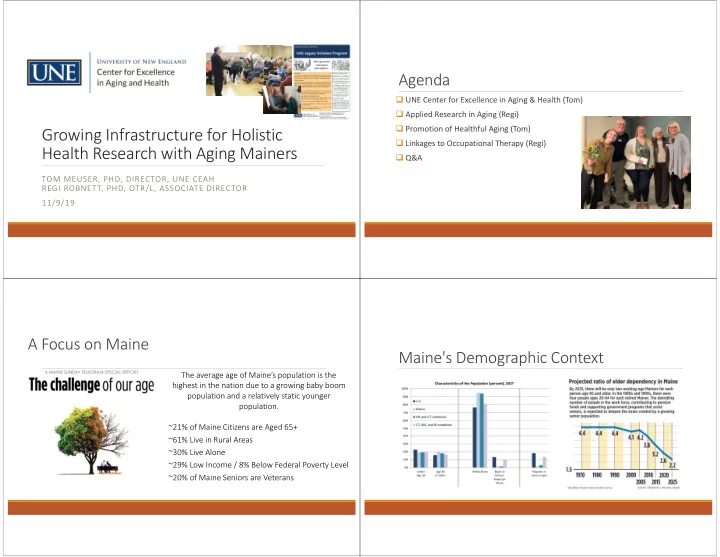
The average age of Maine’s population is the highest in the nation due to a growing baby boom population and a relatively static younger population. ~21% of Maine Citizens are Aged 65+ ~61% Live in Rural Areas ~30% Live Alone ~29% Low Income / 8% Below Federal Poverty Level ~20% of Maine Seniors are Veterans

Maine's Demographic Context

slide-2
SLIDE 2

UNE Context – A Health Sciences University Plus

1831 Building upon the traditions of St. Francis College and Westbrook College, the University of New England has grown and evolved for more than a century. Now encompassing three campuses, over 40 undergraduate majors, six Centers of Excellence in Research, a College of Osteopathic Medicine, a College of Pharmacy, and Northern New England's only College

  • f Dental Medicine, our institution is

poised for progress.

Osteopathic Philosophy of Health (Paulus, 2013)

1. Humans function holistically in a dynamic state of connected

  • neness.

2. The body and psyche have the ability to self‐heal, or to adapt, in the presence of disease, or injury. 3. Structure (anatomy) and function (physiology) are interconnected and inseparable in disease and health. 4. When the musculoskeletal system fails to perform normally, the entire organism may suffer a localized or generalized disorder. 5. Osteopathy is a health care system based upon finding and treating the causes of a disease or injury rather than only attempting to address symptoms. 6. The foundation stone of the Osteopathic system of health care is based upon trusting the unnamed forces of healing, which are concordant with Nature. Andrew T. Still, MD, DO, Founder of Osteopathic Medicine

Adv Advancing ncing in inclu clusiv ive, narr narrativ ive‐in inform rmed and and out

  • utcom
  • me‐orien
  • riented

ed re research on

  • n

heal health thful ful aging. aging.

A longitudinal study and research registry to drive student and faculty research on healthful aging.

The CEAH will fund or, otherwise, support 12 new human aging studies starting this summer. The thematic framework (above) will guide our first call for pilot proposals in December, 2019, for the 2020‐21 Academic Year. Partnerships are critical for successful research on human aging. The CEAH has opened a new research and teaching space in the Motherhouse at Baxter Woods, the old St. Joseph’s Convent, near the Portland

  • Campus. Key local and regional partners are extending
  • ur reach to explore research opportunities near

campus, in the rural north and beyond.
slide-3
SLIDE 3

Satellite Office

 A century old convent repurposed as a 55+ independent living community

  • pened in October, 2018

 88 Units: 22 Market Rate, 66 Affordable  ~100 Residents, Ages 55‐93  Physical plant presents challenges for healthful aging  Many residents face economic, social and health‐related challenges

What is the Legacy Scholars Program?

10/16/19 – Peter Baker from the Alzheimer’s Association presents on the 10 Warning Signs to 90+ Legacy Scholars at the Ferry Beach Retreat and Conference Center, Saco, ME.

Making the LSP Representative of Maine's Population

Early Efforts

Our early recruitment efforts involved UNE alumni, local contacts and friends, and persons reached through community presentations. In recent months, the LSP was featured in statewide and regional conferences (e.g., Wisdom Summit, TriState learning Collaborative

  • n Aging Conference) and in statewide email

blasts.

Reaching rural elders is a priority.

Other Registries in Maine

The Maine Initiative for Neurologic Aging & Health (MAINAH) is a statewide research study and registry in healthy brain aging, memory loss, Alzheimer’s Disease (AD), and related disorders. The registry will help keep you informed of the latest research and services in Maine related to brain and cognitive health. Enrollment will also give you an opportunity to participate in brain aging related research. All expenses are covered by research grants and nothing is charged to you or your insurance.

The goal of the Maine Older Adult Research Registry is to create a way to quickly recruit adults 50+ for research projects through the University of Maine and partner organizations. The registry makes it easy for older adults to connect with and support research. The types

  • f research projects vary and can include

research on topics like caregiving, Alzheimer’s and dementia studies, studies on emotional well‐being, volunteering, and testing new products and services for older adults.

slide-4
SLIDE 4

LSP’s Integrated Approach to Human Subjects Research

LSP

LSP Annual Survey Emphasis Areas

The LSP Annual Survey is not hypothesis driven, nor is it a deep dive into any one area (except for a handful of clinical measures). The goal is to paint a broad picture across the emphasis areas. Planned expansions will examine medication usage, experiences with pain, oral health, etc. Profiles created from these data support hypothesis generation and the targeting of specific sub‐groups for new IRB approved studies. As longitudinal data extend over 3+ years, possibilities open up for additional research utilizing these data and in combination of studies recruiting from this cohort.

Data Snapshot (8/22/19, n = 338)

 74% Female  91% Reside in Maine  25% Born in Maine, 35% in NE (not ME)  98% Caucasian  65% Married/Partnered  71% Retired  23% Rural (“away from a city”)  70% Single Family House  33% Live Alone  88% Drive Most Days  Mean Age = 72 (SD 6.8)  Mean Years Education = 17.4 (SD 2.8)  18% Report Present Caregiving Duties  42% Report Present Forgetfulness  30% Report Present Sleep Disturbance  16% Report Hx of Head Injury  15% Report Hx of Diabetes  44% Report Hx of Hypertension  56% Report Hx of Arthritis

Positive Screens on the Self Report AD8

19% of respondents screen positive for possible dementia on the AD8. This tool has reasonable sensitivity and specificity in community samples when used as a self‐report measure. Investigating this finding is a priority.

slide-5
SLIDE 5

Applied Research

Regi is up...

Applied Research

  • How does this fit with OT?
  • A means of growth through the

development of new approaches

  • Furthers our understanding of humans

as occupational beings

  • Enhances our credibility
  • Promotes evidence‐based practice
  • Can provide the context for

interprofessional collaborations

slide-6
SLIDE 6

Types of Research

QUANTITATIVE

  • Lots of

numbers/statistics

  • Hypothesis driven
  • Can gather support for

specific interventions or assessment methods

QUALITATIVE

  • Explorative
  • The lived experience
  • Phenomenological
  • May not have a priori

assumptions

NEITHER PROVE ANYTHING

Narrative Informed Research

We believe that all research can be informed and enriched through the inclusion of perspectives of real people. Meet Mille (97) and Bud (99) married for 78 years and still living independently in their own two‐bedroom home in a suburb of St. Louis, Missouri, in 2007. Notice how they communicate and their perspectives on successful aging.

Applied Research

What are our interests at UNE?

We are organizing our research on healthful aging based on larger themes (above). Our goal is to bring professionals together across disciplinary lines to address questions and issues that impact the daily lives of Maine’s elders.

Studies @ UNE

A study in PT on knee pain and function

 A clinical trial in DM focused on prevention of cavities below crowns  A study in Psych focused on older adults’ use of e‐reader technology  A study in Psych focused on emotional regulation and close relationships—impact on health (via daily diaries)

slide-7
SLIDE 7
  • A study in MPH looking at understandings of

ageism as a threat to public health

  • A study in DM looking at older patient perspectives
  • n informed consent in dental care
  • A study in SW to validate a board game for

intergenerational family communication

  • A study in OT & COM on perceptions of technology as

solutions for cognitive challenges among people with early stage AD and their caregivers

  • And more in process…

Student projects (OT)

Functional assessment in the home (older adults, LSP)

Follow up from the AD8 study (self‐reported changes in cognition commensurate with early stage AD) One‐hour, to include cognition, balance, physical performance, and visual perception How do performance‐based measures relate to self‐report especially in early stage dementia? This is a pre‐pilot study—hoping to gather data for eventual grant funding

End of life wishes of significant other/self (SOS) dyads

Using GoWish cards Seek to establish percentage of agreement in most important wishes between SOS pair members (quantitative) To explore enhancing GoWish cards by incorporating occupation‐based questions (qualitative exploration) Group just had phone discussion with Michael Pizzi How might this knowledge promote more thoughtful end of life care?

Studies Now Recruiting

slide-8
SLIDE 8

BREAK

Healthful Aging

Lifespan vs. Healthspan

How long do you want to live? “Healthspan”

slide-9
SLIDE 9

“Caring about extending the well period of one’s life should be intuitive – if one is past their healthspan, it means they are chronically sick, often with a degenerating condition…” “While younger people might benefit most in the long‐term from an increased focus on healthspan‐moderating therapies, older adults might be first to see

  • benefits. This is due to the simple fact that research involving older adults gets

to the study outcome, either good or bad, faster.”

Figure & text from Peterson, T. (2017). Healthspan Is More Important Than Lifespan, So Why Don’t More People Know About It?

https://publichealth.wustl.edu/heatlhspan‐is‐more‐important‐than‐ lifespan‐so‐why‐dont‐more‐people‐know‐about‐it/

Extending Healthspan & Geroscience

Extending healthspan requires a dual prong effort: delaying morbidities from disease and the aging process, itself, to as close to the edge of mortality as possible (Crimmins, 2015). “Life extension should no longer be the primary goal

  • f medicine when applied to people older than 65

years of age. The principal outcome and most important metric of success should be the extension

  • f healthspan” (Olshansky, 2018, p. 1324).

When “healthspan” ends…

FRAIL FRAILTY

“The psychological effect of the transition from robust (independent) health to frailty has received little attention in the literature… The term ‘frailty identity crisis’ is proposed to characterize a psychological syndrome that may accompany the transition from independence to frailty. To the author’s knowledge, this concept or framework has not been previously described and may be useful as a framework to focus and encourage research. Such research may validate the concept of the ‘frailty identity crisis’ and might assist clinicians in helping patients to better recognize and understand the implications of frailty as a transitional stage in life and achieve an adaptive rather than maladaptive psychological response to frailty.”

Does the concept of a “Frailty Identity Crisis” make sense to you?

slide-10
SLIDE 10

Individual Perceptions Matter

Marge, 86 “I can’t imagine becoming frail. For me, healthspan means getting out of my house most days, seeing friends and family, volunteering at church, and traveling to fun places. A clear mind and a robust body are what define healthspan in my way of thinking…” Don, 82 “Well, I suppose others might call me

  • frail. I can’t walk more than 30 feet

without becoming winded. I gave up driving last year. On the other hand, I have great friends and enjoy most days. I am limited, yes, but I still see myself as within my period of healthspan…”

Subjective Understandings of Healthspan and the Transition to Frailty: Informing Today’s Geroscience

SPECIFIC AIMS

  • 1. Identify common beliefs and expectations concerning

healthspan, its potential extension, and the perceived tipping points to frailty in later life (Phase 1).

  • 2. Conduct a grounded, thematic analysis, and extract

representative phrases (items) for psychometric measure development.

  • 3. Administer the item set from Aim B to a new sample of

community dwelling adults, aged 60+ years (Phase 2).

  • 4. Name and package the resulting paper and pencil

measure from Aim C.

Small Group Exercise

Form groups of 4‐6. Discuss the following questions:

  • 1. What does the extension of human

healthspan mean from an OT perspective?

  • 2. Are there specific OT approaches or theories

that are especially applicable to the extension of human healthspan?

  • 3. What barriers do you see with respect to

healthspan extension for older Mainers?

Occupational Therapy

Implications & Ideas

slide-11
SLIDE 11

Gaps in Knowledge

You see older adults in your clinical practices and communities. We want our research to apply to real issues. What are the gaps you see?

Questions for you....

  • How can we support the

expansion of healthspan?

  • How can we best support

aging well in rural communities?

Let's Talk about Aging in Place...

  • What does this mean to you or your family?
  • What does it mean to you as an OT or rehab professional?
  • We may think we know what it means, but come to find out people have

different ideas

“Our participants had a great deal to say about the meanings of “staying put” or remaining in their homes or local communities. Aging in place was seen as an advantage in terms of a sense of attachment or connection, practical benefits

  • f

security and familiarity, and as being related to people’s sense of identity through independence and autonomy.”

slide-12
SLIDE 12

ADLs & IADLS

NUR NURSIN ING, OT OT, AND AND A HAN HANDYM YMAN AN‐‐COMMUNI COMMUNITY AGING AGING IN IN PLA PLACE AD ADVANCING NCING BET BETTER LIV LIVING FOR FOR ELD ELDERS (T (THE CAP CAPABLE BLE PR PROGRAM)

LET'S LET'S GET GET CRE CREATIVE TIVE TO TOGETHER!

“Despite the complexity of providing home modifications, we were able to systematically describe and measure meaningful performance outcomes with high levels of adherence. The surge in the aging population will begin taxing existing healthcare services unless solutions to dealing with the functional losses associated with aging are identified. Compensating for functional loss by providing environmental support appears to be a promising solution.”

slide-13
SLIDE 13

Your turn...

What are the barriers to successful "Aging in Place"? As OT practitioners, what can we do? What are the essential aspects to consider?

  • It's an important idea
  • Education is key starting point
  • Aging in place is not for everyone
  • Aging in place is an ideal (it's about taking responsibility and planning)
  • It may be time limited (not unlimited)
  • Aging in place is not about a HOUSE; it's about a lifestyle (ageinplace.com)

Enhancing Function for Aging in Place

Fully Independent Fully Dependent - “Total Care” Functional Adequacy

Individual Specific

Actual Impairment Functional Incapacity

Excess Disability

Final thoughts to consider, from an

  • ptimistic ager

Expect more of us Tsunami –baloney! We either "live to be served or live to serve" Baby Boomers (80 million and counting) tend to be workers/servers

Fiercely independent Self‐assured Goal centric Resourceful Radical and ambitious

Transformational (e.g., civil rights) though we may be braggarts as well

So take heart

As a participant observer... Expect more of us! We will take responsibility We will fight ageism We will advocate for ourselves and

  • thers

We will take care of ourselves and

  • thers (to the best of our ability)

Have faith....

slide-14
SLIDE 14

Discussion—how can we promote healthful aging together?

Thank you for inviting us to give this presentation. We look forward to continued dialogue and future collaboration. Tom Meuser, PhD Regula Robnett, PhD, OTR/L, FAOTA Director, CEAH Associate Director, CEAH University of New England University of New England (207) 221‐4140 (207) 221‐4102 tmeuser@une.edu rrobnett@une.edu