SLIDE 1
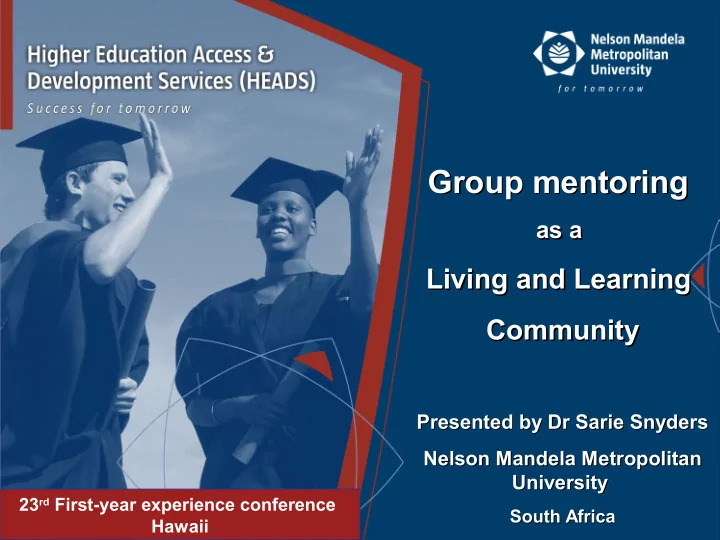
Group mentoring Group mentoring
as a as a
Living and Learning Living and Learning Community Community
Presented by Dr Sarie Snyders Presented by Dr Sarie Snyders Nelson Mandela Metropolitan Nelson Mandela Metropolitan University University
South Africa South Africa 23rd First-year experience conference Hawaii 23rd First-year experience conference Hawaii
SLIDE 2
Port Elizabeth, South Africa
SLIDE 3 South Africa
- Population - about 50 million in 2009
- 80% African, divided in 8 major indigenous groups with
Xhosa and Zulu the largest
- 10% White
- 9 Provinces
- 11 Official languages – only 17% English home language
- Capital Pretoria + Parliament in Cape Town
- First Democratic election in 1994; ANC; President
Nelson Mandela; Jacob Zuma
SLIDE 4 South African Higher Education
- 39 Universities and Technikons before 1994
- Historically divided on racial grounds
- Access to all opened after 1994
- Unequal schooling system with learners from township and rural
schools unprepared for Higher Education studies
- Reduced though mergers in 2004/5 to 23 universities, divided in
3 categories (political rather than educational reasons):
- Traditional universities offering general formative and
professional degrees up to Doctoral level
- Universities of Technologies offering diplomas and certificates
with a strong vocational focus
- Comprehensive universities offering both degrees and diplomas
SLIDE 5
Port Elizabeth, South Africa
SLIDE 6 Port Elizabeth
- Port Elizabeth the largest city in Eastern Cape
- About R1.2m people
- Major automotive industry
- Part of larger Nelson Mandela Bay Metropolitan
area
- Known as “Die Baai – The Bay”, “The Windy City”
- r “The Friendly City”
- Only one university in the Metropolitan area, the
Nelson Mandela Metropolitan University (NMMU)
- Eastern Cape lowest school pass rates in SA
SLIDE 7
Nelson Mandela Metropolitan University
SLIDE 8 Nelson Mandela Metropolitan University
- Comprehensive university formed in 2005 through the merger
- f:
- University of Port Elizabeth
- Port Elizabeth Technikon (University of Technology)
- Port Elizabeth campus of Vista University
- 22 000 students – 56% Black, 27% White, 52% Female
- 5 campuses in Port Elizabeth and 1 in George
- English used as Language of Teaching & Learning
- About 26% with English as home language – 40% Xhosa; 15%
Afrikaans – more than 30 diff ones
- Eastern Cape worst school performance of all provinces
SLIDE 9
GEOGRAPHIC SPREAD OF ALL 2009 NMMU ENROLLED STUDENTS
SLIDE 10 NMMU
- 7 Faculties (Colleges or Schools):
Sciences, Health Sciences, Arts, Business & Economic Sciences, Law and Engineering, the Built Environment and Information Technology
- Higher Education Access and Development Services
(HEADS)
- Centre for Extended Studies (CES)
- Student Counselling
- Centre for Admission Assessment and Research
- Centre for Teaching, Learning and Media
SLIDE 11
Centre for Teaching Learning and Media staff
SLIDE 12
Centre for Teaching Learning and Media (CTLM)
SLIDE 13
South African South African universities are universities are challenged to support challenged to support students in their strive to students in their strive to cope with the demands of cope with the demands of tertiary studies tertiary studies South African South African universities are universities are challenged to support challenged to support students in their strive to students in their strive to cope with the demands of cope with the demands of tertiary studies tertiary studies
Sunday Times, 21 Oct. 2007
SLIDE 14 Why do we have Living and Learning Communities at NMMU?
Many SA students not prepared for demands of tertiary studies
- this may impact on students’ performance and success, some
gaps:
- Knowledge, and important academic and life skills – 2007
intake 4840 first-years, 3653 (75%) medium or high risk - 50.3% not used Writing Centre, 25.9% not aware of SI.
- Achievement gap - lack of values and attitudes needed to
- succeed. 44.9% (2007) do not belong to any student society
- Language needs often linked to difficulties students experience
with writing and not knowing how to reference
- Lack of global awareness
- Cultural diversity
SLIDE 15 Ways in which NMMU provide support and development opportunities
From entering, to cope with demands towards becoming an employable graduate
SLIDE 16 What is Living and learning Communities?
The aim of LLC is to enhance student’s learning and their lives! What is a LLC?
- A setting or group – which forms a community
- That facilitate relationships between students, and staff
- Offer support and a variety of activities
- Mainly focus on first-years – however learning communities are for
senior students and staff
SLIDE 17 Living and Learning Communities ...
- Offer students opportunities to “build networks with peers - provides
both academic and social support” (Tinto, Love and Russo (1993) in
Krause, n.d, 302).
- Students share common theme / academic / professional / personal
interest.
- Encourage connections between students and staff (academic,
HEADS and Student Affairs), and amongst staff.
- Provide a smaller community within the larger university community
- Students can connect more deeply in learning and constructing
meaning, develop more personal and interpersonal relationships, and become part of a friendly, supportive, collaborative and challenging group/community.
- Contribute to academic success, personal and social development,
integration of academic and social experiences, the overall student experience and the wide range of competencies gained Zhao and Kuh
(n.d., p. 16).
SLIDE 18
Living and Learning Communities
Studies indicated positive correlation between social integration variables and academic success, added to that institutional commitment, retention, and career success
(Cabrera, Nora, & Castaneda, 1993, p. 131; Carroll, 1988; Pascarella, 1985; Maxwell, Pascarella & Chapman, 1983; Pascarella & Terenzini, 1991).
Social integration is one of the most influential factors (Tinto
(1993, p. 56)
Living and Learning communities contribute to students social integration. Mentoring as a LLC offers intentional development opportunities - 1st year experience is normalized (they do not feel alone), they have a set of frameworks to think about tertiary studies and they can understand the problem they face better. (Hunter, MacCalla-
Wiggins & White, 2007:16)
SLIDE 19 Mentoring as a LLC
Mentoring enhance the first-year experience, it
- Offer students support to adapt to each other (especially in terms of
diversity
- Build new relationships, living together
- Enables coping with lectures and lecturers (coping in the lectures, taking
notes, understanding them, managing the different academic disciplines
- Support them in managing their time and the workload, knowing their
goals and how to set action plans to achieve them, knowing themselves, study strategies, managing stress and financial management). Factors that define a sense of community:
- “membership,
- influence,
- fulfilment of individuals needs and
- shared events and emotional connections”. (McMillan and Chavis, 1986)
SLIDE 20
Mentoring is ....
SLIDE 21
Goal of mentoring?
SLIDE 22 Benefits of mentoring
First Year Residence Mentor NMMU Academic support Contributes to interaction between students Valuable learning experience Contributes to student life at the university Promotes personal success Promotes personal success Sends students out that have improved leadership and interpersonal skills Improve university- student relationship Promotes student relationships Improve university-student relationship Improve university- student relationship Improve retention and pass rates Develop facilitation skills Improve retention and pass rates Develop leadership + interpersonal skills Develop leadership and interpersonal skills Students that they send
Encourage lifelong learning Contributes to living and learning communities Encourage lifelong learning Developing self management Become more employable Self-development
SLIDE 23
Process of implementing the residence mentoring programme
Similar to what Hopkins-Thomson (2006, 31) describes as denominators for a successful mentoring programme, the process NMMU utilised entailed:
SLIDE 24
Structure of Group mentoring at NMMU
SLIDE 25
Residence mentors
SLIDE 26 Recruit and select
Residence mentors - recruitment via email and posters, paper application, Res manager interview Nursing mentors – Social Work department select them on prior knowledge Engineering mentors – Selected by Academic Staff - they are all post grad students The selection criteria (residence mentors):
- Must be registered and staying in residence
- A caring and resourceful type of person
- Enjoy working in groups
- Academic competence
- Interest in facilitating the adjustment of 1st Years to academic + campus life
- Agree to do training and follow up training and attend meetings
Interview is an opportunity
- to assess applicant’s suitability and commitment t
- allows the applicant to clarify issues
- to share the expectations of being a mentor (Grove and Huon, 2003, 7)
SLIDE 27
Content of mentor training
Ensure that the mentors are able to offer mentoring, therefore focus on:
SLIDE 28 Implementation phase examples
Nursing mentoring
- Offered since 2008
- Implemented with the department
- Department carry all budget costs
Residence mentoring
- Implemented in 2008
- Supported by senior staff, must get residence managers
(who’s job-descriptions have changed) to understand their role and to support it further. Engineering mentoring
- New programme – only implemented this year, 2010
- Departmental buy-in a challenge – however the Dean and
Director of school is very keen
SLIDE 29 Support
Support built the mentors confidence and trust in their ability of being a mentor. Support were offered in different ways:
- Online support via email – encourage them, to offer open line of
- communication. Easy and effective, used to share information, reading material
and sending reminders re administrative tasks
- Regular meetings with an open agenda point - could raise and discuss
anything and the opportunity to learn form each other.
- Follow up training once per semester
- Feedback from mentor said “the occasional meetings that were held seemed
to help because we got a chance to state any problems that were having”.
- Residence staff was close by and available to support mentors. They kept
resources (stationary + reading material for mentors to collect for their groups).
- . Mentors need recognition – received training certificate, as well as a
certificate at residence end of year function and small financial honorarium.
SLIDE 30 Evaluation
All 3 programmes offered the following feedback:
- First-year students (mentees) complete evaluation forms at
the end of the first and second semester
- Mentors submit semester and year reports sharing their
experiences and offer suggestions towards the improvement of the programme.
- Mentors are also encouraged to develop a Portfolio
SLIDE 31
Attendance and how often? (2008 Residence mentoring)
CAMPUS Atu tuended more than 9 tj tjmes Second avenue First semester 62% Second semester 28% North Campus First semester 9% Second semester 10% South campus First semester 11% Second semester 15% How often should the mentoring groups meet? First semester group mentoring: sessions per campus Second N=29 North N=50 South N=115
Once a week 56% 42% 39% Once every two weeks 16% 35% 38% Once a month 24% 18% 22% Once a term 4% 5%
SLIDE 32
Usefullnes
Feedback from first-year Nursing students 2009 Extremely useful Useful Not useful Not Applicabl e
Relevancy to my needs 39% 58% 3% Topics discussed 42% 58% Well facilitated by mentor 64% 36% Met my expectations 39% 53% 6% 3%
SLIDE 33 Feedback first-year diploma students - North Campus residences
n=60 (number of respondents)
SLIDE 34 Feedback first-years degree students South Campus residences
n=115 (number of respondents)
SLIDE 35 Most helpful topics
Residences 1st years indicated most helpful topics to be:
- time management
- stress management
- study techniques
- test and exam preparation
- doing assignments
- discussions between “flat mates”.
SLIDE 36
Qualities of mentors
Descriptions Total N= 185 Approachable 77% Speaks clearly 66% Supporter and encourager 65% Non-judgmental 65% Good listener 65% Encourages participation 64% On time 64% Advisor 63% Well prepared 63% Knowledgeable 60%
SLIDE 37 Impact on mentors
- gained personally, one said “I improved my own time
management and goal-setting. The experience I have gained has improved my marks and has helped me grow as a woman”.
- Another said “Going through certain topics kept me going as I can
re-apply what I will be sharing with the mentees to my own life”.
- A further indicated he “learned a lot even from them because to
deal with diverse cultures in one group is another experience alone but I taught them to learn to assimilate with one another and let each one of us move away from our comfort zones and create an environment that will be conducive for all of us”.
- Many indicated growth, one said “I grew a lot. I became more
- pen and friendlier. I’m confident now to address or speak in front
- f a group”.
SLIDE 38 Mentors valued
- Mentors indicated that participating in the mentoring programme
contributed very positively to their own personal development.
- They highly valued the impact the programme on;
- improving their study strategies
- focusing on their own studies
- having more effective time management
- better relationship skills
- more committed to their studies
- opportunities to share knowledge
- developing mentoring and facilitation skills
- increased self-knowledge.
SLIDE 39 Feedback utilised
More structured residence mentoring programme included:
- Teambuilding event to encouraging community building
- Get to know each other, residence life and adjusting to varsity life
and getting along with your room mate
- Goal setting + Time management
- Study Strategies + Social event of their choice
- The group had a choice of one session’s topic
- Note taking strategies
- One general + one academic reflection - test problems and
progress on tests and assignments
- Dealing with their concerns – Individual sessions
- Organising for exams
- Reflection, social and evaluations
SLIDE 40 Suggestions for improvement
- Mentors should be studying the same course as the mentees to be able
to help with subject content;
- More fun during sessions, creative with mental games, challenges +
discussions that encourage participation;
- Possibly an awards ceremony for best, participating/attending
- Mentoring venue should be made more comfortable;
- Market and advertise the mentoring more;
- Encourage study groups;
- More social functions and interaction;
- Sessions on specific day + time - students then not forget to attend –
consult mentees to decide on convenient time
SLIDE 41 Finally
- The value of a mentoring programme to
the mentor is clearly indicated by a mentor saying “thanks for giving us this wonderful opportunity to help shape the future of fellow students and at the same time developing our facilitation skills and interpersonal relations”.
SLIDE 42 References
Grove, J. and Huon, G. 2003. How to implement a peer mentoring programme. Retrieved on 2 April 2009 from http://www.secretariat.unsw.edu.au/acboard/approved_policy/peer_mentoring_program_guide.pdf Hunter S. MacCalla-Wiggins, B & White E.R. 2007. Academic Advising. NACADA: University of South Carolina Krause, T. Beyond Classroom walls: Students Out-of-class Peer Experiences and implications for teaching and learning. Retrieved on 9 February 2009 from http://www.cshe.nagoya-u.ac.jp/publications/journal/no7/18.pdf McMillan, D.W., & Chavis, D.M. (1986). Sense of community: A definition and theory. Journal of Community Psychology, 14(1), 6-23. Pascarella, E.T. & Terenzini, P.T. (1991). How College affects students. San Francisco, CA: Jossey- Bass Publishers. Tinto, V. (1997). Colleges as communities: Exploring the education character of student
- persistence. Journal of higher education, 68(6), 599-623.
Zhao, C. & Kuh G.D. Adding Value: Learning Communities and Student Engagement. Retrieved on 9 February 2009 from http://nsse.iub.edu/pdf/research_papers/Zhao_Kuh_Learning_Communities.pdf
SLIDE 43
Thank you
For more information please contacte: Sarie Snyders phone: +2741 – 5042759 or Email: Sarie.Snyders@nmmu.ac.za
SLIDE 44
More photos! Second ave campus
SLIDE 45
Second avenue campus
SLIDE 46
North campus
SLIDE 47
South campus
SLIDE 48
George campus
SLIDE 49
SLIDE 50