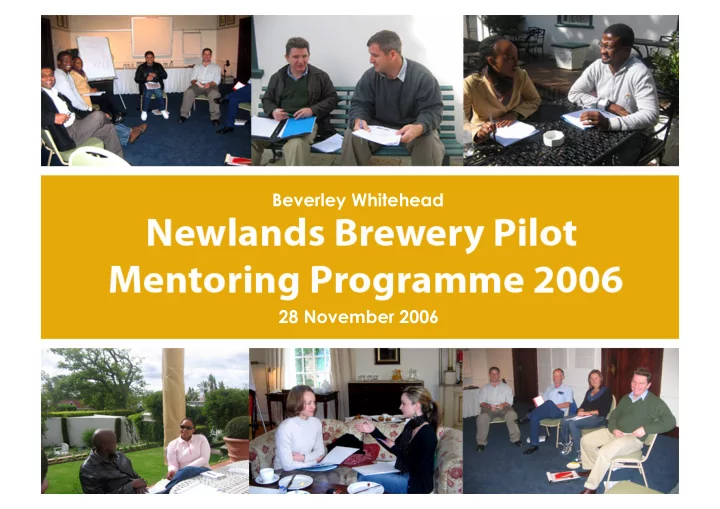
Beverley Whitehead 28 November 2006 Against what criteria will you - - PowerPoint PPT Presentation

beverley whitehead 28 november 2006 against what criteria
SMART_READER_LITE
LIVE PREVIEW

Beverley Whitehead 28 November 2006 Against what criteria will you - - PowerPoint PPT Presentation

Beverley Whitehead 28 November 2006 Against what criteria will you evaluate a formal mentoring programme? Number of active mentoring relationships? Quality of attention given by participants to mentoring? Number of mentoring sessions


slide-1
SLIDE 1

28 November 2006 Beverley Whitehead

slide-2
SLIDE 2

Against what criteria will you evaluate a formal mentoring programme?

  • Number of active mentoring relationships?
  • Quality of attention given by participants to

mentoring?

  • Number of mentoring sessions conducted per pair?
  • Personal benefit derived by mentees?
  • Mutual benefit derived by mentoring pairs?
  • Retention of key individuals?
  • Sustainability of programme?

Newlands Brewery Pilot Mentoring Programme 2006

slide-3
SLIDE 3

How do we see Mentoring?

Off-line help by one person to another in making a significant transition in knowledge work and thinking.

(Clutterbuck, 1990)

Within Newlands Brewery, as part of a formal mentoring programme Inspiring us towards fulfilling our potential

Newlands Brewery Pilot Mentoring Programme 2006

slide-4
SLIDE 4

What is the nature of our mentoring programme?

  • 16 mentoring pairs introduced in groups of 4 pairs over 7 months
  • Mentee-directed
  • Skills offered to to both parties (mutually beneficial)
  • Holistic approach to individual’s personal growth and career

issues

  • Relationship components, inner-being and contextual issues

interact to produce mentoring outcomes

  • Thinking will flourish and solutions will be found in the presence
  • f questions and an attentive other
  • Not administratively intensive – quality relationships
  • Qualitative rather than quantitative emphasis

Newlands Brewery Pilot Mentoring Programme 2006

slide-5
SLIDE 5

How is our programme structured?

Mentee Manager as Coach Mentor

Closure Skills and Practice Contracting Engagement Individual Preparation Programme Facilitator

Newlands Brewery Pilot Mentoring Programme 2006

slide-6
SLIDE 6

How did we gear up for mentoring?

  • Individual preparation (self-reflection and interview)
  • Four days of training, contracting and practice

a) Appreciative Mentoring/ Immersion in Mentoring (1 day) b) Thinking Environment training (2 days) c) +/- 3 self initiated mentoring sessions in pairs d) Thinking Environment review, reflection & other applications (1day)

  • Formal review

Newlands Brewery Pilot Mentoring Programme 2006

slide-7
SLIDE 7

What is the Thinking Environment?

(NANCY KLINE)

  • Positive philosophy of human nature
  • People can think for themselves and solve their own problems if

they are allowed to think!

  • People think well together (thinking partners)
  • Everything we do depends on the quality of the thinking we do first
  • The mind thinks best in the presence of a powerful question
  • A set of conditions, the ‘Ten Components’ (e.g. attention, equality,

ease, appreciation …), used as a system, facilitates transformative thinking

  • The thinking partnership encourages active listening and ‘Free

Exploration’ (without interruption) to facilitate thinking

  • Incisive Questions are formulated to help the thinker to remove

limiting assumptions

Newlands Brewery Pilot Mentoring Programme 2006

slide-8
SLIDE 8

How do you mentor in a Thinking Environment ™?

  • Incorporate the ‘Ten Components’
  • Provide transferable skill to both parties
  • Promote equality
  • Structure the mentoring session (mentee think, interview,

mentor think, appreciation and close)

  • Develop the mentee’s independent thinking
  • Provide mentee with benefit of mentor’s experience

without giving advice

Newlands Brewery Pilot Mentoring Programme 2006

slide-9
SLIDE 9

Thinking Environment Mentoring Session ™

Newlands Brewery Pilot Mentoring Programme 2006

slide-10
SLIDE 10

How have we evaluated our pilot?

  • Focus Groups:

– mentees (n=4) – mentors (n=8)

  • Questionnaires:

– mentees n=14 – mentors n=9

  • Identifying themes that surface in mentees’ & mentors’

experiences

  • Analysing health and vitality of pairs

Newlands Brewery Pilot Mentoring Programme 2006

slide-11
SLIDE 11

What were the high level findings?

  • Overall, positive experience:

1) Eye opening 2) Unique relationship 3) Practical 4) Enjoyable 5) Powerful 6) 1st good mentoring experience 7) Mutually beneficial

Newlands Brewery Pilot Mentoring Programme 2006

slide-12
SLIDE 12

What insights do we have into our mentees’ experiences?

  • Structure mostly welcomed
  • Equality appreciated
  • Contributing to process valued
  • Speaking freely and confronting issues previously avoided
  • Quality time and developing trusting relationship in work

environment (lacking); caring; friendship

  • Sessions fortnightly – monthly
  • Independent thinking and problem solving
  • Increased confidence and self-worth
  • Understanding bigger picture
  • Applying active listening in many other interactions

Newlands Brewery Pilot Mentoring Programme 2006

slide-13
SLIDE 13

What insights do we have into our mentors’ experiences?

  • Mentors don’t need to have all the answers; ownership by

mentee; minimises nervousness of mentor

  • Reciprocal thinking process; both benefit; empowerment;

personal growth

  • Slowing down to think and listen better
  • Significant time investment
  • More beneficial than expected
  • Confidentiality and disclosure in small community can be

difficult in relation to business discussions

  • Quiet individuals are more affirmed
  • Identified synergies to our leadership brand, leadership

essentials and PBS process

Newlands Brewery Pilot Mentoring Programme 2006

slide-14
SLIDE 14

What difficulties were experienced?

  • Allocating time and coordinating schedules;

work pressure; absence (managed fortnightly to monthly sessions)

  • Formulating incisive questions (comes with

practice)

Newlands Brewery Pilot Mentoring Programme 2006

slide-15
SLIDE 15

What were my own assumptions?

  • Counter-culture
  • Pace too slow
  • May be rejected
  • Structure would be welcome
  • Skills would be valued

Newlands Brewery Pilot Mentoring Programme 2006

slide-16
SLIDE 16

What have I learnt?

  • Respite from usual pace was welcomed (albeit heresy)
  • In general, mentees liked 4-days of training; mentors

would prefer a 2-day process

  • TE sets tone and benchmark
  • Ten components form the cornerstone
  • Structure useful
  • Skills are transferable into other contexts
  • Process has impacted on how we are in relationship

with one another, beyond the mentoring relationship (balancing voices)

Newlands Brewery Pilot Mentoring Programme 2006

slide-17
SLIDE 17

How have mentees’ goals guided the sessions?

  • Guided most discussions
  • E.g. Recent Job change/transition
  • E.g. Clarifying career goals;
  • E.g. Exploration of “my next option”
  • E.g. Exploration of “what is possible for me”
  • Mixture personal growth and work-related

issues

Newlands Brewery Pilot Mentoring Programme 2006

slide-18
SLIDE 18

How healthy are our mentoring pairs?

  • Very nearly all were happy or very happy with

choice of mentor or mentee

  • All are actively mentoring at present
  • One pair considering closure
  • All experienced transfer of skills and derived

personal benefit from the mentoring sessions

  • One pair not surveyed

Newlands Brewery Pilot Mentoring Programme 2006

slide-19
SLIDE 19

So where did we meet?

  • Generally Off-site
  • Uninterrupted place e.g. quiet restaurant, pub or
  • utside space
  • Mentor’s office – got one mention

Newlands Brewery Pilot Mentoring Programme 2006

slide-20
SLIDE 20

Any recommendations for a further Newlands rollout?

  • Mentors: YES.
  • Focus on few healthy relationships
  • 16 pairs; more pairs; high potentials
  • Expose as many as possible to TE
  • Mentees: YES.
  • Especially trainees in transition
  • Provide TE tools (for all) then mentoring & pairing (for

some)

  • Levels OE+

Newlands Brewery Pilot Mentoring Programme 2006

slide-21
SLIDE 21

What thoughts about divisional applicability?

  • Good support for divisional application
  • Good linkage with leadership brand
  • Some concerns expressed about approach
  • Need to measure effectiveness to entrench it into

the SAB way, yet this may compromise on essence

  • f programme and not achieve benefits (should

want to … vs have to!)

  • Should not be introduced as a ‘divisional race’

Newlands Brewery Pilot Mentoring Programme 2006

slide-22
SLIDE 22

What other recommendations surfaced?

  • Streamline future training process – perhaps to include 2-day TE

training and 2-day mentoring (intro & contracting & TE application)

  • Further clarification of mentor & manager-coach roles
  • Contracting specifically with manager-coach
  • Evolve how to work flexibly with TE stages
  • 6-monthly forum: TE ‘top up’, reviews for mentoring pairs with time

for mentors and mentees to meet separately

  • Capture mentoring session on SAP as personal / professional

development

  • Monitor health and vitality of mentoring relationships through

regional coordinator of programme

Newlands Brewery Pilot Mentoring Programme 2006

slide-23
SLIDE 23

What would the business

  • utcomes be if all mentees

were mentored in this way?

  • Respect for one another
  • Well-developed interpersonal skills
  • Sharing of knowledge and experience
  • Generating good thinking, ideas and innovation
  • Solving work problems
  • Resolving inner conflicts relating to self or career

Newlands Brewery Pilot Mentoring Programme 2006