Language Impairment in the Classroom Teach Meet: 6 th March 2014 - - PDF document

language impairment in the classroom teach meet 6 th
SMART_READER_LITE
LIVE PREVIEW

Language Impairment in the Classroom Teach Meet: 6 th March 2014 - - PDF document

Language Impairment in the Classroom Teach Meet: 6 th March 2014 Ciara Dunne Speech and Language Therapist B.Sc.(Clin.Lang) My research findings: Bilingualism & Language Impairment in Schools-Working with SLTs (2011) Table 23. Importance


slide-1
SLIDE 1

1

Language Impairment in the Classroom

Teach Meet: 6th March 2014

Ciara Dunne

Speech and Language Therapist

B.Sc.(Clin.Lang)

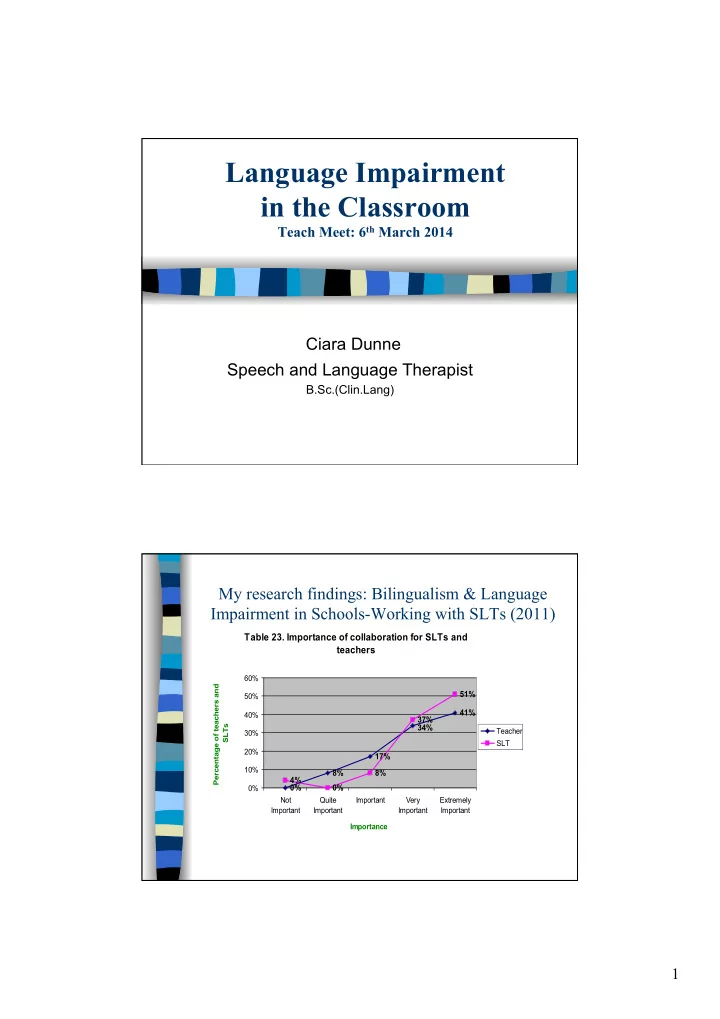
My research findings: Bilingualism & Language Impairment in Schools-Working with SLTs (2011)

Table 23. Importance of collaboration for SLTs and teachers

0% 8% 17% 41% 4% 0% 8% 37% 51% 34% 0% 10% 20% 30% 40% 50% 60% Not Important Quite Important Important Very Important Extremely Important Importance Percentage of teachers and SLTs Teacher SLT

slide-2
SLIDE 2

2

Questions

What is a Language Impairment? How can I identify Language

Impairment in my classroom?

Have you any strategies I could use to

support a child with language difficulties?

What about children with EAL?

What is language?

slide-3
SLIDE 3

3

What is language? What is language?

slide-4
SLIDE 4

4

What is Specific Language Impairment?

IASLT (2007;1) defines SLI as follows: …a term currently used to describe children whose skill in understanding and/or expressing themselves…is significantly impaired. These difficulties occur in the context of normal cognitive abilities and are not primarily attributed to social, emotional, behavioral, educational, physical or sensory difficulties.

Who are these children?

Children…who are unable to communicate

effectively through language or to use language as a basis for learning…

They are handicapped socially, behaviourally, and

as a natural consequence, emotionally…

Their handicap has been described as an invisable

  • ne because it is not obvious to the casual observer.

(Adams, Byers-Brown and Edwards, 1997: 1)

slide-5
SLIDE 5

5

How Can I identify SLI in my classroom?

Comprehension difficulties:

– These students may be labeled as ‘not listening’ ‘doing the wrong thing’ or ‘switching off’ – They may incorrectly follow teacher instructions – Have difficulty taking notes and messages – Provide off target responses as a result of processing a few key words rather than the entire statement.

How Can I identify SLI in my classroom?

Expression difficulties:

  • Having difficulty thinking of and using specific words to describe,

explain, and/or ask questions.

  • Rarely ask questions.
  • Avoid/ anxious about oral tasks for example telling ‘news’.
  • Rarely contribute to classroom discussions.
  • When asked questions may give one word answers or long non

specific answers.

  • Written descriptions may be poorly sequenced or lack important

detail.

  • May take a long time to write descriptions/ sentences/ stories that

require own thoughts.

  • Shouldn’t have difficulty with spelling and dictation tasks.
slide-6
SLIDE 6

6

How Can I identify SLI in my classroom?

Word Retrieval/Vocab difficulties:

  • The student appears to participate well in conversation, with well

formed sentences, but will tend to provide less specific information than their peers.

  • Frequent pauses in speech while the student attempts to retrieve a

suitable word from their vocabulary.

  • Speech or writing is inefficient, contains a lot of non-specific words

(e.g. ‘thing’), or appears to ‘go around’ the target word.

  • Frequently asking questions about the meaning of words.
  • Difficulty remembering names and new words.

Social Language Difficulties

1.

Makes inappropriate comments

2.

Difficulty making maintaining friendships

3.

Poor conversation skills: 1. difficulty with turn-taking 2. introducing topics 3. maintaining topics 4. Shift topics 5. reiterate others ideas or clarify during conversation 6. use body language and facial expression to demonstrate (empathic) listening skills

4.

Misinterprets/ doesn’t detect social cues from facial expression and body language

5.

Processes language literally- difficulty interpreting sarcasm, humour, slang..

6.

Difficulty manipulating language for varying social situations

7.

Unable to defend themselves verbally and may resort to physical aggression

How Can I identify SLI in my classroom?

slide-7
SLIDE 7

7

Key Identifiers for Teachers

The RALLI campaign was created to

Raise Awareness of Language Learning Impairments.

http://www.youtube.com/user/

RALLIcampaign

http://ralliindex.blogspot.co.uk/

What strategies can I use to support these children in my every-day BUSY classroom?

  • 1. Language Processing & Understanding

– Positioning + Attention + Face to Face – Chunking – Visual cues – Rehearsal – Time – Distractions – Seaking help + Checking understanding – Older children: Identification of key words

slide-8
SLIDE 8

8

  • 2. Word Retrieval & Vocabulary

– The 4 S Strategy

  • Say less, stress, go slow, show

– The ‘One Hand approach’:

  • 4 statements & 1 question

What strategies can I use to support these children in my every-day BUSY classroom? What strategies can I use to support these children in my every-day BUSY classroom?

  • 3. Language Behaviours

– Visual instructions/routines – Emphasise, repeat – Instructional transitions – Highlight the positives

slide-9
SLIDE 9

9

  • 4. Social Language
  • Training in how to make friends with words eg: what to say to start

conversations/ join a game…

  • Provide opportunities to practice social skills (e.g. role-play/rehearsal)
  • Use class meetings to problem-solve and to explore concepts such as 'fairness‘
  • Use teamwork for task completion with a range of responsibilities within the

student team eg: recorder, designer, store person, encourager, researcher, explainer and speaker

  • Offer feedback on interactions
  • Monitor self-esteem

What strategies can I use to support these children in my every-day BUSY classroom?

What about children with EAL?

Table 22. Who should assess and treat bilingual children?

5 2 8 18 2 1 5 10 15 20

Bilingual education specialist Language support teachers SLTs Professionals should collaborate Visiting teacher service Special needs assistant Other Number of SLTs

slide-10
SLIDE 10

10

If a child has SLI, then their capacity to learn language is impaired, and they will have difficulties with any and all languages they speak. If they have difficulties with only one language, this is more likely to be due to EAL (English as Additional Language) problems, possibly due to reduced exposure to the 2nd language, causing problems in it, but not in their native language. It's important to assess both languages to see if problems occur in both. If they do, it's a language learning problem that requires speech and language therapy. If not, it's EAL and requires extra coaching from school or home. It takes 2-3 years for surface fluency, but 5-8 years for cognitive academic proficiency (Cummins, 2000).

What about children with EAL? Any Further Questions?

slide-11
SLIDE 11

11

References & Resources

Department of Education and Science (2007). Criteria for Enrolment

in Special Classes for Pupils with Specific Speech and Language

  • Disorder. Circular 0038/07. Athlone: DES, Special Education Section.

Bishop, D. (2004). Diagnostic Dilemmas. In Verhoeven, L. & van

Balkom, H. (Eds.) Classification of Developmental Language Disorders. Theoretical Issues and Clinical Implications. London: Lawrence Erlbaum Associates.

Conti-Ramsden, G. & Botting, N. (2004). Social difficulties and

victimization in children with SLI at 11 years of age. J Speech, Language & Hearing Research. 47(1),145-161.

Gascoigne, M (2006). Supporting Children with speech language and

communication needs within integrated children’s services. RCSLT position paper. London: Royal College of Speech and Language Therapists.

IASLT (2007). Specific Speech and Language Impairment in Children:

Definition, Service Provision and Recommendations for Change. IASLT Position Paper October 2007.

INTO (2001). Let the Children Speak: An INTO report on the Support

Services Available to Primary School Children with Speech and Language Difficulties. Dublin: INTO.

Paul, R. (2007). Language Disorders from Infancy through

  • Adolescence. 3rd ed. St.Louis: Elsevier Mosby.

**Elspeth McCartney (2006). Language Support Model