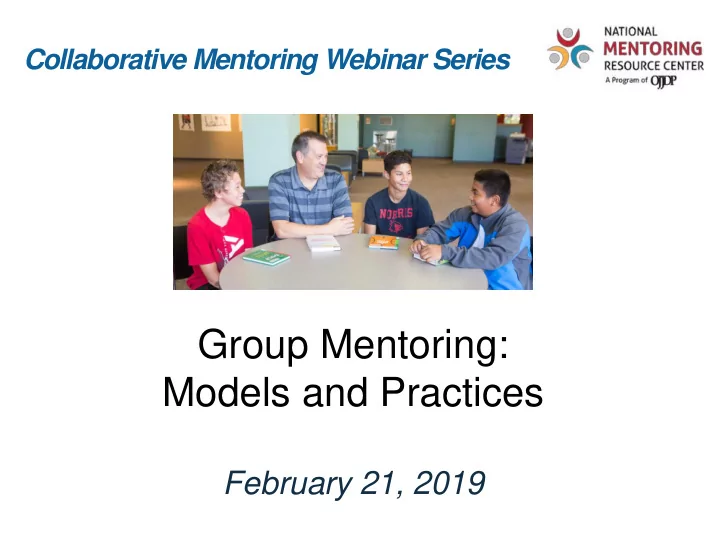
Group Mentoring: Models and Practices February 21, 2019 2018-2019 - - PowerPoint PPT Presentation

group mentoring models and practices
SMART_READER_LITE
LIVE PREVIEW

Group Mentoring: Models and Practices February 21, 2019 2018-2019 - - PowerPoint PPT Presentation

Collaborative Mentoring Webinar Series Group Mentoring: Models and Practices February 21, 2019 2018-2019 Collaborative Mentoring Webinar Series Planning T eam The Collaborative Mentoring Webinar Series is funded by the Office of Juvenile


slide-1
SLIDE 1

Collaborative Mentoring Webinar Series

Group Mentoring: Models and Practices

February 21, 2019

slide-2
SLIDE 2

Collaborative Mentoring Webinar Series

2018-2019 Collaborative Mentoring Webinar Series Planning T eam

The Collaborative Mentoring Webinar Series is funded by the Office

  • f Juvenile Justice and Delinquency Prevention through the

National Mentoring Resource Center and facilitated in partnership with MENTOR: The National Mentoring Partnership

slide-3
SLIDE 3

Collaborative Mentoring Webinar Series

Good to Know…

One week after the webinar, all attendees receive an email with:

  • Instructions for how to access a PDF of presentation slides

and webinar recording

  • Link to the Collaborative Mentoring Webinar Series

webpage, where all slides, recordings and resources are posted Please help us out by answering survey questions at the end of the webinar.

slide-4
SLIDE 4

Collaborative Mentoring Webinar Series

  • All attendees muted for best

sound

  • Type questions and comments in

the question box

  • Respond to polls
  • Who is with us today?

Participate in Today’s Webinar

slide-5
SLIDE 5

Collaborative Mentoring Webinar Series

Today’s Webinar

  • Nancy Deutsch, Ph.D., University of Virginia & Young

Women Leaders Program (YWLP)

  • William Figueroa, Los Angeles Team Mentoring
  • Jerry Sherk, M.A., California Mentoring Partnership, Mentor

Management Systems

Q & A throughout the presentation (use the Q & A panel)

slide-6
SLIDE 6

Collaborative Mentoring Webinar Series

Nancy Deutsch

  • Professor, University of

Virginia Curry School of Education

  • Director, Youth-NEX: UVA

Center to Promote Effective Youth Development

slide-7
SLIDE 7

Collaborative Mentoring Webinar Series

William Figueroa

  • Director of Programs for

L.A. Team Mentoring

  • Began his career over 20

years ago working with foster and probation youth

  • Co-Chair for the Los

Angeles Mentoring Partnership

slide-8
SLIDE 8

Collaborative Mentoring Webinar Series

Jerry Sherk

  • Worked in the field of youth

mentoring for over two decades

  • Ran group mentoring

programs in San Diego City Schools for six years

  • Full-time consultant and

trainer for youth mentoring programs

slide-9
SLIDE 9

Collaborative Mentoring Webinar Series

Today’s Topics

  • Discussion of Various Group Models
  • How to put the “Mentoring” into Group Mentoring
  • Research Results on Young Women Leadership

Program (a 1:1 and Group Mentoring Effort)

  • Resources for Program Development
slide-10
SLIDE 10

Collaborative Mentoring Webinar Series

What is Group Mentoring?

  • 1 or more mentors w/ 2 or more mentees
  • There are countless ratios of mentors to

mentees, and a variety of group models, including peer to peer

  • There are also many “loosely structured”

programs with “roaming mentors” or “team mentors”

slide-11
SLIDE 11

Collaborative Mentoring Webinar Series

Benefits of Group Mentoring

  • 1. Can potentially cut down on staffing time and costs; fewer

mentors can serve more mentees

  • 2. Can attract volunteer mentors that may have an affinity for

group work

  • 3. Reduces risk factors, as mentoring is done onsite
  • 4. Can produce an array of positive outcomes for youth

(behavioral, emotional, academic, etc.) …effective across a wide range of youth participants (ages, ethnicities, etc.) (Kuperminc, 2016)

slide-12
SLIDE 12

Collaborative Mentoring Webinar Series

Potential Cautions & Hurdles Group Mentoring

  • 1. Does not typically offer the intimacy of 1:1
  • 2. Sometimes little “mentoring” included
  • 3. Developing curriculum & activities / keeping

program fresh

  • 4. Mentor and mentee attendance and engagement
slide-13
SLIDE 13

Collaborative Mentoring Webinar Series

E.E.P .’s Focus on 1:1,

but Group Programs can Extrapolate

  • Recruiting
  • Screening
  • Training
  • Matching
  • Monitoring &

Support

  • Closure
slide-14
SLIDE 14

Collaborative Mentoring Webinar Series

Training “Roaming Mentors,” “Team Mentors” & Lightly Structured Programs

  • Even lightly structured programs should provide

training on mentoring concepts and practices and communication skills

  • Train on the basic concepts of mentoring, such

as importance of relationships, finding mentee strengths, and problem solving--asking questions instead of telling mentees what to do

c
  • Consider adding one or more strategies on the

following slides…

slide-15
SLIDE 15

Collaborative Mentoring Webinar Series

Consider 2 or More Mentors for Each Small Group

  • 1. Two mentors can be matched for:
  • young / old;
  • inexperienced / experienced;
  • introvert / extravert, etc.
  • 2. Two mentors help maintain mentee focus & discipline
  • 3. If one mentor absent, small group stays together

(enhances relationship building, group cohesiveness, feelings of safety and confidentiality)

slide-16
SLIDE 16

Collaborative Mentoring Webinar Series

Putting the “Mentoring” into Group Mentoring

To include actual mentoring into groups, consider the acronym “REAL” R: Relationships – same participants working together E: Expression – provide mentees with a safe place to express who they are. A: Actualization -- focus on mentee growth and development via their dreams and goals L: Lessons – curriculum that enhances the R.E.A (above)

slide-17
SLIDE 17

Collaborative Mentoring Webinar Series

REAL Group Mentoring R = Relationships

Relationship Development:

  • Same mentors working with the same mentees
  • ver time (and the same mentees in the small

group setting)

  • Recruiting mentors who are committed, energetic,

and relatable to the mentees

  • Train mentors on relationship development, and

group facilitation

  • Encourage mentors to find 1:1 moments
slide-18
SLIDE 18

Collaborative Mentoring Webinar Series

REAL Group Mentoring E = Expression

Provide Opportunities for Expression

  • Sometimes programs that are 100%

activity focused leave this element out

  • Consider small group check ins: “Good

News/Bad News” / “Highs and Lows"

  • Expression also comes through artistic,

creative exercises and projects

slide-19
SLIDE 19

Collaborative Mentoring Webinar Series

Expression: “Good News/Bad News”

  • Also called “Highs and Lows,” etc.
  • Allows the mentees to reveal who they are, what

they are doing, etc. to mentors and peers-–to be real

  • Mentors share too, but don’t go deeply.
slide-20
SLIDE 20

Collaborative Mentoring Webinar Series

REAL Group Mentoring A = Actualization

Focus on Self-Actualization

  • Assess each mentees’ strengths and also their

needs and interests

  • Encourage youth to dream about possibilities and

then to set goals

slide-21
SLIDE 21

Collaborative Mentoring Webinar Series

REAL Group Mentoring L = Lessons

Lessons/Curriculum Can Tie Other Aspects

(the R.E.A.)Together

  • Curriculum should be creative fun and interactive
  • Lessons can be enhanced by guest speakers and

field trips

  • Consider developing curriculum themes
slide-22
SLIDE 22

Collaborative Mentoring Webinar Series

Sample Lesson / Exercise “Tree that is Me”

  • Ground – what is your

foundation?

  • Roots – What nourishes

you?

  • Trunk – What is your

biggest strength?

  • Big Limbs – What

directions might you go?

  • Leaves – How do you

manage stress?

slide-23
SLIDE 23

Collaborative Mentoring Webinar Series

Developing Mentoring Sessions

Session Development Matrix

slide-24
SLIDE 24

Collaborative Mentoring Webinar Series

Los Angeles Team Mentoring

  • William Figueroa, Director of Programs
  • Founded in the aftermath of the 1992

LA riots

  • Connects 1300 middle school youth

with 330 caring adult mentors weekly

  • Operates at 11 Los Angeles Title-I

middle schools from 3:00-5:00 PM providing

  • Has served over 25,000 at-risk middle

school youth

  • 3:10/12 mentor to mentee ratio
slide-25
SLIDE 25

Collaborative Mentoring Webinar Series

LATM’s 3:10/12 Model

LATM pairs 3 adult mentors to 10 to 12 mentees per group

  • 1. Teacher Mentors
  • Build on an existing student relationships
  • Serve as a constant presence for the student on a daily basis
  • Improve school engagement
  • 2. College Mentors
  • Make higher education a more tangible reality for youth
  • Closer to the mentees’ ages—more relatable
  • Serve as a valuable role model
  • 3. Community/Corporate Mentors
  • Provide varied perspectives in life and career experiences
  • Often expand youths’ horizons beyond immediate school & neighborhood

environment

slide-26
SLIDE 26

Collaborative Mentoring Webinar Series

How “Team/Group” Benefits Mentees

  • Less intimidating – students want to make

friends and enjoy being with their friends and thus, engage more quickly

  • Power of the peer setting – mentees are

forming their identities--that’s why they listen more closely to the opinions of peers—adult mentors can facilitate activities and discussions to move in a positive direction

  • Positive influence of multiple mentors/role

models—in LATM, from 3 life perspectives

  • Curriculum delivery – our lessons give the

mentees the opportunity to open up their worlds, learn new skills, and to stay on a positive path

slide-27
SLIDE 27

Collaborative Mentoring Webinar Series

Mentor Training

  • Recruit mentors that will likely be successful in the

group setting

  • Train mentors on mentoring basics (just like 1:1

mentoring)

  • Additionally, train them on “facilitating group mentoring”
  • Setting group rules and norms
  • Conducting sharing exercises
  • Facilitating group activities
  • Managing discipline problems
slide-28
SLIDE 28

Collaborative Mentoring Webinar Series

Mentor Training

Practice Curriculum Delivery

slide-29
SLIDE 29

Collaborative Mentoring Webinar Series

Training Mentors on Mentee Sharing

  • “What’s good with you today?”
  • Determine upfront if you prefer raised hands or an
  • pen group discussion
  • Follow up with two open-ended questions for every

piece of information shared

  • Don’t force shy kids to share
  • Participate in the exercise, but not too deeply
slide-30
SLIDE 30

Collaborative Mentoring Webinar Series

Training Mentors on Group Management

  • Be aware group with Storm, Norm, Perform and Mourn
  • Prepare them for what could happen (scenarios)
  • Provide them with strategies, e.g.:
  • Remind mentees of group rules
  • Physically approach mentees who are acting out
  • Give warnings
  • Walk the disruptive mentee out of the group
  • Be fair and consistent with rules
  • Start with a clean slate at every session
slide-31
SLIDE 31

Collaborative Mentoring Webinar Series

LATM Curriculum Areas

  • Team Building & Leadership

Development

  • Self-Awareness & Healthy

Relationships

  • Health and Wellness
  • Conflict Resolution and Anger

Management

  • Cultural Diversity and Community

Service

  • Digital Citizenship
slide-32
SLIDE 32

Collaborative Mentoring Webinar Series

Mentor Engagement

  • From the start, inform volunteers that their attendance

is as important as if they were a 1:1 mentor

  • Follow up immediately on absences
  • Encourage mentors to work together, to help each
  • ther accentuate strengths and to bolster any possible

weaknesses

  • LATM has a mentor meeting after each session--

mentors can discuss their obstacles and successes and it’s a place to receive support and encouragement

slide-33
SLIDE 33

Collaborative Mentoring Webinar Series

Mentee Engagement

  • Assess each mentee’s needs, interests and personality and brainstorm

the best way to include them in interactive exercises and personal sharing

  • Encourage mentors to look at each mentee’s participation on an ongoing

basis, and to troubleshoot if they are not fully engaged

  • Design and implement curriculum and activities that are fun and

engaging

slide-34
SLIDE 34

Collaborative Mentoring Webinar Series

Young Women Leaders Program Mentoring Training & Support

  • Semester-long college course on issues facing

adolescent girls & best practices in mentoring

  • Year-long weekly “big sister” meeting of

mentors and facilitator

  • Support and training throughout year from

program staff

slide-35
SLIDE 35

Collaborative Mentoring Webinar Series

Young Women Leaders Program

  • Year-long combined group and one-on-one school-based mentoring

program

  • Pairs college women mentors with 7th grade girls
  • Mentor-mentee pairs meet weekly in groups of 8-10 pairs and a

facilitator

  • Group follows a curriculum on issues facing adolescent girls
  • Pairs are expected to spend one-on-one time outside of group - at least

4 hours a month.

slide-36
SLIDE 36

Collaborative Mentoring Webinar Series

YWLP Research

  • Outcome study
  • Surveys and school records pre/post program
  • Treatment and control groups
  • Processes study
  • Observations of mentoring groups
  • Post-program interviews of mentors and mentees
  • Longitudinal study
  • Surveys and school records of mentees 5 years

after program participation

  • Interviews with highest and lowest quality

mentoring dyads

slide-37
SLIDE 37

Collaborative Mentoring Webinar Series

Implications for Group Mentoring

  • Consider context
  • Matching and formation of groups
  • Adult:youth ratios around 1:4
  • Multiple mentors
  • Don’t make groups too large
  • Avoid grouping youth with behavior problems
  • Cultural competence
  • Mentor training & support
  • Group facilitation
  • Child/adolescent development
  • Ongoing program support
  • Peer support
  • Monitor group dynamics
  • Structured activities/curriculum
slide-38
SLIDE 38

Collaborative Mentoring Webinar Series

Combined Group & 1-on-1 Mentoring Process Model

slide-39
SLIDE 39

Collaborative Mentoring Webinar Series

Group Processes in YWLP

slide-40
SLIDE 40

Collaborative Mentoring Webinar Series

Group Processes in YWLP

slide-41
SLIDE 41

Collaborative Mentoring Webinar Series

Self-Reported Outcomes Girls Attributed to YWLP (N = 113)

CODE Total Attributed to YWLP Attributed to Mentors Attributed to Mentoring Group Attributed to YWLP Curriculum Example Academics 41 (36%) 16 (39%) 8 (20%) 8 (20%) It’s changed like because now like I realize that getting really good grades now can help like in the future. So like when I’m in class I like think about like I get caught up with that person talking, then I most likely won’t get my work done. Relational Development 85 (75%) 24 (28%) 44 (52%) 28 (33%) I think it helped because like I had somebody to talk to. My [mentor] helped me get like – there was this person in [my YWLP] group who I really did not get along with. But she helped me get over that. And like whenever I had a problem she, I could talk to her. And (laugh) I think it helped because there are people in my group that I didn’t know and that I’m now friends with. Self-regulation 75 (66%) 26 (35%) 20 (27%) 29 (39%) I kind of, like, the way I think about it is how I’m going to solve this problem instead of just getting mad over something that somebody told me. Self- Understanding 75 (66%) 29 (39%) 29 (39%) 11 (15%) Oh, because [my mentor] was always telling me like how what I say does like hurt people’s feelings and then um everybody in [YWLP] group was telling me how when I say stuff how it comes out like really mean. And so I – it made me realize like it’s not just like certain people that feel that way. It’s just like a lot of people. And that it’s not them feeling mean, being mean to me. It’s something I have to work on.

slide-42
SLIDE 42

Collaborative Mentoring Webinar Series

Relational Trajectories

  • 5-year longitudinal follow-up
  • Interviews and Relationship Graphs with girls and mentors in most and least

satisfied relationships (n=37)

  • Initial results indicate that “dips” in relational satisfaction almost universal;

recovery not so.

High Satisfaction Dyad Low Satisfaction Dyad

slide-43
SLIDE 43

Collaborative Mentoring Webinar Series

Q&A

Type your questions in the question box:

slide-44
SLIDE 44

Collaborative Mentoring Webinar Series

Group Mentoring Resources

  • Review on Group Mentoring, at the NMRC site, by Dr. Gabriel

Kuperminc, with Mike Garringer http://www.nationalmentoringresourcecenter.org/index.php/what- works-in-mentoring/model-and-population-reviews.html?id=121

  • Project Arrive, A Group Mentoring Program of San Francisco

Unified School District: http://sites.gsu.edu/project-arrive/

  • Group Mentoring for Resilience, Increasing Positive

Development & Reducing Involvement in the Juvenile Justice System (Evaluation of Project Arrive for OJJDP) Kuperminc, Chan, & Hale: https://www.ncjrs.gov/pdffiles1/ojjdp/grants/252131.pdf

slide-45
SLIDE 45

Collaborative Mentoring Webinar Series

Group Mentoring Downloads

Documents Accompanying this Webinar 1. Designing & Implementing a Group Mentoring Program (10-page workbook) 2. Group Mentoring Program Development Matrix 3. How group experiences influence mentor–mentee relational development in a combined group and one-on-one mentoring program for early adolescent girls 4. Understanding mutuality: Unpacking relational processes in youth mentoring relationships 5. Revealing Both Sides of the Story: A Comparative Analysis of Mentors and Protégé’s Relational Perspectives

slide-46
SLIDE 46

Collaborative Mentoring Webinar Series

Additional Resources

Affiliates Affiliates serve as a clearinghouse for training, resources, public awareness and advocacy. Find your local affiliate here: http://www.mentoring.org/our-work/our-affiliates/ Mentoring Connector Recruit mentors by submitting your program to the Mentoring Connector https://connect.mentoring.org/admin National Mentoring Resource Center Check out the OJJDP National Mentoring Resource Center for no-cost evidence-based mentoring resources

slide-47
SLIDE 47

Collaborative Mentoring Webinar Series

Remember…

After the webinar:

  • Please help us out by answering survey

questions at the end of the webinar.

  • Everyone will get an email with information on how

to download the slides, recording, and resources

  • n the CMWS webpage on the MENTOR website:

http://www.mentoring.org/program_resources/training_opp

  • rtunities/collaborative_mentoring_webinar_series/
slide-48
SLIDE 48

Collaborative Mentoring Webinar Series

Stay Connected

  • Email us at collaborativewebinarseries@mentoring.org
  • Tweet with hashtag #MentoringWebinar
  • Visit our webpage on the MENTOR website for past and upcoming webinars:
slide-49
SLIDE 49

Collaborative Mentoring Webinar Series

Rural Mentoring March 21, 2019 1 - 2:15 pm EST

Join Us Next Month!