Support Staff Mentoring Scheme Thinking about mentoring About our - - PDF document

support staff mentoring scheme
SMART_READER_LITE
LIVE PREVIEW

Support Staff Mentoring Scheme Thinking about mentoring About our - - PDF document

Briefing Session Support Staff Mentoring Scheme Thinking about mentoring About our scheme Your expectations LUNCH Feedback from past mentees/mentors Mentoring demonstration Next steps and mentoring contracts Cat


slide-1
SLIDE 1

1

Support Staff Mentoring Scheme

Cat Wilson, University of St Andrews Gaye Manwaring, University of Dundee

Briefing Session

 Thinking about mentoring…  About our scheme  Your expectations  LUNCH  Feedback from past mentees/mentors  Mentoring demonstration  Next steps and mentoring contracts  Any questions

Background to the scheme

 Mentoring and networking scheme for female

academics in 2005

 In 2007 a pilot mentoring scheme for research

staff

 In 2009 a second cycle of the RS scheme  Positive feedback leads to third cycle of the

scheme in 2010, expanded to ‘early career academics’

 Parallel scheme developed in 2010 for support

staff

Lessons from the academic scheme

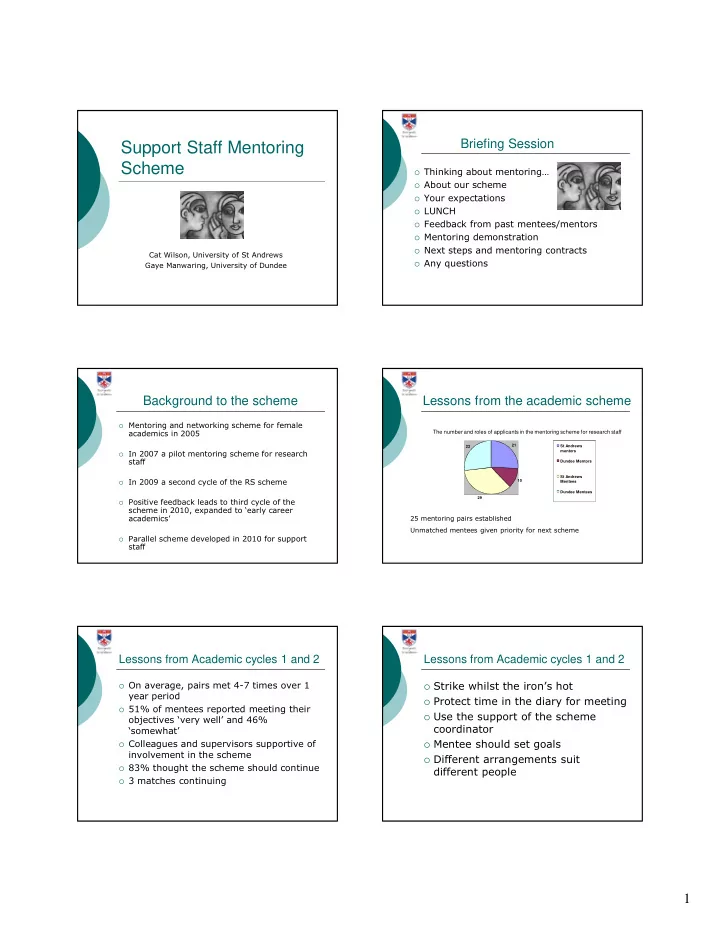
25 mentoring pairs established Unmatched mentees given priority for next scheme

The number and roles of applicants in the mentoring scheme for research staff

21 10 29 22 St Andrews mentors Dundee Mentors St Andrews Mentees Dundee Mentees

Lessons from Academic cycles 1 and 2

 On average, pairs met 4-7 times over 1

year period

 51% of mentees reported meeting their

  • bjectives ‘very well’ and 46%

‘somewhat’

 Colleagues and supervisors supportive of

involvement in the scheme

 83% thought the scheme should continue  3 matches continuing

Lessons from Academic cycles 1 and 2

 Strike whilst the iron’s hot  Protect time in the diary for meeting  Use the support of the scheme

coordinator

 Mentee should set goals  Different arrangements suit

different people

slide-2
SLIDE 2

2

The shape of our scheme

 Approx 50 participants, 20

mentoring pairs

 Finite time period – 1 year  Mentee drives  Evaluation points – Dec + April  Support for mentees and mentors

A mentor can help a mentee to

 set realistic targets  plan own personal development  become more self-confident  accept challenges  learn from experience  develop suitable learning styles  find useful resources

Mentoring skills

 active listening & questioning  analysing & problem solving  reflecting  summarising  giving feedback  supporting  challenging

Mentor roles

 Supporter  Coach  Advisor  Networker  Teacher  Buddy

Questionable mentor roles ???

 Assessor  Role model  Protector  Advocate  Counsellor

A mentor may act as

 a mirror  a sounding

board

 a launch pad  a safety net  a stick  a carrot  a motivator  an eye opener  a door opener  an idea bouncer  a feedback

giver

 a problem

solver

 an inspirer

slide-3
SLIDE 3

3

Personal & professional development

 For mentee

  • Prepare for supervision and review
  • Learn to work reflectively

 For mentor

  • Learn to listen, ask questions, provide

meaningful challenge

  • Help mentee to set realistic goals
  • Do not need to have answers
  • Discipline – stay in role, confidentiality

Underlying principles

 The mentee is in control  Personal responsibility  Trust and confidentiality  Developmental  Collaborative  Protected time for discussion

and reflection

Mentee concerns

Beginning

 Uncertainty, anxiety  Excitement, anticipation

Middle

 Growing confidence  Frustration, mid-term blues

End

 Relief, achievement  Concern about future

Structure of a mentoring meeting

 Agree contract  Introductory stage  Main stage  Concluding stage  Reflection on process

Introductory stage

 Manage environment  Welcome, put at ease  Check expectations  Set time limits  Explain purpose & process: contract

Main stage

 Celebrate things going well and why  Explore concerns & problems  Feedback: support & challenge  Discuss SMART targets

slide-4
SLIDE 4

4

Concluding stage

 Write down SMART targets

S Specific M Measurable A Achievable R Relevant T Time-constrained

 Arrange future meeting  Reflect on process

Mentoring is about

 communicating  clear roles and responsibilities  outcomes and processes  support and challenge  nurturing a good relationship  developing your skills

Your Expectations

 Mentors: What do you expect from

your mentee?

 Mentees: What do you expect from

your mentor?

Reflections from a mentee

 Louise Major, early career academic

scheme

Reflections from mentors

“We have met, revised my mentee’s CV and identified areas for progress. My mentee has changed direction.” “This has given my mentee the confidence and knowledge that there are other people going through similar problems, which makes the problems seem smaller.”

Reflections from mentors

“My mentoring partner and I are well suited and we often discuss work and non-work issues that I can’t discuss at my workplace. I feel I can encourage and advise her given some of my experiences, and in return she also acts as a ‘sounding board’ to give impartial advice.”

slide-5
SLIDE 5

5

Reflections from mentors

“It caused me to think about my career, and how I could have done things differently” “I’ve got a real feeling of giving something

  • back. This has allowed me to do

something positive with my experience, and given me the opportunity to think both critically and positively”

Demonstration

 Listen to the interactions  Follow the sequence  Look at the body language

Mentoring contracts and next steps

 About the mentoring contract…  Mentees to initiate first meeting  Any problems, contact me

cmw9@st-and.ac.uk

Questions?