
SLIDE 1
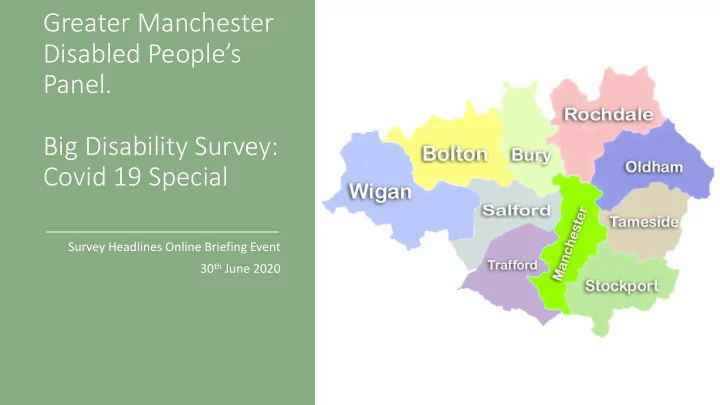
Greater Manchester Disabled People’s Panel. Big Disability Survey: Covid 19 Special
Survey Headlines Online Briefing Event 30th June 2020
Greater Manchester Disabled Peoples Panel. Big Disability Survey: - - PowerPoint PPT Presentation
Greater Manchester Disabled Peoples Panel. Big Disability Survey: Covid 19 Special Survey Headlines Online Briefing Event 30 th June 2020 Agenda 5:00 Welcome and housekeeping, using Zoom accessibly. 5:03 Co-Chairs welcome and
Greater Manchester Disabled People’s Panel. Big Disability Survey: Covid 19 Special
Survey Headlines Online Briefing Event 30th June 2020
GM Big Disability Survey Covid-19 Special:
media, community & voluntary sector, grassroots groups, and GM consult website.
health.
had support needs.
Equipment (PPE)
Covid-19.
Prior to the outbreak, 58% felt satisfied or very satisfied and this has reduced to 35% after Covid-19.
whilst 76% of disabled people are dissatisfied with the help provided by the government.
Respondents were also asked to self-define their ethnicity which led to a large variety
low BAME sample reinforces the recommendation for a DPO to be established for BAME disabled people.
“My mum is doing all my care and I wonder how long she can keep this up as my dad also depends on her as he has dementia and she is very tired”.
Figure 5: Proportion of support needs being met compared across official shielding group and those not officially shielding but still requiring support
standard survey received a shielding letter from the Government as ‘high risk’.
this letter, 57% reported having support needs of which only 19% are getting all their needs met, 10% were having none of their needs met.
We asked people were they satisfied with their care plan before the Pandemic hit 23% Dissatisfied Then we asked were they satisfied with their care plan during the Pandemic 43% Dissatisfied
“I've had no support due to career (sic) self isolating with her family and had to relie (sic) on my teenaged daughter to get my medicine”
“I have a disability, plus my son has autism, and with his school closed, I have been having to care for him 24 /7 and meet his support needs at home while his dad works, which has taken a huge physical toll on my physical and mental health. I think it has been overlooked that there are people with multiple disabilities and caring responsibilities in the same family coping without school childcare and support.”
“Constantly worried about getting food because of scarcity of delivery slots” “I am autistic. I do not consider myself as disabled. However, if I am not able to do my own shopping I dread asking for help. It is worse than that. I am terrified of asking for help. If I get sick, I am also very afraid of needing hospital treatment as I know I will be misunderstood and will struggle.”
“Mental health services have appeared oblivious to the pandemic and make suggestions that can't be done if you can't leave the house.” “Some of my answers are affected by my just being released after 4 weeks fighting Covid in hospital. Bless all NHS staff. They applauded ME for surviving. I cried!” “I had to access A+E recently. Not listened to, manhandled, no proper treatment”
90% of respondents said the Pandemic had negatively affected their mental health.
“I’m struggling because I live alone and my anxiety won’t let me go out much so I’ve been having half a tin of beans or spaghetti with 2 slices of toast every day because I couldn’t get access to home deliveries until today. I’ve spent 3 days in the dark because I couldn’t get out to get electric because of my mental health
“Every support service has phone number. I'm autistic. I don't make calls. Need text number”
In 2017, 56% of adult internet non-users were disabled, much higher than the proportion of disabled adults in the UK population as a whole, which in 2016 to 2017 was estimated to be 22% ONS Exploring the UK’s digital divide 4.3.19
“My confusion with the guidance lies in the fact that the Govt (sic) is not providing a [British Sign Language] BSL interpreter at their press
streaming an interpretation voluntarily.” “I want to emphasise how hard to understand government briefings are if you're autistic - they are not clear at all! The language used is very hard to understand.”
GM Disabled People’s Panel Main Recommendations
1 Equality Impact Assessments. 2 The Panel recommends that digital exclusion be recognised as a key issue during this pandemic, and that digital inclusion is an urgent priority. 3 The Panel recommends that accessible information be implemented and produced consistently. 4 The inclusion of disabled people and disabled people’s
5 Isolation, Safety, Food Insecurity, and Mental Health- urgent prioritisation of funding and resourcing of mental health support. 6 Support independent living for disabled people.
GM Disabled People’s Panel Main Recommendations
7 Personal Assistance / Carers. 8 Statutory Standards, Social Care Assessments, and Health Care 9 The Panel recommends the development of a BAME disabled people’s organisation. 10 The Panel recommends the development and resourcing for a disabled people’s organisation in each of the 10 boroughs. 11 Employment. 12 Education. 13 Utilise the knowledge, insight and value of the lived experience of Disabled People’s Organisations.
Greater Manchester Disabled People’s Panel panel@gmcdp.com gmdisabledpeoplespanel.com 07367 754 595 Text or Voice