Great & Growing Need Knowledge and Diabetes rates are much - - PowerPoint PPT Presentation

great growing need
SMART_READER_LITE
LIVE PREVIEW

Great & Growing Need Knowledge and Diabetes rates are much - - PowerPoint PPT Presentation

9/29/2016 Great & Growing Need Knowledge and Diabetes rates are much higher and rising more Spirituality surrounding quickly Organ Donation in the Prevalence of end-stage renal disease is 3.5 times Native American higher compared


slide-1
SLIDE 1

9/29/2016 1

Knowledge and Spirituality surrounding Organ Donation in the Native American Community

Tasce Bongiovanni, MD, MPP Robert Wood Johnson Foundation, Clinical Scholars Program Yale University, School of Medicine General Surgery Resident University of California, San Francisco

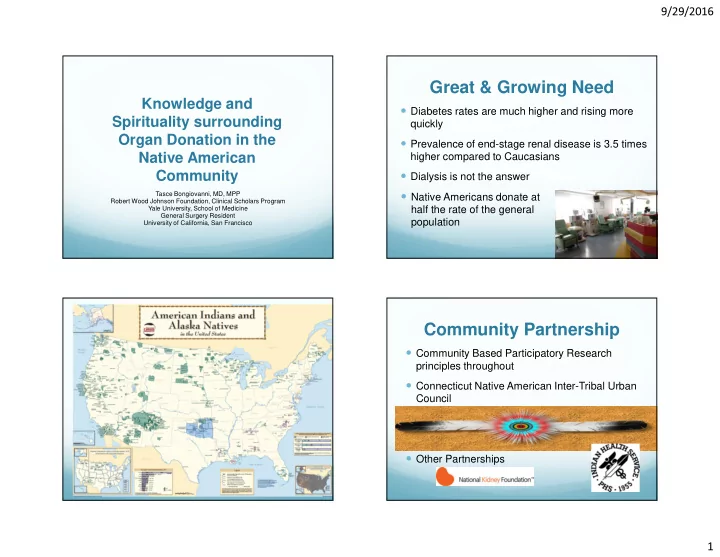
Great & Growing Need

Diabetes rates are much higher and rising more

quickly

Prevalence of end-stage renal disease is 3.5 times

higher compared to Caucasians

Dialysis is not the answer Native Americans donate at

half the rate of the general population

Community Partnership

Community Based Participatory Research

principles throughout

Connecticut Native American Inter-Tribal Urban

Council

Other Partnerships

slide-2
SLIDE 2

9/29/2016 2

Study Aims

Understand Factors Associated with Organ Donation among Native Americans Develop a Culturally Appropriate and Relevant Survey to Explore Cultural Beliefs about Organ Donation among Native Americans

Survey Development

63 items from published instruments

Items Scales

Knowledge: Organ Donation and Transplantation Knowledge Survey Attitudes: Organ Donation Attitude Survey Spiritual beliefs: Spiritual Beliefs Scale about Organ Donation

Survey Development

22 Native Americans: Ages 19-70, 13 tribal affiliations. Purposeful Sampling Sample

Data Collection

Data Analysis 1:1 Cognitive Tests & Interviews Iterative Response Analysis

Surveying the Community

Regional Pow Wows Major Themes: Knowledge Spirituality Trust Family Involvement

slide-3
SLIDE 3

9/29/2016 3

Analysis

Describe demographics Examined bivariate associations between intention to

donate and demographics

Examined bivariate associations between intention to

donate and factors such as knowledge, spirituality and trust

Stata SE 13.1

Sample Demographics

Participants N=183 Willingness to Donate 71% Tribal Affiliations 55 (n) Male 43% Age (range) 18-78 years Age (average) 43 years Education: high school graduates 76% Speak Native Language 20% Practice Native Religion or Spirituality 28%

Domain: Spirituality Domain: Spirituality

Strongly Agree or Agree If I donated my organs, I would worry that my spirit would not be at rest. 17% It is wrong for me to donate my organs because I am making myself incomplete. 14% I believe that donating my organs will disturb my passing process. 15%

slide-4
SLIDE 4

9/29/2016 4

Domain: Spirituality

Strongly Agree or Agree Willingness to Donate (OR) If I donated my organs, I would worry that my spirit would not be at rest. 17% 0.21 * It is wrong for me to donate my organs because I am making myself incomplete. 14% 0.08 * I believe that donating my organs will disturb my passing process. 15% 0.14 *

Domain: Trust Domain: Trust

Strongly Agree

  • r Agree

I trust that doctors and hospitals use donated

  • rgans as they are supposed to be used.

76% I don’t think that doctors would try as hard to save my life if I were an organ donor. 28% Native Americans wait longer for kidney transplants than non-Natives. 76%

Domain: Trust

Strongly Agree or Agree Willingness to Donate (OR) I trust that doctors and hospitals use donated organs as they are supposed to be used. 76% 2.29 * I don’t think that doctors would try as hard to save my life if I were an organ donor. 28% 0.22 * Native Americans wait longer for kidney transplants than non-Natives. 76% 0.44
slide-5
SLIDE 5

9/29/2016 5

Domain: Knowledge Knowledge Questions

Strongly Agree/Agree (%) The matching process for an organ donor is based on blood type and certain health conditions. 97% You can donate certain organs while you are alive and healthy. 37% High blood pressure and diabetes are two of the most common causes leading to people needing a kidney transplant. 85% Transplant recipients can live for many years after a transplant operation. 92% High blood pressure and diabetes are common diseases among Native Americans. 93%

Knowledge Questions

Strongly Agree/Agree (%) The matching process for an organ donor is based on blood type and certain health conditions. 97% You can donate certain organs while you are alive and healthy. 37% High blood pressure and diabetes are two of the most common causes leading to people needing a kidney transplant. 85% Transplant recipients can live for many years after a transplant operation. 92% High blood pressure and diabetes are common diseases among Native Americans. 93%

Knowledge Questions

Strongly Agree/Agree (%) The matching process for an organ donor is based on blood type and certain health conditions. 97% You can donate certain organs while you are alive and healthy. 37% High blood pressure and diabetes are two of the most common causes leading to people needing a kidney transplant. 85% Transplant recipients can live for many years after a transplant operation. 92% High blood pressure and diabetes are common diseases among Native Americans. 93%

slide-6
SLIDE 6

9/29/2016 6

Knowledge Questions

Strongly Agree/Agree (%) The matching process for an organ donor is based on blood type and certain health conditions. 97% You can donate certain organs while you are alive and healthy. 37% High blood pressure and diabetes are two of the most common causes leading to people needing a kidney transplant. 85% Transplant recipients can live for many years after a transplant operation. 92% High blood pressure and diabetes are common diseases among Native Americans. 93%

Knowledge Questions

Strongly Agree/Agree (%) The matching process for an organ donor is based on blood type and certain health conditions. 97% You can donate certain organs while you are alive and healthy. 37% High blood pressure and diabetes are two of the most common causes leading to people needing a kidney transplant. 85% Transplant recipients can live for many years after a transplant operation. 92% High blood pressure and diabetes are common diseases among Native Americans. 93%

Conclusions

Knowledge is high Factors of trust and spirituality highly associated with

willingness to donate

Spirituality relating to organ donation was significant but

represented small part of our sample

Though knowledge is high, there is confusion about living

donation

Implications

Knowledge in general about organ donation is not the

problem

Building trust between the Native community and the

medical establishment might increase willingness to donate

Focusing education and awareness around LIVING

donation could increase the number of living donors within the Native community

slide-7
SLIDE 7

9/29/2016 7

Limitations

We did not interview youth Self selection bias May not represent all Native Americans as tribes are

diverse

Exploratory in nature only

Thank you

Robert Wood Johnson Foundation Clinical

Scholars Program

Veterans Administration Community Partners, especially Connecticut

Native American Inter-Tribal Urban Council

Project Team: Jim Rawlings, Joyce Trompeta,

Marcella Nunez-Smith,

Surveyors: Sebastian Medina-Tayac,

Theodora Simon, Nicholas Friedlander

Joseph Ross, Program Advisor Everyone at RWJF CSP Yale!!!!!

Final Survey, page 1

  • I know someone who donated an organ while they were still living
  • I know someone who donated an organ after they died
  • I know someone who has received an organ transplant
  • I have received education about organ donation in general
  • I am registered as organ donor on my driver’s license
  • I am willing to have my organs donated after my death.
  • I could need an organ transplant at some point in my life.
  • The types of diseases that lead to the need for transplant are unusual and rare.
  • High blood pressure and diabetes are common diseases among Native

Americans.

  • It is possible for a brain-dead person to recover from their injuries.

Final Survey, page 2

  • Transplant recipients can live for many years after a transplant operation.
  • High blood pressure and diabetes are two of the most common causes leading to people

needing a kidney transplant.

  • You can donate certain organs while you are alive and healthy.
  • A patient can receive an organ transplant from a living donor.
  • A matching process for an organ donor is based on blood type and certain health

conditions.

  • The matching process for an organ donor is based on genetics.
  • After receiving a transplant, the person is never well enough to return to a normal healthy

life.

  • Native Americans wait longer for kidney transplants than non-Natives.
  • I support organ donation.
slide-8
SLIDE 8

9/29/2016 8

Final Survey, page 3

  • I would agree to receive an organ transplant, if my life were in danger without
  • ne.
  • It is important to discuss my wishes for after my death with my family.
  • I have discussed my wishes for after my death with my family.
  • If needed, I would prefer to receive an organ from a person of my same

ethnicity.

  • I think that organ donation is a safe, effective practice.
  • I would be willing to be an organ donor if I knew my organs were going to a

member of my family.

  • In general, I think that organ donation is a good thing.
  • I would prefer to donate my organs to a person of my same ethnicity.

Final Survey, page 4

  • Ethnic discrimination prevents minority patients from receiving the transplant

they need.

  • A wealthy person has a better chance of getting an organ transplant than a

non-wealthy person.

  • I trust that doctors and hospitals use donated organs as they are supposed to

be used.

  • I don’t think that doctors would try as hard to save my life if I were an organ

donor.

  • In general, I think that organ donation is a good thing.
  • Native Americans don’t donate because they distrust the medical community.
  • My spirit would feel a special connection with the recipient of my organs.

Final Survey, page 5

Organ donors can’t have regular funerals because the body

is deformed by the removal of organs.

I believe that removing any organs from my body damages

my body so my spirit cannot pass.

If I donated my organs, I would worry that my spirit would

not be at rest.

It is wrong for me to donate my organs because I am

making myself incomplete.

I believe that donating my organs will disturb my passing

process.

My religious beliefs do not support organ donation.