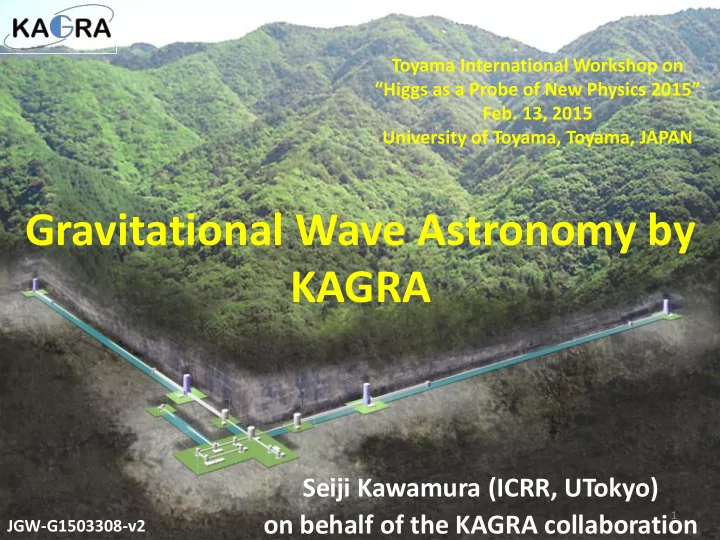
Gravitational Wave Astronomy by KAGRA
Seiji Kawamura (ICRR, UTokyo)
- n behalf of the KAGRA collaboration
Toyama International Workshop on “Higgs as a Probe of New Physics 2015”
- Feb. 13, 2015
University of Toyama, Toyama, JAPAN
1
JGW-G1503308-v2
Gravitational Wave Astronomy by KAGRA Seiji Kawamura (ICRR, UTokyo) - - PowerPoint PPT Presentation
Toyama International Workshop on Higgs as a Probe of New Physics 2015 Feb. 13, 2015 University of Toyama, Toyama, JAPAN Gravitational Wave Astronomy by KAGRA Seiji Kawamura (ICRR, UTokyo) 1 on behalf of the KAGRA collaboration
Gravitational Wave Astronomy by KAGRA
Seiji Kawamura (ICRR, UTokyo)
Toyama International Workshop on “Higgs as a Probe of New Physics 2015”
University of Toyama, Toyama, JAPAN
1
JGW-G1503308-v2
Outline: Gravitational wave and its detection Review of KAGRA Current status of KAGRA Summary
2
equation is derived
Gravitational wave
Gravitational wave
5
Taylor et al., ApJ.345(1989) p435
PSR1913+16 found by Hulse
se and Taylor
Period of rotation decrease
ses s by GW GW
Nobel prize in 1993
1.3 Ms – 1.6 Ms (Equation of state: APR4)
Hotokezaka, et al. (Kyoto Univ, and others)
Simulation of neutron star binary coalescence (1)
1.2 Ms – 1.5 Ms (Equation of state: APR4)
Hotokezaka, et al. (Kyoto Univ, and others)
Simulation of neutron star binary coalescence (2)
380,000 year (Recombination)
Electromag agnet etic wave
1 sec (First atoms) Neutrino
Observation of the beginning of the Universe
The beginning of the Universe
13.7B year (Now)
Gravitation
10 -43 sec (Planck epock)
Laser Interfering light Beam splitter Mirror Mirror Lens Screen
Gravitational waves
The mirrors and beam splitter are suspended.
Laser Photodetector Mirror Mirror Laser Photodetector Mirror Mirror
Large-scale interferometers in the world
LIGO (4 km) LIGO (4 km) VIRGO (3 km) GEO (600 m) TAMA (300 m) CLIO (100 m) KAGRA (3 km)
12
Mozumi Entrance Shin-atotsu Entrance
Location (Kamioka)
Super-Kamiokande CLIO
13
◎Tokyo Kamioka◎ Toyama airport 40min. by car
Underground Cryogenic Mirror
14
Technologies crucial for the 3rd-generation detectors; KAGRA can be regarded as a 2.5-generation detector.
Two technologies + one
Undergro round nd Cryogenic c Mirror Resonan ant Sideband Extraction Strain Frequency
Typical sensitivity of the 1st generation detectors
Ground motion in Kamioka mine
Kashiwa Kamioka
16
Further seismic isolation is still necessary
Vibration of mirrors: 10-11 mHz-1/2 10-18 mHz-1/2 @10 Hz
Should be improved by 7 orders of magnitude
Vibration isolation system
2nd floor Inverted pendulum Geometrical antispring (GAS) filter Multi-stage pendulum (with GAS filter) 1st floor Another pendulum (with GAS filter) Mirror suspension
18
Two-layer structure to avoid the resonances of the tall structure.
GAS filter
Cryogenics System
Main Beam Cooling 8K shield Cooling Cryo-Payload Duct Shield 400kW 4W? ~1W Cryostat 80K shield 8K shield 2 units 80K PTC with Vibration reduction 2 units 300K Radiation
19
Platform (14 K) Upper Mass (15 K) Mirror (20 K)
Sapphire Mirror
Two Sapphire substrates have been delivered. (Φ220mm, t 150mm, c-axis)
Resonant Sideband Extraction interferometer
Fabry-Perot arm cavity: Increase the effective arm length
Power recycling mirror: Increase the effective power
Signal extraction mirror: Extract GW signal before cancellation
Detuned for the best NS-NS inspiral range
Ultimate Sensitivity Limit of KAGRA
Beating the standard quantum limit
Duty factor: > 80%
Expected event rate for NS-NS coalescence
Inspiral range: 176 Mpc (the same definition as LIGO/Virgo) Assuming Inspiral rate per galaxy: 100 Myr-1 Expected event rate: 10 yr-1 We could reveal the mechanism of Short GRB with -ray observation group.
23
Other GW sources
0.41000 events per year
3 Gpc
years
pulsars
Schedule of KAGRA
2010 2011 2012 2013 2014 2015 2016 2017 2018
Calendar year Project start Tunnel excavation initial-KAGRA baseline-KAGRA Observation iKAGRA obs.
Cryogenic system
iKAGRA
Michelson interferometer Room temperature Simple seismic isolation system
bKAGRA
Resonant sideband extraction Cryogenic temperature Advanced seismic isolation system
25
Shin-Atotsu entrance (2014.9.26)
片岡優氏撮影1st floor of central area (2014.7.4)
東京大学宇宙線研究所広報室2nd floor(2014.7.4)
東京大学宇宙線研究所広報室Installation of beam tubes(2014.10.23)
片岡優氏撮影Clean booth and sound-proof room (2014.10.31)
麻生洋一氏撮影Summary
detector (2.5-generation).
and bKAGRA.
at the end of 2015.
bKAGRA at the end of 2017.
31