Grapes vinifera : Vitis Vitis Vitis vinifera Vitis: non non- - - PDF document

grapes
SMART_READER_LITE
LIVE PREVIEW

Grapes vinifera : Vitis Vitis Vitis vinifera Vitis: non non- - - PDF document

22/07/54 Oral Presentation CRDC 5 Grapes vinifera : Vitis Vitis Vitis vinifera Vitis: non non- -climacteric climacteric fruit fruit botanically a true botanically a true berry berry woody climbing vine woody climbing vine


slide-1
SLIDE 1

Oral Presentation CRDC 5 22/07/54 1

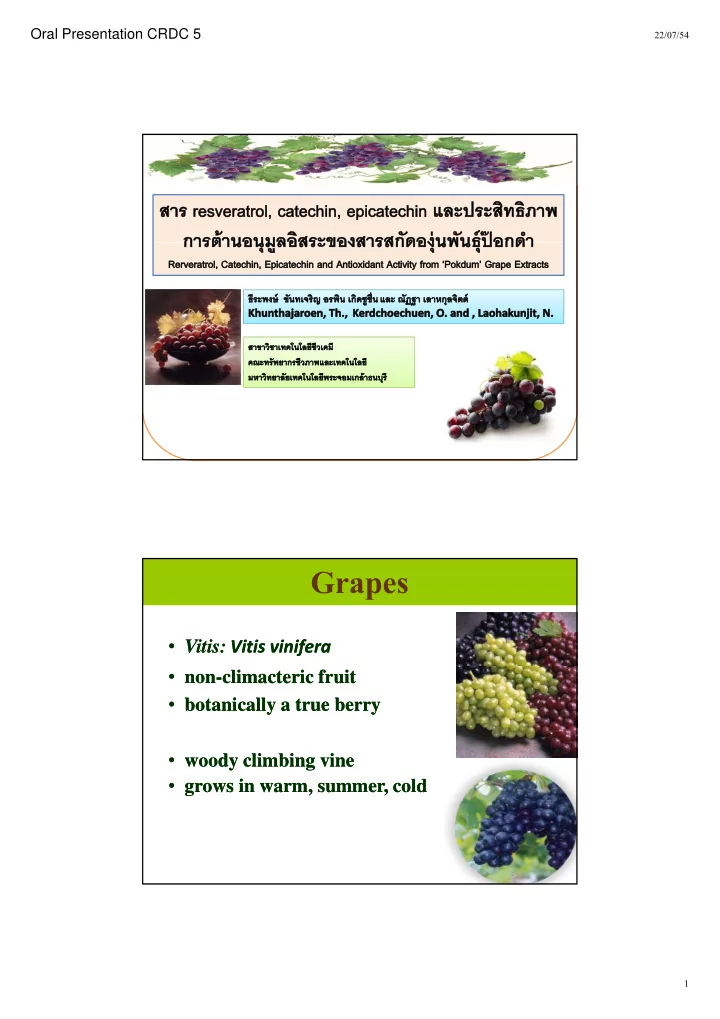
Grapes

  • Vitis

Vitis: : Vitis Vitis vinifera vinifera

  • non

non-

  • climacteric

climacteric fruit fruit

  • botanically a true

botanically a true berry berry

  • woody climbing vine

woody climbing vine

  • grows in

grows in warm, summer, warm, summer, cold cold

slide-2
SLIDE 2

Oral Presentation CRDC 5 22/07/54 2

Nutritional value of Grapes 100 g

Nutritional value Content (mg.)

Carbohydrates 18100

  • Sugars sucrose>

Nutritional value Content (mg.)

Vitamin C 10.8 Vitamin K 0.022

Vitamin Carbohydrate Carbohydrate Vitamin C Vitamin C

glucose> fructose

  • Dietary fiber

Fat 160 Protein 720 Thiamine (Vitamin B1) 0.069 Rib fl i (Vit i B2) 0 07 Vitamin K 0.022 Calcium 10 Iron 0.36 Magnesium 7 Manganese 0.071

Vitamin B K Minerals anthocyanin Protein Protein

Riboflavin (VitaminB2) 0.07 Niacin (VitaminB3) 0.188 Pantothenic acid (VitaminB5) 0.05 Vitamin B6 0.086 Folate(VitaminB9) 0.002 Phosphorus 20 Potassium 191 Sodium 3.02 Zinc 0.07

Phenolic compound

resveratrol

A phytochemical is a natural bioactive compound found in plant foods that works with nutrients and dietary

Phytochemicals or phytonutrients

found in plant foods that works with nutrients and dietary fiber to protect against diseases.

color Smell

Other : phytosynthesis,

Flavor Antioxidant Enzyme activation Self defensive

Other : phytosynthesis, respiration, growth and development

slide-3
SLIDE 3

Oral Presentation CRDC 5 22/07/54 3

Phytochemicals

Primary metabolite Secondary metabolite

Essential Oil Resins and Balsums Alkaloids Carbohydrate Lipids P i Glycosides

Phenolic compounds

Proteins Phenolic compounds are naturally occurring secondary

Phenolic compounds

> 8000 type

Phenolic compounds are secondary metabolites that are derivatives of the pentose phophate, shikimate, and phenylpropanoid pathways in plant. phytochemicals. The term ‘phenolic’ is used to define substances that possess one or more hydroxy (OH) substituents bonded

  • nto an aromatic ring.

Marinova et al.,2005, Balasundram et al.,2006

slide-4
SLIDE 4

Oral Presentation CRDC 5 22/07/54 4

photosynthesis

7 groups of phenolic compounds

1. Flavonoids (polyphenols): anthocyanins, isoflavones,catechins, Quercetin Quercetin, , myricetin myricetin, , apigenin apigenin, , lueteolin

lueteolin, , kaempferol

kaempferol, isorhamnetin isorhamnetin

anthocyanins

Isoflavones (ถัวเหลือง) catechins Quercetin Quercetin myricetin myricetin apigenin apigenin lueteolin lueteolin kaempferol kaempferol

rutin rutin

slide-5
SLIDE 5

Oral Presentation CRDC 5 22/07/54 5

  • 2. Phenolic acids: gallic acid, tannic acids, vanillin,

neochlorogenic neochlorogenic acid acid, p-coumaric coumaric acid acid

gallic acid (มะม่วง ชา ) Vanillin (วะนิลา) tannic acids (ชา เบอร์รี) p‐coumaric acid coumaric acid neochlorogenic acid neochlorogenic acid

  • 3. Hydroxycinnamic acid: caffeic acid, ferulic acid

chlorogenic acid

caffeic acid (แอปเปิล) ferulic acid(ส้ม สับปะรด) chlorogenic acid (กาแฟ สตรอเบอรี)

slide-6
SLIDE 6

Oral Presentation CRDC 5 22/07/54 6

4. . Lignans Lignans: : pinoresinol pinoresinol

pinoresinol (เมล็ดงา)

  • 5. Tannins: condensed tannins

. Tannins: condensed tannins (ชา) 6 Q i Q i b h b h th th

Flavone Gallic acid

  • 6. Quinones,

. Quinones, benzophenones benzophenones : : xanthones xanthones (

(มังคุด)

  • 7. Others:

. Others: monophenol monophenol, , tyrosol tyrosol ester, ester, stilbenoids stilbenoids, , punicalagins punicalagins

stilbenoids stilbenoids

resveratrol glucopyranoside

slide-7
SLIDE 7

Oral Presentation CRDC 5 22/07/54 7

Phenolic compound in grapes

d Skin Skin

anthocyanins quercetin rutin ll i id catechin epicatechin myricetin

seed seed

ellagic acid resveratrol kaempferol resveratrol Catechin is a polyphenolic antioxidant plant secondary metabolite. The term catechins is also commonly

Catechin

secondary metabolite. The term catechins is also commonly used to refer to the related family of flavonoids and the subgroup flavan-3-ols (or simply flavanols).

http://en.wikipedia.org/wiki/Catechin#Chemistry (+)-catechin (-)-catechin

slide-8
SLIDE 8

Oral Presentation CRDC 5 22/07/54 8

Epicatechin is a polyphenolic antioxidant plant secondary metabolite.

Epicatechin

Epicatechin can be found in cacao beans. The different other enantiomers can as well be found in chocolate.

http://en.wikipedia.org/wiki/Catechin#Chemistry

(-)-epicatechin

(+)-epicatechin

Variety/clone Phenolic content (mg/100 g DM) Seeds

Catechin Epicatechin AP SG1 96.9+5.9 d 106.8+1.6 d

Related research

F 9 74.4+0.9 e 98.4+9.9 de ISV 2 72.9+7.0 e 88.0+0.7 e ISV RC1 60.3+8.3 e 67.9+6.2 f Merlot 138.8+0.4 bc 131.8+9.7 c Cabernet Sauv. 141.8+7.9 b 127.6+4.4 c Canaiolo 140.7+2.2 bc 205.7+3.1 a Colorino V.no 124.4+0.1 c 89.0+8.6 e Foglia Tonda 67.4+5.1 e 47.2+3.5 g Montepulciano 205.7+19.0 a 164.6+16.8 b

Iacopini และคณะ, 2008

slide-9
SLIDE 9

Oral Presentation CRDC 5 22/07/54 9

years Sample Variables Influence on Alonso et al. 1991 Entire dried seeds from red grape marc after vinification Water content in ethanol: 5–40–60–80% Extraction time (without stirring): 3–6–12 h Yield of catechins and proanthocyanidins Entire dried seeds from Related research Pekic et al. 1998 white grape marc after pressing Water content in ethyl acetate: 3.3–5–10– 15–20% Extraction time 1–12–24 h Yield of proanthocyanidins Manzano et al. 2004 grape seed and skin 80% ethanol Extraction time 1-5 h Yield of flavan-3-ols Pinelo et Dried red and white Solvent: ethanol, methanol, water Solvent/solid ratio: 1–3–5 (v/w) Extraction time: 30–60–90 min Extraction Yield of total phenols, concentration andantioxidant al 2005grape marc temperature: 25–37.5–50 ˚C activity of extract Iacopini et al. 2008grape seed and skin ethanol:water:hydrochloric acid 0.12M(70:29:1 v/v/v) f: 4 h Yield of catechins and epicatechin

Resveratrol

  • Resveratrol is a phytoalexin produced naturally by

several plants when under attack by pathogens such as bacteria or fungi.

  • Resveratrol is found in the skin of red grapes and is a

constituent of red wine

slide-10
SLIDE 10

Oral Presentation CRDC 5 22/07/54 10

Structure Structure

B A

Content of Resveratrol and Piceid Isomers in Grape Berry Skins Extracted in Ethanol 80% at 60 °C during 30 min

Romero‐Perez, 2001

slide-11
SLIDE 11

Oral Presentation CRDC 5 22/07/54 11

years Sample Variables Influence on Romero- Perez et l 2001 grape berries selected were from the Carinena d i t five extraction solvents were tested: ethanol/water(80:20 v/v), ethanol 100%, ethyl acetate/methanol (50:50 v/v),acetone/water (75:25 / ) d t 100% t 60 °C f 30 i Resveratrol and Piceid Isomers in G B Ski

Related research

al. 2001red variety v/v), and acetone 100%. at 60 °C for 30 min Grape Berry Skins Pineiro et al. 2006 grapes of the Viura (white) and Tempranillo (red)varieties cultivated in Jerez (Spain) Solvent: methanol different temperatures 50, 100, 150 ˚C Determination of trans-resveratrol in grapes Spigno and De Dried powdered red grape marc (after Solvent: 90% ethylacetate–ethanol Faveri Extraction time: 5–24 hExtraction temperature: 28– Yield of total phenols, resveratrol and antioxidant Faveri 2007 g p ( vinification) and stems p 60 ˚C activity of extract Iacopini et al. 2008grape seed and skin ethanol:water:hydrochloric acid 0.12M(70:29:1 v/v/v) f: 4 h Yield of resveratrol

Marti และ คณะ 2001 สกัด resveratrol จาก grape skin (Vitis vinifera) Final extraction conditions were:40°C, 150 bar, 7.5% ethanol and extraction time 15 min. ั

Related research

Piantino และคณะ 2008 สกัด phenolic จากBaccharis dracunculifolia temperatures of 40, 50 and 60 ◦C and pressures

  • f 20, 30 and 40MPa.

Gelmez และคณะ 2009 สกัด phenolic จาก roasted wheat germ pressure (148–602 bar), temperature (40–60 ◦C) and time (10–60 min) Benova และคณะ 2010 สกัด resveratrol จาก Japanese knotweed pressure 25–40 Mpa , temperature 50–110 ◦C and extraction time 5–60 min Casas และ คณะ 2010 สกัด resveratrol จาก Palomino fino grapes pressure 100, 400 bar, temperature 35, 55 ◦C addition of modifier (5% v/v of ethanol) Castro‐ Vargas และคณะ 2010 สกัด phenolic จาก guava seeds (Psidium guajava L.) co‐solvents:ethyl acetate (EtAc)and ethanol (EtOH) conditions, using 10, 20 and 30MPa and 40,50 and 60 ◦C.
slide-12
SLIDE 12

Oral Presentation CRDC 5 22/07/54 12

งานวิจัยทีเกียวข้องกับการศึกษาคุณสมบัติของ resveratrol

ศึกษาผลของ resveratrol ในการยับยังเนือ Li และคณะ 2007 ศกษาผลของ resveratrol ในการยบยงเนอ งอก และ Leukemia cell L 1210 Colin และคณะ 2008 ศึกษาคุณสมบัติผลของ resveratrol ในการ ยับยังเซลล์มะเร็ง Fukui และคณะ 2010 ศึกษาคุณสมบัติผลของ resveratrol ในการ ยับยังเซลล์มะเร็ง Leiro และคณะ 2010 ศึกษาผลของ resveratrol ในการยับยังเนือ งอก

กระบวนการผลิตไวน์

องุ่นป ๊ อกดํา ไวน์

ทิง

บ่ม คันแยกนําและกาก peel seed

slide-13
SLIDE 13

Oral Presentation CRDC 5 22/07/54 13

วัตถุประสงค์

  • เพือศึกษาปริมาณสาร resveratrol, catechin, epicatechin และ

ประสิทธิภาพการต้านอนุมูลอิสระของสารสกัดเมล็ดและเปลือก องุ่นพันธุ์ป ๊ อกดํา

การเตรียมตัวอย่างและการสกัด

40°C แยกเปลือกและเมล็ด

องุ่นป ๊ อกดํา บด

40°C แยกเปลือกและเมล็ด

องุ่นป ๊ อกดํา

ร่อนด้วย mesh ขนาด 60

slide-14
SLIDE 14

Oral Presentation CRDC 5 22/07/54 14

วิเคราะห์ปริมาณฟีนอลิกทังหมดโดยใช้ Folin Ciocalteu method

10% folin‐ciocalteu phenol reagent 5 mL 7.5% sodium carbornate 4 mL

ตัวอย่าง 50 μL + นํากลัน 0.95 mL

Spectrophotometer

Singleton and Rossi, 1965 2 hr 30 min

760 nm

เทียบผลกับกราฟของสารละลายมาตรฐาน gallic acid

High‐performance liquid chromatography (HPLC)

slide-15
SLIDE 15

Oral Presentation CRDC 5 22/07/54 15

การวิเคราะห์สาร resveratrol, catechin และ epicatechin

resveratrol catechin และ epicatechin

mobile phase A คือ glacial acetic acid in water 52.6:900 (v/v) และ mobile phase B คือ 20%phase A และ 80%acetonitile (ACN) โดย อัตราส่วนของ A:B คือ 0 min, 83.5% A, 16.5% B; 13 min, 82.0% A, 18.0% B; 15 min, 82.0% A, 18.0 B; 17 min 77.0% A, 23.0% B flow rate 0.5 ml/min นาน 50 นาที ใช้ตัวอย่างปริมาณ

  • mobile phase A คือ 100%acetonitile (ACN)

mobile phase B คือ 0.05% PPA อัตราส่วน A:B คือ 13%:87% flow rate 0.5 ml/min ใช้ ตัวอย่างปริมาณ 20 μl ใช้ UV-visible diode- array ความยาวคลืน 231 nm วิเคราะห์ ปริมาณเทียบกับกราฟมาตรฐาน catechin, 100 μl ใช้ UV-visible diode-array ความยาวคลืน 306 nm วิเคราะห์ปริมาณเทียบกับกราฟ มาตรฐานเรสเวอราทรอล ฐ epicatechin

วิเคราะห์ประสิทธิภาพการเป็นสารต้านอนุมูลอิสระด้วยวิธี DPPH (2,2-diphenyl-1-picrylhydrazyl)

ตัวอย่าง 50 μL 0.1 mM DPPH 3.95 mL

Spectrophotometer

30 min

517 nm

เทียบผลกับกราฟของสารละลายมาตรฐาน Trolox

slide-16
SLIDE 16

Oral Presentation CRDC 5 22/07/54 16

วิเคราะห์ประสิทธิภาพการเป็นสารต้านอนุมูลอิสระด้วยวิธี ABTS 2,2'-azino-bis(3-ethylbenzothiazoline-6-sulphonic acid)

ตัวอย่าง 50 μL ABTS•+ 3.95 mL

Spectrophotometer

6 min

734 nm

เทียบผลกับกราฟของสารละลายมาตรฐาน Trolox

ผลการทดลอง

slide-17
SLIDE 17

Oral Presentation CRDC 5 22/07/54 17

ปริมาณ total phenolic

120

116.4 mg GAE/g DW Seed ; 67‐87 mg GAE/g DW Peel ; 9‐14 mg GAE/g DW

20 40 60 80 100 Phenolic contents (mg GAE/g DW)

seed peel

<0.01 mg GAE/g DW

20 1hrs 30°C 1hrs 40°C 1hrs 50°C 12hrs 30°C 12hrs 40°C 12hrs 50°C 24hrs 30°C 24hrs 40°C 24hrs 50°C 1hrs 30°C 12hrs 30°C 24hrs 30°C 1hrs 30°C 12hrs 30°C 24hrs 30°C

water ethanol petroleum ether

Resveratrol

seed peel

Resveratrol Resveratrol

p

slide-18
SLIDE 18

Oral Presentation CRDC 5 22/07/54 18

ปริมาณ resveratrol

250 300

268.31μg/g DW Seed ; 243.32 μg/g DW peel; 207.95 μg/g DW

100 150 200 resveratrol contents(μg/g DW)

seed peel

50 1hrs 30°C 1hrs 40°C 1hrs 50°C 12hrs 30°C 12hrs 40°C 12hrs 50°C 24hrs 30°C 24hrs 40°C 24hrs 50°C 1hrs 30°C 12hrs 30°C 24hrs 30°C 1hrs 30°C 12hrs 30°C 24hrs 30°C

water ethanol petroleum ether

catechin epicatechin

seed peel

catechin epicatechin catechin catechin epic

slide-19
SLIDE 19

Oral Presentation CRDC 5 22/07/54 19

ปริมาณ catechin

450 500 150 200 250 300 350 400 catechin contents (mg/100g DW)

seed peel

50 100 1hrs 30°C 1hrs 40°C 1hrs 50°C 12hrs 30°C 12hrs 40°C 12hrs 50°C 24hrs 30°C 24hrs 40°C 24hrs 50°C 1hrs 30°C 12hrs 30°C 24hrs 30°C 1hrs 30°C 12hrs 30°C 24hrs 30°C

water ethanol petroleum ether

ปริมาณ epicatechin

300

250.89 mg/100gDW

100 150 200 250 picatechin contents (mg/100g DW)

seed peel

<0.01 mg /100g DW

50 1hrs 30°C 1hrs 40°C 1hrs 50°C 12hrs 30°C 12hrs 40°C 12hrs 50°C 24hrs 30°C 24hrs 40°C 24hrs 50°C 1hrs 30°C 12hrs 30°C 24hrs 30°C 1hrs 30°C 12hrs 30°C 24hrs 30°C ep

water

/100g DW

ethanol petroleum ether

slide-20
SLIDE 20

Oral Presentation CRDC 5 22/07/54 20

ประสิทธิภาพการต้านอนุมูลอิสระ (DPPH)

60

54.58 mM TE/g DW Seed ; 33‐48 mM TE/g DW Peel ; 1‐3 mM TE/g DW

20 30 40 50 mM TE/g DW seed peel

<0.01 mM TE/g DW

10 1hrs 30°C 1hrs 40°C 1hrs 50°C 12hrs 30°C 12hrs 40°C 12hrs 50°C 24hrs 30°C 24hrs 40°C 24hrs 50°C 1hrs 30°C 12hrs 30°C 24hrs 30°C 1hrs 30°C 12hrs 30°C 24hrs 30°C

water ethanol petroleum ether

ประสิทธิภาพการต้านอนุมูลอิสระ(ABTS)

45.33 mM TE/g DW 37.36 mM TE/g DW

15 20 25 30 35 40 45 50 mM TE/g DW seed peel

<0.01 mM

5 10 15 1hrs 30°C 1hrs 40°C 1hrs 50°C 12hrs 30°C 12hrs 40°C 12hrs 50°C 24hrs 30°C 24hrs 40°C 24hrs 50°C 1hrs 30°C 12hrs 30°C 24hrs 30°C 1hrs 30°C 12hrs 30°C 24hrs 30°C

water ethanol petroleum ether

TE/g DW

slide-21
SLIDE 21

Oral Presentation CRDC 5 22/07/54 21

สรุปผล

1 สารสกัดจากเมล็ดขององ่นพันธ์ป ๊ อกดํามีปริมาณ 1. สารสกดจากเมลดขององุนพนธุปอกดามปรมาณ total phenolic, resveratrol, catechin, epicatechin และ ประสิทธิภาพการต้านอนุมูลอิสระสูงกว่าสารสกัดจาก เปลือก ั ้ ั โ ป็ ีไ ้

  • 2. การสกัดด้วยเอทานอลนาน 24 ชัวโมง เป็นสภาวะทีได้

ปริมาณ resveratrol, catechin, epicatechin และมี ประสิทธิภาพการต้านอนุมูลอิสระสูงทีสุด

สรุปผล

3 รส ั ้ ํ ิ 40°C 1 ชั โ ไ ้

  • 3. การสกดดวยนาอุณหภูม 40°C นาน 1 ชวโมง ได

ปริมาณสารฟีนอลิค resveratrol, catechin, epicatechin และประสิทธิภาพการต้านอนุมูลอิสระสูง

slide-22
SLIDE 22

Oral Presentation CRDC 5 22/07/54 22

ขอขอบคุณ

The end The end

Acknowledgement :

  • Assoc. Prof. Dr. Orapin Kerdchoechuen
  • Assist. Prof. Dr. Natta Laohakunjit