Grapes in Latvia: irts Mielsons ASSOCIATION OF LATVIAN VINEGROWERS - - PowerPoint PPT Presentation

grapes in latvia
SMART_READER_LITE
LIVE PREVIEW

Grapes in Latvia: irts Mielsons ASSOCIATION OF LATVIAN VINEGROWERS - - PowerPoint PPT Presentation

Grapes in Latvia: irts Mielsons ASSOCIATION OF LATVIAN VINEGROWERS AND WINEMAKERS , Latvia Heppenheim, March 27, 2010 Climate challenges and restrictions in Latvia: Maritime climate: short summer, frequent thaws in winter. June:


slide-1
SLIDE 1

Grapes in Latvia:

Ģirts Miķelsons ASSOCIATION OF LATVIAN VINEGROWERS AND WINEMAKERS, Latvia

Heppenheim, March 27, 2010

Climate challenges and restrictions in Latvia:

  • Maritime climate: short summer, frequent

thaws in winter.

  • June: cool/ rainfalls, frosts until mid of

June,

  • July: possible rainfalls, often cloudy,
  • August: growth ceases, cool nights,
  • September: killing frosts at the first

decade

  • Vegetation period about 120 days and

DDC around 800. Ripening and wood hardening for outdoor grapes in August is very important!

  • Varieties based on V.labrusca are feeling

more or less OK: Zilga, Guna, Supaga, but we want more...

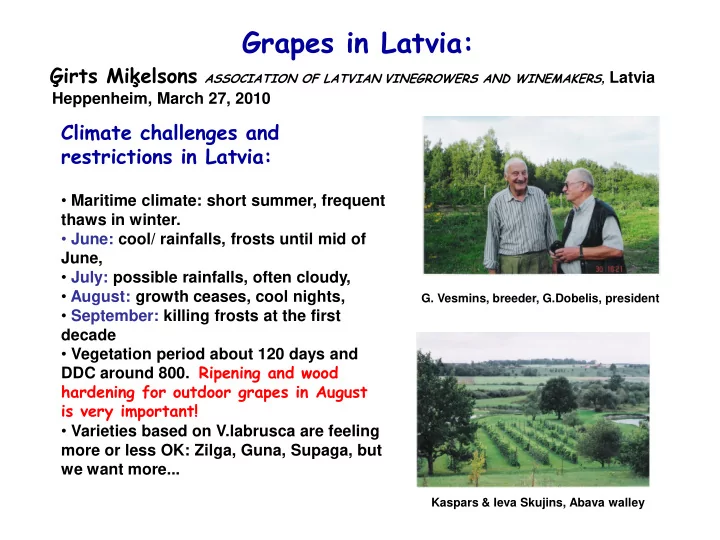
  • G. Vesmins, breeder, G.Dobelis, president

Kaspars & Ieva Skujins, Abava walley

slide-2
SLIDE 2

Zilga – old, still grown, known in northern countries

Breeder: Pauls Sukatnieks, Latvia Cross: Smugljanka x Dvietes Zila + Jubilejnij Novgoroda

advantages:

  • very productive
  • hardy with cold resistance up to
  • 32 oC, can be uncovered on

winter

  • early wood hardening (August)

disadvantages (as a wine grape):

  • sugars often low (Brix~15, but

in 2009 Brix 19 ),TA ≥ 1%

  • r more
  • strong foxy, wine usually non-

accepted

  • low resistance to Peronospora
slide-3
SLIDE 3

Hasanskij Sladkij – old, well known now thanks to Baltics, but not developed in Baltics

Breeder: K.Bous, Russia, Far East Cross: OP of ‘Dalnevostocnij Tihonova’ advantages: something for wine

  • early – middle September
  • hardy (about as Zilga, ~ 30 oC)
  • quite resistant to mildews
  • Brix ≥ 20%
  • TA 0.7-0.8%

disadvantages:

  • low crops on young vines
  • small clusters
  • wine simple, only for blends
slide-4
SLIDE 4

Liepajas Dzintars – new high quality muscat

Breeder: Gunvaldis Vēsmiņš, Moldova/Latvia Cross: (S65 x Muskat Jantarnij) x (S5-6-3 x Pearl of Szaba)

[S65 = Halili Belij x V.amurensis; S5-6-3 = Nimrang x SV 20-473] advantages:

  • ripens in August
  • productive
  • high vinifera type quality,

(muscat flavor)

  • good wood hardening
  • Brix 20-23%
  • TA 0.7%
  • cold resistance better than for

viniferas disadvantages:

  • female
  • coverable on winter,
  • new variety, field tests only

started

  • no wine yet from open grown

vines

slide-5
SLIDE 5

Ciravas Agra - new high quality muscat

Breeder: Gunvaldis Vēsmiņš, Moldova/Latvia

Cross: (S90 x Ranij VIRa) x (S5-6-3 x Pearl of Szaba)

[S90 = Irshai Oliver x V.amurensis; Rannij VIRa = Chaus x Kish Mish Chornij; S5-6-3 = Nimrang x SV 20-473]

advantages:

  • ripens in August
  • productive
  • high vinifera type quality,

muscat flavor

  • good wood hardening
  • Brix 18-20%
  • TA 0.7%, hopefully a wine grape

disadvantages:

  • coverable on winter, cold

resistance – 24 oC

  • new variety, field tests only

started

slide-6
SLIDE 6

Dovga – new high quality muscat

Breeder: Gunvaldis Vēsmiņš, Moldova/Latvia

(S68 x Chiljaki Belij) x (S3-4-5 x Pearl of Szaba)

[S68 = Halili Belij x V.amurensis clone M; S3-4-5 = Koroljeva Vinogradnikov x SV 20-473; Koroljeva Vinogradnikov = King Elizabeth x Pearl of Szaba]

advantages:

  • ripens in August
  • good wood hardening: 90 %
  • Brix 18-20%
  • TA 0.6-0.7%

disadvantages:

  • new variety, field tests only

started

  • cold resistance – 24 oC
  • unstable productivity ?
slide-7
SLIDE 7

Summary of top most early varieties

Variety Ripening in Septemb er Flavor/ taste Resistanc e Wood hardening Cold resistance Yield Brix max TA

Zilga

Middle- end Hybrid/ foxy DM - low PM - OK Good High High

19

0.80- 1.25

Hasanskij sladkij

Middle - end Simple DM - good PM - good Good High Good

22

0.70- 0.80

Liepajas Dzintars

Early, late August Muscat DM -good Good Medium High

23

0.70

Ciravas Agra

Early, late August Muscat DM - good Good Medium Good

20

0.65- 0.75

Dovga

Early, late August Muscat DM - good Good Medium Good

20

0.60- 0.70

slide-8
SLIDE 8

Varieties in Latvia 2009, taste and

sugar

slide-9
SLIDE 9

Varieties 2009, continuated

slide-10
SLIDE 10

Latvian wine, some hopes

Variety Positive arguments Problems Solutions

Skujins 675, white Early, high Brix, TA

  • ptimal, productive,

hardy Small clusters, vigorous, complex hybrid tones in wine Wine of local character Jubilejnij Novgoroda, white Early, high Brix, TA

  • ptimal, medium hardy,

aromatic Productivity problematic, chlorosis, hybrid tones in wine Wine of local character Sukribe, white Early, productive, non- strong labrusca Foxy, winter cover needed, wine is plane Blending with

  • ther: (Jubilejnij

Novgoroda, Skujins 675) Hasanskij Sladkij, red Early, high Brix, TA

  • ptimal, hardy

Small clusters, wine without character Use as a base for blending (with Varnava-2)

slide-11
SLIDE 11

Latvian Wine: some other hopes

Variety Positive arguments Problems Solutions

Liepajas Dzintars, Ciravas Agra, Dovga, whites Early, high Brix, TA

  • ptimal, good muscat

aroma No field tests yet, wine can lack body Blending Sele, Productive, good size of berries and cluster, floral Gewurztraminer aromas, non labrusca Small clusters, wine without character, low Brix, not very early Vine management, site selection Varnava-2 Rich color, normal TA, tannins Productivity problematic, not particularly early, weak aroma Blending component Guna Productive when

  • pollinated. Rose wine

with interesting tones Female, not very early, Wine of local wine

slide-12
SLIDE 12

Acidity and sugar of Latvian grapes used for wines

slide-13
SLIDE 13

Conclusions

  • Latvia today is a place where variety tests

are going on on large scale

  • Several hybrid grape varieties were

developed in Latvia in last 40 years with reliable Labruscan varieties of medium quality and breeding work is going on with many hybrids under investigation

  • several new early non-Labruscan desease

resistant varieties are under test Thank you for attention!