
1/20/2013 1
Integrated Processing of Jamun (Syzygium cumini Skeels) Fruit For Value Addition and Assesment of its Impact on Health and Nutrition Susanta K.Roy , Sunil Saran & Vigya Mishra
Amity International Centre for Post Harvest Technology & Cold Chain Management
Amity University Uttar Pradesh
Sector-125, Expressway, Noida, India www.amity.edu/aicpht
Workshop on “Valorisation of traditional processing of indigenous and underutilized fruits” Institute of Technology of Cambodia Phnom Penh, Cambodia
The workshop organized under the project “International network on preserving safety and nutrition of indigenous fruits and their derivatives” January 14-16, 2013, funded by Leverhulme Trust, UK
INTRODUCTION
- An important indigenous fruit of the family Myrtaceae.
- Large, evergreen tree widely distributed in different agro-
climatic conditions in South Asia but remains underutilized
- The ripe fruits are purplish black in colour due to the presence
- f anthocyanins
- Fruits are rich in minerals and have high antioxidant property
which contribute to many health benefits
- Jamun is highly perishable, therefore, very difficult to store and
market at distant places
- Jamun seeds are used in traditional medicine
Average Nutritional composition (per 100g) of Jamun fruit
Carbohydrate 14.00% Protein 0.15-0.30g Fibre 0.30-0.90% Calcium 8.30-15.00mg Potassium 55.00mg Magnesium 35.00mg Phosphorus 15-16.20mg Iron 1.20-1.60mg Folic acid 3.00mcg
Harvesting
- The ripe fruits are available during summer
and disappear with onset of the monsoon.
- Common method of harvesting- By shaking
the tree and collecting the fruits by holding a big piece of cloth or canvas under the tree.
- The fruits cannot remain on the tree in the
ripe stage and start dropping to the ground immediately after ripening.
- As a result, a considerable amount of fruit is
damaged and become unfit for fresh consumption.
- It is unfortunate that no proper technique
for harvesting jamuns has yet been developed.
Cultivar
- There is no standard cultivar of jamun.
- Recently
some cultivars have been developed and are being propagated.
- There are two different types of jamun one
small and the other big .
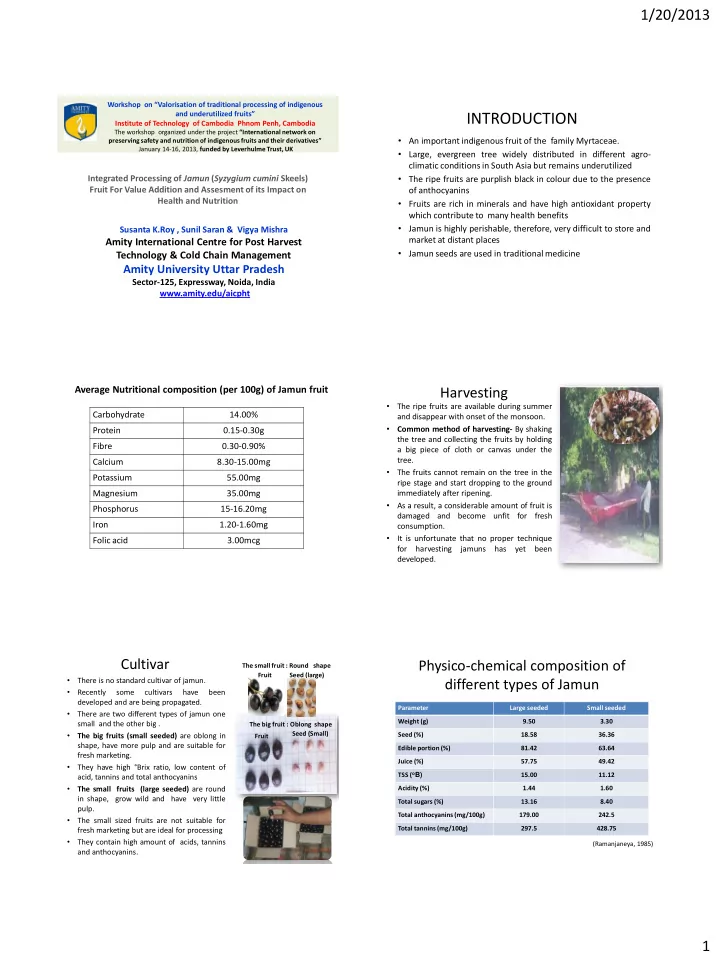
- The big fruits (small seeded) are oblong in
shape, have more pulp and are suitable for fresh marketing.
- They have high °Brix ratio, low content of
acid, tannins and total anthocyanins
- The small fruits (large seeded) are round
in shape, grow wild and have very little pulp.
- The small sized fruits are not suitable for
fresh marketing but are ideal for processing
- They contain high amount of acids, tannins
and anthocyanins.
The big fruit : Oblong shape Fruit Seed (Small) The small fruit : Round shape Fruit Seed (large)
Physico-chemical composition of different types of Jamun
Parameter Large seeded Small seeded Weight (g) 9.50 3.30 Seed (%) 18.58 36.36 Edible portion (%) 81.42 63.64 Juice (%) 57.75 49.42 TSS (oB) 15.00 11.12 Acidity (%) 1.44 1.60 Total sugars (%) 13.16 8.40 Total anthocyanins (mg/100g) 179.00 242.5 Total tannins (mg/100g) 297.5 428.75 (Ramanjaneya, 1985)