Grape Growing 102 Answers To Questions Site Selection and Soil - - PDF document

grape growing 102
SMART_READER_LITE
LIVE PREVIEW

Grape Growing 102 Answers To Questions Site Selection and Soil - - PDF document

Grape Growing 102 Answers To Questions Site Selection and Soil Science Thank you to the following for contributing to this presentation: Wine or Table Grapes Rebecca Harbut - University of Wisconsin Madison, Extension Fruit


slide-1
SLIDE 1

1

Grape Growing 102

Thank you to the following for contributing to this presentation:

  • Rebecca Harbut - University of Wisconsin Madison, Extension Fruit Specialist
  • Kevin Schoessow – Agriculture Agent NW Wisc – Spooner
  • Tim Rehbein - Agricultural Agent Vernon County
  • Dean Volenberg - Agricultural Agent Door County
  • Wisconsin Grape Growers Association

Answers To Questions

  • Site Selection and Soil Science
  • Wine or Table Grapes

– Which Varieties to Plant

  • Planting, Trellis, etc…..
  • Vine Anatomy and How To Prune and Train
  • Pest Problems
  • Harvest

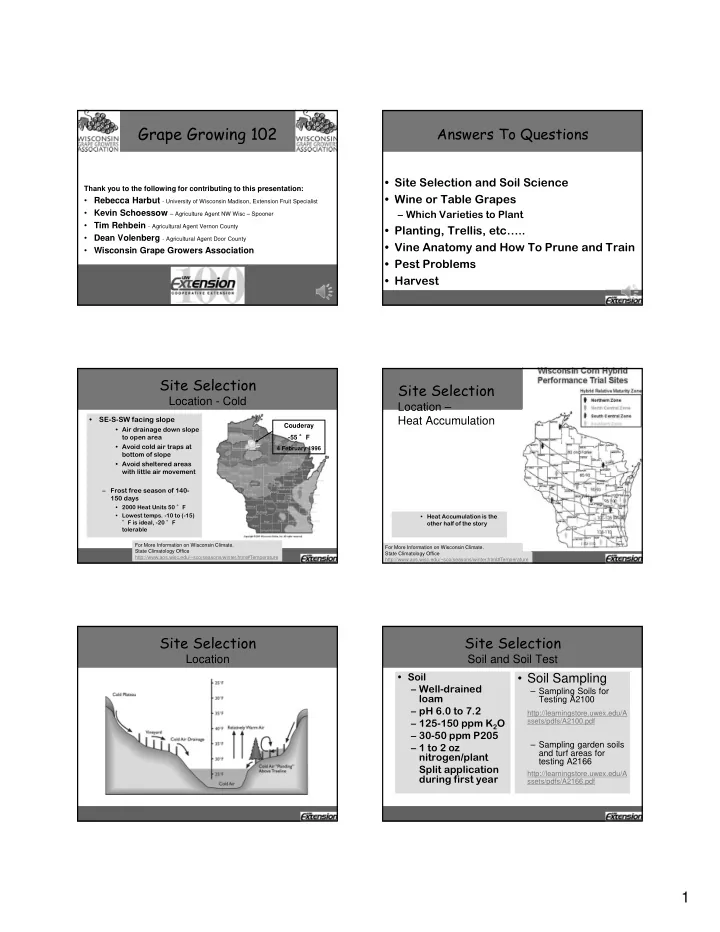
Site Selection

Location - Cold

  • SE-S-SW facing slope
  • Air drainage down slope

to open area

  • Avoid cold air traps at

bottom of slope

  • Avoid sheltered areas

with little air movement – Frost free season of 140- 150 days

  • 2000 Heat Units 50 °F
  • Lowest temps. -10 to (-15)

°F is ideal, -20 °F tolerable

For More Information on Wisconsin Climate. State Climatology Office http://www.aos.wisc.edu/~sco/seasons/winter.html#Temperature

Couderay

  • 55 °F

4 February 1996

Site Selection

Location – Heat Accumulation

  • Heat Accumulation is the
  • ther half of the story

For More Information on Wisconsin Climate. State Climatology Office http://www.aos.wisc.edu/~sco/seasons/winter.html#Temperature

Site Selection

Location

Site Selection

Soil and Soil Test

  • Soil

– Well-drained loam – pH 6.0 to 7.2 – 125-150 ppm K2O – 30-50 ppm P205 – 1 to 2 oz nitrogen/plant Split application during first year

  • Soil Sampling

– Sampling Soils for Testing A2100

http://learningstore.uwex.edu/A ssets/pdfs/A2100.pdf

– Sampling garden soils and turf areas for testing A2166

http://learningstore.uwex.edu/A ssets/pdfs/A2166.pdf

slide-2
SLIDE 2

2

Vine Balance

  • DO NOT OVER-FERTILIZE
  • 1 cup of a 9-23-30 is sufficient

Wine or Dine

  • Wine Grapes ( 15 pounds per plant)

– Numerous hardy varieties to choose from – White or red wine – Quality dependent on

  • Growing conditions
  • Crop load management
  • Training system
  • Table Grapes (Can get to 20 pounds per plant)

– Seedless varieties both blue, red, and green/white – Somewhat reduced hardiness – Easy to grow – Unique flavors and qualities – Juice options for some seeded varieties – Some folks will eat seeded grapes

Wine or Dine or Sublime

Some uses of the grape vine in the backyard or horticultural setting are for mainly visual purposes For example on an arbor NOT for fruit production Don’t over fertilize Don’t have to worry about critters Don’t have to worry about colored bird poop! The University of Minnesota is breeding a vine just for this purpose

Table Grape Varieties

  • Red Seedless Varieties

– Reliance (Arkansas) – Einset (New York) – Vanessa (Ontario) – Canadice (New York) – Petite Jewel (Wisconsin,Swenson) – Somerset seedless (Minnesota)

Reliance

  • Vines hardy for zone 5 (T.R.)
  • Early ripening
  • High production potential
  • Medium sized cling skin berries
  • Mild flavor and good quality
  • Variable fruit color if shaded
  • Consistent performance

Red Table Grape

Einset

  • Vines are hardy with moderate

vigor zone 5 (T.R.)

  • Early ripening after Reliance
  • Medium sized berries, slightly

thick cling-slip skin

  • Mild flavor, strawberry after taste
  • Production level variable
  • Good storage potential
  • Hardy -15 to -25 °F

Red Table Grape

slide-3
SLIDE 3

3

Vanessa

  • Moderately hardy, vigorous vines
  • Zone 5 (T.R.)
  • Prefers well-drained fertile soils
  • Early ripening with Einset
  • Medium sized berries,thin skinned

cling skin with very firm crisp flesh

  • Production and vigor site dependent
  • Very high quality and storage life
  • Hardy -15 to -25 °F

Red Table Grape

Canadice

  • Vines are hardy, moderate vigor
  • Zone 5 (T.R.)
  • Sets heavy crops limiting vigor
  • Ripens with Einset
  • Medium sized berries slip skin

tendency, somewhat soft flesh

  • Good quality, similar flavor to
  • Delaware. Labrusca (foxy) flavor
  • Cluster thin to maintain vigor
  • Hardy -10 to -20 °F

Red Table Grape

Petite Jewel

  • Very hardy, moderate vigor vine
  • Zone 4
  • Ripens with or before Reliance
  • Berries small-medium size
  • Firm flesh, fruity-spicy flavor
  • Small loose clusters
  • Very consistent performer for

harsh winter conditions

Red Table Grape

Somerset Seedless

  • Very vigorous vine
  • Zone 4
  • First to ripen at WMARS trial – end
  • f August
  • Berries small-medium size
  • Clusters ~ ¼ lb
  • Loose clusters
  • Very consistent performer for

harsh winter conditions

Red Table Grape

Table Grape Varieties

  • White/Green Seedless

– Marquis (New York) – Himrod (New York)

Marquis

  • Vines are hardy of moderate vigor zone 5 (T.R.)
  • Ripens with,- slightly after Vanessa
  • Large round berries borne in long loose clusters
  • Skin thickness reduces with maturity
  • Good production; slow to establish
  • Best green for Midwest
  • Long maturity, best for southern WI

White/Green Table Grape

slide-4
SLIDE 4

4

Himrod

  • Moderately hardy and vigorous
  • Zone 5 (T.R.)
  • Medium sized cling skin berries
  • Ripens with Einset
  • High quality fruit and flavor
  • Excellent storage potential
  • Hardiness is still questionable for

reliable production in northern areas of WI

White/Green Table Grape

Table Grape Varieties

  • Blue seedless

– Trollhaugen – Mars

Mars

  • Hardy vigorous vines
  • Zone 4 if protected (T.R.)
  • Midseason maturity
  • Medium-large, slip skin

berries, somewhat thick skinned

  • Concord type flavor, good

quality and storage potential

  • Very productive and reliable

Blue Table Grape

Trollhaugen

  • Very hardy vines of moderate vigor
  • Zone 4 and possibly zone 3?
  • Early maturity before Mars
  • Small, thin skinned slip skin berries
  • Excellent mild Concord flavor for

fresh market sales

  • Very productive and reliable with

good storage potential

  • Excellent for harsh winter conditions

Blue Table Grape

Seeded Varieties

  • Buffalo

– Concord type, hardy, vigorous, early maturity – Large fruit of excellent quality

  • Swenson Red

– Red variety, very hardy, late maturity – Large fruit, firm, excellent quality, needs heat

  • Bluebell

– Concord type, early maturity – Very hardy – Reported as best juice variety

  • Concord

– Old favorite – Very hardy, very vigorous – Needs heat and long season Seeded Table Grape

Wine Varieties

  • Red Wine

– Foch – St. Croix – Frontenac – Leon Millot – Marquette – Baltica – Petite Pearl

  • White Wine

– La Crescent – La Crosse – St. Pepin – Frontenac gris – Brianna – Edelweiss

Wine Grape

slide-5
SLIDE 5

5

Marechal Foch

  • Very hardy vines zone 4b
  • Low to moderate vigor
  • Early maturity
  • High sugar and high acid
  • Making some nice wines

Red Wine Grape

  • St. Croix
  • Very hardy vines 4 a & b
  • Moderate vigor
  • Matures early
  • Harvested at low sugar
  • Very productive
  • Popular wine variety in

MN

Red Wine Grape

Frontenac

  • Very hardy MN introduction
  • Vigorous and very productive
  • Good disease resistance
  • Except for black rot
  • Susceptible to Grape Phylloxera
  • High sugar 24-28%
  • Very high acid
  • Matures early October
  • Deep red color for ports

Wine Grape

Leon Millot

  • Hardy, vigorous vines zone 4a
  • Ripens before Foch, early season
  • Produces good quality Burgundy
  • Very productive
  • Relatively disease free
  • Good choice in short season area
  • Relative of Foch

Red Wine Grape

Marquette

  • Very hardy MN introduction
  • Moderate vigor
  • Production levels of 10#/plant
  • Matures mid-late September
  • High sugar relatively low acid
  • Good disease resistance

Red Wine Grape

Baltica

  • Introduction from Estonia
  • Parentage: V. amurensis, V. labrusca,
  • V. riparia, and V. vinifera
  • Long loose clusters
  • Small sized berries (2 g)
  • Disease resistant except P. mildew
  • Makes a light red to full complex red

wine, climate dependant

  • Excellent variety for short growing

season

Red Wine Grape

slide-6
SLIDE 6

6

Petite Pearl

  • Introduction from MN Breeder

Tom Plocher

  • Matures mid-September to early

October in MN

  • Compact cluster with small berries
  • Breaks bud late (frost protection)
  • Disease resistant to P. mildew, D.

mildew, and black rot

  • High tannin levels and low TA

Red Wine Grape

La Crescent

  • Very hardy
  • Vigorous and productive
  • Resembles Vignoles in flavor
  • High acid/High sugar
  • Low disease susceptibility

except for downy mildew

  • Matures late September

White Wine Grape

La Crosse

  • Hardy vines, moderate vigor
  • Early midseason maturity
  • Produces fruity non-labrusca wine
  • Very productive
  • Unique flavor even as a table grape
  • Consistent producer
  • Can get bunch rots

White Wine Grape

  • St. Pepin
  • Very hardy, vigorous vines
  • Midseason maturity
  • Pistillate type needs pollinator

which is usually La Crosse

  • Produces fruity Riesling type

wine

  • Moderate production
  • Blends well like La Crosse is a

good table grape

  • Out of all the whites, most in

demand by winemakers

White Wine Grape

Frontenac Gris

  • Bud sport of Frontenac
  • Same viticultural characteristics

as Frontenac

  • Late midseason 24 to 25° Brix

(MN)

  • Peach, apricot, and tropical

aromas

  • Very winter hardy

White Wine Grape

Brianna

  • Bred by Elmer Swenson and

named by Ed Swanson

  • Medium to large berries
  • Medium to small tight clusters
  • Vigorous growth
  • Very cold hardy
  • Grapefruit, tropical, floral

characteristics

  • Often harvested at low brix 16 to

18, as ripening progresses foxy notes become apparent

White Wine Grape

slide-7
SLIDE 7

7

Edelweiss

  • Bred by Elmer Swenson in the

1970’s

  • Medium to large berries
  • Fairly loose clusters
  • Vigorous growth
  • Very cold hardy
  • German style sweet/semi sweet

wine

  • Often harvested at low brix 16 to

18, as ripening progresses foxy notes become apparent

  • This photo has hail damage

showing

White Wine Grape

Planting

  • Select North-South row orientation
  • Most of the plants are bare root stock
  • Spring plant into well tilled weed-free soil
  • Row spacing greater than trellis height
  • Plant spacing 6-8’ apart
  • Root prune vs. plant all roots

– Excessively long roots cut back – Prevent twisting and entangling of roots

  • Plants pruned back to 2-3 expanding buds

– Best done after bud swell

Trellis Construction

  • Trellis responsible for vine + crop weight

– Provides platform for pruning and training – Needs to function for 20-30 yrs. – Construct once and only once

  • In place year one preferred

– Wire available for initial shoot – Keep shoots off of ground

  • Training systems for trellis

– Cane pruning – Spur(2-3 bud cane) pruning

Major Trellis Components

  • Posts

Posts: Wood Wood (preferred)

– Line Line Post Posts

  • Space

aced 21, 24 or 21, 24 or 28 ft apar 28 ft apart - Dependent on vine spacing

– End End Post Posts

  • An

Anchor

  • red: earth anchor or tie-back post for rows less than 600 ft.
  • Braced

aced: H-brace or slant brace for rows over 600 ft.

  • Wire Support

– High-tensile g

  • tensile galvanized

anized s steel w wire-12 re-12 gauge

  • High cordon, or Kniffen: 1 to 3 wires
  • Vertical shoot positioning: 5 to 7 wires
  • Geneva Double Curtain: 3 or 4 wires

End Post End Post

slide-8
SLIDE 8

8

End Post Line Post Vine Anatomy

Vine Anatomy

CANES, CORDONS AND SHOOTS… OH MY!

  • Cordon-permanent stem

– Trained horizontally – Not all systems have cordons

  • Cane

– One year old shoot – SPUR- Canes pruned to 2- 3 buds

  • Shoot

– Current seasons growth – Bear fruit clusters

Vine Anatomy

CANES, CORDONS AND SHOOTS… OH MY!

  • Cordon-permanent stem

– Trained horizontally – Not all systems have cordons

  • Cane

– One year old shoot – SPUR- Canes pruned to 2- 3 buds

  • Shoot

– Current seasons growth – Bear fruit clusters

Pruning and Training http://ohioline.osu.edu/b919/

Initial Pruning from planting to fruiting High Bi-Lateral Cordon Relies on downward combing of new growth

slide-9
SLIDE 9

9

Pruning and Training

Initial Pruning from planting to fruiting High Bi-Lateral Cordon Relies on downward combing of new growth

Training Methods

High Cordon Low Cordon Use for trailing grape cultivars Use for upright grape cultivars

Training Methods

Low-Cordon Vertical Shoot Positioning

Pruning Rules

40 buds per plant for medium to larger cluster grapes Up to 60 buds per plant for smaller cluster grapes The 2013 growing season is developing the 2014 crop For a mature vine, you will remove 80- 90% of last year’s growth

Pruning Rules

Year one is for developing the root Year two is for developing the trunk Year three is for developing the cordon and maybe a little fruit, 5-10 fruiting buds Year four is for more fruit, 20 fruiting buds Year five should be a mature vine

Pruning Rules

When you start to prune, you have to be able to tell what was last year’s growth which is usually a nice light brown color

slide-10
SLIDE 10

10

Grape Pests

  • Weed management

critical during establishment years

– Start weed free – Maintain weed free zone in rows – Weeds impede air flow-resulting in potential higher incidence of grape diseases

With Weed Control Without Weed Control

Diseases Problems

  • Powdery Mildew
  • Downy Mildew
  • Black Rot
  • Phomopsis Cane and Leaf spot
  • Copper and Sulfur Sensitivities

Diseases Problems

  • Producing organically or naturally does NOT

mean “do nothing”

  • If you want fruit and you want to do it
  • rganically, as a rule of thumb, you will be

using twice as much product and spraying twice as often

  • A dormant application of lime sulfur will help
  • At minimum, apply the dormant lime sulfur

and then spray fungicides just before bloom, at bloom and just after bloom

  • Midwest Fruit and Grape Spray Guide

Powdery Mildew

  • Fungal Disease
  • Can infect all green tissue
  • Cluster petioles and stems

– Susceptible all season

  • Berries susceptibility

– Based on sugar content – <10% high, >10% none

  • Overwinters in buds & canes
  • Dependent on environment

– Temps. 68-80F – Cloudy and High Humidity

slide-11
SLIDE 11

11

Powdery Mildew Management

Early Control is Critical

  • Heavy rains will disrupt development
  • Dry, warm, am/pm dews favor development
  • Fungicide applications; 8-10” shoot-pre-bloom

– 2-3 Applications ,repeat Sept-Oct.; Weather dependent

  • Commercial

– Nova – Rally, Elite, Procure – Strobilurins; Sovran, Flint

  • Broader spectrum; Control other diseases
  • Protective qualities
  • Home vineyards

– Immunox (Myclobutanil)

Downy Mildew

  • Fungal disease
  • Overwinters in infected leaves
  • Early leaf infection moves to blossoms
  • Favored by rapid growth + wet conditions
  • Ideal temperature for infection 65° F

Downy Mildew Management

  • Susceptibility Dependent on Variety

– Vinifera hybrids most- American least

  • Control Starts Early

– Initial shoot growth to pre-Bloom – Critical before bloom to prevent fruit infection – Fungicide applications very effective – Continue 10-14 d interval dependent on weather

  • Commercial

– Sovran, Flint, Dithane, Mancozeb or Captan

  • Home

– Captan, Dithane

Black Rot

  • Fungal disease infecting leaves - fruit

– Overwinters in mummified fruit

  • Infects early leaves

– Requires a wetting period

  • Temperature + rainfall(.1”+) + Hrs. leaf wetness

– Sporulates on leaves and infects fruit – Susceptibility lessens as leaves, fruit mature – Control with Captan, Dithane

  • Begin at Pre-bloom – Verasion (fruit coloring)
  • Intervals of 14 days, 21 days dry weather

Phomopsis

  • Fungus Overwinters In Canes and Buds
  • Spores Released in Spring

– Needs Free Water – Optimum Temps. Of 65-70F – Susceptibility

  • Very Young Tissue of Stems and Fruit
  • Bud Break – Early Fruit Set
  • Varies Among Varieties

Phomopsis Management

  • Sanitation

– Remove all dead and infected canes – Use only clean healthy propagation wood

  • Fungicide Program

– Start early shoot development – Continue through fruit set-pea sized fruit – Early protection

  • Captan, Dithane
slide-12
SLIDE 12

12

Grape Insects

  • Grape Berry Moth
  • Grape Leafhopper
  • Grape Flea Beetle
  • Rose Chafer
  • Sporadic Pests

Grape Berry Moth

  • Overwinters in cocoon on ground
  • Adults emerge May 15-June 15
  • Eggs laid near/On grape clusters
  • Look for webs on clusters
  • 1st Generation pupate in leaf
  • 2nd Generation larva enter fruit
  • Larvae leave fruit to pupate in leaves and

debris on ground

  • Control with Sevin if detected

Leafhoppers

  • Grape and Potato
  • Overwinter or migrate
  • Feeding speckles leaves
  • Examine leaf undersides
  • High populations

– Can Stunt Vines – Fruit Quality Affected

  • Treatment

– Imidacloprid, Imidan, Sevin

Grape Flea Beetle

  • Emerge in Spring

– Feed on swelling buds

  • Lay eggs on emerging leaves
  • Hatching larvae feed on lvs.
  • Monitor on warm spring days

– Apply Danitol or Sevin to active adults – Can cause significant damage

Rose Chafer

  • Larvae overwinter in soil
  • Adults emerge at bloom
  • Adults feed on blossoms developing,

fruit, and leaves

  • Common pest in light sandy soils
  • Control with Sevin, Danitol, and Assail

Sporadic Pests

  • Phylloxera

– Aphid-like insect – Foliar most important to Midwest – Root feeding important to Vinifera hybrids – Produces galls on leaves – Sevin or Danitol at pre-bloom if galls present

  • Japanese Beetle

– Biggest problem in southern WI – Monitor and spray – Do not use Japanese beetle traps

slide-13
SLIDE 13

13

Grape Pests and Phenology

Growth stage Visual Bud swell Shoot 1-5” Shoot 8-12” Pre- bloom Bloom Pea- sized Berry touch Bunch closin g Verais

  • n

Pre- harvest Harves t Post- Harves t Growth stage Modified Eichhorn-Lorenz 2-3 7-13 14-18 19-22 23 31 32 33-34 35 36-37 38 39-47 Insects Cutworm + + Grape Flea beetle + Rose Chafer + + + Grape Berry Moth + + + + + + + + + Grape Leafhopper + + + + + + + Potato Leafhopper + + + + + + Japanese beetle + + + Diseases Phomopsis + + + + + + + + + + Black rot + + + + + + + + Downy mildew + + + + + + + + + + Powdery mildew + + + + + + + + + + + Botrytis bunch rot + + + + +

Grape Pests and Phenology Other Grape Pests

  • Robin
  • Starling
  • Pileated Woodpecker
  • The smaller and redder the berry

the more they like them - Netting

Other Grape Pests

  • Deer

– Delightful to see but can eat a cluster at a time – Fence, repellants (non- bearing years)

  • Raccoon

– Peels the grapes first – Electric fence, they will rip plastic bird netting – Trap out

Mid-Summer

Leaf removal around clusters at veraison Remove from east side/north side first Helps with color and sugar development Cluster Thin if needed Usually 2 clusters per shoot for large berry 3 Clusters per shoot for smaller berry Shoot Thinning Remove secondary shoots that develop Keep shoots growing up or down and NOT sideways

Pre-Harvest

– More Leaf removal around clusters at verasion

  • From the south/west side if it is cooler than normal

growing season

  • Can get sunscald
slide-14
SLIDE 14

14

Harvest

  • Harvest – Use a Refractometer to test

– Table grape harvest

  • Multiple harvests for color and flavor
  • Grapes do not develop more flavor after harvest
  • Store at 35 °F for up to 7 days

– Wine grapes

  • Sugar development and acid reduction
  • Should be 20% + (variety dependent)
  • Can store in refrigeration for several days before processing
  • Double check all the Pre-Harvest

Intervals (PHI) of all the products that you used on the grapes.

Advanced Pruning – The Challenge Advanced Pruning – The Options

  • Cut them all off at the base of the trunk in spring and

hope for suckers to grow this year….50/50 chance

  • Prune back into balance….80/20 chance
  • Take dormant 4 bud count cuttings during February
  • r March and propagate them first, then go with one
  • f the options above

Advanced Pruning – Let’s Prune

  • Cut out all the known dead material
  • Follow dead vines to trunks and cut them out if dead
  • If buds are tight, it is easier to pull out prunings
  • Keep track of good shoots
  • You WILL make cutting errors – just don’t make it a

finger or hand!

Advanced Pruning – ID the good Advanced Pruning – Count buds

slide-15
SLIDE 15

15

Advanced Pruning–What a difference

Information

  • Wisconsin Grape Growers Association

http://wigrapes.org/

  • Weekly Grape IPM Scouting Reports

http://www.uwex.edu/ces/cty/door/

  • Grape Cultivar Trials @

– West Madison ARS – Peninsular ARS – Spooner ARS

Upcoming Events

For the commercial growers……. All grape production events are always posted on the Wisconsin Grape Grower’s Website http://wigrapes.org/