Grad Student Life with Children Survey Satisfaction with Student - - PowerPoint PPT Presentation

grad student life with children survey
SMART_READER_LITE
LIVE PREVIEW

Grad Student Life with Children Survey Satisfaction with Student - - PowerPoint PPT Presentation

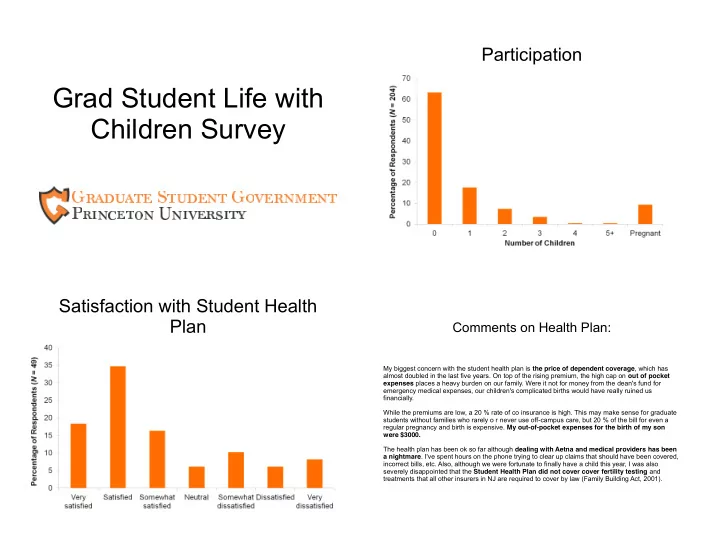
Participation Grad Student Life with Children Survey Satisfaction with Student Health Plan Comments on Health Plan: My biggest concern with the student health plan is the price of dependent coverage , which has almost doubled in the last five


slide-1
SLIDE 1

Grad Student Life with Children Survey

Participation Satisfaction with Student Health Plan

Comments on Health Plan:

My biggest concern with the student health plan is the price of dependent coverage, which has almost doubled in the last five years. On top of the rising premium, the high cap on out of pocket expenses places a heavy burden on our family. Were it not for money from the dean's fund for emergency medical expenses, our children's complicated births would have really ruined us financially. While the premiums are low, a 20 % rate of co insurance is high. This may make sense for graduate students without families who rarely o r never use off-campus care, but 20 % of the bill for even a regular pregnancy and birth is expensive. My out-of-pocket expenses for the birth of my son were $3000. The health plan has been ok so far although dealing with Aetna and medical providers has been a nightmare. I've spent hours on the phone trying to clear up claims that should have been covered, incorrect bills, etc. Also, although we were fortunate to finally have a child this year, I was also severely disappointed that the Student Health Plan did not cover cover fertility testing and treatments that all other insurers in NJ are required to cover by law (Family Building Act, 2001).

slide-2
SLIDE 2

Further Issues Health Plans: Communication

42% of Students with Children find the

Princeton Health Plan somewhat unclear or very unclear in terms of coverage of pregnancy and birth (especially costs)

82% don't know or are unsure about the

differences in policy between having childbirth during normal enrollment or DCE status

Utilization of Princeton's Student Child Care Assistance Program (SCCAP) Reasons for non-use of SCCAP

Costs for childcare in Princeton too high Spouse not employed more than 20 hours per

week

Children too old Income too high

Quote: Personally, I think this is unfair for parents like us who believe that a child can

receive better care from a parent than from a childcare facility. Princeton seems to be saying that only if so meo ne unrelated to me watches my daughter, their work is worthy of

  • renumeration. I think a fairer policy would be to acknowledge that since stay at home mothers

choose to forfeit the extra income for the sake of providing the best care for their children actually save Princeton money by not receiving childcare assistance, they should be also be eligible for some sort of assistance so that they can at least work part time. (For us, because we can't receive childcare assistance unless my wife works full time, I have to take time out of my school schedule to watch my daughter so that my wife can at least work a little bit and earn enough to cover our living expenses while still remaining the primary caregiver).

Financial Situation and SCCAP

slide-3
SLIDE 3

Comments on Financial Situation

$5000 subsidy has not been increased in five

years

Even with University help, cheapest child care

facility in Princeton is about $1000/month

46% of students say that the current SCCAP

program does not match their needs

Housing Issues Housing Issues: Comments

71% of students say that the housing options

  • ffered by the university do not match their

needs

Rent issues for families with need for more than

1 BR

After Butler is gone, no more family-friendly

environment

Lack of support for students who give birth

during DCE

Currently, a student only gets time off after

childbirth if he/she is the primary caregiver

Additional recurrent issues