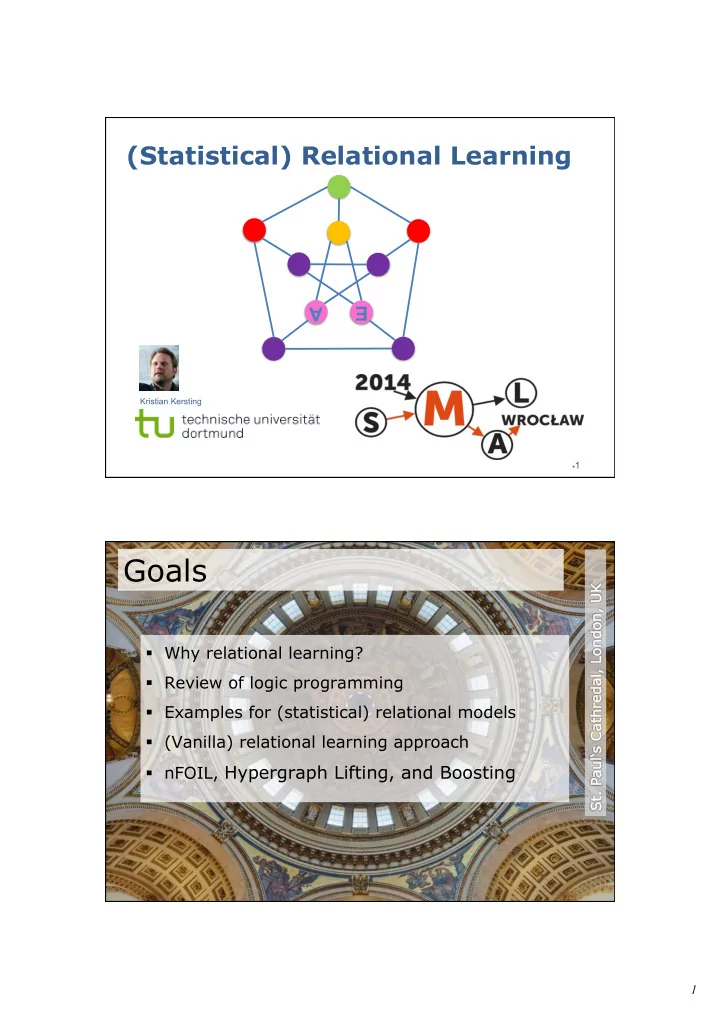
Goals Why relational learning? Review of logic programming - - PDF document

goals
SMART_READER_LITE
LIVE PREVIEW

Goals Why relational learning? Review of logic programming - - PDF document

(Statistical) Relational Learning A E Kristian Kersting 1 Goals Why relational learning? Review of logic programming Examples for (statistical) relational models (Vanilla) relational learning approach nFOIL,


slide-1
SLIDE 1

1

(Statistical) Relational Learning

Kristian Kersting

§ 1

A E

Goals

§ Why relational learning? § Review of logic programming § Examples for (statistical) relational models § (Vanilla) relational learning approach § nFOIL, Hypergraph Lifting, and Boosting

slide-2
SLIDE 2

2

Rorschach Test

Kristian Kersting (Statistical) Relational Learning

§ 3

Etzioni’s Rorschach Test for Computer Scientists

Kristian Kersting (Statistical) Relational Learning

§ 4

slide-3
SLIDE 3

3

Moore’s Law?

Kristian Kersting (Statistical) Relational Learning

§ 5

Storage Capacity?

Kristian Kersting (Statistical) Relational Learning

§ 6

slide-4
SLIDE 4

4

Number of Facebook Users?

Kristian Kersting (Statistical) Relational Learning

§ 7

Number of Scientific Publications?

Kristian Kersting (Statistical) Relational Learning

§ 8

slide-5
SLIDE 5

5

Number of Web Pages?

Kristian Kersting (Statistical) Relational Learning

§ 9

Number of Actions?

Kristian Kersting (Statistical) Relational Learning

§ 10

slide-6
SLIDE 6

6

Computing 2020: Science in an Exponential World

How to deal with millions of images ? How to deal with millions of inter- related research papers ? How to accumulate general knowledge automatically from the Web ? How to deal with billions of shared users’ perceptions stored at massive scale ? How to realize the vision of social search?

“The amount of scientific data is doubling every year”

[Szalay,Gray; Nature 440, 413-414 (23 March 2006) ]

Kristian Kersting (Statistical) Relational Learning

§ 11

Real world is structured in terms of objects and relations Relational knowledge can reveal additional correlations between variables of interest . Abstraction allows one to compactly model general knowledge and to move to complex inference

Machine Learning in an Exponential World

Machine Learning = Data + Model ML = Structured Data + Model + Reasoning

Most effort has gone into the modeling part How much can the data itself help us to solve a problem?

[Fergus et al. PAMI 30(11) 2008; Halevy et al., IEEE Intelligent Systems, 24 2009]

Kristian Kersting (Statistical) Relational Learning

§ 12

slide-7
SLIDE 7

7

http://www.cs.washington.edu/research/textrunner/ Object Object Relation Uncertainty

“Programs will consume, combine, and correlate everything in the universe of structured information and help users reason over it.” [S.

Parastatidis et al., Communications of the ACM Vol. 52(12):33-37 ] [Etzioni et al. ACL08]

Kristian Kersting (Statistical) Relational Learning

§ 13

So, the Real World is Complex and Uncertain

§ Information overload § Incomplete and contradictory information § Many sources and modalities § Variable number of objects and relations among them § Rapid change

How can computer systems handle these ?

Kristian Kersting (Statistical) Relational Learning

§ 14

slide-8
SLIDE 8

8

AI and ML: State-of-the-Art Learning

Decision trees, Optimization, SVMs, …

Logic

Resolution, WalkSat, Prolog, description logics, …

Probability

Bayesian networks, Markov networks, Gaussian Processes…

Logic + Learning

Inductive Logic Programming (ILP)

Learning + Probability

EM, Dynamic Programming, Active Learning, …

Logic + Probability

Nillson, Halpern, Bacchus, KBMC, ICL, …

Kristian Kersting (Statistical) Relational Learning

§ 15

(First-order) Logic handles Complexity

atomic propositional first-order/relational

§ Many types of entities § Relations between them § Arbitrary knowledge

19th C 5th C B.C. Explicit enumeration

daugther-of(cecily,john) daugther-of(lily,tom) …

E.g., rules of chess (which is a tiny problem): 1 page in first-order logic, ~100000 pages in propositional logic, ~100000000000000000000000000000000000000 pages as atomic-state model Logic true/false

Kristian Kersting (Statistical) Relational Learning

§ 16

slide-9
SLIDE 9

9

Probability handles Uncertainty

Logic true/false Probability atomic propositional first-order/relational Sensor noise Human error Inconsistencies Unpredictability 5th C B.C. 19th C 17th C 20th C Many types of entities Relations between them Arbitrary knowledge Explicit enumeration

Kristian Kersting (Statistical) Relational Learning

§ 17

Will Traditional AI Scale ?

Logic true/false Probability atomic propositional first-order/relational Sensor noise Human error Inconsistencies Unpredictability 5th C B.C. 19th C 17th C 20th C Many types of entities Relations between them Arbitrary knowledge Explicit enumeration “Scaling up the environment will inevitably overtax the resources of the current AI architecture.”

Kristian Kersting (Statistical) Relational Learning

§ 18

slide-10
SLIDE 10

10

Statistical Relational Learning / AI (StarAI*)

… unifies logical and statistical AI, … solid formal foundations, … is of interest to many communities.

Let‘s deal with uncertainty, objects, and relations jointly

Robotics CV Search Planning SAT Probability Statistics Logic Graphs Trees Learning

§

Natural domain modeling:

  • bjects, properties,

relations

§

Compact, natural models

§

Properties of entities can depend on properties of related entities

§

Generalization over a variety of situations

The study and design of intelligent agents that act in noisy worlds composed of objects and relations among the

  • bjects

Kristian Kersting (Statistical) Relational Learning

§ 19

See also Lise Getoor‘s lecture on Friday!

§ 20

Prop First-Order Propositional Logic First Order Logic Statistical Relational Learning And AI Probability Theory Inductive Logic Programming (ILP) Classical (Statisitcal) Machine Learning Propositional Rule Learning Deterministic Stochastic Learning No Learning Probabilistic Logic

Kristian Kersting Lifted Approximate Inference

slide-11
SLIDE 11

11

Let’s consider a simple example: Reviewing Papers

§ The grade of a paper at a conference depends

  • n the paper’s quality and the difficulty of the

conference.

§ Good papers may get A’s at easy conferences § Good papers may get D’s at top conference § Weak papers may get B’s at good conferences § …

Kristian Kersting (Statistical) Relational Learning

§ 21

Propositional Logic § Good papers get A’s at easy conferences

§

good(p1)∧conference(c1,easy)⇒grade(p1,c1,a)

§

good(p2)∧conference(c1,easy)⇒grade(p2,c1,a)

§

good(p3)∧conference(c3,easy)⇒grade(p3,c3,a) Number of statements explodes with the number of papers and conferences No generalities, thus no (easy) generalization

Kristian Kersting (Statistical) Relational Learning

§ 22

slide-12
SLIDE 12

12

First Order Logic § The grade of a paper at a conference depends on the paper’s quality and the difficulty of the conference.

§ Good papers get A’s at easy conferences

§

∀P,C [good(P)∧conference(C,easy)⇒grade(P,C,a)] Many ‘all universals’ are (almost) false Even good papers can get either A, B, C True universals are rarely useful

Kristian Kersting (Statistical) Relational Learning

Modeling the Uncertainty Explicitely

Compact representation of the joint probability distribution Associate a conditional probability distribution to each node Random Variables Direct Influences Bayesian Networks: Directed Acyclic Graphs

Kristian Kersting (Statistical) Relational Learning

§ 24

slide-13
SLIDE 13

13

(Reviewing) Bayesian Network …

P(Qual) low middle high 0.3 0.5 0.2 P(Diff) low middle high 0.2 0.3 0.5 Qual Diff P(Grade) c b a low low 0.2 0.5 0.3 low middle 0.1 0.7 0.2 ... Kristian Kersting (Statistical) Relational Learning

§ 25

(Reviewing) Bayesian Network …

P(Qual) low middle high 0.3 0.5 0.2 P(Diff) low middle high 0.2 0.3 0.5 Qual Diff P(Grade) c b a low low 0.2 0.5 0.3 low middle 0.1 0.7 0.2 ... Kristian Kersting (Statistical) Relational Learning

§ 26

slide-14
SLIDE 14

14

The real world, however, has inter- related objects

These ‘instance’ are not independent !

Kristian Kersting (Statistical) Relational Learning

§ 27

Information Extraction

Parag Singla and Pedro Domingos, “Memory-Efficient Inference in Relational Domains” (AAAI-06). Singla, P., & Domingos, P. (2006). Memory-efficent inference in relatonal

  • domains. In Proceedings of the Twenty-First National Conference on Artificial

Intelligence (pp. 500-505). Boston, MA: AAAI Press.

  • H. Poon & P. Domingos, Sound and Efficient Inference with Probabilistic and

Deterministic Dependencies”, in Proc. AAAI-06, Boston, MA, 2006.

  • P. Hoifung (2006). Efficent inference. In Proceedings of the Twenty-First National

Conference on Artificial Intelligence.

Kristian Kersting (Statistical) Relational Learning

§ 28

slide-15
SLIDE 15

15

Information Extraction

Paper

Parag Singla and Pedro Domingos, “Memory-Efficient Inference in Relational Domains” (AAAI-06). Singla, P., & Domingos, P. (2006). Memory-efficent inference in relatonal

  • domains. In Proceedings of the Twenty-First National Conference on Artificial

Intelligence (pp. 500-505). Boston, MA: AAAI Press.

  • H. Poon & P. Domingos, Sound and Efficient Inference with Probabilistic and

Deterministic Dependencies”, in Proc. AAAI-06, Boston, MA, 2006.

  • P. Hoifung (2006). Efficent inference. In Proceedings of the Twenty-First National

Conference on Artificial Intelligence.

Kristian Kersting (Statistical) Relational Learning

§ 29

Segmentation

Author Title Venue Paper

Parag Singla and Pedro Domingos, “Memory-Efficient Inference in Relational Domains” (AAAI-06). Singla, P., & Domingos, P. (2006). Memory-efficent inference in relatonal

  • domains. In Proceedings of the Twenty-First National Conference on Artificial

Intelligence (pp. 500-505). Boston, MA: AAAI Press.

  • H. Poon & P. Domingos, Sound and Efficient Inference with Probabilistic and

Deterministic Dependencies”, in Proc. AAAI-06, Boston, MA, 2006.

  • P. Hoifung (2006). Efficent inference. In Proceedings of the Twenty-First National

Conference on Artificial Intelligence.

Kristian Kersting (Statistical) Relational Learning

§ 30

slide-16
SLIDE 16

16

Kristian Kersting (Statistical) Relational Learning

Entity Resolution

Author Title Venue Paper

Parag Singla and Pedro Domingos, “Memory-Efficient Inference in Relational Domains” (AAAI-06). Singla, P., & Domingos, P. (2006). Memory-efficent inference in relatonal

  • domains. In Proceedings of the Twenty-First National Conference on Artificial

Intelligence (pp. 500-505). Boston, MA: AAAI Press.

  • H. Poon & P. Domingos, Sound and Efficient Inference with Probabilistic and

Deterministic Dependencies”, in Proc. AAAI-06, Boston, MA, 2006.

  • P. Hoifung (2006). Efficent inference. In Proceedings of the Twenty-First National

Conference on Artificial Intelligence.

Again, ‘instance’ are not independent !

§ 31

Topic Models

0,1 0,2 0,3 0,4 0,5 0,6

Prob.

Prob.

Kristian Kersting (Statistical) Relational Learning

§ 32

slide-17
SLIDE 17

17

Kristian Kersting (Statistical) Relational Learning

Wikipedia

Again, ‘instance’ are not independent !

§ 33

Kristian Kersting (Statistical) Relational Learning

http://www.cs.washington.edu/research/textrunner/ Object Object Relation Uncertainty [Etzioni et al. ACL08]

No complex inference (yet) !

TextRunner: (Turing, born in, London) + WordNet: (London, part of, England) + Rule: ‘born in’ is transitive thru ‘part

  • f’

Conclusion: (Turing, born in, England)

And again, ‘instance’ are not independent !

§ 34

slide-18
SLIDE 18

18

Relations are everywhere …

  • Hyperlinks in web pages
  • References in scientific publications
  • Social networks
  • Ontologies

and connectivity is important

  • PageRank

Kristian Kersting (Statistical) Relational Learning

§ 35

Objects + Relations + Uncertainty are everywhere

BioInformatics Scene interpretatio n/ segmentatio n Social Networks Robotics Natural Language Processing Activity Recognition Planning a b d c e e a b d c a b d c e a b d e c Games Data Cleaning

§ Web data (web) § Biological data (bio) § Social Network Analysis (soc) § Bibliographic data (cite) § Epidimiological data (epi) § Communication data (comm) § Customer networks (cust) § Collaborative filtering problems (cf) § Trust networks (trust) § …

Kristian Kersting (Statistical) Relational Learning

§ 36

slide-19
SLIDE 19

19

Costs and Benefits of SRL / StarAI

Relations can reveal additional

  • correlations. Abstraction allows for

generalization. Yes, SRL/StarAI are challenging but can make the difference SRL/StarAI techniques have the potential to lay the foundations of next generation AI systems

Benefits Better predictive accuracy Better understanding of domains Growth path for machine learning and artificial intelligence Costs Learning is much harder Inference becomes a crucial issue Greater complexity for user

Kristian Kersting (Statistical) Relational Learning

§ 37

So far § The world is complex and uncertain § Reviewing papers § Joint segmentation and entity resolution § Topic models

Now

§ Let‘s get started! § How is statistical relational learning working? Kristian Kersting (Statistical) Relational Learning

§ 38

slide-20
SLIDE 20

20

Main StarAI / SRL Key Dimensions § Logical language First-order logic, Horn clauses, frame systems § Probabilistic language Bayesian networks, Markov networks, PCFGs § Type of learning

§ Generative / Discriminative § Structure / Parameters § Knowledge-rich / Knowledge-poor

§ Type of inference

§ MAP / Marginal § Full grounding / Partial grounding / Lifted

Kristian Kersting (Statistical) Relational Learning

§ 39

Kristian Kersting (Statistical) Relational Learning

Fact

(Propositional) LP – Some Notations

Clauses: IF burglary and earthquake are true THEN alarm is true Clause burglary. earthquake. alarm :- burglary, earthquake. marycalls :- alarm. johncalls :- alarm. Herbrand Base (HB) = all atoms in the program burglary, earthquake, alarm, marycalls, johncalls Program atom body head

Two closely related ways to define semantics

  • 1. Model-theoretic
  • 2. Proof-theoretic

§ 40

slide-21
SLIDE 21

21

Model Theoretic: Restrictions on Possible Worlds

§ Herbrand Interpretation

§ Truth assigments to all elements of HB

§ An interpretation is a model of a clause C ó If the body of C holds then the head holds, too

0.9 0.1

e b e

0.2 0.8 0.01 0.99 0.9 0.1

b e b b e B E

P(A | B,E)

Earthquake JohnCalls Alarm MaryCalls Burglary

burglary. earthquake. alarm :- burglary, earthquake. marycalls :- alarm. johncalls :- alarm.

Kristian Kersting (Statistical) Relational Learning

§ 41

Goal

Proof Theoretic: Restrictions on Possible Derivations § A set of clauses can be used to prove that atoms are entailed by the set of clauses.

burglary. earthquake. alarm :- burglary, earthquake. marycalls :- alarm. johncalls :- alarm. :- johncalls. :- alarm. :- burglary, earthquake. :- earthquake. {}

Kristian Kersting (Statistical) Relational Learning

§ 42

slide-22
SLIDE 22

22

Stochastic Grammars

Weighted Rewrite Rules

S NP VP VP PP i saw V NP P NP Det N Det N man with the telescope the

1.0 : S → NP, VP 1/3 : NP → i 1/3 : NP → Det, N 1/3 : NP → NP, PP 1.0 : Det → the 0.5 : N → man 0.5 : N → telescope 0.5 : VP → V, NP 0.5 : VP → VP, PP 1.0 : PP → P, NP 1.0 : V → saw 1.0 : P → with 1.0 * 1/3 * 0.5 * 0.5 * 1.0 * ... = 0.00231 Upgrade HMMs (regular languages) to more complex languages such as context-free languages.

Kristian Kersting (Statistical) Relational Learning

§ 43

Upgrading to First-Order Logic

The maternal information mchrom/2 depends on the maternal and paternal pchrom/2 information of the mother mother/2:

mchrom(fred,a). mchrom(fred,b),...

  • r better

mchrom(P,a) :- mother(M,P), pchrom(M,a), mchrom(M,a).

mchrom(P,a) :- mother(M,P), pchrom(M,a), mchrom(M,b). mchrom(P,b) :- mother(M,P), pchrom(M,a), mchrom(M,b).

...

father(rex,fred). mother(ann,fred). father(brian,doro). mother(utta, doro). father(fred,henry). mother(doro,henry). pchrom(rex,a). mchorm(rex,a). pchrom(ann,a). mchrom(ann,b). ...

Kristian Kersting (Statistical) Relational Learning

§ 44

slide-23
SLIDE 23

23

Upgrading - continued

alarm :- burglary, earthquake. clause head body

Propositional Clausal Logic Expressions can be true or false

Kristian Kersting (Statistical) Relational Learning

§ 45

Upgrading - continued

Substitution: Maps variables to terms: {M / ann}: mc(P,a) :- mother(ann,P),pc(ann,a),mc(ann,a). Herbrand base: set of ground atoms (no variables): {mc(fred,fred),mc(rex,fred),…} atom mc(P,a) :- mother(ann,P),pc(ann,a),mc(ann,a). clause head body variable (placeholder) constant terms

Relational Clausal Logic Constants and variables refer to objects Propositional Clausal Logic Expressions can be true or false

Kristian Kersting (Statistical) Relational Learning

§ 46

slide-24
SLIDE 24

24

Upgrading - continued

Full Clausal Logic Functors aggregate objects Relational Clausal Logic Constants and variables refer to

  • bjects

Propositional Clausal Logic Expressions can be true or false

§ Substitution: Maps variables to terms: {M / ann}: § mc(P,a) :- mother(ann,P),pc(ann,a),mc(ann,a). § Herbrand base: set of ground atoms (no variables): § {mc(fred,fred),mc(rex,fred),…}

nat(0). nat(succ(X)) :- nat(X). atom clause head body variable constant functor term Interpretations can be infinite ! nat(0),nat(succ(0)), nat(succ(succ(0))), ...

Kristian Kersting (Statistical) Relational Learning

§ 47

Inference in First-Order Logic § Traditionally done by theorem proving (e.g.: Prolog) § Main approach within SRL: Propositionalization followed by “model checking”

§ Propositionalization: Create all ground atoms and clauses § Model checking: Inference in graphical models, weighted Satisfiability testing

Kristian Kersting (Statistical) Relational Learning

§ 48

slide-25
SLIDE 25

25

Forward Chaining

father(rex,fred). mother(ann,fred). father(brian,doro). mother(utta, doro). father(fred,henry). mother(doro,henry). pc(rex,a). mc(rex,a). pc(ann,a). mc(ann,b). ... mc(P,a) :- mother(M,P), pc(M,a), mc(M,a). mc(P,a) :- mother(M,P), pc(M,a), mc(M,b). {M/ann, P/fred} mc(P,a):- mother(M,P), pc(M,a), mc(M,b). mc(fred,a)

...

mother(ann,fred). pc(ann,a) mc(ann,b) father(rex,fred).

... ... ...

Set of derivable ground atoms = least Herbrand model

Kristian Kersting (Statistical) Relational Learning

§ 49

Backward Chaining

father(rex,fred). mother(ann,fred). father(brian,doro). mother(utta, doro). father(fred,henry). mother(doro,henry). pc(rex,a). mc(rex,a). pc(ann,a). mc(ann,b). ... mc(P,a) :- mother(M,P), pc(M,a), mc(M,a). mc(P,a) :- mother(M,P), pc(M,a), mc(M,b). mother(ann,fred). {M/ann} pc(ann,a),mc(ann,a) mother(ann,fred). {M/ann} pc(ann,a),mc(ann,b) pc(ann,a). mc(ann,a) fail pc(ann,a). mc(ann,b) success mc(fred,a) {P/fred} mother(M,fred),pc(M,a),mc(M,a) mc(P,a):- mother(M,P), pc(M,a), mc(M,a). mother(M,fred),pc(M,a),mc(M,b) mc(P,a):- mother(M,P), pc(M,a), mc(M,b). {P/fred}

§ 50

slide-26
SLIDE 26

26

So far § Motivation § Brief review of logic

Now

§ Let‘s see some actual SRL frameworks Kristian Kersting (Statistical) Relational Learning

§ 51

Alphabetic Soup of SRL

§ Knowledge-based model construction

[Wellman et al., 1992]

§ PRISM [Sato & Kameya 1997] § Stochastic logic programs [Muggleton, 1996] § Probabilistic relational models [Friedman et al.,

1999]

§ Bayesian logic programs [Kersting & De Raedt,

2001]

§ Bayesian logic [Milch et al., 2005] § Markov logic [Richardson & Domingos, 2006] § Relational dependency networks

[Neville & Jensen 2007]

§ ProbLog [De Raedt et al., 2007] And many others!

Kristian Kersting (Statistical) Relational Learning

§ 52

slide-27
SLIDE 27

27

Relational Dependency Networks § Logical language: SQL queries § Probabilistic language: Dependency networks

§ Conditional probability template for each predicate § Atoms depend on related atoms § >1 clause w/ head: aggregate functions § Cyclic dependencies

§ Learning:

§ Parameters: EM based on Gibbs sampling § Structure: relational probability trees, boosting

§ Inference: Gibbs sampling

[Neville & Jensen 2007]

Kristian Kersting (Statistical) Relational Learning

§ 53

Markov Logic § Logical language: “First-order” logic § Probabilistic language: Markov networks

§ Syntax: First-order formulas with weights § Semantics: Templates for Markov net features

§ Learning:

§ Parameters: Generative or discriminative § Structure: ILP with arbitrary clauses and MAP score

§ Inference:

§ MAP: Weighted satisfiability § Marginal: MCMC with moves proposed by SAT solver § Partial grounding + Lazy inference

[Richardson & Domingos, 2006]

Kristian Kersting (Statistical) Relational Learning

§ 54

slide-28
SLIDE 28

28

Markov Logic

§ A Markov Logic Network (MLN) is a set

  • f pairs (F, w) where

§ F is a formula in first-order logic § w is a real number § Together with a finite set of constants, it defines a Markov network with § Kind of undirected BLPs

Iterate over all first-order MLN formulas # true groundings

  • f ith clause

Normalization constant Cancer Cough Asthma Smoking

Kristian Kersting (Statistical) Relational Learning

§ 55

P(X) = 1 Z exp wini(x)

i∈F

# $ % & ' (

Example of First-Order KB

Co-authors are either both smart or both not High quality papers get accepted

Kristian Kersting (Statistical) Relational Learning

§ 56

slide-29
SLIDE 29

29

Example of First-Order KB

( )

_ ( ) ( ) , _ ( , ) ( ) ( ) x high quality p accepted p x y co author x y smart x smart y ∀ ⇒ ∀ ⇒ ⇔

Kristian Kersting (Statistical) Relational Learning

§ 57

Markov Logic

( )

) , ( _ ) , ( ) , ( , ) ( ) ( ) , ( _ , ) ( ) ( _ ) ( _ ) ( ) , ( y x author co p y author p x author p y x y smart x smart y x author co y x p accepted p quality high x p quality high x smart p x author x ⇒ ∧ ∃ ∀ ⇔ ⇒ ∀ ⇒ ∀ ⇒ ∧ ∀

∞ 2 . 1 1 . 1 5 . 1

Suppose we have constants: alice, bob and p1

smar mart(bob) bob) smar mart(alice alice) ) high_qualit high_quality(p1) p1) aut author hor(p1,alice) p1,alice) aut author hor(p1,bob) p1,bob) accept accepted( ed(p1) p1) co_aut co_author hor(bob,alice bob,alice) ) co_aut co_author hor(alice,bob alice,bob) ) co_aut co_author hor(alice,alice alice,alice) ) co_aut co_author hor(bob,bob bob,bob) ) Kristian Kersting (Statistical) Relational Learning

§ 58

Same procedure for different (numbers of) papers and conference Model holds for a variable number of objects and relations among objects

slide-30
SLIDE 30

30

Most common approach to semantics and inference

§ Propositionalization followed by graphical model inference respectively (probabilistic) model checking § Propositionalization: Create all ground atoms and clauses using essentially forward or backward chaining. Can be query directed. There even exists first-order Bayes’ ball variants § Variable elimination, Belief Propagation, Gibbs Sampling, Weighted (MAX)-SAT, BDD-based, …

Kristian Kersting (Statistical) Relational Learning

§ 59

Costs and Benefits of the SRL soup § Benefits

§ Rich pool of different languages § Very likely that there is a language that fits your task at hand well § A lot research remains to be done, ;-)

§ Costs

§ “Learning” SRL is much harder § Not all frameworks support all kinds of inference and learning settings

Kristian Kersting (Statistical) Relational Learning

§ 60

How do we actually learn relational models from data? Quite similar to propositional ones!

slide-31
SLIDE 31

31

Relational Parameter Estimation

bt pc mc Person bt pc mc Person mc pc mc Person mother Mother mc pc mc Person mother Mother pc pc mc Person father Father pc pc mc Person father Father bt/1 pc/1 mc/1 bt/1 pc/1 mc/1

Model(1) pc(brian)=b, bt(ann)=a, bt(brian)=?, bt(dorothy)=a Model(1) pc(brian)=b, bt(ann)=a, bt(brian)=?, bt(dorothy)=a Background m(ann,dorothy), f(brian,dorothy), m(cecily,fred), f(henry,fred), f(fred,bob), m(kim,bob), ... Background m(ann,dorothy), f(brian,dorothy), m(cecily,fred), f(henry,fred), f(fred,bob), m(kim,bob), ... Model(2) bt(cecily)=ab, bt(henry)=a, bt(fred)=?, bt(kim)=a, bt(bob)=b Model(2) bt(cecily)=ab, bt(henry)=a, bt(fred)=?, bt(kim)=a, bt(bob)=b Model(3) pc(rex)=b, bt(doro)=a, bt(brian)=? Model(3) pc(rex)=b, bt(doro)=a, bt(brian)=?

+

Kristian Kersting (Statistical) Relational Learning

§ 61

Relational Parameter Estimation

bt pc mc Person bt pc mc Person mc pc mc Person mother Mother mc pc mc Person mother Mother pc pc mc Person father Father pc pc mc Person father Father bt/1 pc/1 mc/1 bt/1 pc/1 mc/1

Model(1) pc(brian)=b, bt(ann)=a, bt(brian)=?, bt(dorothy)=a Model(1) pc(brian)=b, bt(ann)=a, bt(brian)=?, bt(dorothy)=a Background m(ann,dorothy), f(brian,dorothy), m(cecily,fred), f(henry,fred), f(fred,bob), m(kim,bob), ... Background m(ann,dorothy), f(brian,dorothy), m(cecily,fred), f(henry,fred), f(fred,bob), m(kim,bob), ... Model(2) bt(cecily)=ab, bt(henry)=a, bt(fred)=?, bt(kim)=a, bt(bob)=b Model(2) bt(cecily)=ab, bt(henry)=a, bt(fred)=?, bt(kim)=a, bt(bob)=b Model(3) pc(rex)=b, bt(doro)=a, bt(brian)=? Model(3) pc(rex)=b, bt(doro)=a, bt(brian)=?

+

Parameter tighting

Kristian Kersting (Statistical) Relational Learning

§ 62

slide-32
SLIDE 32

32

Kristian Kersting (Statistical) Relational Learning

So, apply „standard“ EM

bt pc mc Person bt pc mc Person mc pc mc Person mother Mother mc pc mc Person mother Mother pc pc mc Person father Father pc pc mc Person father Father bt/1 pc/1 mc/1 bt/1 pc/1 mc/1

Model(1) pc(brian)=b, bt(ann)=a, bt(brian)=?, bt(dorothy)=a Model(1) pc(brian)=b, bt(ann)=a, bt(brian)=?, bt(dorothy)=a Background m(ann,dorothy), f(brian,dorothy), m(cecily,fred), f(henry,fred), f(fred,bob), m(kim,bob), ... Background m(ann,dorothy), f(brian,dorothy), m(cecily,fred), f(henry,fred), f(fred,bob), m(kim,bob), ... Model(2) bt(cecily)=ab, bt(henry)=a, bt(fred)=?, bt(kim)=a, bt(bob)=b Model(2) bt(cecily)=ab, bt(henry)=a, bt(fred)=?, bt(kim)=a, bt(bob)=b Model(3) pc(rex)=b, bt(doro)=a, bt(brian)=? Model(3) pc(rex)=b, bt(doro)=a, bt(brian)=?

Initial Parameters q0 Logic Program L Expected counts of a clause

Expectation

Inference Update parameters (ML, MAP)

Maximization iterate until convergence

Current Model (M,qk)

P( head(GI), body(GI) | DC )

M M

DataCase DC Ground Instance GI

P( head(GI), body(GI) | DC )

M M

DataCase DC Ground Instance GI

P( body(GI) | DC )

M M

DataCase DC Ground Instance GI

Variants exists! Combining Rules, Generative, discriminative, max-margin, …

But how do we select a model ? ILP= Machine Learning + Logic Programming

[Muggleton, De Raedt JLP96]

Examples E

pos(mutagenic(m1)) neg(mutagenic(m2)) pos(mutagenic(m3)) ...

c c c c c c n

  • Background Knowledge B

molecule(m1) atom(m1,a11,c) atom(m1,a12,n) bond(m1,a11,a12) charge(m1,a11,0.82) ... molecule(m2) atom(m2,a21,o) atom(m2,a22,n) bond(m2,a21,a22) charge(m2,a21,0.82) ...

Find set of general rules

mutagenic(X) :- atom(X,A,c),charge(X,A, 0.82) mutagenic(X) :- atom(X,A,n),...

Relational Model Selection / Structure Learning

Kristian Kersting (Statistical) Relational Learning

§ 64

slide-33
SLIDE 33

33

:- true Coverage = 0.5,0.7 Coverage = 0.6,0.3 Coverage = 0.4,0.6 :- atom(X,A,c) :- atom(X,A,n) :- atom(X,A,f) Coverage = 0.8 Coverage = 0.6 :- atom(X,A,c),bond(A,B) :- atom(X,A,n),charge(A,0.82)

Example ILP Algorithm: FOIL [Quinlan MLJ 5:239-266,

1990]

mutagenic(X) :- atom(X,A,n),charge(A,0.82) mutagenic(X) :- atom(X,A,c),bond(A,B)

1 …

∨ ∨

≡ 1

Some objective function, e.g. percentage of covered positive examples

Kristian Kersting (Statistical) Relational Learning

§ 65

Vanilla SRL [De Raedt, Kersting ALT04]

§ Traverses the hypotheses space a la ILP § Replaces ILP’s 0-1 covers relation by a “smooth”, probabilistic one [0,1]

1 …

∨ ∨

≡ 1

mutagenic(X) :- atom(X,A,n),charge(A,0.82) mutagenic(X) :- atom(X,A,c),bond(A,B)

=0.882

Kristian Kersting (Statistical) Relational Learning

§ 66

slide-34
SLIDE 34

34

If data is complete: To update score after local change,

  • nly re-score (counting) families

that changed If data is incomplete: To update score after local change, reran parameter estimation algorithm

So, essentially like in the propositional case !

S C E D Reverse C →E Delete C →E Add C →D S C E D S C E D S C E D

Kristian Kersting (Statistical) Relational Learning

§ 67

Structural EM [Friedman et al. 98]

Training Data

Expected Counts

EN(X1) EN(X2) EN(X3) EN(H, X1, X1, X3) EN(Y1, H) EN(Y2, H) EN(Y3, H)

Computation

X1 X2 X3 H Y1 Y2 Y3 X1 X2 X3 H Y1 Y2 Y3

+

Score & Parameterize Reiterate

EN(X2,X1) EN(H, X1, X3) EN(Y1, X2) EN(Y2, Y1, H) X1 X2 X3 H Y1 Y2 Y3 Kristian Kersting (Statistical) Relational Learning

§ 68

slide-35
SLIDE 35

35

Kristian Kersting (Statistical) Relational Learning

nFOIL = FOIL + Naive Bayes

§ Clauses are independent features § Likelihood for parameter estimation § Conditional likelihood for scoring clauses

atom(X,A,n),charge(A,0.82) atom(X,A,c),bond(A,B)

mutagenic(X) P(truth value clauses|truth value target predicate) x P(truth value target predicate) [Landwehr, Kersting, De Raedt JMLR 8(Mar):481-507, 2007]

§ 69

Several variants exists! Top-down, bottom-up, boosting, transfer learning, among others Let‘s have a look at bottom-up, i.e. data-driven approaches

Relational Pathfinding [Richards & Mooney, AAAI’92]

§ Find paths of linked ground atoms !formulas § Path ´ conjunction that is true at least once § Exponential search space of paths § Restricted to short paths

Sam Pete CS1 CS2 CS3 CS4 CS5 CS6 CS7 CS8 Paul Pat Phil Sara Saul Sue Teaches TAs Advises Pete CS1 Sam

Advises(Pete, Sam) ^ Teaches(Pete, CS1) ^ TAs(Sam, CS1) Advises( p , s ) ^Teaches( p , c ) ^ TAs( s , c )

Kristian Kersting (Statistical) Relational Learning

§ 70

slide-36
SLIDE 36

36

Advises Pete Sam Pete Saul Paul Sara … … TAs Sam CS1 Sam CS2 Sara CS1 … … Teaches Pete CS1 Pete CS2 Paul CS2 … … Sam Pete CS1 CS2 CS3 CS4 CS5 CS6 CS7 CS8 Paul Pat Phil Sara Saul Sue TAs Advises Teaches

Learning via Hypergraph Lifting

[Kok & Domingos, ICML’09]

§ Relational DB can be viewed as hypergraph

§ Nodes ´ Constants § Hyperedges ´ True ground atoms

Kristian Kersting (Statistical) Relational Learning

§ 71

Advises Pete Sam Pete Saul Paul Sara … … TAs Sam CS1 Sam CS2 Sara CS1 … … Teaches Pete CS1 Pete CS2 Paul CS2 … … Sam Pete CS1 CS2 CS3 CS4 CS5 CS6 CS7 CS8 Paul Pat Phil Sara Saul Sue TAs Advises Teaches

Pete Paul Pat Phil Sam Sara Saul Sue CS1 CS2 CS3 CS4 CS5 CS6 CS7 CS8

Teaches TAs Advises Professor Student Course

‘Lifts’

Learning via Hypergraph Lifting

[Kok & Domingos, ICML’09]

Using “2nd”-order MLNs

§ Jointly clusters nodes into higher-level concepts § Clusters hyperedges

slide-37
SLIDE 37

37

Advises Pete Sam Pete Saul Paul Sara … … TAs Sam CS1 Sam CS2 Sara CS1 … … Teaches Pete CS1 Pete CS2 Paul CS2 … … Sam Pete CS1 CS2 CS3 CS4 CS5 CS6 CS7 CS8 Paul Pat Phil Sara Saul Sue TAs Advises Teaches

Pete Paul Pat Phil Sam Sara Saul Sue CS1 CS2 CS3 CS4 CS5 CS6 CS7 CS8

Teaches TAs Advises Professor Student Course

‘Lifts’ Trace paths & convert paths to first-order clauses

Learning via Hypergraph Lifting[Kok & Domingos,

ICML’09]

§ 73

FindPaths

Pete Paul Pat Phil Sam Sara Saul Sue CS1 CS2 CS3 CS4 CS5 CS6 CS7 CS8 T e a c h e s T A s

Advises

Paths Found

Pete Paul Pat Phil Sam Sara Saul Sue CS1 CS2 CS3 CS4 CS5 CS6 CS7 CS8

Advises( , ) Advises( , ) , Teaches ( , ) Advises( , ) , Teaches ( , ), TAs( , )

Kristian Kersting (Statistical) Relational Learning

§ 74

slide-38
SLIDE 38

38

Advises( , ) , Pete Paul Pat Phil Sam Sara Saul Sue Teaches( , ) , CS1 CS2 CS3 CS4 CS5 CS6 CS7 CS8 Pete Paul Pat Phil TAs( , ) Sam Sara Saul Sue CS1 CS2 CS3 CS4 CS5 CS6 CS7 CS8

not Advises(p, s) V not Teaches(p, c) V not TAs(s, c)

Clause Creation

Advises( , ) Pete Paul Pat Phil Sam Sara Saul Sue Teaches( , ) CS1 CS2 CS3 CS4 CS5 CS6 CS7 CS8 Pete Paul Pat Phil TAs( , ) Sam Sara Saul Sue CS1 CS2 CS3 CS4 CS5 CS6 CS7 CS8

and and

Advises( , ) Teaches( , ) TAs( , )

and and

p p s s c c Advises(p, s) and Teaches(p, c) and TAs(s, c) Advises(p, s) V Teaches(p, c) V notTAs(s, c)

Advises(p, s) V not Teaches(p, c) V notTAs(s, c)

Kristian Kersting (Statistical) Relational Learning

§ 75

0,2 0,4 0,6 0,8 1 0,2 0,4 0,6 0,8 0,17 0,19 0,21 0,23

LHL vs. BUSL vs. MSL

Area under Prec-Recall Curve

LHL BUSL MSL

IMDB UW-CSE Cora

LHL BUSL MSL LHL BUSL MSL

Kristian Kersting (Statistical) Relational Learning

§ 76

slide-39
SLIDE 39

39

4 8 12 16

LHL vs. BUSL vs. MSL

Runtime

20 40 60 4 8 12

UW-CSE IMDB Cora min

§ hr

hr

LHL BUSL MSL LHL BUSL MSL LHL BUSL MSL

Kristian Kersting (Statistical) Relational Learning

§ 77

Boosted Statistical Relational Learning

Idea: drop the finite model assumption Most SRL approaches seek to find models with a finite set of parameters … … but we deal within infinite domains!

Kristian Kersting (Statistical) Relational Learning

§ 78

slide-40
SLIDE 40

40

Gradient (Tree) Boosting

[Friedman Annals of Statistics 29(5):1189-1232, 2001]

§ Models = weighted combination of a large number of small trees (models) § Intuition: Generate an additive model by sequentially fitting small trees to pseudo-residuals from a regression at each iteration…

Data Predictions

  • Residuals

=

Data

+

Loss fct Initial Model

+ + +

Induce Iterate Final Model =

+ + + + …

Kristian Kersting (Statistical) Relational Learning

§ 79

Gradient (Tree) Boosting

§ Has been used for several learning tasks such as

aglinment, learning relational dependency models, learning MLNs, policy estimation, etc.

§ ... and can be extended to deal with latent variables.

Main step: estimate a relational regression model

Kristian Kersting (Statistical) Relational Learning

§ 80

slide-41
SLIDE 41

41

Professor(P) Level(P,L) Student(S) IQ(S,I) Difficulty(C,D) Course(C) taughtBy(P,C) takes(S,C) ratings(P,C,R) satisfaction(S,B) grade(S,C,G) avgCGrade(C,G) avgSGrade(S,G)

Relational Dependency Network-Example

Aggregator

Kristian Kersting (Statistical) Relational Learning

§ 81

Relational Probability Trees

§ Each conditional probability distribution can be learned as a tree § Leaves are probabilities § The final RDN is the set of these RPTs

speed(X,S), S > 120 job(X, politician) CountY(knows(X,Y)) > 0 job(Y, politician)

0.01 0.05 0.1 0.98 0.98

no yes no yes no no yes yes Essentially like TILDE [Blockeel & De Raedt ’98]

To predict Fine(X)

Kristian Kersting (Statistical) Relational Learning

§ 82

slide-42
SLIDE 42

42

Gradient Tree Boosting

§ Find ML parameters, i.e. maximize without fixing the model structure/features § Functional Gradient

Kristian Kersting (Statistical) Relational Learning

§ 83

Boosting RDNs

Other preds Other preds Other preds Other preds Other preds …

pred pred pred pred pred

… …

Generate Example

Kristian Kersting (Statistical) Relational Learning

§ 84

slide-43
SLIDE 43

43

Boosting RDNs

Other preds Other preds Other preds Other preds Other preds …

pred pred pred pred pred

… …

Generate Example

  • 0.5

“Weight” of each example

Kristian Kersting (Statistical) Relational Learning

§ 85

Boosting RDNs

Other preds Other preds Other preds Other preds Other preds …

pred pred pred pred pred

… …

Generate Example

  • 0.5

0.2

  • 0.8

Kristian Kersting (Statistical) Relational Learning

§ 86

slide-44
SLIDE 44

44

Boosting RDNs

Other preds Other preds Other preds Other preds Other preds …

pred pred pred pred pred

… …

Generate Example

  • 0.5

0.2

  • 0.8

Induce Regression Tree

Kristian Kersting (Statistical) Relational Learning

§ 87

Boosting RDNs

Other preds Other preds Other preds Other preds Other preds …

pred pred pred pred pred

… …

Generate Example

  • 0.5

0.2

  • 0.8

Induce Regression Tree Update Model

Kristian Kersting (Statistical) Relational Learning

§ 88

slide-45
SLIDE 45

45

Boosting RDNs

Other preds Other preds Other preds Other preds Other preds …

pred pred pred pred pred

… …

Generate Example

  • 0.5

0.2

  • 0.8

Induce Regression Tree Update Model

Final Model =

+ + + + …

Kristian Kersting (Statistical) Relational Learning

§ 89

UW-CSE Results § Task: Entity Relationship prediction

§ Predict advisedBy relation § Train in 4 areas and test in 1 § Used RDN with Regression Tree Learner

AUC-ROC AUC-PR Likelihood Training Time Boosting 0.961 0.930 0.810 9 s RDN 0.888 0.781 0.805 1 s Alchemy 0.535 0.621 0.731 93 hrs

Kristian Kersting (Statistical) Relational Learning

§ 90

slide-46
SLIDE 46

46

OMOP Results

§ Task: Predict Adverse-drug events

§ Input: Drugs and conditions (side-effects) § Goal: Predict if a patient is on a given drug (onDrug(D,P)) § Learning “in reverse” § Averaged over 5 train-test sets § Each set is a different drug

AUC-ROC AUC-PR Accuracy Training Time Boosting 0.824 0.839 0.753 497.8 s RDN 0.738 0.736 0.697 39.4 s ILP + Noisy- Or 0.420 0.582 0.687 2400 s

Kristian Kersting (Statistical) Relational Learning

§ 91

Direct Policy Learning

§ Value functions can often be much more complex to represent than the corresponding policy § When policies have much simpler representations than the corresponding value functions, direct search in policy space can be a good idea

Goal: cl(a)

Policy: put each block on top of a on the floor

Kristian Kersting (Statistical) Relational Learning

§ 92

slide-47
SLIDE 47

47

Non-Parametric Policy Gradients

[Kersting, Driessens ICML08]

§ Assume policy to be expressed using an arbitray potential function § Do functional gradient search w.r.t. world-value

( , ) ( , )

( , , )

s a s b b

e s a e π

Ψ Ψ

Ψ = ∑

, ,

( ) ( , ) ( , ) ( , ) ( ) ( , )

s a s a

d s s a Q s a s a d s Q s a

π π π π

∂ρ ∂ π ∂ ∂ ∂π ∂ = Ψ Ψ = Ψ

∑ ∑

sample compute locally

Kristian Kersting (Statistical) Relational Learning

§ 93

π(s,a) = eΨ(s,a ) eΨ(s,b)

b

Local Evaluation

Monte-Carlo estimate or actor critic

∂π(s,a) ∂Ψ(s,a) = π(s,a)(1− π(s,a)) ∂π(s,a) ∂Ψ(s,b) = −π(s,a)π(s,b)

Qπ (s,a)

Kristian Kersting (Statistical) Relational Learning

§ 94

slide-48
SLIDE 48

48

i a b d c e f j h g

Some Experimental Results

Kristian Kersting (Statistical) Relational Learning

§ 95

Allows us to treat propositional, continuous and relational features in a unified way!

Lessons learnt

§ Relational data is everywhere § Relational models take the additional correlations provided by relations into account § Main insight for parameter estimation: parameter tighing § Vanilla relational learning approach does a greedy search by adding/deleting literals/ clauses using some (probabilistic) scoring function § Learning many weak rules of how to change a model can be much faster