GIVNER & KAYE BRUCE GIVNER PHONE (310) 207-8008 - - PDF document

givner kaye
SMART_READER_LITE
LIVE PREVIEW

GIVNER & KAYE BRUCE GIVNER PHONE (310) 207-8008 - - PDF document

LAW OFFICES GIVNER & KAYE BRUCE GIVNER PHONE (310) 207-8008 (bruce@GivnerKaye.com) A PROFESSIONAL CORPORATION OWEN D. KAYE (818) 785-7579 SUITE 445 (owen@GivnerKaye.com) 12100 WILSHIRE BOULEVARD KATHLEEN GIVNER FAX


slide-1
SLIDE 1

LAW OFFICES

GIVNER & KAYE

A PROFESSIONAL CORPORATION SUITE 445 12100 WILSHIRE BOULEVARD LOS ANGELES, CALIFORNIA 90025 www.GivnerKaye.com

BRUCE GIVNER (bruce@GivnerKaye.com) OWEN D. KAYE (owen@GivnerKaye.com) KATHLEEN GIVNER (kathy@GivnerKaye.com) NEDA BARKHORDAR (neda@GivnerKaye.com) JACQUELINE BURBANK (jacqueline@GivnerKaye.com)

PHONE (310) 207-8008 (818) 785-7579 FAX (310) 207-8708 (818) 785-3027

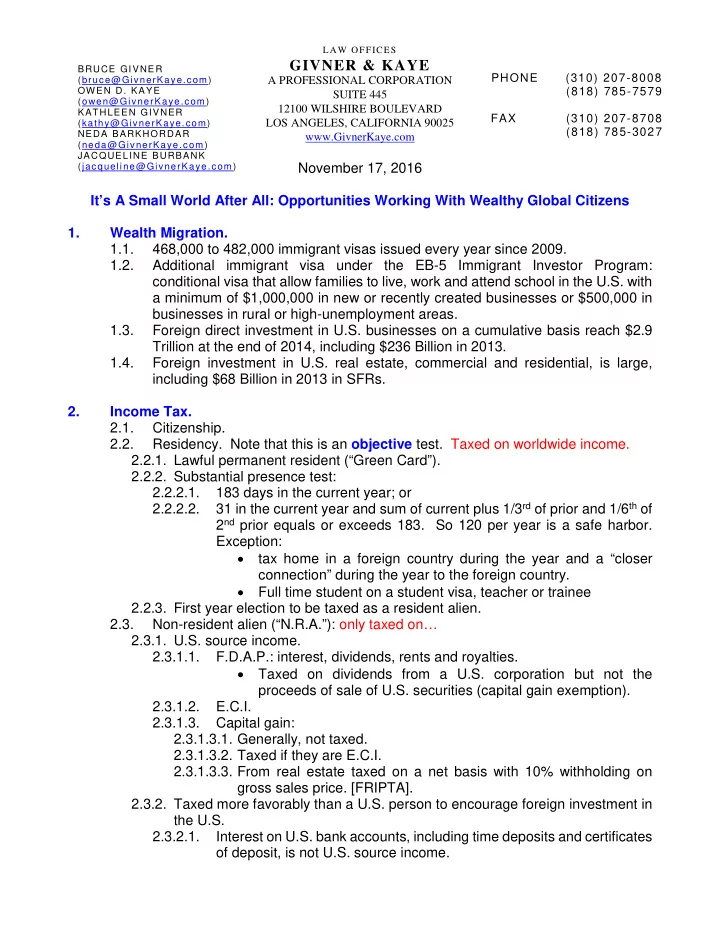
November 17, 2016 It’s A Small World After All: Opportunities Working With Wealthy Global Citizens 1. Wealth Migration. 1.1. 468,000 to 482,000 immigrant visas issued every year since 2009. 1.2. Additional immigrant visa under the EB-5 Immigrant Investor Program: conditional visa that allow families to live, work and attend school in the U.S. with a minimum of $1,000,000 in new or recently created businesses or $500,000 in businesses in rural or high-unemployment areas. 1.3. Foreign direct investment in U.S. businesses on a cumulative basis reach $2.9 Trillion at the end of 2014, including $236 Billion in 2013. 1.4. Foreign investment in U.S. real estate, commercial and residential, is large, including $68 Billion in 2013 in SFRs. 2. Income Tax. 2.1. Citizenship. 2.2.

  • Residency. Note that this is an objective test. Taxed on worldwide income.

2.2.1. Lawful permanent resident (“Green Card”). 2.2.2. Substantial presence test: 2.2.2.1. 183 days in the current year; or 2.2.2.2. 31 in the current year and sum of current plus 1/3rd of prior and 1/6th of 2nd prior equals or exceeds 183. So 120 per year is a safe harbor. Exception:

  • tax home in a foreign country during the year and a “closer

connection” during the year to the foreign country.

  • Full time student on a student visa, teacher or trainee

2.2.3. First year election to be taxed as a resident alien. 2.3. Non-resident alien (“N.R.A.”): only taxed on… 2.3.1. U.S. source income. 2.3.1.1. F.D.A.P.: interest, dividends, rents and royalties.

  • Taxed on dividends from a U.S. corporation but not the

proceeds of sale of U.S. securities (capital gain exemption). 2.3.1.2. E.C.I. 2.3.1.3. Capital gain: 2.3.1.3.1. Generally, not taxed. 2.3.1.3.2. Taxed if they are E.C.I. 2.3.1.3.3. From real estate taxed on a net basis with 10% withholding on gross sales price. [FRIPTA]. 2.3.2. Taxed more favorably than a U.S. person to encourage foreign investment in the U.S. 2.3.2.1. Interest on U.S. bank accounts, including time deposits and certificates

  • f deposit, is not U.S. source income.
slide-2
SLIDE 2

LAW OFFICES

GIVNER & KAYE

A PROFESSIONAL CORPORATION

It’s A Small World After All: Opportunities Working With Wealthy Global Citizens November 17, 2016 Page 2 of 10 2.4. Trade or business: does it have a Permanent establishment? 3. Transfer Taxes. 3.1. General rule: Gift and Estate Tax. 3.1.1. U.S. citizen or resident/ worldwide assets.

  • A U.S. resident for gift and estate tax is a person whose primary

residence or domicile is in the United States. This means that the person lives in the U.S. and has no definite present intent to leave, as shown by the surrounding facts and circumstances 3.1.2. Non-citizen, non-domiciliaries: U.S. situs assets. 3.2.

  • Domicile. Note that this is a subjective test.

3.2.1. No current intent to leave the U.S. 3.2.2. So can be U.S. resident but not a U.S. domiciliary. In other words you may be subject to U.S. income tax because you are a resident (“bright line test”) but you are not a domicile of the U.S. (“facts and circumstances test”).

slide-3
SLIDE 3

LAW OFFICES

GIVNER & KAYE

A PROFESSIONAL CORPORATION

It’s A Small World After All: Opportunities Working With Wealthy Global Citizens November 17, 2016 Page 3 of 10 3.3. U.S. Sitused Assets [for estate tax purposes]: 3.3.1. U.S. real property. 3.3.2. U.S. tangible personal property

  • (jewelry, antiques, artwork, car unless the items are in transit or on

loan for an exhibition). 3.3.3. U.S. intangible personal property.

  • Share of stock of a U.S. corporation; share of stock of a foreign

corporation are not U.S. situs property. 3.4. Non-U.S. Sitused Assets: 3.4.1. Life insurance on the life of the N.C.N.D., no matter who owns the policy §2015(a). Big opportunity!! If an NRA owns a policy on another and that policy is a U.S. situs asset, its value, not the proceeds, are includible in the NRA’s gross estate for U.S. estate tax purposes. 3.4.2. Works of art on loan in the U.S. 3.4.3. Shares of Stock of a Foreign corporation. 3.4.4. Bank Account 3.5. Estate Tax Deductions/Exclusions. 3.5.1. Many are not allowed unless the return includes the value of the non-U.S. assets. 3.5.2. So most N.C.N.D.’s will forgo the deduction to avoid disclosure. 3.5.3. QDOT. 3.5.4. $60,000 v. $5,450,000 estate tax exemption. 3.6. Gift Tax. 3.6.1. Must be U.S. real and tangible assets is U.S. situs property for Gift Tax purposes 3.6.1.1. Planning : So convert tangible to intangible, e.g., contribute to an corp Gifts of cash (including checks) that take place within the United States

slide-4
SLIDE 4

LAW OFFICES

GIVNER & KAYE

A PROFESSIONAL CORPORATION

It’s A Small World After All: Opportunities Working With Wealthy Global Citizens November 17, 2016 Page 4 of 10 may be subject to gift tax. Therefore, any gifts of cash by a non-U.S. person should be made outside of the U.S. 3.6.2. Same annual gift exclusion, e.g., $14,000. 3.6.3. Same medical and education expense exclusion. 3.6.4. Cannot elect to split gifts even with U.S. citizen spouse. 3.6.5. $60,000 estate tax exemption not available for gifts. 3.6.6. Annual spousal gift exclusion of $148,000, adjusted for inflation. 3.7. GSTT. Transfer by a N.C.N.D. is subject to GSTT only to the extent that it would also be subject to U.S. transfer tax. 3.8. Treaties. 3.8.1. Designed to reduce or eliminate double estate tax. 3.8.2. Double tax occurs when an individual dies domiciled in 2 countries or is domiciled in one and owns property in both. 3.8.3. Some individuals are not domiciled in any one country. 3.8.4. Treaties have tie-breaker provisions to determine which country has primary taxing authority. 3.8.5. Failure to disclose a treaty position on a return can result in penalties. 3.9. Gift vs. Estate Tax. 3.9.1. U.S. Real Estate. 3.9.1.1. Contribute it to a U.S. corporation makes it an intangible, the transfer

  • f which is gift tax free.

3.9.1.2. N.C.N.D. will own home through a foreign corporation, and stock is not a U.S. situs asset for estate tax purposes. Note: transfer of theproperty might trigger capital gain tax and withholding under FIRPTA. 3.9.2. U.S. Tangible Personal Property. N.C.N.D.’s gift with a retained income interest (IRC §2036) within 3 years of death keeps the asset in his or her U.S. taxable estate. 3.9.3. Cash or currency. 3.9.3.1. Gift tax: is a tangible asset. So gifts should take place outside the U.S.

  • r wire from N.C.N.D’s non-U.S. account to the U.S. donee. Debt
  • bligation are not subject to gift tax.

3.9.3.2. Estate tax. Cash in a U.S. bank or bank deposit account is not U.S. situs (to encourage foreign deposits with U.S. banks and their offshore branches). Exception: if E.C.I. Accounts at brokerage houses do not qualify as bank deposits. 3.9.4. Stock In A U.S. Corporation. 3.9.4.1. Gift tax: intangible so N.C.N.D. can transfer without gift tax. 3.9.4.2. Estate Tax: U.S. situs so subject to estate tax. Not true if a treaty applies, e.g., the U.S. – U.K. treaty.

slide-5
SLIDE 5

LAW OFFICES

GIVNER & KAYE

A PROFESSIONAL CORPORATION

It’s A Small World After All: Opportunities Working With Wealthy Global Citizens November 17, 2016 Page 5 of 10 3.9.5. Qualified Portfolio Debt Obligations. 3.9.5.1. Estate tax: Not U.S. situs. Does not apply to registered obligations with a maturity at issue of not more than 1 year, including U.S. Treasury instruments. Payment obligations must be payable

  • utside the U.S. to non-U.S. Persons.

3.9.5.2. Gifts: transferring this obligation can potentially invalidate its status as a non-U.S. situated asset or trigger U.S. income tax. 3.9.6. Life Insurance. Estate tax: Insurance on the life of an N.C.N.D. is not deemed property within the U.S. Whether foreign or domestic issuer.

slide-6
SLIDE 6

LAW OFFICES

GIVNER & KAYE

A PROFESSIONAL CORPORATION

It’s A Small World After All: Opportunities Working With Wealthy Global Citizens November 17, 2016 Page 6 of 10

slide-7
SLIDE 7

LAW OFFICES

GIVNER & KAYE

A PROFESSIONAL CORPORATION

It’s A Small World After All: Opportunities Working With Wealthy Global Citizens November 17, 2016 Page 7 of 10

  • 4. Typical Inbound Situations.

1.1. Turkish mother not coming to the U.S., U.S. daughter and granddaughter, transfer of liquid assets.

  • Completed gift:
  • stock in a U.S. “C” corporation which the child can then elect “S” status
  • Non-U.S. bank account for both donor and donee.
  • Foreign grantor trust (taxed as NRA) with the daughter as trustee and

mom with power to remove trustee.

  • Incomplete gift:
  • Stock in a foreign corporation can be gifted to the U.S. daughter.
  • Foreign trust holding non-U.S. situs assets.

1.2. Korean grandfather, not coming to the U.S., transferring condo to granddaughter.

  • Estate Tax: If transfer tax is an issue, foreign trust owning foreign

corporation owning U.S. corporation. (Note FIRPTA.)

  • Gift Tax: U.S. corporation and grandfather transfers stock.

1.3. Russian mother coming to the U.S., U.S. daughter and granddaughter.

  • Sale of appreciated assets before coming to the U.S. for basis increase.
  • Recognize any ordinary income items, e.g., retirement plans.
  • Completed gift – all above (except make it a domestic trust to avoid §684).

1.4. French grandmother with large U.S. securities position.

  • Make a gift to U.S. family to avoid U.S. estate tax.

I. Expatriation Mark-to-Market Tax Under IRC §877A

  • a. Citizen or Long Term Resident
  • A long-term resident is defined as an individual who has held a U.S.

permanent residence (green card) in at least 8 of the prior 15 years.

  • Check if under “tie-breaker” provision of a treaty he is a resident of

foreign county even though he holds a U.S. green card and considered a long-term resident.

  • Does not apply to residents under the substantial presence test.
  • Exception for certain dual citizens or individuals who renounce their

citizenship before age 18 ½

slide-8
SLIDE 8

LAW OFFICES

GIVNER & KAYE

A PROFESSIONAL CORPORATION

It’s A Small World After All: Opportunities Working With Wealthy Global Citizens November 17, 2016 Page 8 of 10

  • b. Threshold Requirements

Meet any one of the following three requirements then considered a “covered expatriate”:

  • An Individual with an average annual net income tax for the five

taxable years ending before the date of expatriation exceeding $160,000 (2015); or

  • An Individual with a net worth of $2,000,000 or more; or
  • An Individual who fails to certify that he has been in compliance with

the requirements of the Code for the five preceding taxable years. If any of the above do not apply, still need to file Form 8854 to certify compliance. Form 8854 must be filed with a timely Form 1040. Penalty for failure to file Form 8854 is $10,000.

  • c. Meets above Requirements then Subject to Mark-to-Market Rule of 877A
  • 877A (a)(1) treats all property (with a few exceptions) held by covered

expatriate as sold on the day before he expatriates.

  • 1. Covered expatriate must determine the value and the tax basis
  • f all his property as of the day before his expatriation date.

Losses are taken into account to the extent they would be allowed if the property was sold.

  • 2. Property is defined as any property that would have been

included in the expatriate’s gross estate if he had died on the day prior to the expatriation date.

  • a. Exception:
  • i. Deferred compensation items
  • ii. Interests in grantor trusts, etc.
  • 3. Gain is recognized only to the extent it exceeds the exclusion of

$690,000 (2015). Need to allocate the exclusion to each gain

  • asset. Notice 2009-85.
slide-9
SLIDE 9

LAW OFFICES

GIVNER & KAYE

A PROFESSIONAL CORPORATION

It’s A Small World After All: Opportunities Working With Wealthy Global Citizens November 17, 2016 Page 9 of 10

  • d. Option to Defer Mark-to-Market Tax
  • Allowed to defer the gain on the property until it is actually sold,

exchanged, expatriate’s death or the security fails to meet the statutory requirements.

  • To defer the tax need to provide adequate security and agree to pay

interest.

  • e. Documents that must be submitted to IRS
  • W-8CE, “Notice of Expatriation and Waiver of Treaty Benefits.”

Needs to be filed if you have eligble deferred compensation, beneficial interst is a nongrantor trust etc.

  • Form 8854
  • Form 1040 and 1040 NR (part-year U.S. resident)
  • Deferral Agreement and Security is election to defer

Transfer Tax on Gift and Bequests to Certain U.S. Persons

  • a. IRC §2801 enacted in 2008
  • General rule: If a U.S. citizen or residence receives a covered gift or

bequest, the U.S. person must pay a tax at the highest rate (40%) on the fair market value of the gift or bequest.

  • 1. There is an exclusion of $14,000. However, it is not per person.

It is only one $14,000 exclusion.

  • 2. Tax is reduced by any foreign estate or gift tax paid.
  • “Covered gift” is defined as:
  • 1. any property acquired by gift from an individual who at the time

is a covered expatriate.

  • a. Planning that is not a gift. A sale of property for FMV in

return for a note. Remove the gift portion?

slide-10
SLIDE 10

LAW OFFICES

GIVNER & KAYE

A PROFESSIONAL CORPORATION

It’s A Small World After All: Opportunities Working With Wealthy Global Citizens November 17, 2016 Page 10 of 10

  • 2. Any property acquired by reason of death.
  • Exceptions: (i) Charity or (ii) gifts qualify for the marital deduction
  • Gifts in Trusts
  • 1. Domestic Trust: treated the same as a U.S. Person.
  • 2. Foreign Trust: taxed at the time of distribution