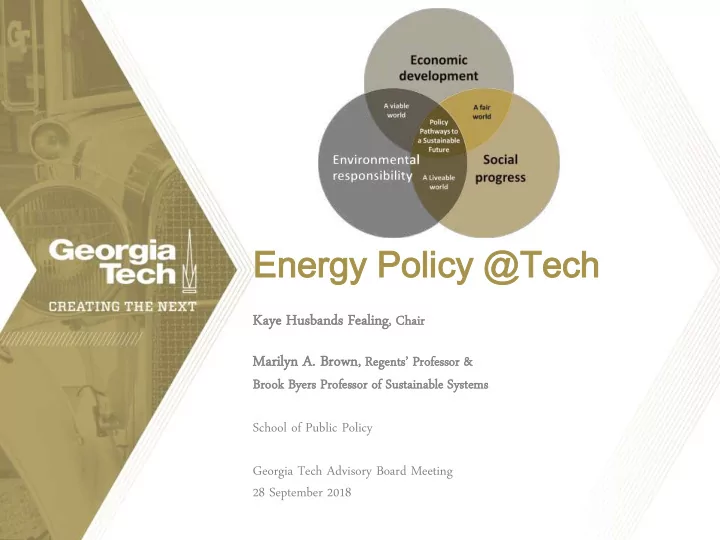
Energ ergy y Poli licy cy @Tech ch Kaye e Husbands nds Fealin - - PowerPoint PPT Presentation

energ ergy y poli licy cy tech ch
SMART_READER_LITE
LIVE PREVIEW

Energ ergy y Poli licy cy @Tech ch Kaye e Husbands nds Fealin - - PowerPoint PPT Presentation

Energ ergy y Poli licy cy @Tech ch Kaye e Husbands nds Fealin ling , , Chair ir Marilyn rilyn A. Brow own , Regents Professor & Brook ok Byers Profes fessor or of Sustain inable ble Systems School of Public Policy Georgia


slide-1
SLIDE 1

Energ ergy y Poli licy cy @Tech ch

Kaye e Husbands nds Fealin ling,

, Chair ir

Marilyn rilyn A. Brow

  • wn, Regents’ Professor &

Brook

  • k Byers Profes

fessor

  • r of Sustain

inable ble Systems School of Public Policy Georgia Tech Advisory Board Meeting 28 September 2018

slide-2
SLIDE 2

Disci cipl plin ines es of Fa Facul ulty ty in the Georgi gia a Te Tech Sc School l of Pu Public ic Po Policy cy

  • 1. Business administration
  • 2. City and regional

planning

  • 3. Communications
  • 4. Economics
  • 5. Engineering
  • 6. Ethics
  • 7. Geography
  • 8. History and philosophy of

science

  • 9. Information systems

10.Law

  • 11. Management and
  • rganizational theory
  • 12. Philosophy
  • 13. Political science
  • 14. Public affairs
  • 15. Public management
  • 16. Public policy
  • 17. Science and technology

studies

  • 18. Sociology
  • 19. Telecommunications policy
  • 20. Theoretical high energy

physics

slide-3
SLIDE 3

Complex ex Web of To Topics cs Defin ine Georgia Tech’s School of Public Policy

3

slide-4
SLIDE 4

Te Technology hnology & Po Policy licy

So Some

  • Biomedical ethics
  • Cybersecurity policy
  • En

Energy y & & enviro ironm nmen ental tal policy cy

  • Data analytics
  • Infrastructure & environmental sustainability
slide-5
SLIDE 5

5

Ou Our Fa Faculty ulty in E&E Policy licy

U.S. News and World Report rated the Georgia Tech School of Public Policy (SPP) 12th in the nation in “Environmental Policy and Management”

slide-6
SLIDE 6
  • How Georgia Tech can help create a fertile policy landscape to use better technologies?
  • How humans interact with the built and natural environments?
  • How clean energy solutions can be employed in households and industry, and improve

regional economic development?

  • Why are least-cost options not employed?
  • Where are the most efficient allocations of clean tech investments?
  • How to engage life-long learners in energy and environmental sustainability?

Qu Questio stions ns

6

slide-7
SLIDE 7

Ene nergy gy Pol

  • lic

icy: y: From

  • m Lo

Local al-to to-Globa lobal

7 GT Campus: s: Walking ing the talk

Assisting Atlanta’s Sustai tainabi nability ty Office Partnerin nering g acros

  • ss Georgia

Model eling ng E&E policies es across the Southe heas ast Data analyti tics to infor

  • rm

m nation

  • nal

al policy debates tes Macro-ec econ

  • nomi
  • mic modeling

ng of global bal energy gy & climate mate chang nge e policies es

slide-8
SLIDE 8

Bl Blending nding Research & Curriculum

Ge Georgia rgia Te Tech

8

slide-9
SLIDE 9

Th The Living ving Bu Building ilding

  • The Kendeda

eda Fund generously gave $30 million to fund the first Living Building in the Southeast – at Georgia Tech.

  • It embodies the philosophy of the Living Building Challenge – to change how

humans interact with the built environment. 7 Petal Structure

9

Alice Favero & Dan Matisoff How much PV is cost-effective? How can solutions be replicated

slide-10
SLIDE 10

Teaching hing Su Susta tainab inability: ility: Pr Proposed

  • sed Ne

New De w Degree ee & Ce & Certifi tificat cate On- Ca Campus s and On-Lin Line

2 required classes: -

  • Sustainable Energy

& Environmental Management -

  • Economics of

Environmental Policy 1 quantitative methods class 1 SEEM elective OR 1 policy and management elective

Same 2 required core classes 2 quantitative methods classes 3 SEEM electives + 1 policy and management elective Professional Paper to be completed in two 3-credit- hour courses

CSEEM: Certificate of Sustainable Energy and Environmental Management MSEEM: Master of Sustainable Energy and Environmental Management

10

slide-11
SLIDE 11

As Assi sisting sting Atlanta’s Sustainability Office Th The Greate ater r At Atlanta nta Ar Area

11

slide-12
SLIDE 12

SPP Has Enabled Atlanta’s Clean Energy Le Lead ader ership hip

  • Co-founded and hosted the launch of the Southeast Energy

Efficiency Alliance.

  • Calculated the City’s first Carbon Footprint.
  • Modeled energy benchmarking, assisting with the first

benchmarking ordinance the South.

  • Hosted the first public discussion of “100% renewables” and

co-hosted three town hall meetings to discuss energy futures.

  • Helped bring sustainability funds to Atlanta (most recently

the Bloomberg Foundation).

  • The Greenlink Group (a spinoff from SPP) modeled the

100% Clean Energy goal for the City.

12

Valerie Thomas & Marilyn Brown

slide-13
SLIDE 13

Atlanta’s Energy Burden is 3rd

rd Highest

est in the Nation

  • n among

ng Low Low-income ncome Househ seholds

  • lds

13

Marilyn Brown, Beril Toktay, & Michael Oxman

  • Energy burden is emerging as a

“material” issue for investor-owned utilities.

  • It influences the quality of life of our

students in off-campus housing.

  • The challenge is to convert “shared

values” into solutions. Atlanta Electricity Burden by Zip Code Data analytics combined with focus groups have help visualize and understand the problem.

slide-14
SLIDE 14

Co Collabo laborating rating on Smart Cities and Economic Development

Geo eorgia gia

14

slide-15
SLIDE 15

Georgia Tech’s Smart Communities Challenge

  • To spur smart community development

throughout GA

  • To position GA as a smart community

leader

  • To build a workforce familiar with

advanced technologies

15

Debra Lam, Omar Asensio & Marilyn Brown

Randomized Controlled Trials

Randomized Policy Experiments

Smart Grid and Energy Efficiency Program Evaluation

  • SPP developed tools for the GA

Environmental Leadership Program.

  • SPP co-launched the Georgia

Climate Project (with Emory and UGA).

slide-16
SLIDE 16

Who Win ins s and Who Loses s fro rom m Taxing ng Ca Carbon? n?

16

Scott Ganz & Marilyn Brown

The Southeast’s carbon intensive economy would be saddled with high carbon taxes. Recycling tax revenues on a per capita basis would result in a transfer of wealth from the Southeast to the West and Northeast.

The Southeast would lose wealth from a household “carbon dividend.” Cutting taxes on wages would benefit Georgia’s cities.

Answer: It depends on how the tax revenues are recycled. The National Energy Modeling System

slide-17
SLIDE 17

Mo Mode deling ling Energy Costs, Use and Impacts

So South theast east USA SA

17

slide-18
SLIDE 18

Indus ustrie ies s Need High Fi Fidelit lity y Data and Models ls

18

Jennifer Clark

  • Lead the development of a governance framework for

industrial data

  • Support up-skilling in the regional labor market
slide-19
SLIDE 19

Why hy Are e th the Lea e Least-Cost Cost Opt ptio ions ns Not

  • t

Dep eplo loye yed? d?

19

Marilyn Brown, Valerie Thomas, & Alice Favero

102

Virginia City Hybrid Energy Center

slide-20
SLIDE 20

Communic unicating ating Policy Design and Implementation

The e Nati tion

  • n

20

slide-21
SLIDE 21

Atlanta’s Emergence as a Warehousing Capital

Center for Advancing Research in Transportation Energy, Emissions and Health

Freight Electrification Machine Learning & Real-Time Intelligence in EV Infrastructure Civic Data Science and Urban Sustainability Electric urban delivery trucks: energy use, GHGs & Cost

21

Valerie Thomas, Omar Asensio, Mike Rodgers & Marilyn Brown

slide-22
SLIDE 22

Va Valuing ng Non-mar arke ket t Costs ts & & Be Benefit fits s in En Energy

  • How do we include societal values when weighing multiple

criteria in project decisions?

  • How flexible is the US hydropower system, given the

context of intermittent renewables?

Emily Grubert

22

slide-23
SLIDE 23

Reac aching hing Collaborators, Stakeholders and Students Around the World

Gl Globe be

23

slide-24
SLIDE 24

Climate Mitigation Will Cause Redistribution of Investments

From fossil fuels to low-emission power & energy efficiency

24

Emanuele Massetti 2010 2010-2029 029

  • No. of

studies Median Min Mean Max

World Total electricity generation 5 126.3 16.5 104.1 205.2 Renewables 5 85.4

  • 3.2

86.0 175.6 Nuclear 5 31.6 27.7 43.1 66.8 Power plants with CCS 5 29.8 6.3 40.7 117.2 Total fossil power plants 5

  • 29.7
  • 165.8
  • 65.6
  • 2.1

Extraction of fossil fuels 5

  • 55.9
  • 368.9
  • 115.7

8.3 Energy efficiency 4 335.7 0.8 328.3 641.0 R&D in energy sector* 3 4.5 78.0

slide-25
SLIDE 25

Th The Contes tested ted Role of Bi Bio-ene nergy gy in Carbon

  • n Fu

Future res

  • Using markets for bio-energy

to sequester carbon in forests

  • Bio-energy with Carbon

Capture and Storage and the role of negative emissions in future climate scenarios

  • Potential complementarity of

forest carbon sequestration and bio-energy expansion

25

Alice Favero, Valerie Thomas & Marilyn Brown

slide-26
SLIDE 26

Our E& E&E E Graduates ates Ar Are Making ng a Di Differ ference nce

Univ iver ersit ities ies Busine iness Govern rnmen ent

26

slide-27
SLIDE 27
  • How Georgia Tech can help create a fertile policy landscape to use better

technologies?

  • How humans interact with the built and natural environments?
  • How clean energy solutions can be employed in households and industry, and

improve regional economic development?

  • Why are least-cost options not employed?
  • Where are the most efficient allocations of clean tech investments?
  • How to engage life-long learners in energy and environmental sustainability?

Qu Questio stions ns

27

slide-28
SLIDE 28

khf@gatech.edu marilyn.brown@pubpolicy.gatech.edu

Thank ank yo you! u!

slide-29
SLIDE 29

Ex Extr tras as

slide-30
SLIDE 30

Our ur Con

  • nne

nectednes tedness s an and I d Int nterd erdisciplina isciplinarity rity

30

SPP has strong ties across campus, in part because of our interdisciplinarity.

slide-31
SLIDE 31

GT Study y Abroad ad Program ram on Susta tainab inable le De Developme pment nt and Cl Climate te Ch Change in Venice

  • A 5-week, 6-credit program with two 3-credit courses on Climate Policy (PUBP

3320) and Sustainable Development (PUBP 3600).

  • The Program offers a multi-disciplinary learning experience through a

combination of in-class lectures, guest speakers and instructional field trips.

  • Students have the opportunity to participate in lectures from experts on

sustainable development and climate change.

  • Five IPCC authors gave lectures during the program.
  • Dr. Antonio Navarra

CMCC, Bologna

31

FAO, Rome Professor Carlo Carraro H-Farm

  • Dr. Massimo Tavoni

Politecnico, Milan

Alice Favero & Emanuele Massetti

slide-32
SLIDE 32

Na Nationa nal l E&E Policy y Adopti tion n and Affor forda dabil bility ity

  • LEED construction optimizes

metric, not sustainability

Spatial Distribution of LEED Buildings

  • Solar net metering causes rates to

rise, harming poorer customers Dan Matisoff & Marilyn Brown

32