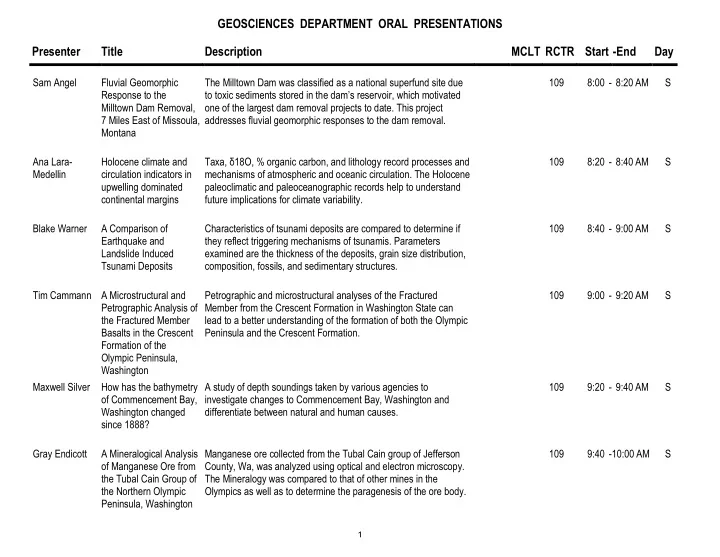
SLIDE 1 GEOSCIENCES DEPARTMENT ORAL PRESENTATIONS Presenter Title Description MCLT RCTR Start -End Day
1
Sam Angel Fluvial Geomorphic Response to the Milltown Dam Removal, 7 Miles East of Missoula, Montana The Milltown Dam was classified as a national superfund site due to toxic sediments stored in the dam’s reservoir, which motivated
- ne of the largest dam removal projects to date. This project
addresses fluvial geomorphic responses to the dam removal. 109 8:00 - 8:20 AM S Ana Lara- Medellin Holocene climate and circulation indicators in upwelling dominated continental margins Taxa, δ18O, % organic carbon, and lithology record processes and mechanisms of atmospheric and oceanic circulation. The Holocene paleoclimatic and paleoceanographic records help to understand future implications for climate variability. 109 8:20 - 8:40 AM S Blake Warner A Comparison of Earthquake and Landslide Induced Tsunami Deposits Characteristics of tsunami deposits are compared to determine if they reflect triggering mechanisms of tsunamis. Parameters examined are the thickness of the deposits, grain size distribution, composition, fossils, and sedimentary structures. 109 8:40 - 9:00 AM S Tim Cammann A Microstructural and Petrographic Analysis of the Fractured Member Basalts in the Crescent Formation of the Olympic Peninsula, Washington Petrographic and microstructural analyses of the Fractured Member from the Crescent Formation in Washington State can lead to a better understanding of the formation of both the Olympic Peninsula and the Crescent Formation. 109 9:00 - 9:20 AM S Maxwell Silver How has the bathymetry
Washington changed since 1888? A study of depth soundings taken by various agencies to investigate changes to Commencement Bay, Washington and differentiate between natural and human causes. 109 9:20 - 9:40 AM S Gray Endicott A Mineralogical Analysis
the Tubal Cain Group of the Northern Olympic Peninsula, Washington Manganese ore collected from the Tubal Cain group of Jefferson County, Wa, was analyzed using optical and electron microscopy. The Mineralogy was compared to that of other mines in the Olympics as well as to determine the paragenesis of the ore body. 109 9:40 -10:00 AM S
SLIDE 2 GEOSCIENCES DEPARTMENT ORAL PRESENTATIONS Presenter Title Description MCLT RCTR Start -End Day
2
BREAK 10:00 -10:20 AM Riley Swanson Glacial Retreat on Mount Rainier: Past, Present, and Future This project tracks the spatial and temporal retreat of seven glaciers on Mount Rainier. Field and computer mapping show the moraine chronology since the late Pleistocene. Modeling will track possible glacial responses to climate change. 109 10:20 -10:40 AM S Katherine Harlan The Impact of El Nino Events on Coastal Erosion and Hazards in the PNW This project investigates how El Nino events impact the Pacific Northwest coastal erosion. Sites: Cape Shoalwater, WA and Yaquina Bay, OR. Both areas are populated with beach communities and have recorded major shoreline changes in recent decades. 109 10:40 -11:00 AM S Taylor Christensen Suspended sediment concentrations in glacial meltwater on Mount Rainier, WA Suspended sediment in glacial meltwater can show how fast glaciers erode, how much sediment is carried by the meltwater stream, and how sediment concentrations vary diurnally, seasonally, and interannually. 109 11:00 -11:20 AM S Courtney Serad Interplay Between bank Erosion and Hillslope Stability: Oso, Washington Key Factors in hazard assessment of areas at risk for sliding based
- n an analysis of the Oso Landslide.
109 11:20 -11:40 AM S Nichole Rathbun Modeling Glacial Change in the Antarctic Peninsula. Calving glaciers in Marguerite Bay and in the northwest Weddell Sea were modeled to provide insight on climate change responses
- n the Antarctic Peninsula.
109 11:40 -12:00 PM S In Morken Center 103 COMPLIMENTARY PIZZA 103 12:00 -12:30 PM BREAK 12:30 - 1:00 PM
SLIDE 3
GEOSCIENCES DEPARTMENT ORAL PRESENTATIONS Presenter Title Description MCLT RCTR Start -End Day
3
Greg Hibbard Projecting the Effect of Global Carbon Emission Pathways on Future Climate This study builds off of my economic capstone which determined a date of global independence from fossil fuel energy. Using different emission pathways in a global climate model, I predict plausible long-term future climatic conditions. 109 1:00 - 1:20 PM S Elizabeth Tapler An analysis of the aquifer potential beneath Pacific Lutheran University's campus for use in expanding Ground Source Heat Pumps applications Can PLU heat and cool campus thru use of groundwater source heat pumps? Well tests and aquifer analysis research provide data to assess the hydrologic properties beneath PLU’s campus. 109 1:20 - 1:40 PM S Adam Smith Migmatite Dynamics of the Sandia Mountains, NM In this study, migmatite in the contact zone of the Sandia Pluton in New Mexico was studied using textural and compositional data. The primary goal was to determine its formation history, and determine if partial melting or metasomatism with nearby granit 109 1:40 - 2:00 PM S Matt Lindmark Hicks Butte Tonalite Symplectites and the Easton Metamorphic Suite Mapping and sample analysis has revealed that the margins of Hicks Butte show mineral textures that are concordant with subduction related textures in neighboring rocks; this suggests Hicks Butte was related to subduction related tectonics nearby 109 2:00 - 2:20 PM S BREAK 2:20 - 2:40 PM Cody Driscoll The Geochemical Record of Cretaceous Oceanic Anoxic Event 2 in the Atlantic Ocean. Geochemical parameters including organic carbon content, δ13C, %CaCO3 and trace metals were examined in order to assess the intensity of OAE-2 in the Atlantic Ocean, with an emphasis on the influence of basin bathymetry and geometry. 109 2:40 - 3:00 PM S
SLIDE 4
GEOSCIENCES DEPARTMENT ORAL PRESENTATIONS Presenter Title Description MCLT RCTR Start -End Day
4
Ryan Radke Precipitation and a Changing Climates Effects of Mass Wasting and Slope Stability, Seattle, WA This study was conducted to determine how precipitation, climate change, and geology of the area all work together to cause mass wasting in Seattle. A look at past and resent precipitation data and landslide data was the base for the study 109 3:00 - 3:20 PM S Isaac Moening- Swanson A Glacial Geologic History of Tucker Glacier, Antarctica Tucker glacier terminates in the Ross Sea near the edge of the ice sheet during the last glacial maximum. Elevations of erratics were taken to identify past ice thickness. These elevations constrain Antarctic contributions to sea-level rise. 109 3:20 - 3:40 PM S Hallie Peterson Potential Geothermal Energy Production at Oceanic Ridges On the bases of spreading rate, heat flow, and ridge geometry, three ridges have been analyzed to determine an optimal set of mid-ocean ridge characteristics for utilizing geothermal energy present at seafloor spreading centers. 109 3:40 - 4:00 PM S