Orals,Transdermals, Cases and Other Estrogens in the Perimenopause - - PowerPoint PPT Presentation

orals transdermals
SMART_READER_LITE
LIVE PREVIEW

Orals,Transdermals, Cases and Other Estrogens in the Perimenopause - - PowerPoint PPT Presentation

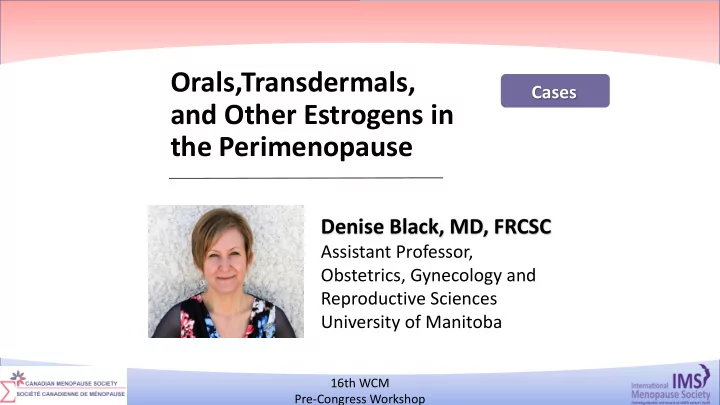
Orals,Transdermals, Cases and Other Estrogens in the Perimenopause Denise Black, MD, FRCSC Assistant Professor, Obstetrics, Gynecology and Reproductive Sciences University of Manitoba 16th WCM 6/4/18 197 Pre-Congress Workshop Facu


slide-1
SLIDE 1

6/4/18 197 16th WCM Pre-Congress Workshop

Orals,Transdermals, and Other Estrogens in the Perimenopause

Denise Black, MD, FRCSC

Assistant Professor, Obstetrics, Gynecology and Reproductive Sciences University of Manitoba Cases
slide-2
SLIDE 2

6/4/18 198 16th WCM Pre-Congress Workshop

Facu culty/Presenter Discl closure

Faculty: Dr. Denise Black Relationships with commercial interests:

  • Speakers Bureau/Honoraria: Merck, Bayer,

Pfizer, Actavis/Allergan, Abbvie, Amgen

  • Consulting Fees: Merck, Bayer, Pfizer
  • Grants/Research Support: na
  • Other: na
slide-3
SLIDE 3

6/4/18 199 16th WCM Pre-Congress Workshop

Ca Case e 4a 4a

  • 48 year old P2 presents with intermittent vasomotor

symptoms of moderate severity

  • She has a LNG-IUS 52 mg device in place. It was placed 3

years ago for the combined indication of contraception and heavy menstrual bleeding

  • Since placement, her bleeding has decreased markedly. She

now describes intermittent spotting only

slide-4
SLIDE 4

6/4/18 200 16th WCM Pre-Congress Workshop

Ca Case e 4a 4a

  • She describes these symptoms: for 3-4 months she will have

profound vasomotor symptoms, difficulty sleeping, and irritability.

  • She will then feel “normal” for a few weeks, then have an

episode of vaginal spotting

  • Following this, the vasomotor and other symptoms return.

She is asking for treatment for these symptoms

slide-5
SLIDE 5

6/4/18 201 16th WCM Pre-Congress Workshop

Ca Case e 4a 4a

  • She is healthy, lean, and exercises regularly
  • She is a non-smoker, and consumes 3-4 alcoholic beverages

per week

  • She takes no medication
  • What is her diagnosis, and what are her treatment options?
slide-6
SLIDE 6

6/4/18 202 16th WCM Pre-Congress Workshop

Ca Case e 4a 4a

  • Diagnosis: most likely late perimenopause—not 12 months
  • f amenorrhea, but symptomatic periods consistent with

hypoestrogenism

  • Hormonal treatment options: addition of estrogen therapy.

Adequate endometrial protection in place (off label in Canada).

  • Contraception still required
  • Oral or transdermal estrogen?
slide-7
SLIDE 7

6/4/18 203 16th WCM Pre-Congress Workshop

Gu Guid idelin lines—Sa Safety of Orals s vs vs Td Td

  • SOGC 2014: Women at increased VTE risk should be offered

transdermal rather than oral estrogen

  • NAMS 2017: Meta analysis of observational studies suggest

that lower doses of oral or transdermal HT have less effect

  • n risk of VTE; however, RCT data lacking
  • Endocrine Society: For women at increased risk of VTE, we

recommend a non-oral route of estrogen and progesterone for those with a uterus

slide-8
SLIDE 8

6/4/18 204 16th WCM Pre-Congress Workshop

VT VTE—Ar Are e Transder erma mal Estr trogen ens Safer er th than Or Orals i in the n the A Average Ri Risk W Woman? n?

  • With respect to VTE risk, only one

study has done a head to head comparison at relatively equivalent doses using the same progestogen (KEEPs), with too few subjects to draw any conclusions.1

  • Observational studies suggesting better

safety with Td did not use equivalent dosing, and did not control for the different progestogens used 2

  • 1. Harman et al, Ann Int Med 2014;161:249
  • 2. Canonico et al Circulation 2007;115:840
slide-9
SLIDE 9

6/4/18 205 16th WCM Pre-Congress Workshop

1 2 3 4 5

Nonusers Oral estrogen users Transdermal estrogen users

Adjusted Odds Ratio (5% CI)

Risk k of VTE with Oral vs. Transdermal

OR = 4.0 (1.9-8.3)

Scarabin PY, et al. Lancet 2003;362(9382):428-32.

1.0

3.5 (1.8-6.8) 0.9 (0.5-1.6)

ESTHER Study

ESTHER: Estrogen and Thromboembolism Risk Study

slide-10
SLIDE 10

6/4/18 206 16th WCM Pre-Congress Workshop

ES ESTHER

  • Estrogen dosing: average transdermal dose 50

ug patch, average oral dose 1.5 mg

  • Low dose oral was up to 2 mg, low dose Td was

<50 ug

slide-11
SLIDE 11

Po Postmenopausal HT and Risk of VTE: Re Results of the E3n Trial

Treatment

Hazard ratios (95% CI) Age-Adjusted Multivariable Adjusted*

Never use (n=181) 1 [reference] 1 [reference] Past use (n=66) 1.0 (0.7–1.3) 1.1 (0.8–1.5)

Current use of oral estrogens (n=81)

1.5 (0.9–2.3) 1.7 (1.1–2.8)

Current use of transdermal estrogens (n=174)

1.1 (0.7–1.6) 1.1 (0.8–1.8)

No progestogens use (n=26)

···· ····

Current use of micronized progesterone (n=47)

0.9 (0.6–1.4) 0.9 (0.6–1.5)

Current use of norpregnane derivatives (n=69)

1.7 (1.1–2.6) 1.8 (1.2–2.7)

Current use of nortestosterone derivatives (n=22)

1.4 (0.8–2.5) 1.4 (0.7–2.4)

*Adjusted for age, body-mass index, parity, educational level and time-period

Canonico et al. Arterioscler Thromb Vasc Biol 2010;30(2):340-5.

slide-12
SLIDE 12

6/4/18 208 16th WCM Pre-Congress Workshop

Wh When t to C

  • Con
  • nsider U

Use of

  • f T

Transdermal E Estrog

  • gen

A. Smokers B. For patients with underlying medical conditions

  • Higher risk of DVT or PE
  • High triglyceride levels
  • Gall bladder disease
  • Hypertension

C. For “steady state” drug release

  • Daily mood swings
  • Migraine headaches
  • Patients who do shift work

D. Inability to use oral tablets

  • Stomach upset due to oral estrogen intake
  • Problems with taking a daily pill

E. Patient choice of delivery system

slide-13
SLIDE 13

6/4/18 209 16th WCM Pre-Congress Workshop

Ca Case e 4b 4b

  • 41 year old P1, partner has had vasectomy
  • Having hot flushes, night sweats, irritability, difficulty

sleeping, anxiety, “rage”

  • Menses irregular—coming between 3 and 5 weeks apart,

sometimes heavy

  • Healthy non-smoker currently on no medications
  • Exam normal, pertinent investigations (including ultrasound)

normal

slide-14
SLIDE 14

6/4/18 210 16th WCM Pre-Congress Workshop

Ca Case e 4b 4b

  • Diagnosis?
  • Pathophysiology?
  • Treatment options?
slide-15
SLIDE 15

6/4/18 211 16th WCM Pre-Congress Workshop

Ca Case e 4b 4b

  • Diagnosis—perimenopause, early
  • Pathophysiology—widely fluctuating hormonal levels, with

supraphysiologic estradiol production. Symptoms likely precipitated by sudden declines in hormone levels, not by hypoestrogenism per se

  • Treatment: capturing aberrant ovarian cycling (generally

with a low dose combined hormonal contraceptive, in the absence of contraindications)

slide-16
SLIDE 16

6/4/18 212 16th WCM Pre-Congress Workshop

De Defining Me Menopause: : the STRAW Staging System

Stages

  • 5
  • 4
  • 3
  • 2
  • 1

+1 +2

Terminology

Reproductive

Menopausal Transition Postmenopause Early Peak Late Early Late* Early* Late*

Perimenopause

Duration of Stage

Variable Variable

A 1 yr B 4 yrs

Until demise Menstrual Cycles Variable to Regular Regular

Variable Cycle Length (>7 days different from normal) ≥2 skipped cycles & an interval of amenorrhea (≥60 days)

A m e n x 1 2 m

  • s

None Endocrine

Normal FSH Elevated FSH Elevated FSH Elevated FSH

* Stages most likely to be characterized by vasomotor symptoms Final Menstrual Period (FMP)

Adapted from Soules et al. Executive summary: Stages of Reproductive Aging Workshop (STRAW). Fertil Steril. 2001;76(5):874-878

FSH: follicle-stimulating hormone.

slide-17
SLIDE 17

Menopausal Transition*

(lasts average of 5 y)

Postmenopause

(recognized 12 months post-FMP)

Early Late Early Late Perimenopause Variable cycle length ≥2 skipped cycles & interval of amenorrhea

Amen

  • rrhe

a x 12 mos

None

FMP

Premenopausal years Estrogen Levels Fluctuate During Menopausal Transition

Santoro N, et al. J Clin Endocrinol Metab 1996;81:1495-1501. Kronenberg F. Ann N Y Acad Sci 1990;592:52-86.

Menopause

Postmenopausal years

slide-18
SLIDE 18

6/4/18 214 16th WCM Pre-Congress Workshop

Ca Case e 4c 4c

  • 48 year old P2, has tubal ligation
  • Troublesome vasomotor symptoms for the last 6 months
  • Amenorrheic for last 5 months
  • Non-smoker
  • Has elevated cholesterol and high triglycerides
  • In both pregnancies had severe pre-eclampsia necessitating induction
  • f labour at 34 weeks and 32 weeks
  • Strong family history of heart disease
slide-19
SLIDE 19

6/4/18 215 16th WCM Pre-Congress Workshop

Ca Case e 4c 4c

  • Drinker of 10 alcoholic beverages per week
  • BMI 28
  • Has recently started a health and wellness program at her

workplace

slide-20
SLIDE 20

6/4/18 216 16th WCM Pre-Congress Workshop

Ca Case e 4c 4c

  • Diagnosis? Likely late perimenopause—prolonged periods of

amenorrhea and hypoestrogenic symptoms but not fufilling the criteria for post-menopausal

  • Treatment options?
  • Lifestyle? Diet, exercise, limiting alcohol consumption
  • If HT desired, what combination?
slide-21
SLIDE 21

6/4/18 217 16th WCM Pre-Congress Workshop

Ca Case e 4c 4c

  • Considered at increased cardiovascular risk (increased

triglycerides, overweight, relatively inactive, positive personal history for hypertensive disorders of pregnancy, positive family history)

  • Treatment with estrogen should be transdermal (universal

guideline agreement for CV high risk women)

slide-22
SLIDE 22

6/4/18 218 16th WCM Pre-Congress Workshop

Ca Case e 4c 4c

  • As per guidelines (IMS), micronized progesterone is preferred

for high risk patients

  • Cyclical is recommended (expert opinion) rather than

continuous in the recently post-menopausal woman

slide-23
SLIDE 23

6/4/18 219 16th WCM Pre-Congress Workshop

Th Thank k You

slide-24
SLIDE 24

6/4/18 220 16th WCM Pre-Congress Workshop

Discu cussion