Generation From Thermal Catalytic NH 3 Decomposition Miao Yu (PI), - - PowerPoint PPT Presentation

generation from thermal catalytic nh 3 decomposition
SMART_READER_LITE
LIVE PREVIEW

Generation From Thermal Catalytic NH 3 Decomposition Miao Yu (PI), - - PowerPoint PPT Presentation

Fed. funding: $1.6M Length 24 mo. A Novel Hollow Fiber Membrane Reactor For High Purity H 2 Generation From Thermal Catalytic NH 3 Decomposition Miao Yu (PI), Rensselaer Polytechnic Institute Shiguang Li (co-PI), Gas Technology Institute


slide-1
SLIDE 1

A Novel Hollow Fiber Membrane Reactor For High Purity H2 Generation From Thermal Catalytic NH3 Decomposition

Miao Yu (PI), Rensselaer Polytechnic Institute Shiguang Li (co-PI), Gas Technology Institute Jochen Lauterbach (co-PI), University of South Carolina

Project Vision

  • Fed. funding:

$1.6M Length 24 mo.

Project Impact

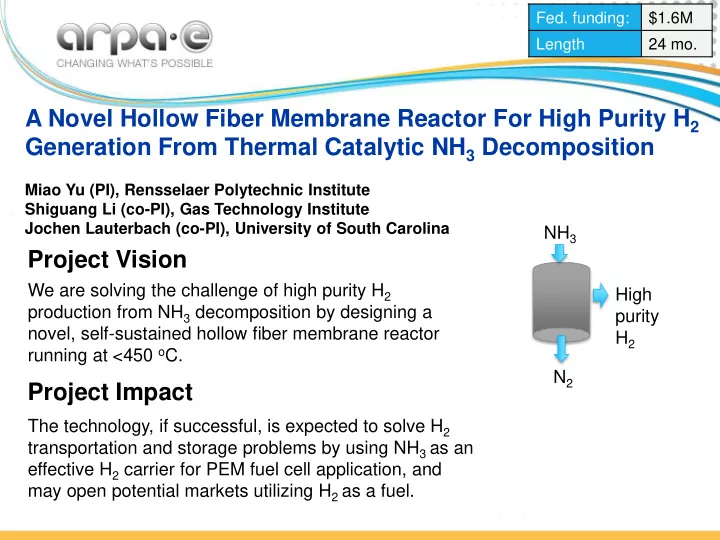
We are solving the challenge of high purity H2 production from NH3 decomposition by designing a novel, self-sustained hollow fiber membrane reactor running at <450 oC. The technology, if successful, is expected to solve H2 transportation and storage problems by using NH3 as an effective H2 carrier for PEM fuel cell application, and may open potential markets utilizing H2 as a fuel. NH3 High purity H2 N2

slide-2
SLIDE 2

Innovation and Objectives

Innovation

Novel membrane reactor:

  • Lower cost and active Ru-based catalysts
  • Highly selective H2 membranes
  • High packing-density hollow fibers.

Tech-to-Market strategy

  • Develop technology from TRL-2 to TRL-5
  • Fabricate modular system, and minimize

manufacturing and scalability risks

  • Secure IP, and identify next phase funding
  • Solicit industrial partners assisting in the

future development and value creation

  • Anticipated first markets: 2024

Task outline, technical objectives

Component Development and proof-of- concept:

  • Ru-based catalyst development (USC and

GTI; Q1-Q6)

  • H2 selective membrane (RPI and GTI; Q1-

Q6)

  • Equilibrium reaction shifting (RPI; Q5-Q6)
  • Mini membrane reactor: (GTI; Q3-Q7)

398 K 473 K 398 K 473 K

1.4 1.2 1.0 0.8 0.6 0.4 Permeance x 107 (molm-2·s-1·Pa-1) 0.2 0.6 1.0 1.4 Feed pressure, MPa 1200 1000 800 600 400 200 Separation selectivity (H2/N2)

H2 H2

monia conversion, %

tion

Catalysts Membrane

slide-3
SLIDE 3

Innovation and Objectives

Proposed targets Desirable partnerships

  • Current phase (4/2017-3/2019): ceramic

membrane company Media and Process Technology Inc. (MPT)

  • Prototype (4/2019-9/2020): MPT
  • Demonstration phase (10/2020-

10/2023): MPT and Engineering Companies (e.g. EPIC System)

Anticipated challenges

  • Membrane permeance and selectivity:

ultrathin molecular layer deposition (MLD) coatings will be used

  • NH3 <100 ppb level in product: a H+

form ion exchange resin or commercial adsorbent may be used

Project history

  • Prior collaboration between YU (PI) and LI

(co-PI) on three DOE (ARPA-E or NETL) projects

  • Ru-based catalyst developed in

Lauterbach’s group

  • H2 selective membranes developed by YU

(PI)

  • Experience/expertise on high-temperature

membrane reactors of LI (co-PI)

Metric State of the Art Proposed Size 7.5 L H2/min 10 L H2/min Temperature 480-660 oC 350-450 oC H2 generation rate, g H2/h/cm3 0.126 >0.15 H2 purity ~25% >99% Cost of H2 delivered at 30 bar N/A <$4.5/kg